More, Henry
Henry More was a 17th-century Cambridge Platonist philosopher and theologian who sought to merge Platonism with Christianity and critiqued Cartesian thought.
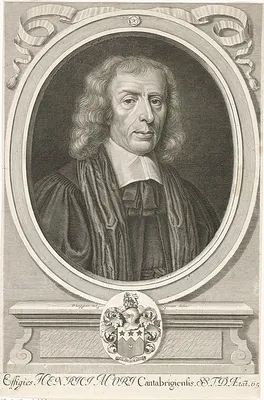
Henry More (1614-1687) was an English philosopher, priest, and poet associated with the Cambridge Platonists. His intellectual work focused on reconciling Platonic philosophy with Christian theology and offering critiques of René Descartes's philosophy. More's metaphysical explorations delved into the nature of spirit, matter, divine guidance, and the soul, establishing him as a significant voice in the religious and philosophical discussions of the 17th century.
He notably challenged Cartesian dualism, proposing that spirit, much like matter, must occupy space. More coined the term 'fourth dimension' and introduced 'essential spissitude' to describe how immaterial substances might possess spatial extension. He also posited a 'Spirit of Nature,' an unconscious, incorporeal force through which God maintained the physical world's order. This metaphysical framework underpinned his rejection of atheistic materialism and highlighted the necessity of non-material principles for explaining life and motion.
Metaphysics and Dualism
More developed a complex metaphysical system, influenced by Neoplatonism but distinct from other Cambridge Platonists. He rejected Calvinist predestination and materialist atheism, arguing for a morally perfect God bound by absolute goodness. More proposed a dualistic view distinguishing body from spirit, asserting that all motion and life originate from an immaterial, self-moving soul. He disagreed with Descartes's identification of body with extension, contending that immaterial substances, including souls and even God, must also be extended in space. To explain this, he introduced the concept of 'essential spissitude' and coined the term 'fourth dimension' as a way for spirit to possess extension, thus addressing the mind-body problem.
The Spirit of Nature and Divine Providence
To explain natural phenomena not adequately covered by mechanical laws, such as gravity and magnetism, More proposed the existence of a 'Spirit of Nature.' This was an incorporeal yet extended substance acting as a secondary, unconscious cause in the natural world, emanating from divine power to uphold cosmic order. More viewed animals as integral to divine providence, citing their utility to humans as evidence of design. While acknowledging theological challenges posed by animal suffering and predation, he suggested these reflected creation's limitations rather than divine flaws. He maintained a clear distinction between animals, driven by instinct and bodily needs, and humans, capable of reason and moral virtue.
Influence and Legacy
More's extensive writings in both Latin and English covered metaphysics, ethics, natural philosophy, and theology, including poetry and prose. He significantly influenced contemporaries and later thinkers. Among his notable intellectual connections were Lady Anne Conway, whose spiritual interests shaped some of his ideas, and Joseph Glanvill. His work was later referenced by prominent figures such as Ralph Waldo Emerson, who used a quotation from More as an epigraph for his essay 'The Over-Soul,' and Helena Blavatsky, the founder of modern Theosophy, who discussed his concepts in 'Isis Unveiled.'
Key Ideas
- Reconciliation of Platonism and Christian theology
- Critique of Cartesian dualism
- Extended spirit and essential spissitude
- Concept of the Spirit of Nature
- Animals possess immaterial but mortal souls
- Absolute space and time as real, immaterial entities
Books by More, Henry
1 free public domain book · Read online or download