Martin Mulsow
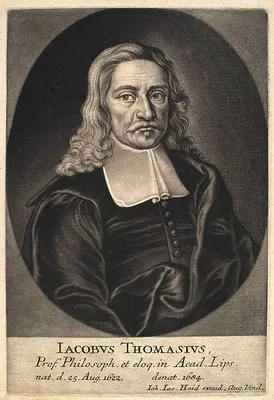
Jakob Thomasius was a German philosopher and jurist, influential in the history of philosophy and early esotericism.
Jakob Thomasius (1622–1684) was a significant German philosopher and jurist whose work marked a turning point in the academic study of philosophy's history. He held the position of rector at the Old St Nicholas School in Leipzig and is recognized as a foundational figure in this scholarly field. Thomasius's philosophical outlook was eclectic, and his ideas were later adopted by his son, Christian Thomasius.
His intellectual contributions extended to various topics, including Gnosticism, plagiarism, and the education of women. He taught Gottfried Wilhelm Leibniz at the University of Leipzig, where Thomasius was a professor of Rhetoric and Moral Philosophy. Their relationship evolved into a lasting friendship and correspondence, with Thomasius being described as Leibniz's mentor. Thomasius is also noted for publishing the first critique of Spinoza's "Theological-Political Treatise." In the study of Western esotericism, he is considered a pivotal figure who contributed to the decline of the previously dominant concept of the "prisca theologia."
Philosophical Contributions and Influence
Jakob Thomasius played a crucial role in reshaping philosophy as an academic discipline. His "Schediasma historicum" from 1665 articulated a theological perspective that emphasized the distinct separation between the Creator and Creation, God and Nature. Consequently, he advocated for philosophy to be rooted in Christian Aristotelianism, steering clear of Stoic or Neoplatonic influences. This approach positioned him as a key figure in the historical analysis of philosophical thought. His intellectual legacy was carried forward by his son, Christian Thomasius, who embraced his father's eclectic views. Thomasius's work also addressed subjects such as Gnosticism, plagiarism, and the intellectual development of women, demonstrating a broad range of scholarly interests.
Academic Career and Key Relationships
Serving as rector of the Old St Nicholas School in Leipzig from 1670 to 1676, Thomasius also held a professorship in Rhetoric and Moral Philosophy at the University of Leipzig. It was here that he encountered and mentored Gottfried Wilhelm Leibniz, a relationship that developed into a significant friendship and ongoing correspondence. Thomasius's influence on Leibniz has led to him being described as the philosopher's mentor. Beyond his teaching and academic roles, Thomasius is prominently remembered for his critical engagement with other thinkers. His published critique of Baruch Spinoza's "Theological-Political Treatise" stands as a notable example of his scholarly discourse and his role in shaping philosophical debates of his time.
Impact on Western Esotericism
Within the academic exploration of Western esotericism, Jakob Thomasius is recognized as a pivotal intellectual figure. His work is seen as marking a transition away from the previously dominant concept of the "prisca theologia," a notion suggesting a single, ancient, and universal theology underlying all religions and philosophies. Thomasius's critical approach and his emphasis on historical and theological distinctions contributed to a scholarly environment where the monolithic idea of a "prisca theologia" began to lose its hegemonic status. This shift facilitated a more nuanced understanding of the diverse historical currents within esoteric thought and philosophy.
Key Ideas
- Separation of Creator from Creation, God from Nature
- Philosophy rooted in Christian Aristotelianism, distinct from Stoicism or Neoplatonism
- Critique of Spinoza's "Theological-Political Treatise"
- Intellectual watershed leading to the decline of the "prisca theologia"
Books by Martin Mulsow
2 free public domain books · Read online or download