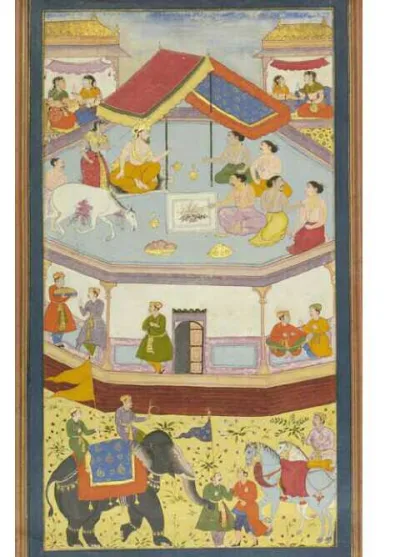
The Ashvamedha was an ancient Vedic horse sacrifice ritual for kings to assert imperial sovereignty and gain prosperity.
The Ashvamedha was a significant ritual within the Vedic religion, primarily practiced by ancient Indian kings to demonstrate and solidify their imperial authority. The ceremony involved releasing a royal stallion to roam freely for a year; any challenges to its passage by rival rulers would be met by the king's warriors. If the horse completed its journey unharmed, it was sacrificed, and the king's sovereignty was declared absolute. This elaborate and costly ritual required the participation of many individuals and animals, along with precise ceremonies. While once common, the Ashvamedha was performed less frequently over centuries, with the last known instance occurring in 1741. The ritual's persistence, despite the evolution of Hinduism towards opposing animal sacrifices, is attributed to its strong political and symbolic prestige. The ceremony itself was complex, involving specific preparations, astrological timing, and numerous offerings and recitations, culminating in the horse's sacrifice and subsequent rites for the king's purification and prosperity.
The Ritual of Sovereignty
The Ashvamedha ritual served as a powerful declaration of a king's supreme authority and imperial ambitions. It was an immensely expensive undertaking, demanding extensive resources, specialized personnel, and a multitude of animals. The core of the ceremony involved a specially chosen white stallion with black spots. After initial consecration rites and a symbolic overnight vigil with the queen, the horse was set loose to wander for a period, typically a year, accompanied by a retinue of warriors tasked with protecting it. The horse's journey was a symbolic extension of the king's dominion; any territory it traversed fell under his purview, and any who dared challenge its passage risked subjugation. The ritual's successful completion, marked by the horse's return and subsequent sacrifice, affirmed the king's uncontested rule, prosperity, and the potential for progeny.
Complex Ceremonial Stages
The Ashvamedha was marked by intricate and lengthy ceremonial stages. Preparations included constructing a dedicated sacrificial house and fire altar. Upon the horse's return, a month of further rites ensued, including twelve days of preparatory consecration (dīkṣā) and twelve days of preliminary ceremonies (upasād). The main sacrifice involved the agniṣṭoma, a key part of Soma sacrifices, where the horse, along with numerous other animals dedicated to various deities, was ultimately sacrificed. This was followed by the Avabhṛtha, a purificatory bath for the sacrificer, his consorts, and priests, which in the Ashvamedha also included sinners and criminals. The ritual concluded with further sacrifices and the distribution of wealth (dakshina) to the priests, sometimes involving the king's wives or attendants.
Symbolism and Evolution
The Ashvamedha was deeply intertwined with solar symbolism, with the horse's yearly course mirroring the Sun's path. The ritual's endurance for centuries, even as Brahminical Hinduism evolved to oppose animal sacrifice, highlights its profound political and cultural significance. The Laws of Manu suggest a moral equivalence between performing the Ashvamedha daily for a century and abstaining from meat, indicating a potential shift in understanding or emphasis. While the ritual was primarily a political act, its complex structure and association with various deities and Vedic verses also imbued it with spiritual and cosmological dimensions.
Key Ideas
- Imperial Sovereignty
- Vedic Sacrifice Ritual
- Cosmic Cycles
- Political Legitimation
Books by
2 free public domain books · Read online or download