Éliphas Lévi
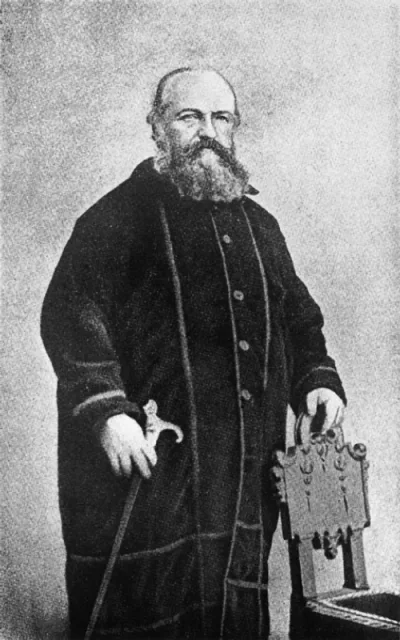
Éliphas Lévi was a French occultist, writer, and ceremonial magician who significantly influenced modern Western esotericism.
Alphonse Louis Constant, who adopted the pen name Éliphas Lévi, was a prominent French esotericist, poet, and author active in the 19th century. Initially trained for the Catholic priesthood, he left that path in his mid-twenties to pursue ceremonial magic and occult studies. Lévi became known for his extensive writings on magic, Kabbalah, alchemy, and occultism, authoring over 20 books that gained attention among esotericists and artists in Paris and London. He developed a unique approach to magic, incorporating elements of Kabbalah and Tarot, and his ideas profoundly impacted later occult movements and figures.
Lévi's life was marked by intellectual exploration and personal struggles, including poverty and complex relationships. He was influenced by various philosophical and mystical traditions, including those of Joseph de Maistre, Paracelsus, and Swedenborg. His departure from Freemasonry stemmed from his belief that its symbols had lost their original meaning and his conviction that true Freemasonry should embody tolerance. Lévi's theories on magic, which posited the existence of astral forces and magnetic currents rather than autonomous spirits, offered a distinct perspective on the supernatural phenomena of his time.
Early Life and Esoteric Awakening
Born Alphonse Louis Constant in Paris, Lévi initially entered the seminary of Saint Sulpice with aspirations of becoming a Catholic priest. Though ordained as a deacon, he ultimately departed from the priestly path before priesthood ordination, a decision that caused friction with his superiors. He continued to wear clerical attire for several years, experiencing periods of poverty that led him to work as a tutor. Around 1838, he encountered mystic Simon Ganneau, and later briefly joined the monastic life at the Abbey of Solesmes. His early publication, 'La Bible de la liberté,' resulted in a prison sentence. A significant turning point occurred around age 40, when Lévi experienced a profound financial and spiritual crisis, leading him to fully embrace the study and practice of esotericism and the occult.
Magical Philosophy and Influence
Lévi became a prolific writer, authoring numerous books that explored magic, Kabbalah, and occult philosophy. His works, such as 'Dogme et Rituel de la Haute Magie,' significantly shaped the landscape of Western esotericism. He developed a complex magical system that integrated Kabbalistic principles and the Tarot, which became a fundamental tool for Western magicians. Lévi's approach to magic distinguished itself from contemporary Spiritualism by suggesting that phenomena were manifestations of 'astral forces' rather than independent spirits. He viewed these forces as manipulable by skilled practitioners. His teachings were presented as accessible knowledge for humanity's betterment, without claims of initiation into secret societies.
Later Life and Political Views
Following Napoleon III's coup in 1851, Lévi initially supported the new regime, viewing it as a restorer of order. However, he later became disillusioned with its dictatorial nature and was imprisoned in 1855 for publishing a critique of the Emperor. His political and social views evolved, leading him to adopt theocratic ideas, influenced by Joseph de Maistre, advocating for a spiritual authority led by an elite. He expressed skepticism about the masses' capacity for self-emancipation, believing they required guidance. Lévi contributed to philosophical and religious journals, publicly disseminating his Kabbalistic ideas. He also revisited London, engaging with British esoteric circles, though he expressed initial discouragement at being asked to perform wonders.
Key Ideas
- Magic as the manipulation of astral forces and magnetic currents.
- Integration of Kabbalah and Tarot into magical systems.
- The pentagram's symbolism representing good or evil based on orientation.
- Belief in the necessity of a guiding spiritual authority led by an elite.
Notable Quotes
“I ceased being a freemason, at once, because the Freemasons, excommunicated by the Pope, did not believe in tolerating Catholicism ... [and] the essence of Freemasonry is the tolerance of all beliefs.”
“The phenomena which quite recently have perturbed America and Europe, those of table-turning and fluidic manifestations, are simply magnetic currents at the beginning of their formation, appeals on the part of Nature inviting us, for the good of humanity, to reconstitute great sympathetic and religious chains.”
“A poor and obscure scholar [who] has found the lever of Archimedes, and he offers it to you for the good of humanity alone, asking nothing whatsoever in exchange.”
Books by Éliphas Lévi
0 free public domain books · Read online or download