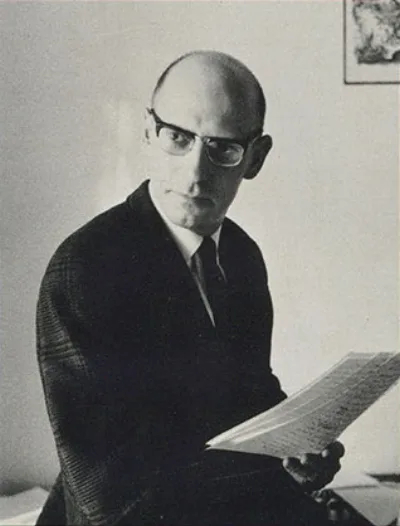
Michel Foucault was a French philosopher and historian of ideas who examined power, knowledge, and social control.
Paul-Michel Foucault (1926–1984) was a French historian of ideas and philosopher whose work explored the intricate connections between power, knowledge, and liberty, and how these forces shape social control through various institutions. Despite being associated with structuralism and postmodernism, Foucault resisted these labels, preferring to critique authority without self-imposed limitations. His intellectual contributions have significantly impacted numerous academic fields, including anthropology, criminology, cultural studies, feminism, literary theory, psychology, and sociology, as well as influencing critical theory and Marxism–Leninism through his activism against prejudice.
Born in Poitiers, France, Foucault received a rigorous education at prestigious institutions like the École Normale Supérieure and the University of Paris. Early in his career, he developed a historical method he termed "archaeology," which he employed in his initial major works. Throughout his life, Foucault was also deeply involved in political activism, campaigning against racism and human rights violations, particularly advocating for penal reform. His later works, such as "Discipline and Punish" and "The History of Sexuality," further developed his analytical methods, emphasizing the pervasive role of power in societal structures. Foucault died in Paris from complications of HIV/AIDS, becoming a prominent public figure whose death raised awareness of the pandemic and inspired activism.
Philosophical and Historical Methodologies
Foucault's academic journey led him to develop distinctive approaches to understanding history and society. His early publications, including "The History of Madness" (1961), "The Birth of the Clinic" (1963), and "The Order of Things" (1966), showcased a method he termed "archaeology." This approach involved excavating historical layers to reveal the underlying structures of knowledge and discourse. While initially associated with structuralism, Foucault later distanced himself from this label. His subsequent work, particularly "The Archaeology of Knowledge" (1969), further refined these methodologies. Later, he introduced "genealogical" methods, notably in "Discipline and Punish" (1975) and "The History of Sexuality" (1976), which traced the historical development of power relations and their impact on social institutions and individual subjectivities.
Power, Knowledge, and Social Control
A central theme in Foucault's philosophy is the complex interplay between power, knowledge, and liberty. He meticulously analyzed how power operates not merely as a repressive force, but as a productive one, shaping what is considered knowledge and truth within a society. Foucault argued that institutions like prisons, hospitals, and schools function as sites of social control, utilizing specific forms of knowledge to regulate individuals. His work critically examined how these power-knowledge dynamics contribute to the normalization of certain behaviors and the marginalization of others, thereby influencing social order and individual conduct.
Activism and Social Justice
Beyond his academic pursuits, Foucault was a committed activist engaged in various social and political causes. He actively opposed racism, homophobia, and other forms of prejudice, contributing to movements for human rights. His involvement extended to campaigns for penal reform, challenging existing systems of punishment and justice. Foucault's intellectual framework provided a critical lens through which to analyze and critique oppressive structures, influencing critical theory and Marxist thought. His personal life and public stance on issues of sexuality and identity also played a role in shaping discourse around these topics.
Key Ideas
- Archaeology (historiographical technique)
- Genealogy (method emphasizing power relations)
- Power-Knowledge (intertwined nature of power and knowledge)
- Social Control (mechanisms used by institutions)
Books by
3 free public domain books · Read online or download