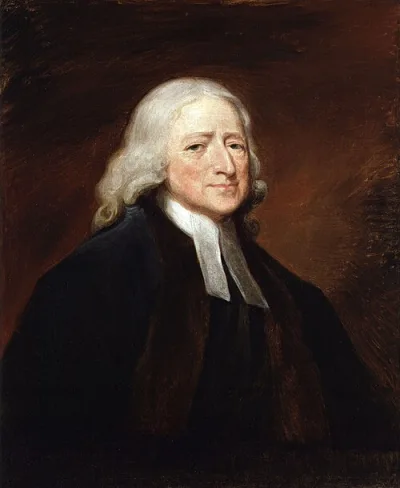
John Wesley was a key leader in the Methodist revival, emphasizing personal holiness, evangelism, and social reform.
John Wesley (1703-1791) was an English cleric and evangelist who became a principal figure in the Methodist revival within the Church of England. Educated at Oxford, he was ordained an Anglican priest and, while at university, led the "Holy Club," a group dedicated to devout Christian living. After a challenging ministry in Georgia, Wesley experienced a profound evangelical conversion that shaped his subsequent work.
Wesley's ministry was characterized by extensive travel and open-air preaching, advocating for Arminian doctrines and the concept of Christian perfection. He organized small Christian groups across Great Britain and Ireland, fostering personal accountability and discipleship, and appointed unordained evangelists to lead them. Methodists under his guidance became involved in social issues, including the abolition of slavery and support for women preachers. Despite initial persecution and exclusion from many churches, Wesley gained widespread respect by the end of his life.
Early Life and Upbringing
Born in 1703, John Wesley was the fifteenth child of Samuel and Susanna Wesley. His parents provided his early education, emphasizing rigorous study of Latin and Greek, memorization of scripture, and weekly spiritual interviews. A significant childhood event was his miraculous rescue from a house fire at age five, which was later seen as a sign of his special destiny. The family also reported paranormal activity at their rectory, which they attributed to a ghost named 'Old Jeffery,' contributing to the mystical atmosphere of his youth.
Oxford and the 'Holy Club'
Wesley entered Christ Church, Oxford, in 1720, pursuing his studies and eventually being ordained as a deacon and then a priest. Elected a fellow of Lincoln College, he taught Greek and philosophy. During his absence from Oxford, his brother Charles formed a study group for devout Christian living, which John led upon his return. This group, which met daily for prayer and scripture study, adopted strict practices like fasting and visiting prisoners. They were derisively nicknamed the "Holy Club" by their peers, and later "Methodists" by critics, for their methodical approach to piety. Wesley's intense spiritual discipline, including detailed self-examination and a pursuit of inner holiness, marked this period.
Ministry, Conversion, and Methodism
Following a period of ministry in Savannah, Georgia, Wesley experienced a pivotal evangelical conversion on May 24, 1738, after encountering Moravian Christians whose deep faith influenced him. This experience led him to depart from the Moravians and begin his distinct ministry. He adopted a pattern of widespread travel and outdoor preaching, promoting Arminian theology and the doctrine of Christian perfection—a state of complete love for God achievable in this life. He established organized Christian societies, emphasizing personal accountability and spiritual growth, and appointed itinerant preachers to serve them. Wesley's teachings, known as Wesleyan theology, continue to shape Methodist doctrine, emphasizing faith, sanctification, and the means of grace.
Key Ideas
- Christian Perfection: The belief that believers can achieve a state of complete love for God in this life.
- Evangelical Conversion: A profound personal experience of faith transformation.
- Means of Grace: Sacramental and other religious practices that aid in sanctification.
- Arminian Doctrines: Theological views emphasizing free will and God's universal grace, contrasting with Calvinism.
- Methodical Piety: A disciplined and structured approach to religious practice and self-examination.
Books by
3 free public domain books · Read online or download