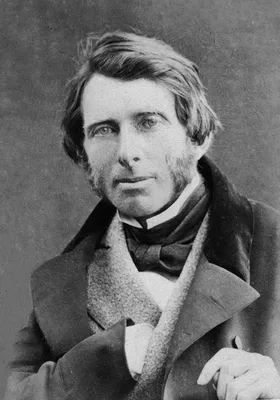
John Ruskin
John Ruskin was a Victorian polymath whose writings on art, nature, and society influenced environmentalism and ethical consumerism.
John Ruskin was a prominent English figure of the Victorian era, known for his extensive work as a writer, lecturer, art historian, and philanthropist. His intellectual output spanned a wide array of subjects, including art, architecture, political economy, education, and natural sciences. Ruskin's writing style evolved over time, moving from an elaborate early approach to a more direct and accessible language, yet always emphasizing the interconnectedness of nature, art, and society. His influence was significant in the late 19th and early 20th centuries, and his ideas have seen a resurgence in academic interest since the 1960s, with his concerns now seen as precursors to modern environmentalism, sustainability, and ethical consumption.
Ruskin first gained public recognition with the publication of 'Modern Painters' (1843), which defended the artist J. M. W. Turner and promoted the idea of "truth to nature" in art. He later championed the Pre-Raphaelite Brotherhood. His focus gradually shifted towards social and political matters, notably marked by his work 'Unto This Last'. He held the first Slade Professorship of Fine Art at Oxford University, establishing the Ruskin School of Drawing. His monthly letters, 'Fors Clavigera', detailed his vision for an ideal society and led to the founding of the Guild of St George, an organization that continues to this day.
Early Life and Education
Born in London in 1819, John Ruskin was the only child of first cousins John James and Margaret Ruskin. His father, a wine importer and business partner, fostered his son's appreciation for Romantic literature and travel. His mother, an evangelical Christian, instilled a deep reverence for the Bible, which profoundly shaped his writing. Ruskin received his education at home from his parents and private tutors, developing early skills in observation and drawing. His privileged childhood included extensive travel across Britain and continental Europe, exposing him to diverse landscapes and architecture, which significantly influenced his developing aesthetic sensibilities and artistic techniques. He also attended King's College, London, preparing for further studies.
Artistic and Social Philosophy
Ruskin's early influential work, 'Modern Painters', championed the artist J. M. W. Turner and articulated the principle of "truth to nature," advocating for art rooted in direct experience and careful observation. This philosophy extended to his support for the Pre-Raphaelite artists. Over time, his writings increasingly addressed social and political issues, reflecting a growing concern for the impact of industrialization on society and the environment. Works like 'Unto This Last' marked this significant shift in his focus. He believed in the inherent connection between the natural world, artistic creation, and the fabric of society, advocating for ethical principles in both consumption and production.
Academic and Practical Influence
Ruskin's academic career included his tenure as the first Slade Professor of Fine Art at the University of Oxford, where he founded the Ruskin School of Drawing. His engagement with the public extended through his "letters to the workmen and labourers of Great Britain," published as 'Fors Clavigera'. In these writings, he expounded on his vision for an ideal society, emphasizing principles of craftsmanship, community, and connection to the land. This philosophical exploration led to the practical establishment of the Guild of St George, an organization dedicated to promoting his ideals and which still exists today, demonstrating the enduring impact of his thought.
Key Ideas
- Truth to nature in art
- Connection between nature, art, and society
- Ethical consumerism
- Environmentalism
- Sustainability
- Craftsmanship
Notable Quotes
“She read alternate verses with me, watching at first, every intonation of my voice, and correcting the false ones, till she made me understand the verse, if within my reach, rightly and energetically.”
Books by John Ruskin
3 free public domain books · Read online or download