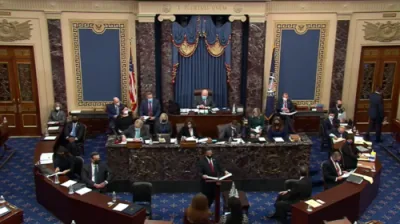
Donald Trump's second impeachment trial, the first for a former president, concluded with his acquittal.
Donald Trump's second impeachment trial took place from February 9 to February 13, 2021, following his impeachment by the House of Representatives on January 13, 2021. The sole article of impeachment charged him with inciting an insurrection, referencing his efforts to overturn the 2020 election results and the subsequent attack on the U.S. Capitol. This marked the first time a former president faced an impeachment trial, as Trump had left office before the proceedings began. A key constitutional debate arose regarding the Senate's authority to try a former official, with arguments centering on whether impeachment's purpose, including disqualification from future office, remained relevant. Ultimately, the Senate voted to acquit Trump, falling short of the two-thirds majority required for conviction, though a significant number of Republican senators voted to convict.
Impeachment and Trial Proceedings
Donald Trump was impeached for a second time by the House of Representatives on January 13, 2021, with the charge being incitement of insurrection. This action stemmed from his attempts to challenge the 2020 presidential election results and his role in the events leading to the attack on the Capitol. The Senate trial commenced on February 9, 2021, and concluded on February 13, with Trump being acquitted. A significant legal question before the trial was the constitutionality of trying a former president. While the House impeached him, he had already left office prior to the Senate trial, making it the first such trial for a former president. The defense team, led by Michael van der Veen, questioned the Senate's jurisdiction, arguing that impeachment primarily applied to current officeholders and that removal from office was no longer a possible outcome. However, proponents of the trial pointed to the Constitution's allowance for disqualification from future office as a valid consequence, even for former officials.
Constitutional Debate and Senate Vote
The impeachment trial of Donald Trump presented novel constitutional questions, particularly concerning the Senate's power to try a former president. Senator Rand Paul initiated a vote to dismiss the charges, asserting that impeachment was exclusively for current federal officers. Conversely, legal scholars and arguments within the Senate highlighted that impeachment also carries the power to disqualify an individual from holding future office, thus maintaining the trial's relevance even after the president's term ended. This power to disqualify was cited as a key reason why the trial should proceed. The Senate ultimately voted 57–43 to convict Trump of inciting insurrection. This vote fell short of the two-thirds majority needed for conviction, resulting in his acquittal. Notably, seven Republican senators joined all Democrats and independents in voting to convict, representing a substantial bipartisan consensus on the impeachment conviction of a U.S. president or former president.
Background and Procedural Aspects
The U.S. Constitution grants the House of Representatives the sole power of impeachment and the Senate the sole power to try all impeachments. Trump became the third U.S. president to face a Senate impeachment trial, and the only federal official to be impeached twice. The Senate trial procedures are governed by rules adopted in 1986, with specific rules often tailored for each trial, influenced by the Senate majority leader. The timing of the impeachment and the subsequent trial was affected by the transition of presidential power. With Trump impeached days before leaving office and the Senate in pro forma sessions, the transmission of the impeachment article to the Senate was debated. Ultimately, the article was transmitted, and the trial was scheduled to begin shortly after the inauguration of President Joe Biden, allowing for the Senate to potentially manage both the trial and other urgent legislative business.
Key Ideas
- Impeachment of a former president
- Constitutional authority to try former officials
- Disqualification from future office as a consequence of impeachment
- Incitement of insurrection
Notable Quotes
“There's no question that President Trump is practically and morally responsible for provoking the events of the day.”
Books by
5 free public domain books · Read online or download