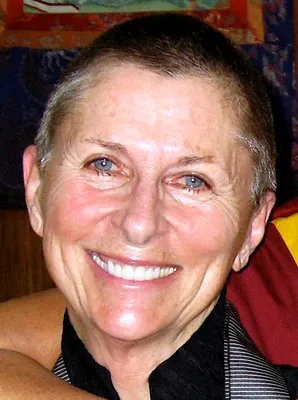
Joan Halifax
Joan Halifax is a Buddhist teacher, anthropologist, and author known for her work with the dying and founding Zen centers.
Joan Halifax, born in 1942, is an American Zen Buddhist teacher, anthropologist, and author recognized for her extensive work in hospice care and founding spiritual communities. She is the guiding teacher of Upaya Zen Center in Santa Fe, New Mexico, which she established in 1990 as a Zen Peacemaker community. Halifax has received Dharma transmission and studied with prominent Zen masters. Her career has involved collaboration on LSD research in the 1970s with her former husband, Stanislav Grof, and significant engagement with the dying through her Project on Being with Dying. She also founded the Ojai Foundation in California. Halifax's academic background includes a Ph.D. in medical anthropology and psychology, and she has conducted anthropological studies among indigenous groups in Mali and Mexico.
Her approach to working with the terminally ill is characterized by a compassionate and direct engagement, offering comfort and easing suffering by physically and emotionally connecting with them. This practice is rooted in Buddhist traditions but presented in a flexible manner suitable for diverse cultural and spiritual contexts. Halifax is also involved with the Mind and Life Institute, exploring the intersection of science and Buddhism. Her writings and teachings often address themes of spirituality, Buddhism, and confronting mortality.
Founding and Guiding Spiritual Centers
Joan Halifax is the founder and guiding teacher of Upaya Zen Center, a Zen Peacemaker community established in Santa Fe, New Mexico, in 1990. The center provides Zen training and offers courses and retreats focused on engaged Buddhism and end-of-life care. Earlier in her career, she founded the Ojai Foundation in California, an educational and interfaith center, which she led from 1979 to 1989. Her vision for Upaya integrates existing structures while emphasizing a comprehensive design based on the interconnectedness of mind and space, ancestral ties, natural cycles, and the relationship between interior and exterior environments. The stewardship of the land is a core principle in the center's development.
Engaged Buddhism and Work with the Dying
A significant aspect of Halifax's work is her dedication to the dying through her Project on Being with Dying. She teaches methods for 'being with death and dying' to patients, healthcare professionals, and family members. In a culture that often avoids discussing death, Halifax offers direct physical and emotional support, holding, listening to, and comforting those at the end of life. Her approach, drawing from Buddhist traditions, is presented with calm authority and cultural flexibility, enabling her to minister in various settings like hospitals and hospices. This compassionate engagement aims to ease suffering and share the profound experiences of dying.
Anthropological and Early Research
Halifax's academic foundation in anthropology has informed her spiritual and humanitarian work. She holds a Ph.D. in medical anthropology and psychology and has conducted ethnographic research, including studies of the Dogon tribe in Mali and the Huichols in Mexico. In the 1970s, she was involved in research projects examining the use of LSD as a support for the terminally ill, collaborating with her then-husband Stanislav Grof. This period also saw her work with figures like Joseph Campbell and Alan Lomax, and her early engagement with Buddhist texts and meditation practices began in the mid-1960s.
Key Ideas
- The practice of 'being with dying' involves compassionate and direct engagement with the terminally ill.
- Engaged Buddhism applies spiritual principles to social and humanitarian issues, particularly end-of-life care.
- The interconnectedness of mind, space, and environment is a foundational concept in designing spiritual centers.
- Confronting death with compassion and fearlessness is essential for spiritual growth.
Books by Joan Halifax
3 free public domain books · Read online or download