Jeffrey Burton Russell
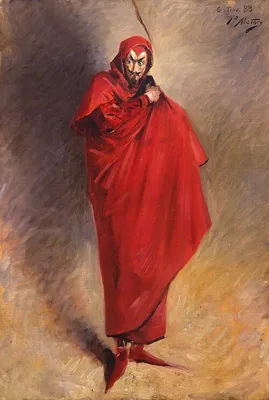
Mephistopheles is a literary demon from German folklore, best known as the devil's agent in the Faust legend.
Mephistopheles, also known by variations like Mephisto, is a prominent demonic figure originating in German folklore, primarily recognized as the chief devil in the Faust legend. He emerged as a literary character around the 15th to 17th centuries, a period when the Devil became a more symbolic literary figure representing evil and corruption, sometimes depicted sympathetically as the "Romantic Devil." This figure is distinct from the traditional Christian understanding of Satan or Lucifer, who is the adversary of God and ruler of Hell. Instead, Mephistopheles functions as a messenger or servant of the Devil, often portrayed as a trickster, liar, and negotiator who makes deals for souls. His name is believed to be a corruption of Greek words, possibly meaning "not loving light" or related to poisonous vapors, and was first invented for the historical alchemist Johann Georg Faust.
While not originally part of traditional magical lore, Mephistopheles gained significant literary prominence through works like Christopher Marlowe's "Doctor Faustus" and Johann Wolfgang von Goethe's "Faust." In these adaptations, he is depicted with varying degrees of complexity, sometimes showing introspection, regret, or even a sense of humanity, contrasting with earlier comical or purely evil portrayals. Mephistopheles' character has been interpreted as a fallen angel or a demon who serves Lucifer, often appearing to those already deemed damned, and acting as an agent for their ultimate collection by Hell. His actions can be seen as a warning or a persuasion, depending on the interpretation, and he is known for his ability to shapeshift and use illusion.
Origins and Etymology
Mephistopheles emerged as a literary demon during a period in Europe (15th-17th centuries) when the concept of the Devil transitioned from a literal theological figure to a more symbolic representation of evil in literature. This shift coincided with waning beliefs in witchcraft and an increasing focus on the "metaphysical existence" of Satan. Some authors explored a more sympathetic portrayal of the Devil, known as the "Romantic Devil," which resonated with pantheistic mystical beliefs about fallen angels desiring heaven for themselves. The name "Mephistopheles" itself is thought to be a corrupted Greek compound, with proposed meanings such as "not loving light" or "not a friend of light," possibly derived from Greek words for negation, love, and light. Other etymologies suggest connections to poisonous vapors or Hebrew words for "destroyer" and "slanderer." The name was initially coined for the historical alchemist Johann Georg Faust and later popularized and modified by writers like Goethe and Shakespeare.
Role in the Faust Legend
Mephistopheles is intrinsically linked to the Faust legend, which is based on the life of the historical Johann Georg Faust, an ambitious scholar who supposedly made a pact with the Devil for knowledge and power. In this narrative, Mephistopheles typically acts as the Devil's agent, facilitating the pact in exchange for Faust's soul. The legend has come to symbolize the perils of unchecked ambition and the pursuit of empowerment beyond moral and intellectual boundaries. Early literary appearances in the late 16th-century "Faust chapbooks" established Mephistopheles as a key character. Later adaptations, notably by Christopher Marlowe in "Doctor Faustus" and Johann Wolfgang von Goethe in "Faust," explored deeper psychological dimensions. Marlowe's portrayal introduced a Mephistopheles who laments his lost happiness and expresses introspection, deviating from simpler, comical medieval depictions. Goethe's version further developed the character, presenting him as intelligent, ironic, and sometimes cold-hearted, but also capable of humor and complex motivations.
Interpretations and Esoteric Significance
Interpretations of Mephistopheles vary, but he is consistently portrayed as a servant of Lucifer, distinct from Satan or Lucifer himself. Some scholars argue that Mephistopheles does not actively seek to corrupt individuals but rather appears to those already on the path to damnation, acting as an agent to collect their souls. This perspective suggests that Mephistopheles himself is trapped in his own form of Hell through his service to the Devil. He can be seen as a morally aware figure who warns Faust of the consequences of his pact, even while facilitating it. This dual nature—simultaneously embodying depravity and possessing moral awareness—makes him a complex character. The Protestant revisioning of magic in the late 16th century influenced these interpretations, framing conjurations as theatrical performances by demons designed to further damn the magician's soul. Mephistopheles' willingness to perform the Devil's bidding, sometimes persuasively rather than purely coercively, aligns with this view, where his actions are a performance leading to the soul's capture.
Key Ideas
- Symbolic representation of evil and corruption in literature
- The "Romantic Devil" archetype
- The Faustian bargain and its consequences
- Mephistopheles as a servant/messenger of the Devil
- The complex nature of demonic figures in literature and folklore
Notable Quotes
“O Faustus, leave these frivolous demands”
Books by Jeffrey Burton Russell
7 free public domain books · Read online or download