James I, King of England
James I of England and VI of Scotland was a prolific writer and monarch who unified the crowns and fostered a literary golden age.
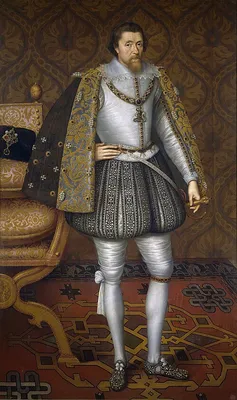
James VI of Scotland and I of England (born James Charles Stuart in 1566) ascended the Scottish throne as an infant and later inherited the English and Irish crowns, uniting them in a personal union in 1603. Raised Protestant despite his mother Mary, Queen of Scots' Catholicism, his early years were governed by regents. He eventually gained control of his government, married Anne of Denmark, and had three children who survived to adulthood. His reign, known as the Jacobean era, saw significant literary and dramatic flourishing, with writers like Shakespeare and Jonson active. James himself was a writer, producing works such as 'Daemonologie,' 'The True Law of Free Monarchies,' and 'Basilikon Doron.' He also supported the translation of the Bible that became known as the King James Version. Despite advocating for closer political union between Scotland and England, they remained separate states with their own institutions. His reign in Scotland was the longest of any Scottish monarch, though he faced challenges in England, including the Gunpowder Plot and disputes with Parliament. He pursued a peace policy, attempting to avoid involvement in European religious wars. Historians have increasingly viewed him as a thoughtful monarch, moving away from earlier critical assessments.
Early Life and Accession
Born James Charles Stuart in 1566, he was the son of Mary, Queen of Scots, and Henry Stuart, Lord Darnley. His mother's turbulent reign led to her abdication in 1567, placing the infant James on the Scottish throne. He was raised as a Protestant under the care of regents, including George Buchanan, who instilled in him a passion for learning despite harsh discipline. His minority officially ended in 1578, but he did not secure full control of his government until 1583. He married Anne of Denmark in 1589, and they had three children who lived to adulthood. In 1603, he succeeded his childless cousin Elizabeth I, becoming King of England and Ireland, thus uniting the crowns of Scotland, England, and Ireland.
Reign and Governance
As King of Scotland and then England and Ireland, James sought a closer political union between the kingdoms, but they remained sovereign states under his personal rule. He based himself primarily in England after 1603, returning to Scotland only once. His reign, known as the Jacobean era, coincided with a 'Golden Age' of English literature and drama, with prominent figures like William Shakespeare and Ben Jonson contributing to the cultural scene. James himself was a prolific author, and he sponsored a significant English Bible translation. He faced challenges in England, including the Gunpowder Plot and conflicts with Parliament, while in Scotland, his reign was the longest of any Scottish monarch. He maintained a commitment to peace, trying to avoid entanglement in major European religious conflicts.
Literary and Philosophical Contributions
James I was not only a monarch but also a notable writer and patron of the arts and scholarship. His own literary output included works that explored themes of kingship and the supernatural, such as 'Daemonologie' (1597), which discussed witchcraft, and 'The True Law of Free Monarchies' (1598) and 'Basilikon Doron' (1599), which outlined his political philosophy regarding the divine right of kings and royal authority. He also played a role in the revision of the Book of Common Prayer in 1604 and championed the translation of the Bible into English, which ultimately bore his name. His reign fostered a vibrant literary culture, continuing the trends of the Elizabethan era.
Key Ideas
- Divine Right of Kings
- Union of the Crowns (Personal Union)
- Peace Policy in European Conflicts
Books by James I, King of England
2 free public domain books · Read online or download