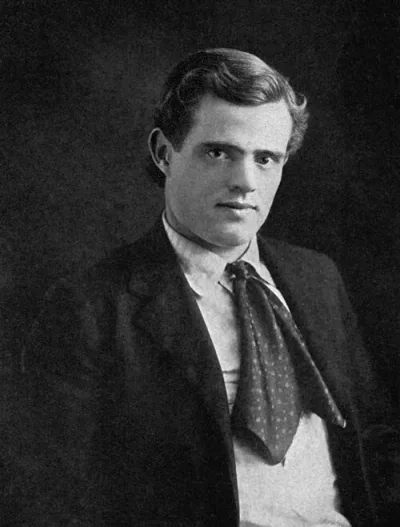
Jack London was a pioneering American author, journalist, and activist known for adventure novels and early science fiction.
John Griffith London, known as Jack London, was a prominent American writer, journalist, and social activist who achieved international fame and fortune through his prolific literary output. He is recognized as a pioneer of commercial fiction and an innovator in the genre that would evolve into science fiction. London was also deeply involved with radical literary circles and a staunch advocate for animal welfare, workers' rights, and socialist ideals, themes that permeated many of his works.
Born in San Francisco, London's early life was marked by a search for his identity, including the circumstances surrounding his birth and parentage, which he explored in his writings. He experienced a working-class upbringing, though he later embellished accounts of his poverty. His education was largely self-directed, fueled by a voracious appetite for reading and encouraged by figures like librarian Ina Coolbrith. London's early adulthood involved a series of demanding jobs and adventures, including oyster piracy, working on sealing schooners, and experiencing the hardships of vagrancy and imprisonment, which significantly shaped his worldview and writing.
Literary Innovation and Social Activism
Jack London was a trailblazer in the burgeoning American magazine industry, becoming one of the first authors to achieve widespread international recognition and substantial financial success from his writing. He is also credited with significant contributions to the development of science fiction. Beyond his literary achievements, London was a passionate advocate for social justice, aligning himself with the radical literary group "The Crowd" in San Francisco. His activism extended to fervent support for animal welfare, the rights of laborers, and the principles of socialism. These deeply held beliefs were frequently explored in his literary works, including the dystopian novel "The Iron Heel" and the non-fiction exposé "The People of the Abyss."
Early Life and Influences
Born John Griffith Chaney in San Francisco, Jack London's parentage was a subject of uncertainty for much of his life, with astrologer William Chaney believed to be his biological father. His mother, Flora Wellman, had a complex relationship with Chaney, and London's upbringing was further shaped by his adoptive father, John London, and a significant maternal figure, Virginia Prentiss, a former slave who provided him with crucial emotional support. London's early life involved manual labor, including work at a cannery and as an oyster pirate, experiences that instilled in him a strong sense of social consciousness and socialist leanings. He was largely self-educated, finding inspiration in books and supportive librarians, which ignited his ambition to become a writer.
The Klondike Gold Rush and Literary Breakthrough
At the age of 21, Jack London embarked on the Klondike Gold Rush, an experience that profoundly impacted his health and provided rich material for his writing. The harsh conditions and malnourishment led to him developing scurvy and losing teeth, leaving lasting physical reminders of his time in the Yukon. Despite these hardships, his experiences in the Klondike served as the basis for some of his most celebrated works, including the short story "To Build a Fire." Upon returning to California, London dedicated himself to becoming a published author. He faced initial rejections and low pay, but his perseverance, coupled with the expansion of popular magazines, led to his first significant financial success as a writer, earning him substantial income by 1900.
Key Ideas
- Pioneering commercial fiction
- Innovation in science fiction
- Advocacy for animal welfare
- Advocacy for workers' rights
- Socialism
- Impact of harsh environments on character
- Self-education and literary ambition
Notable Quotes
“Man-handling was merely one of the very minor unprintable horrors of the Erie County Pen. I say 'unprintable'; and in justice I must also say undescribable. They were unthinkable to me until I saw them, and I was no spring chicken in the ways of the world and the awful abysses of human degradation. It would take a deep plummet to reach bottom in the Erie County Pen, and I do but skim lightly and facetiously the surface of things as I there saw them.”
Books by
4 free public domain books · Read online or download