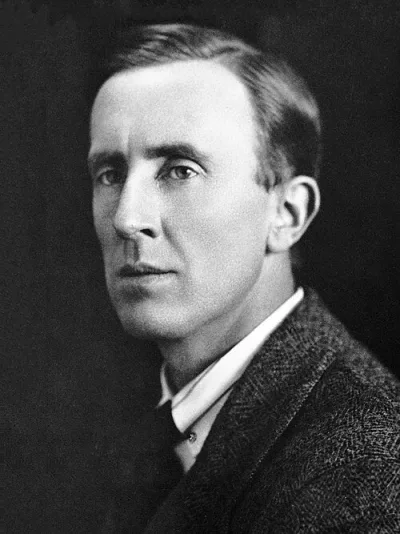
J.R.R. Tolkien
J.R.R. Tolkien was a renowned philologist and author, celebrated for his influential fantasy works and academic career in English studies.
John Ronald Reuel Tolkien was an English writer and scholar, best known for his seminal high fantasy novels, The Hobbit and The Lord of the Rings. Born in South Africa in 1892, he returned to England as a child and developed an early fascination with languages and drawing. His academic career was spent at the University of Oxford, where he held professorships in Anglo-Saxon and later English Language and Literature. A devout Catholic, Tolkien was part of the literary discussion group known as the Inklings, alongside C. S. Lewis.
Following his death, his extensive unpublished writings, notes, and invented languages related to his fantasy world of Arda and Middle-earth were compiled and published by his son, Christopher. These works, along with his major novels, solidified his reputation as a foundational figure in modern fantasy literature, earning him the title 'father' of the genre and recognition as one of history's most impactful authors.
Early Life and Influences
Born in 1892 in South Africa, John Ronald Reuel Tolkien moved to England with his mother and brother after his father's death. He was raised in Birmingham by his mother, Mabel, who educated him at home and instilled a love for languages and botany. His childhood explorations of the Worcestershire countryside, including Sarehole Mill and Moseley Bog, later served as inspiration for his fictional landscapes. Tolkien's mother, a convert to Catholicism, died when he was twelve, leaving his guardianship to Father Francis Xavier Morgan, who ensured he was raised in the Catholic faith. This upbringing deeply influenced his worldview and spiritual outlook.
Academic Career and Literary Endeavors
Tolkien's academic path led him to the University of Oxford, where he initially studied classics before shifting to English Language and Literature. He held significant academic positions, serving as the Rawlinson and Bosworth Professor of Anglo-Saxon and later the Merton Professor of English Language and Literature. His scholarly work focused on philology and ancient languages, which deeply informed his creative writing. He was a member of the Inklings, a literary group whose discussions fostered his development of complex mythologies and languages for his fictional worlds.
The Father of Modern Fantasy
The publication of The Hobbit and The Lord of the Rings brought Tolkien immense acclaim and had a profound impact on the literary landscape. While fantasy existed before his work, the immense success of his novels sparked a widespread resurgence of interest in the genre, leading to a proliferation of new fantasy authors and works. This legacy has led to his widely recognized status as the 'father' of modern fantasy literature, acknowledging his pivotal role in popularizing and shaping the genre.
Key Ideas
- Creation of elaborate fictional worlds with invented languages and histories.
- Exploration of themes of good versus evil, courage, and fellowship.
- The concept of a 'legendarium' as a unified body of mythological writings.
Notable Quotes
“My own dear mother was a martyr indeed, and it is not to everybody that God grants so easy a way to his great gifts as he did to Hilary and myself, giving us a mother who killed herself with labour and trouble to ensure us keeping the faith.”
Books by J.R.R. Tolkien
10 free public domain books · Read online or download