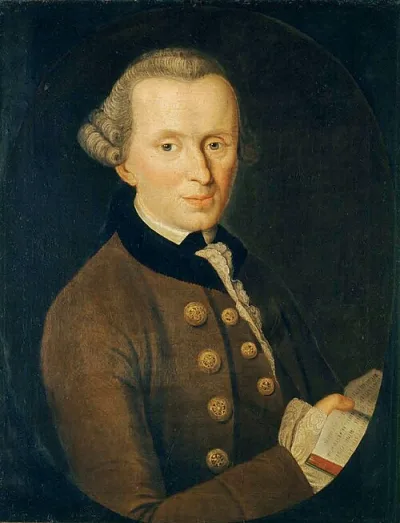
Immanuel Kant
Immanuel Kant was a central Enlightenment philosopher whose works explored knowledge, morality, and religion, profoundly influencing Western thought.
Immanuel Kant, born in Prussia in 1724, was a pivotal figure of the Enlightenment, whose philosophical system addressed epistemology, metaphysics, ethics, and religion. His work aimed to safeguard the foundations of knowledge and morality against skepticism and determinism. Kant's seminal contribution, transcendental idealism, proposed that our experience is shaped by innate mental structures like space, time, and categories of understanding, meaning we perceive phenomena rather than things-in-themselves. He also posited that morality stems from reason, embodied in the categorical imperative, and that true religion is rooted in moral principles.
Kant's intellectual journey began with a rigorous education and early academic promise. He studied under Martin Knutzen, who introduced him to Newtonian physics and cautioned against idealism. After a period as a private tutor following his father's death, Kant published his first work in 1749. He later became a professor at the University of Königsberg, lecturing on diverse subjects from mathematics to metaphysics. His early scientific inquiries included theories on the Moon's effect on Earth's rotation and the formation of the solar system, prefiguring the nebular hypothesis. Kant's philosophical development culminated in his major works, notably the Critique of Pure Reason, which revolutionized epistemology by shifting focus to the active role of the mind in structuring experience.
Transcendental Idealism and the Structure of Experience
Kant's philosophy is famously characterized by transcendental idealism, a doctrine presented in his *Critique of Pure Reason*. He argued that space and time are not inherent properties of the world but rather 'forms of intuition' that structure all human perception. This means that our experience is limited to 'appearances'—how things seem to us—rather than direct knowledge of 'things in themselves.' Kant proposed a 'Copernican Revolution' in philosophy, suggesting that the objects of our experience conform to the mind's innate structures (forms of intuition and categories of understanding) rather than the mind passively conforming to external objects. This approach sought to establish the possibility of objective knowledge while acknowledging the mind's active role in constructing reality.
Morality, Reason, and Religion
Central to Kant's ethical framework is the belief that reason is the source of morality. He formulated the 'categorical imperative,' a universal moral law that binds all rational beings, obligating them to act only according to principles that could be willed as universal laws. This concept underscores the inherent dignity and autonomy of individuals. In aesthetics, Kant proposed that judgments of beauty arise from a faculty of 'disinterested judgment.' His views on religion were closely tied to his ethics, asserting that true religion is fundamentally grounded in morality. However, the precise nature of his religious beliefs remains a subject of scholarly debate.
Early Life and Intellectual Development
Born in Königsberg, Prussia, Immanuel Kant received a strict Pietist upbringing that emphasized religious devotion and discipline. His early education focused on Latin and religious studies. He later attended the University of Königsberg, where he studied under Martin Knutzen, who introduced him to Newtonian physics and rationalist philosophy. After interrupting his studies to work as a private tutor, Kant returned to academia, eventually becoming a professor. His early work spanned scientific inquiries, including theories on celestial mechanics and geology, before he increasingly focused on philosophical problems. He was deeply influenced by David Hume, who he credited with awakening him from 'dogmatic slumber' and prompting his critical examination of the foundations of knowledge and belief.
Key Ideas
- Transcendental Idealism: The view that space and time are forms of intuition structuring experience, limiting knowledge to phenomena.
- Categorical Imperative: A universal moral law derived from reason, binding all rational agents.
- Forms of Intuition: Innate mental structures (space and time) that organize sensory input.
- Categories of Understanding: Innate concepts (e.g., causality) that organize experience.
- Phenomena vs. Noumena: The distinction between things as they appear to us and things as they are in themselves.
Books by Immanuel Kant
5 free public domain books · Read online or download