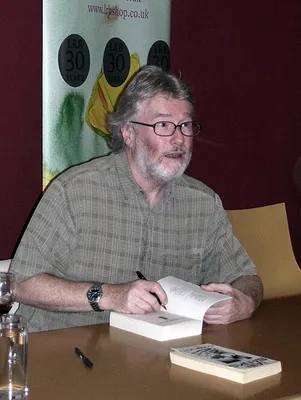
Iain Banks
Scottish author Iain Banks wrote mainstream fiction as Iain Banks and science fiction as Iain M. Banks, exploring complex themes.
Iain Menzies Banks, born in 1954, was a Scottish author who achieved significant recognition for both his mainstream fiction and his science fiction works, published under the names Iain Banks and Iain M. Banks, respectively. His career began in earnest after the success of his debut novel, 'The Wasp Factory,' in 1984. This novel, which has sold over a million copies and been translated into numerous languages, was critically acclaimed and recognized in various polls of significant literary works. Banks's foray into science fiction began with 'Consider Phlebas' in 1987, initiating his renowned 'Culture' series.
Throughout his career, Banks explored diverse themes and genres, producing a substantial body of work that included novels, a travel book on Scotch whisky, and contributions to radio and television. His writing often touched upon philosophical and political ideas, reflecting his "left of centre" stance and support for Scottish independence. Banks passed away in June 2013 at the age of 59, following a diagnosis of inoperable cancer. His literary legacy continues with posthumous publications and ongoing projects related to his work.
Literary Career and Themes
Iain Banks began writing at a young age, completing his first novels in his teens. While he initially saw himself primarily as a science fiction writer, publishing challenges led him to mainstream fiction. His breakthrough came with 'The Wasp Factory' (1984), a novel that garnered widespread attention and commercial success. This paved the way for him to write full-time, producing a book annually. He distinguished his science fiction work, notably the 'Culture' series initiated by 'Consider Phlebas' (1987), by using the middle initial 'M.' His writing explored complex societal structures, philosophical questions, and often featured elements that could be interpreted through an esoteric lens, particularly in his expansive 'Culture' universe. Banks drew inspiration from prominent science fiction authors like Robert Heinlein and Arthur C. Clarke.
Personal Life and Influences
Born in Dunfermline, Scotland, Iain Banks's early life was influenced by his parents' professions and his proximity to naval dockyards. An early exposure to science fiction through the Kemlo series sparked his interest in writing the genre. He pursued higher education at the University of Stirling, studying English, philosophy, and psychology. After graduating, he held various jobs that provided him the flexibility to write in the evenings and travel. These experiences, combined with his academic background, likely informed the depth and breadth of his fictional worlds. Banks's engagement with philosophy and psychology may have contributed to the intricate character development and societal commentary present in his works.
Political and Social Stances
Banks was known for his "left of centre" political views and actively supported Scottish independence, becoming a signatory to the Declaration of Calton Hill. He was also an Honorary Associate of the National Secular Society and a Distinguished Supporter of Humanist Society Scotland. In protest against the 2003 invasion of Iraq, he famously destroyed his passport. His political convictions were often woven into his fiction, sometimes through direct commentary and other times through the societal structures depicted in his novels. He advocated for a cultural and educational boycott of Israel in 2010 following the Gaza flotilla raid. Banks viewed death realistically, considering it an essential part of life.
Key Ideas
- Distinction between mainstream and science fiction authorship (Iain Banks vs. Iain M. Banks)
- Exploration of utopian/dystopian societies in the 'Culture' series
- Critique of political and social structures
- Philosophical reflections on life, death, and existence
Notable Quotes
“Scots just seem to be more communitarian than the consensus expressed by the UK population as a whole.”
“part of the totality of life”
Books by Iain Banks
3 free public domain books · Read online or download