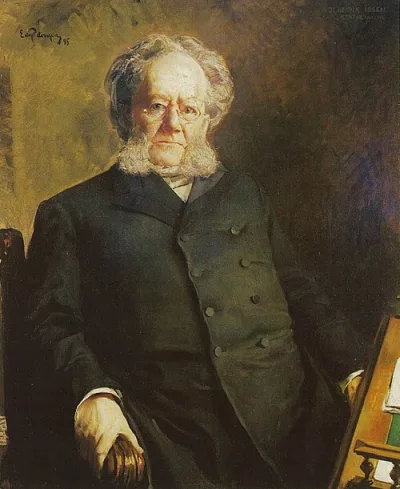
Henrik Ibsen, a pivotal 19th-century Norwegian playwright, revolutionized drama with realism and explored profound societal and psychological themes.
Henrik Ibsen was a highly influential Norwegian playwright born in 1828 into a prosperous merchant family. He is widely regarded as one of the most significant writers of the 19th century and is often credited as the originator of modern drama. Ibsen initially experimented with lyrical epic works before pioneering theatrical realism. His career spanned decades, during which he lived abroad for many years, primarily in Italy and Germany, before returning to Norway. Most of his plays are set in Norwegian environments, frequently drawing inspiration from his family and the societal structures of his upbringing.
Ibsen's later dramas were often controversial, challenging the conventional morality and expectations of the era by delving into the hidden realities beneath societal facades. He approached his subjects with a critical perspective, conducting an independent examination of life's conditions and moral dilemmas. His work is celebrated for its depth and complexity, with critics often highlighting plays like 'The Wild Duck' and 'Rosmersholm' as his finest achievements, though Ibsen himself considered 'Emperor and Galilean' his masterpiece. His legacy extends to his influence on subsequent generations of writers and his enduring position as a central figure in the Norwegian literary canon.
Pioneering Modern Drama and Realism
Henrik Ibsen is celebrated as a foundational figure in modern theater, often called "the father of modern drama." He was instrumental in developing and popularizing theatrical realism, a style that sought to portray life and society truthfully, moving away from earlier romantic and melodramatic conventions. While he began with more lyrical and epic works, such as "Brand" and "Peer Gynt," which contained surreal elements, he later shifted to writing in realistic prose. This shift allowed him to explore complex psychological states and societal issues with greater precision. His plays frequently examined the darker aspects of human nature and societal hypocrisy, presenting characters grappling with moral ambiguity and existential questions.
Themes and Controversial Nature
Many of Ibsen's later plays were considered scandalous during his time because they directly confronted the strict moral codes and societal expectations prevalent in 19th-century Europe. He used his writing to investigate the hidden truths behind the polished exteriors of bourgeois life, revealing disquieting realities that challenged his contemporaries. Ibsen possessed a critical intellect, engaging in a free inquiry into the conditions of existence and the complexities of morality. His works often delved into themes of individual freedom versus societal constraints, the disillusionment of ideals, and the psychological impact of past actions, making them deeply resonant and enduring.
Early Life and Influences
Born in 1828 into an affluent merchant family in the port town of Skien, Ibsen's upbringing was shaped by his family's connections to influential local elites. His background provided him with intimate knowledge of the social dynamics and values of the Norwegian bourgeoisie, which he would later depict in his plays. His childhood was marked by his father's financial decline, a significant event that may have influenced his later explorations of societal pressures and personal struggles. Ibsen's early engagement with model theater and his introspective nature, possibly inherited from his family, are noted aspects of his formative years.
Key Ideas
- Pioneering theatrical realism
- Critique of bourgeois morality and societal hypocrisy
- Exploration of individual psychology and existential dilemmas
- The examination of hidden truths beneath societal facades
Notable Quotes
“my parents were members on both sides of the most respected families in Skien”
“just about all the patrician families who then dominated the place and its surroundings”
“In my childhood, Skien was an extremely joyful and festive town, quite the opposite of what it would later become. Many highly cultured, prosperous families at that time lived partly in the city itself, partly on large farms in the area. Close or more remote kinship connected most of these families amongst themselves, and balls, dinner parties, and musical soirées came one after another in rapid succession both during winters and summers. [...] Visits from strangers were almost a constant occurrence at our spacious farmhouse and especially around Christmastime and the market days, our townhouse was full and the table was set from morning to nightfall.”
“a boy who was pampered by his father, who enjoyed being creative in solitude, and who provoked peers with his superiority and arrogance”
“it is with the Paus family that Henrik Ibsen has the most pronounced temperament traits in common”
Books by
4 free public domain books · Read online or download