Heinrich Cornelius Agrippa
Heinrich Cornelius Agrippa was a Renaissance polymath and occult writer whose influential "Three Books of Occult Philosophy" drew on Kabbalah, Hermeticism, and Neoplatonism.
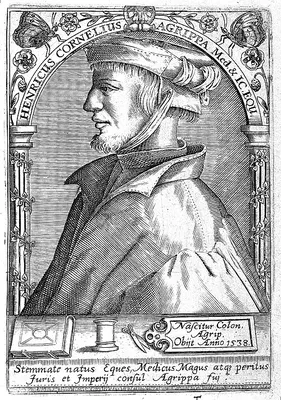
Heinrich Cornelius Agrippa von Nettesheim (1486–1535) was a German Renaissance figure with diverse talents, including medicine, law, theology, and the occult. Born near Cologne, he received a solid education, likely developing an early interest in esoteric thought through Albertist influences at the University of Cologne. His life was marked by extensive travel and service in various capacities, including military service as a knight for Emperor Maximilian I. Agrippa also pursued an academic career, lecturing on theological and philosophical topics, and earning a doctorate in theology. However, his unconventional views and studies often brought him into conflict with religious authorities, leading to denunciations and forced departures from academic posts.
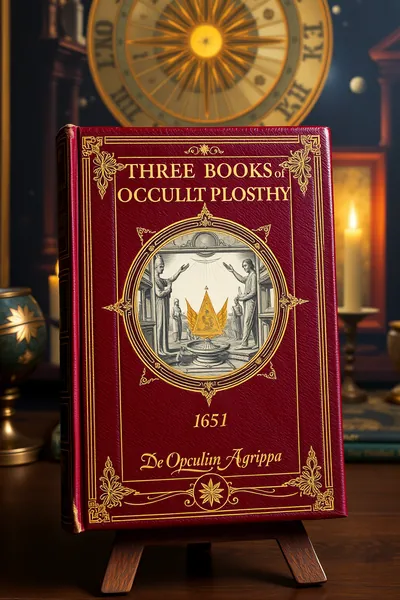
Agrippa's most significant contribution to esoteric thought is his "Three Books of Occult Philosophy," published in the early 1530s. This work synthesized Kabbalistic, Hermetic, and Neoplatonic ideas, aiming to present a comprehensive system of magic. Despite its later condemnation as heretical, the book profoundly influenced esotericists during the early modern period. Throughout his life, Agrippa engaged in theological debates, practiced medicine, and held various official positions, but his intellectual pursuits, particularly his writings on occult philosophy, frequently placed him at odds with the Inquisition and other detractors, leading to periods of persecution and hardship.
Early Life and Education
Born in 1486 near Cologne, Heinrich Cornelius Agrippa hailed from a family of minor nobility. His early education at the University of Cologne, a center for Thomist and Albertist philosophy, likely exposed him to the occult through the latter's influence, as Agrippa himself cited Albertus Magnus's "Speculum" as an early text. He later studied in Paris, where he may have participated in secret occult societies. His academic journey began in earnest in 1509 with patronage from Margaret of Austria and Antoine de Vergy. He lectured on Johann Reuchlin's "De verbo mirifico" and wrote "De nobilitate et praecellentia foeminae sexus," a work arguing for the superiority of women using cabalistic concepts, likely to impress his patron.
Academic and Military Pursuits
Agrippa's career was varied, encompassing military service and academic endeavors. In 1508, he traveled to Spain and served as a captain under Emperor Maximilian I, who bestowed upon him the title of knight. His academic path led him to lecture on Hebrew scholarship and theology, earning him a doctorate. However, he faced accusations of heresy, forcing him to leave Dole in 1510. He continued his studies with Johannes Trithemius and later traveled to England, where he defended his Christian faith while acknowledging an appreciation for Jewish thought. His time in Italy involved service to noble patrons and study of philosophers like Ficino and Pico della Mirandola, as well as Kabbalah. He lectured on the "Pimander" of Hermes Trismegistus at the University of Pavia.
Occult Philosophy and Conflicts
Agrippa's most renowned work, "Three Books Concerning Occult Philosophy," published in stages between 1531 and 1533, synthesized Kabbalah, Hermeticism, and Neoplatonism into a complex system of natural magic. This work was intended, in part, as a response to the skepticism expressed in his earlier "Declamation Attacking the Uncertainty and Vanity of the Sciences and the Arts." His writings and lectures, however, often brought him into conflict with religious authorities. He served as a town advocate in Metz, where his defense of a woman accused of witchcraft led to a dispute with an inquisitor. Later, his publications drew the ire of the Inquisition, and he faced imprisonment for debt. Despite facing accusations and persecution, scholarly analysis suggests that the denunciations were often based on theological grounds rather than direct accusations of practicing magic, and Agrippa himself argued against the persecution of witches.
Key Ideas
- Synthesis of Kabbalah, Hermeticism, and Neoplatonism in occult philosophy
- Exploration of natural magic as a divinely sourced practice
- Skeptical critique of the certainty and vanity of human knowledge
- Argument for the nobility and superiority of the female sex
Notable Quotes
“But of magic I wrote whilst I was very young three large books, which I called Of Occult Philosophy, in which what was then through the curiosity of my youth erroneous, I now being more advised, am willing to have retracted, by this recantation; I formerly spent much time and costs in these vanities. At last I grew so wise as to be able to dissuade others from this destruction. For whosoever do not in the truth, nor in the power of God, but in the deceits of devils, according to the operation of wicked spirits presume to divine and prophesy, and practising through magical vanities, exorcisms, incantations and other demoniacal works and deceits of idolatry, boasting of delusions, and phantasms, presently ceasing, brag that they can do miracles, I say all these shall with Jannes, and Jambres, and Simon Magus, be destinated to the torments of eternal fire.”
Books by Heinrich Cornelius Agrippa
10 free public domain books · Read online or download