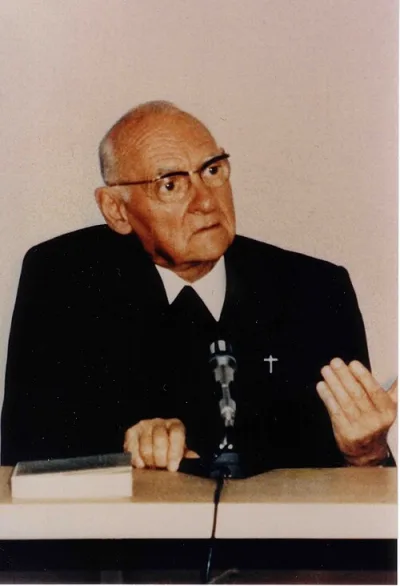
Hans Urs von Balthasar was a 20th-century Swiss Catholic theologian and priest known for his monumental theological works.
Hans Urs von Balthasar, born in 1905 in Switzerland, was a prominent Catholic theologian and priest of the 20th century. He came from a devout Catholic family and developed a strong faith early on, influenced by his upbringing and later by his university studies. After a profound spiritual experience, he joined the Society of Jesus and was ordained a priest in 1936. Balthasar authored a vast number of books and articles, becoming recognized for his extensive theological trilogy exploring beauty, goodness, and truth. He was nominated to become a cardinal shortly before his death in 1988. His work was highly regarded by contemporaries, including Pope John Paul II and Joseph Ratzinger (Pope Benedict XVI).
Early Life and Influences
Born into a patrician family in Lucerne, Switzerland, Hans Urs von Balthasar's upbringing was deeply Catholic. His father was a church architect, and his mother was involved in Catholic women's organizations. His early faith was described as straightforward and untroubled by doubt, with fond memories of attending Mass. The family's regular stays at a hotel managed by his grandmother exposed him to a cosmopolitan, multilingual environment. Balthasar also showed a strong affinity for classical music from a young age, spending considerable time at the piano and later demonstrating exceptional musical recall.
Education and Spiritual Awakening
Balthasar received his early education at Benedictine and Jesuit schools, where he developed interests in literature, particularly Dante and Goethe. He pursued doctoral studies in German literature at the University of Zurich, focusing on eschatology in German thought, a topic he approached from a Catholic theological perspective. Despite the academic risks, his dissertation was awarded summa cum laude. During his university years, particularly in Vienna, he was influenced by theological discussions and, after a powerful spiritual encounter in 1929, felt a distinct call to religious life. This experience led him to enter the Society of Jesus, understanding himself as being called to serve a purpose beyond his own plans.
Jesuit Priesthood and Theological Work
As a Jesuit, Balthasar studied philosophy and theology, engaging with figures like Erich Przywara and encountering fellow Jesuits such as Henri de Lubac, who fostered his interest in the Church Fathers. Ordained a priest in 1936, he initially worked for a theological journal before choosing pastoral work as a student chaplain in Basel. In this role, he edited literary series, translated works, published studies on Church Fathers, and established an institute for student formation, emphasizing Ignatian spirituality. He also collaborated closely with Adrienne von Speyr, a mystic who dictated numerous spiritual and scriptural texts to him, which he then edited and published through his founded Johannes Verlag publishing house.
Notable Quotes
“Even today [in 1959], after thirty years, I could still find again the tree on the lost path in the Black Forest, not far from Basel, under which I was struck as if by lightning.... [I]t was neither theology nor the priesthood that, at that moment, appeared in a flash before my mind; it was this alone: You have nothing to choose; you are called. You will not serve; another will use you. You have no plans to make; you are only a small little tile in a mosaic that has long been ready. I needed only to "leave everything and follow," without making plans, without wishes or ideas: I needed only to stand there and wait and see what I would be used for—and so it happened.”
“I did not choose him; he set me ablaze like a bolt of lightning.”
“Benedixit, fregit, deditque”
“its fundamental impulse was the desire to reveal ... the ultimate religious attitude, often hidden, of the great figures of modern German literature. I wanted to let them, so to speak, 'make their confession'. The work was of insufficient maturity—most of the chapters ought to be rewritten—and yet some of it may still be valid.”
“In the instructions she understood everything immediately, as though she had only—and for how long!—waited to hear exactly what I was saying in order to affirm it.”
Books by
9 free public domain books · Read online or download