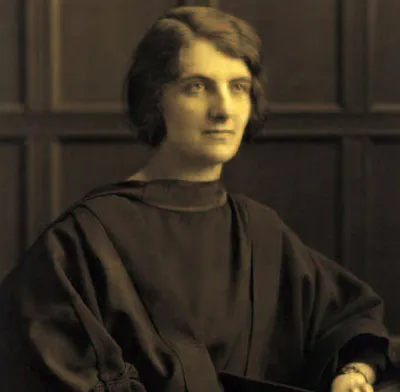
Frances A. Yates
Frances Yates was a Renaissance historian who made esotericism accessible, notably through her work on Giordano Bruno and Hermeticism.
Dame Frances Yates was a prominent English historian specializing in the Renaissance, particularly known for her work on the history of esotericism. After earning a degree in French, she began publishing research on 16th-century theatre and John Florio. Her employment at the Warburg Institute in London marked a shift towards what she termed "Warburgian history," an approach emphasizing a broad, interdisciplinary view of European cultural history.
Yates significantly contributed to making occult and Neoplatonic philosophies of the Renaissance more understandable. Her most celebrated book, "Giordano Bruno and the Hermetic Tradition," highlighted the influence of Hermeticism, magic, and mysticism on Renaissance thought. Other major works explored memory techniques and the Rosicrucian movement. Her scholarship challenged prevailing interpretations and brought previously overlooked aspects of Renaissance intellectual life into mainstream academic discussion.
Early Life and Education
Born in Southsea, England, in 1899, Frances Yates was the fourth child of middle-class parents. Her father, a shipyard supervisor, fostered a love of reading in his children. Despite a somewhat inconsistent formal education, Yates was an avid reader from a young age, drawn to Shakespeare and Romantic poets. She began writing early, publishing a short story as a teenager. Her early life was marked by family moves and the loss of her brother in World War I, an event that deeply affected her. She pursued higher education, eventually studying French at University College, London, where she excelled academically despite a lack of social engagement.
Scholarly Beginnings and John Florio
Yates's academic career began with a focus on 16th-century French drama and English theatre. Her early publications explored topics such as English actors in Paris and the social drama of the period. A significant early interest was the linguist John Florio, which led to her first biography, "John Florio: The Life of an Italian in Shakespeare's England." This work, published in 1934, received positive reviews and accolades. Her research into Florio's associates, particularly Giordano Bruno, began to steer her towards the esoteric and philosophical currents of the Renaissance, influencing her developing interpretations of historical figures and movements.
Warburg Institute and Esoteric Studies
Joining the Warburg Institute in 1941 provided Yates with an environment conducive to her research. She adopted and promoted "Warburgian history," advocating for a comprehensive, pan-European, and interdisciplinary approach to understanding culture, thought, and imagery. This period saw her delve deeply into the occult and Neoplatonic philosophies of the Renaissance. Her groundbreaking work, "Giordano Bruno and the Hermetic Tradition," published in 1964, re-evaluated the philosopher's work, emphasizing the crucial role of Hermeticism, magic, and mystical traditions in shaping Renaissance intellectual life. This book, along with others like "The Art of Memory" and "The Rosicrucian Enlightenment," cemented her reputation as a leading scholar who illuminated these complex fields for a wider audience.
Key Ideas
- Warburgian history: An interdisciplinary and pan-European approach to cultural history, encompassing thought, science, art, imagery, and symbolism.
- The influence of Hermeticism, magic, and mysticism on Renaissance thought and philosophy.
- Re-evaluation of Renaissance figures like Giordano Bruno, highlighting their engagement with esoteric traditions.
Books by Frances A. Yates
0 free public domain books · Read online or download