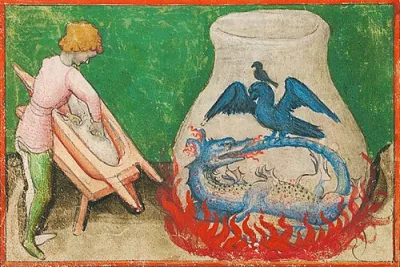
Alchemy is an ancient philosophical tradition, blending practical arts with spiritual pursuits across cultures.
Alchemy, originating from the Arabic word 'al-kīmīā', is an ancient discipline that historically developed in China, India, the Muslim world, and Europe. It was considered a branch of natural philosophy and a protoscientific tradition. Alchemists aimed to purify and perfect materials, with common goals including the transmutation of base metals into gold, the creation of an elixir of immortality, and the development of panaceas. The concept of the philosopher's stone was often linked to these endeavors, as was the perfection of the human body and soul through the 'Great Work'.
Islamic and European alchemists developed laboratory techniques and terminology still in use. They maintained the ancient Greek idea of four elements and often used coded language and symbolism. The 12th-century translations of Islamic works and the rediscovery of Aristotelian philosophy spurred a significant Latin alchemy tradition in Europe, which later influenced early modern science, particularly chemistry and medicine. Modern study of alchemy often divides into its practical applications and its esoteric spiritual dimensions, though some scholars argue these aspects are complementary. Alchemy has also significantly impacted literature and the arts.
Origins and Etymology
The term 'alchemy' derives from the Arabic 'al-kīmīā', which itself is believed to be a borrowing from the Late Greek term 'khēmeía'. This Greek word has several proposed origins, including a connection to the Egyptian word 'kēme' meaning 'black earth', referring to the fertile Nile valley. This interpretation suggests 'al-kīmīyā' could mean 'the Egyptian [science]'. Another theory links it to a book title, 'Khemeu', or to the Greek word for metallic objects formed by casting. The practice itself is ancient, with philosophical traditions spanning millennia across Asia and Europe. Western alchemy's roots are often traced to Hellenistic Egypt, particularly Alexandria, which was a hub for alchemical knowledge through Greek and Roman periods. Early alchemical practice in the Roman Empire is seen by scholars as emerging from Egyptian goldsmithing, Greek philosophy, and various religious traditions.
Core Concepts and Practices
Alchemists sought to purify, mature, and perfect specific substances. Key objectives included chrysopoeia, the transformation of less valuable metals like lead into precious ones such as gold. They also pursued the creation of an elixir of immortality and universal remedies for diseases. A central concept was the 'magnum opus' or 'Great Work', which involved the perfection of both the physical body and the soul. The legendary philosopher's stone was frequently associated with all these alchemical goals. Alchemists developed fundamental laboratory techniques and theoretical frameworks, some of which persist today. They often relied on symbolic and cryptic language to conceal their work, adhering to the ancient Greek philosophical concept that all matter comprised four elements. Their practices were deeply intertwined with philosophical and religious ideas, leading to a rich symbolic tradition.
Mythology and Hermeticism
Alchemical texts frequently incorporated mythological figures from Greek, Roman, and Egyptian traditions to allegorize transmutation processes. Key figures included deities associated with planets, as well as figures like Isis and Osiris. The central mythical figure in alchemy is Hermes Trismegistus, a composite of the Greek god Hermes and the Egyptian god Thoth. Hermes, often depicted with his caduceus, was considered a principal symbol in alchemy. The Hermetica, a collection of texts attributed to Hermes Trismegistus, are closely linked to Western alchemical philosophy and practice, sometimes referred to as Hermetic philosophy. These texts are divided into 'technical' Hermetica, dealing with alchemy, astrology, and medicine, and 'religio-philosophical' Hermetica. The oldest parts of the technical Hermetica, written in Greek, may date back to the 2nd or 3rd century BC.
The Emerald Tablet and Transmission
Among the most significant Hermetic texts is the Emerald Tablet (Tabula Smaragdina), a concise and enigmatic work. Its earliest known versions are Arabic recensions found in mystical and alchemical treatises between the 8th and 10th centuries AD, notably in 'The Secret of Creation' and 'The Secret of Secrets'. From the 12th century onwards, Latin translations, such as the widely circulated Vulgate version, introduced the Emerald Tablet to Europe. It garnered considerable scholarly attention, with medieval commentators like Ortolanus interpreting it as a foundational guide for alchemical procedures, including the creation of the philosopher's stone and gold. Many of these technical Hermetic texts were translated and adapted over centuries, influencing both the Islamic world and medieval Europe.
Key Ideas
- Transmutation of metals (chrysopoeia)
- Creation of an elixir of immortality
- Development of panaceas (universal cures)
- The Great Work (Magnum Opus) involving spiritual and physical perfection
- The Philosopher's Stone as a key element
- Hermeticism and its associated texts (Hermetica, Emerald Tablet)
- Use of symbolism, allegory, and cryptic language
- Connection to ancient philosophies (e.g., four elements)
Books by
4 free public domain books · Read online or download