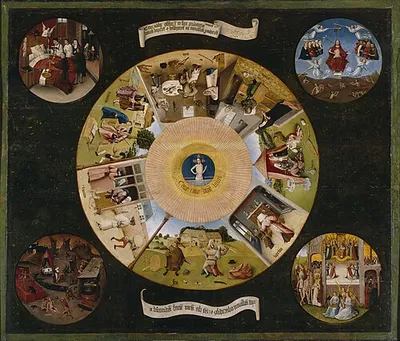
Evagrius Ponticus
Evagrius Ponticus categorized eight destructive thoughts, influencing the Christian concept of the seven deadly sins.
Evagrius Ponticus, a fourth-century monk, played a significant role in the development of the Christian concept of the seven deadly sins. He categorized "evil thoughts" or logismoi into eight distinct forms, drawing from both Greco-Roman and Biblical traditions. His list included gluttony, fornication, greed, sadness/envy, wrath, acedia (apathy/sloth), boasting, and pride.
Evagrius's work was later translated into Latin by his student John Cassian, integrating his ideas into Western Christian thought and devotions. Over time, this list evolved, notably through Pope Gregory I's revision in 590 AD, which condensed the list to the seven sins commonly recognized today: pride, envy, wrath, gluttony, lust, sloth, and greed. These sins have since profoundly influenced religious, philosophical, and artistic expressions throughout history.
Evagrius's Eight Destructive Thoughts
Evagrius Ponticus organized "evil thoughts," or logismoi, into eight categories, which served as a precursor to the later defined seven deadly sins. His classification addressed thoughts arising from physical appetites, emotional states, and mental conditions. The eight forms he identified were gluttony (gastrimargia), fornication (porneia), greed (philargyria), sadness or envy (lypē), wrath (orgē), acedia (apathy, neglect, or dejection), boasting (kenodoxia), and pride (hyperēphania). This detailed breakdown provided a framework for understanding temptations and spiritual challenges within early Christian asceticism.
Influence on Western Christian Tradition
The teachings of Evagrius Ponticus on destructive thoughts were transmitted to Western Christianity through the writings of his disciple, John Cassian. Cassian's translations and elaborations integrated Evagrius's concepts into the spiritual practices and theological discussions of the Roman Catholic Church. This transmission was crucial in shaping the Western understanding of vices and their spiritual implications. While Evagrius's original list contained eight items, subsequent developments, particularly Pope Gregory I's revisions, led to the more commonly known list of seven deadly sins, which retained many of Evagrius's core ideas but were slightly reconfigured and supplemented.
The Evolution of the Seven Deadly Sins
The concept of the seven deadly sins, while rooted in early Christian thought, underwent significant evolution. Evagrius Ponticus's eight categories were influential, but it was Pope Gregory I who, around 590 AD, refined the list into the form that became standard. Gregory merged some of Evagrius's categories, such as combining sadness and acedia, and boasting and pride, while also introducing envy as a distinct vice. This revised list, further defended and elaborated upon by figures like Thomas Aquinas, became a cornerstone of Catholic theology and spiritual guidance, influencing art, literature, and popular culture for centuries.
Key Ideas
- Logismoi: Evagrius Ponticus's term for destructive thoughts or forms of temptation.
- Eight Destructive Thoughts: Evagrius's specific categorization of vices.
- Transmission via John Cassian: How Evagrius's ideas entered Western Christian tradition.
- Evolution to Seven Deadly Sins: The process of refinement and adaptation of the list by later theologians, notably Pope Gregory I.
Books by Evagrius Ponticus
4 free public domain books · Read online or download