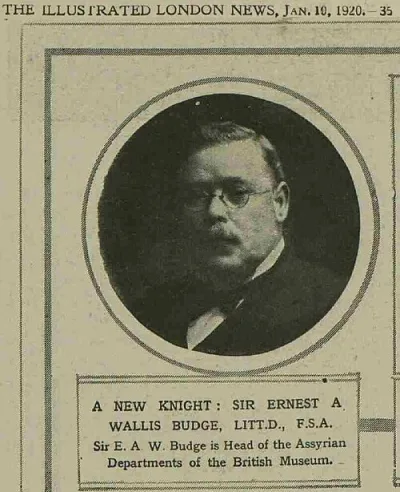
E. A. Wallis Budge
E. A. Wallis Budge was a British Museum Egyptologist known for acquiring antiquities and publishing on ancient Near Eastern cultures, though his work is now considered outdated.
Sir Ernest Alfred Thompson Wallis Budge (1857–1934) was an English scholar specializing in Egyptology and the ancient Near East, who spent most of his career at the British Museum. Born in Cornwall, he developed an early interest in languages and, with the support of influential figures, pursued his studies at Cambridge. He joined the British Museum in 1883, initially in the Assyrian section before moving to Egyptian antiquities. Budge was instrumental in significantly expanding the museum's collection of cuneiform tablets, manuscripts, and papyri through numerous acquisition trips to Egypt and Anglo-Egyptian Sudan.
His role involved not only acquiring artifacts but also publishing scholarly works to make these findings accessible to a wider audience. Budge's acquisitions were substantial, contributing to what is considered one of the world's finest collections of Ancient Near East artifacts. Despite his significant contributions and eventual knighthood in 1920 for his service, his published works, while widely read, have been noted for inaccuracies and are now considered outdated by modern scholarship. He retired from the museum in 1924.
Early Life and Scholarly Beginnings
Born in 1857, E. A. Wallis Budge's early life was marked by humble beginnings in Cornwall. He moved to London as a child and, despite leaving formal schooling at twelve, developed a profound interest in languages. Working as a clerk, he dedicated his spare time to studying languages like Hebrew and Syriac. His encounters at the British Museum sparked an interest in Assyrian, leading him to connect with scholars like Samuel Birch and George Smith. Through their guidance and access to the museum's resources, Budge immersed himself in Assyrian studies. His dedication was noticed by John Stainer, the organist at St. Paul's Cathedral, who, recognizing Budge's potential, enlisted the help of prominent figures like W. H. Smith and William Gladstone to fund his university education. Budge subsequently studied Semitic languages at Cambridge from 1878 to 1883, continuing his independent study of Assyrian.
Career at the British Museum and Antiquities Acquisition
Upon joining the British Museum in 1883, Budge began his career in the Department of Egyptian and Assyrian Antiquities. He soon transferred to the Egyptian section, studying the language under Samuel Birch and later Peter le Page Renouf. Between 1886 and 1891, Budge was tasked with investigating and preventing the illicit sale of cuneiform tablets originating from the museum's excavation sites in Iraq. This involved establishing connections with local dealers to acquire artifacts directly. Budge undertook multiple missions to Mesopotamia and frequent visits to Egypt and Sudan, amassing vast collections of cuneiform tablets, Syriac, Coptic, and Greek manuscripts, and hieroglyphic papyri. His acquisition methods, which sometimes involved bribery and smuggling, have led to him being described as a significant figure in the illegal antiquities trade. He became assistant keeper in 1891 and keeper in 1894, a position he held until 1924.
Publications and Scholarly Legacy
Budge was a highly prolific author, publishing over 100 books on Egyptology and related subjects. His publications aimed to bring the discoveries of the ancient Near East to a broader audience. He is recognized for his hieroglyphic primers and his works on ancient Egyptian religion. Notably, Budge proposed theories about the origins of Egyptian religion, suggesting connections to indigenous African peoples, which were met with skepticism by his contemporaries who favored theories of an invading 'Dynastic Race.' While his books were widely read by the public and scholars like James Frazer, modern Egyptology has found Budge's works to be unreliable and outdated due to advancements in translation and dating accuracy. His writing style, lacking clear distinctions between fact and opinion, is also considered a limitation by contemporary academic standards.
Key Ideas
- Theory of Egyptian religion originating from indigenous African peoples.
Notable Quotes
“What a revolution you have effected in the Oriental Department of the Museum! It is now a veritable history of civilization in a series of object lessons.”
“crowning discovery”
“England may congratulate herself that even in these days of the 'Axe' men can be found willing and magnanimous enough to spend treasure merely with the idea of increasing the sum of human knowledge.”
Books by E. A. Wallis Budge
1 free public domain book · Read online or download