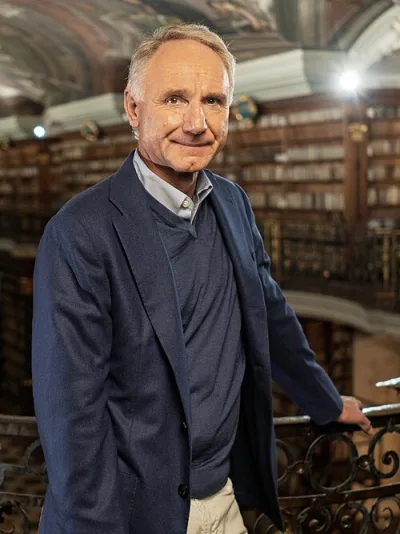
Dan Brown
Dan Brown is an American author known for his thriller novels featuring cryptography, art, and conspiracy theories, often exploring religious and spiritual themes.
Daniel Gerhard Brown, born June 22, 1964, is an American author celebrated for his suspenseful novels that frequently weave together elements of cryptography, art history, and conspiracy theories. His most recognized works are the Robert Langdon series, which includes titles like 'Angels & Demons,' 'The Da Vinci Code,' and 'Inferno.' These novels typically unfold over a 24-hour period, presenting readers with intricate puzzles and treasure hunts.
Brown's books have achieved global success, translated into numerous languages and selling millions of copies. Several of his novels have been adapted into films and television series. While deeply engaging with Christian themes and historical fiction, his works have also sparked controversy. Brown himself has stated that his intentions are not anti-Christian, describing his writing as a means to encourage spiritual discussion and introspection.
Early Life and Spiritual Influences
Born in Exeter, New Hampshire, Dan Brown's upbringing was steeped in academic and musical traditions. His father was a mathematics teacher and textbook author, while his mother was an accomplished church organist with a background in sacred music and a lineage tracing back to Pennsylvania Dutch Schwenkfelders. Raised as an Episcopalian, Brown's childhood experiences with science, particularly astronomy and cosmology, led him to question religious dogma, finding scientific explanations more compelling. This early intellectual curiosity and exposure to puzzles, anagrams, and elaborate treasure hunts devised by his father fostered a lifelong fascination with secrets and codes.
Musical Beginnings and Transition to Writing
Before establishing himself as a novelist, Brown explored a career in music. He released several self-produced albums, including children's music and adult contemporary tracks, and even formed his own record label. He later moved to Hollywood to pursue a career as a singer-songwriter and pianist, teaching to support himself. During this time, he met his wife, Blythe Newlon, who played a significant role in promoting his early projects. A pivotal moment occurred in 1993 when, inspired by Sidney Sheldon's 'The Doomsday Conspiracy,' Brown decided to shift his focus to writing thriller novels, a decision that would ultimately lead to international acclaim.
Themes of Cryptography, Art, and Conspiracy
Dan Brown's novels are characterized by their intricate plots centered around cryptography, art history, and conspiracy theories. His protagonists often navigate complex symbolic puzzles and historical enigmas, frequently within a compressed 24-hour timeframe. Recurring themes include the exploration of secret societies, religious symbolism, and the intersection of science and spirituality. Brown's work often delves into the hidden meanings within famous artworks and architectural landmarks, inviting readers to engage with historical mysteries and speculative theories.
Key Ideas
- The interplay between science, religion, and spirituality.
- The use of cryptography and symbology in uncovering historical secrets.
- Conspiracy theories woven into art history and religious narratives.
- The concept of novels as 'treasure hunts' unfolding over a short period.
Notable Quotes
“I was raised Episcopalian, and I was very religious as a kid. Then, in eighth or ninth grade, I studied astronomy, cosmology, and the origins of the universe. I remember saying to a minister, "I don't get it. I read a book that said there was an explosion known as the Big Bang, but here it says God created heaven and Earth and the animals in seven days. Which is right?"”
“Unfortunately, the response I got was, "Nice boys don't ask that question."”
“A light went off, and I said, "The Bible doesn't make sense. Science makes much more sense to me."”
“The irony is that I've really come full circle. The more science I studied, the more I saw that physics becomes metaphysics and numbers become imaginary numbers. The further you go into science, the mushier the ground gets. You start to say, "Oh, there is an order and a spiritual aspect to science."”
“My books are not anti-Christian. I am on a constant spiritual journey myself.”