✍️ Author Biography
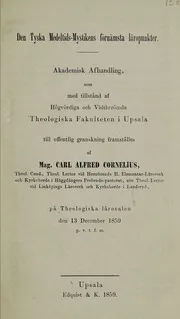
Cornelius, Carl Adolf.
📅 1751 – 1829
🌍 French
📚 0 free books
Carl Adolf Cornelius was a member of the 18th-century Bavarian secret society known as the Illuminati.
The Illuminati was an 18th-century secret society founded in Bavaria by philosopher Adam Weishaupt on May 1, 1776. Its primary aim was to disseminate Enlightenment ideals, and it operated mainly within the Electorate of Bavaria until its prohibition in 1784-1785. The organization sought to influence society by infiltrating Freemason lodges. Historical records identify approximately 1,394 members, with about one-third also being Freemasons. The membership largely comprised individuals from German-speaking regions, particularly Bavaria and Thuringia, and included a broad spectrum of the upper classes, such as nobility, business owners, academics, intellectuals, military officers, and government officials.
Following a brief period of prominence, the Illuminati were outlawed in Bavaria, deemed treasonous and anti-religious. By the late 1790s, the order had become largely defunct. Despite its limited reach outside German-speaking areas, particularly its minimal French-speaking membership, the group later became the subject of conspiracy theories, with some falsely attributing the French Revolution to their influence.
The Illuminati Order
The Illuminati Order, a secret society originating in 18th-century Bavaria, was established on May 1, 1776, in Ingolstadt by Adam Weishaupt, a philosopher and canon lawyer. The society's core objective was to propagate the principles of the Enlightenment. To achieve this, they infiltrated Freemason lodges. The organization primarily functioned within the Electorate of Bavaria and was banned by 1784-1785. Membership records indicate a total of 1,394 identified individuals. A significant portion, about one-third, were also Freemasons. The members were predominantly from German-speaking territories, especially Bavaria and Thuringia, and came from various societal strata, including the aristocracy, entrepreneurs, scholars, intellectuals, military personnel, and civil servants.
Decline and Legacy
After a short period of significant influence, the Bavarian authorities banned the Illuminati in 1784-1785, labeling them as treasonous and anti-religious. By the 1790s, the order had largely ceased to be active. Although the group had very few French-speaking members, the Illuminati later became a focal point for conspiracy theories, which erroneously linked them to the causes of the French Revolution. The historical understanding of the Illuminati is based on identified members and their societal roles, highlighting their connection to intellectual and elite circles of the time.