Clasper, Paul D.
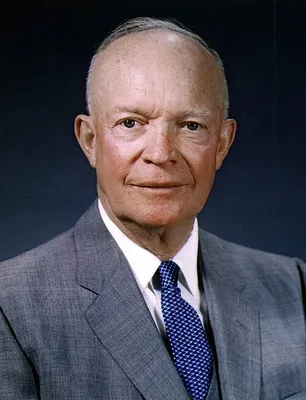
Dwight D. Eisenhower was a five-star general and the 34th U.S. President, leading Allied forces in WWII and shaping Cold War policy.
Dwight David Eisenhower, born David Dwight Eisenhower, served as the 34th President of the United States from 1953 to 1961. Prior to his presidency, he achieved the rank of General of the Army and was the supreme commander of the Allied Expeditionary Force in Europe during World War II, playing a critical role in Allied victories. His military career began after graduating from West Point in 1915, and he held various command and staff positions, including overseeing invasions in North Africa, Sicily, France, and Germany.
Following the war, Eisenhower held several significant posts, including military governor of the American zone in Germany, Army Chief of Staff, president of Columbia University, and the first supreme commander of NATO. He entered politics as a Republican, winning the presidency in 1952 and 1956. His administration focused on containing communism, reducing deficits, and implementing a nuclear deterrence strategy known as the "New Look" policy. He also oversaw the creation of the Interstate Highway System and NASA, and played a role in civil rights advancements. His presidency concluded with a warning about the dangers of the "military–industrial complex."
Early Life and Influences
Born David Dwight Eisenhower in Texas in 1890, his mother later swapped his first two names. The family relocated to Abilene, Kansas, which he considered his hometown. As a child, Eisenhower developed an interest in the outdoors and military history, influenced by his mother's collection of history books, despite her pacifist leanings. His upbringing included regular family Bible readings and disciplined chores. Though his mother was a member of the River Brethren sect of Mennonites and later joined the International Bible Students Association, Dwight never joined their religious meetings. He was baptized into the Presbyterian Church in 1953. His mother's opposition to war did not deter his aspiration to attend West Point, a decision he made despite a serious leg injury in high school that nearly led to amputation.
Military Career and Command
Eisenhower graduated from West Point in 1915, where he participated in athletics, including football, though a knee injury limited his participation. After graduation, he was initially denied an assignment in the Philippines and instead trained tank crews during World War I. Between the wars, he served in various staff roles, including in the Philippines, and rose to brigadier general before World War II. His leadership was instrumental in Allied successes, notably commanding the Allied forces during Operation Torch in North Africa and Operation Overlord, the invasion of Normandy. Post-war, he served as military governor of the American-occupied zone of Germany and as the first supreme commander of NATO.
Presidency and Cold War Policies
As the 34th President, Eisenhower prioritized containing communism and reducing national debt. He employed a "New Look" defense policy emphasizing nuclear weapons over conventional forces. His administration's actions included considering nuclear threats to end the Korean War, supporting South Vietnam financially, and facilitating regime changes in Iran and Guatemala. He navigated international crises like the Suez Crisis and the Hungarian Revolution, and initiated the Interstate Highway System and NASA in response to Soviet advancements like Sputnik. Despite economic prosperity during most of his terms, he warned of the dangers of the "military–industrial complex" in his farewell address.
Key Ideas
- New Look policy: Prioritizing nuclear weapons for deterrence while reducing funding for conventional forces.
- Military–industrial complex: Warning about the potential dangers of the symbiotic relationship between the military and defense industry.
Books by Clasper, Paul D.
0 free public domain books · Read online or download