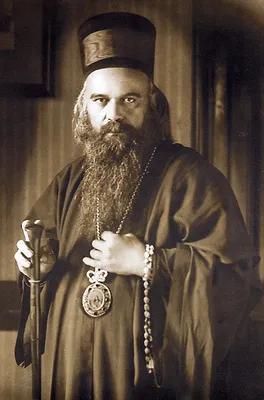
Bishop Nikolai Velimirovich
Nikolai Velimirovich was an influential Serbian Orthodox bishop, theologian, and writer, later canonized as a saint.
Nikolaj Velimirović served as the Bishop of Ohrid and Žiča from 1920 until his death in 1956. He was a prominent theological writer and orator, often called the "new John Chrysostom," and is considered one of the most significant bishops in the history of the Serbian Orthodox Church in the 20th century. His life journey began with a near-death experience that led him to dedicate himself to God, eventually becoming a monk and then a bishop. During World War II, he was imprisoned by the Nazis and sent to Dachau concentration camp. After the war, he lived in the United States until his passing. He was a strong advocate for Orthodox unity and fostered relationships with Anglican and Episcopal churches. In 2003, he was canonized as Saint Nikolaj of Ohrid and Žiča by the Serbian Orthodox Church, though some of his views remain controversial, including accusations of antisemitism and early admiration for Adolf Hitler.
Early Life and Education
Born Nikola Velimirović in 1881 in the Principality of Serbia, he was the eldest of nine children from devout farming parents. A childhood illness nearly claimed his life, leading him to vow a life of religious service. After recovering, he was baptized and educated in religious teachings by his mother. His formal education began at the Ćelije monastery and continued in Valjevo. Despite an initial rejection from the Military Academy due to a physical exam failure, he was admitted to the Seminary of Saint Sava in Belgrade. There, he delved into the works of numerous Eastern and Western thinkers. An exceptional student, he was selected for advanced theological studies in Russia and Western Europe, demonstrating a talent for languages. He earned doctorates in divinity from the University of Berne and philosophy from the University of Geneva, with his doctoral dissertation on "Faith in the Resurrection of Christ" being published in Switzerland and later translated into Serbian.
Monasticism and Ecclesiastical Career
In 1909, Nikola returned to Serbia and, after recovering from a severe bout of dysentery, took monastic vows, receiving the name Nikolaj. He was soon ordained as a hieromonk and elevated to Archimandrite. In 1910, he undertook a mission to Great Britain to secure cooperation for educating Serbian students evacuated during wartime. Following World War I, he was consecrated Bishop of Žiča in 1919, later assuming leadership of the Eparchy of Ohrid and then the Eparchy of Ohrid and Bitola. He undertook several missions to the United States, including organizing the Serbian Orthodox Diocese of North America. His writings and sermons often addressed the suffering of the Serbian clergy and people, particularly during wartime.
World War II Imprisonment and Post-War Life
Upon the German occupation of Yugoslavia in 1941, Bishop Nikolaj was arrested by the Nazis and initially confined to monasteries before being transferred to Dachau concentration camp in September 1944, along with Patriarch Gavrilo V. They were held as "special prisoners." After his release in December 1944, he spent time in Slovenia, where he blessed anti-communist volunteers. Following the war, he relocated to the United States in 1946, remaining there until his death in 1956. He was a proponent of Eastern Orthodox unity and cultivated strong ties with the Anglican and Episcopal Churches.
Legacy and Controversies
Nikolaj Velimirović is highly respected within the Serbian Orthodox Church and among Serbian right-wing political circles. In 2003, he was canonized as Saint Nikolaj of Ohrid and Žiča. Despite his veneration, certain aspects of his work and life remain subjects of controversy. Critics point to instances of antisemitism in his writings, his early expressions of admiration for Adolf Hitler, and his associations with figures like Dimitrije Ljotić, a Nazi collaborator. These elements contribute to ongoing discussions surrounding his complex legacy.
Notable Quotes
“Down with all antinational elements: parasites and bloodsuckers, capitalists, godless, and communists! ... Serbian national consciousness is awakened because it resists attacks from all internationalists and those who build bridges for the Pope in Rome and his Church–the oldest international, the oldest fascism, the oldest dictatorship in Europe!”
Books by Bishop Nikolai Velimirovich
1 free public domain book · Read online or download