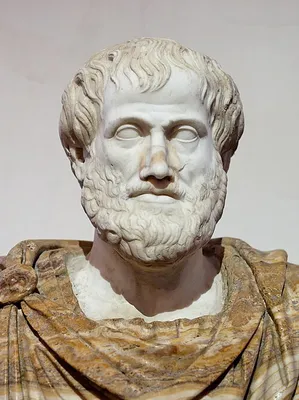
Aristoteles
Aristotle was an ancient Greek philosopher whose vast writings laid foundations for Western science, logic, and philosophy.
Aristotle, an ancient Greek polymath born in Stagira, significantly shaped the course of Western thought. His extensive writings covered diverse fields including natural sciences, philosophy, linguistics, economics, politics, and the arts. He founded the Peripatetic school of philosophy at the Lyceum in Athens, establishing a tradition that influenced scientific development for centuries. Despite his prolific output, only a portion of his original works survives, primarily in treatise form rather than the dialogues he initially intended for publication. His teachings synthesized earlier philosophies and left a profound impact on medieval scholarship across Judeo-Islamic and Christian traditions, earning him titles like "The First Teacher" and "The Philosopher."
Foundations of Western Thought and Science
Aristotle's intellectual legacy is immense, extending from the natural sciences to abstract philosophy. He established the Peripatetic school at the Lyceum in Athens, a center for learning and research that fostered the Aristotelian tradition. This tradition provided a crucial groundwork for the evolution of modern scientific inquiry. His systematic approach to understanding the world and his comprehensive writings addressed subjects that would remain central to intellectual discourse for millennia, influencing everything from biology and physics to ethics and politics.
Logic and Systematic Inquiry
The philosopher is credited with developing the earliest known systematic study of logic, particularly through his work "Prior Analytics." This formalization of logical reasoning became the dominant model in Western thought until the 19th century. His logical works, compiled as the "Organon," provided a framework for argumentation and analysis that was studied and built upon by scholars throughout the Middle Ages and beyond. This rigorous method of inquiry allowed for a more precise examination of philosophical and scientific problems.
Influence on Medieval and Renaissance Scholarship
Aristotle's philosophical and scientific views profoundly shaped medieval intellectual life. His ideas were integrated into Judeo-Islamic philosophies and Christian theology, particularly influencing the Neoplatonism of the early Church and the scholastic tradition. Medieval scholars revered him, with Muslim scholars calling him "The First Teacher" and Christian thinkers like Thomas Aquinas referring to him simply as "The Philosopher." His physical science remained influential until the Enlightenment, and his ethical theories continue to be a subject of renewed interest in contemporary philosophy.
Key Ideas
- Systematic study of logic
- Synthesis of prior philosophies
- Foundations for modern science
- Influence on medieval theology and philosophy
- Virtue ethics
Notable Quotes
“to experience is to learn”
Books by Aristoteles
1 free public domain book · Read online or download