Andrew Louth is an author associated with the town of Louth, England, known for its historical and religious significance.
Andrew Louth is an author whose background is connected to Louth, a market town in Lincolnshire, England. This town has a long history, with evidence of inhabitation dating back to the Paleolithic era. It developed at a crossing point of ancient routes and waterways, situated at the edge of the Lincolnshire Wolds and Marsh.
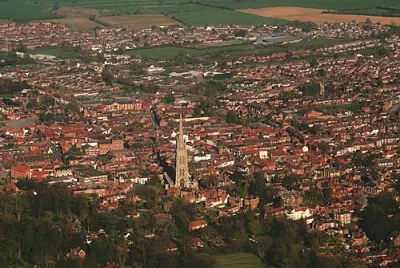
Louth holds considerable historical and religious importance. It features significant landmarks like St. James' Church, which boasts one of the tallest medieval parish church spires in the UK and was the starting point of the Lincolnshire Rising in 1536. The area also has connections to early Christian and pagan veneration sites, including St. Helen's Spring, potentially linked to the water goddess Alauna, and an Anglo-Saxon burial ground. The town's history includes monastic foundations, involvement in the English Civil War, and notable events like the 1920 flood. Its transport links have evolved, with the railway station now closed but the town remaining a hub for bus services.
Historical and Religious Roots
The town of Louth has a deep historical and spiritual legacy. Archaeological findings indicate Paleolithic inhabitation, and a significant Anglo-Saxon pagan burial ground from the fifth to sixth centuries highlights early settlement. The area also features St. Helen's Spring, a site believed to be a Christianized Romano-British location for honoring the pagan water goddess Alauna, indicating a layering of spiritual practices. Louth Park Abbey, founded in 1139, represents a medieval monastic presence, though only earthworks remain today. The town's religious significance is further underscored by St. James' Church, a prominent landmark whose spire is the tallest medieval parish church spire in the United Kingdom. This church was also the site where the Lincolnshire Rising began in 1536, a significant historical event.
St. Herefrith and Spiritual Continuity
Louth is associated with St. Herefrith, a bishop who died around 873 and is considered a 'forgotten saint.' While historical texts present some confusion regarding his exact bishopric (Lincoln or Lindsey) and even mention him as a Bishop of Auxerre, his veneration in Louth is documented. A shrine dedicated to him was established there, and his relics were sought by Æthelwold, Bishop of Winchester. An 11th-century account details how Æthelwold's monks took Herefrith's remains from Louth to Thorney Abbey. A church dedicated to St. Herefrith existed in Louth from the 13th to 15th centuries, and an ivory comb belonging to him was recorded in St. James' Church. While direct evidence linking St. Herefrith's shrine to St. James' Church is lacking, the presence of his relics and the continued celebration of his feast day suggest a possible connection and continuity of sacred sites.
Geographical and Infrastructural Context
Louth is geographically situated at the convergence of the Lincolnshire Wolds and the Lincolnshire Marsh, developing where an ancient trackway, Barton Street, crossed the River Lud. The town is located near Hubbard's Hills, a gorge formed by glacial activity. The River Lud meanders through this gorge before entering the town. Louth's transport infrastructure has evolved significantly. Historically, it was a key station on the East Lincolnshire Railway and the terminus for the Mablethorpe Loop line. Although the railway station closed to passengers in 1970 and freight in 1980, and the line is now removed, there are plans to potentially reintroduce rail services via the Lincolnshire Wolds Railway. The town is currently served by bus routes and National Express coaches, though late-night and Sunday services are limited. The Louth Canal, built to connect the town to the sea, was abandoned in 1924.
Books by
3 free public domain books · Read online or download