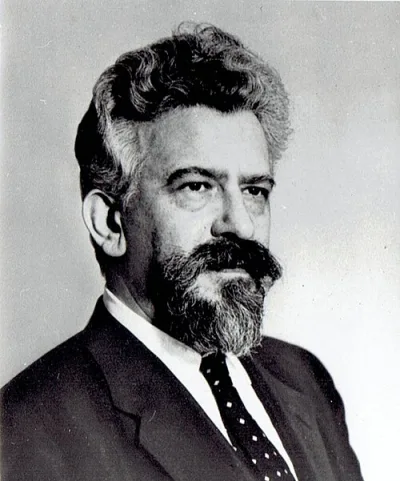
Abraham, Sylvia
Abraham Joshua Heschel was a prominent 20th-century rabbi, theologian, and philosopher known for his insights into Jewish mysticism and his activism.
Abraham Joshua Heschel, born in Warsaw in 1907, was a significant Polish-American rabbi, theologian, and philosopher of the 20th century. He was a professor of Jewish mysticism and authored widely read books on Jewish philosophy. Heschel was also a notable figure in the U.S. civil rights movement. His academic journey included traditional Jewish education followed by doctoral studies at the University of Berlin and rabbinic ordination from the Hochschule für die Wissenschaft des Judentums. He taught Talmud and was involved in Yiddish poetry before facing persecution by the Gestapo and deportation. After escaping Nazi Germany, he made his way to the United States, where he held academic positions at Hebrew Union College and later the Jewish Theological Seminary of America until his death in 1972. His family suffered greatly during the Holocaust, with several siblings and his mother perishing. Heschel married Sylvia Straus, and their daughter Susannah also became a Jewish scholar.
Philosophical and Mystical Contributions
Heschel delved deeply into various aspects of Jewish thought, including medieval Jewish philosophy, Kabbalah, and Hasidic philosophy. He was particularly interested in spirituality and the human religious experience, viewing Kabbalah as an extension of classical rabbinic sources that highlight God's reliance on humanity to fulfill divine plans. This perspective contrasted with scholars who emphasized external influences on Kabbalah. Heschel's approach focused on the mystical dimensions and the continuity of these traditions with earlier Jewish sources. He also promoted a view of Jewish thought emphasizing the interconnectedness of God and humanity, moving away from strict adherence to legalistic interpretations and advocating for a holistic understanding of rabbinic tradition.
Social Activism and Interreligious Dialogue
A central tenet of Heschel's ideology was the belief that the teachings of the Hebrew prophets served as a powerful call for social action. He famously stated, "Some are guilty, but all are responsible," reflecting his commitment to civil rights for African Americans and his opposition to the Vietnam War. His influence extended beyond the Jewish community; as a representative at the Second Vatican Council, he played a crucial role in persuading the Catholic Church to revise liturgical passages that were deemed offensive to Jews. Heschel's theological works posited that religious experience is a universal human impulse, asserting that no single religious community holds a monopoly on truth. This open-mindedness earned him praise from figures like Martin Luther King Jr., who referred to him as "a truly great prophet."
Key Works and Themes
Heschel authored several influential books that explored profound philosophical and theological themes. In "Man Is Not Alone," he examined how individuals can connect with the divine, focusing on the concept of radical amazement in encountering God and the balance between doubt and faith. "The Sabbath: Its Meaning for Modern Man" presented Judaism as a "religion of time," where the Sabbath signifies the sanctification of time against the encroaching pressures of a technologically driven, space-conquering civilization. "God in Search of Man" further explored religious thought, the nature of faith, and humanity's metaphysical longing, suggesting a reciprocal relationship where God also seeks humanity.
Key Ideas
- Radical amazement as a response to the divine
- Judaism as a religion of time, not space
- The concept of "some are guilty, but all are responsible" regarding social issues
- The interconnectedness of God and humanity
- Emphasis on spirituality and mystical experience within Judaism
Notable Quotes
“If I should go to Poland or Germany, every stone, every tree would remind me of contempt, hatred, murder, of children killed, of mothers burned alive, of human beings asphyxiated.”
“Some are guilty, but all are responsible”
“Technical civilization is man's conquest of space. It is a triumph frequently achieved by sacrificing an essential ingredient of existence, namely, time.”
“to enhance our power in the world of space is our main objective”
“we have often suffered from degradation by poverty, now we are threatened with degradation through power.”
Books by Abraham, Sylvia
2 free public domain books · Read online or download