The Sufistic Quatrains of Omar Khayyam

UNIVERSAL CLASSICS
LIBRARY
ILLUSTRATED
WITH PHOTOGRAVURES ON
JAPAN VELLUM, ETCHINGS
HAND PAINTED INDIA-PLATE
REPRODUCTIONS, AND
FULL PAGE PORTRAITS
OF AUTHORS.
M WALTER DUNNE, PUBLISHER
NEW YORK & LONDON
Copyright, 1903,
BY
M. WALTER DUNNE;
PUBLISHER
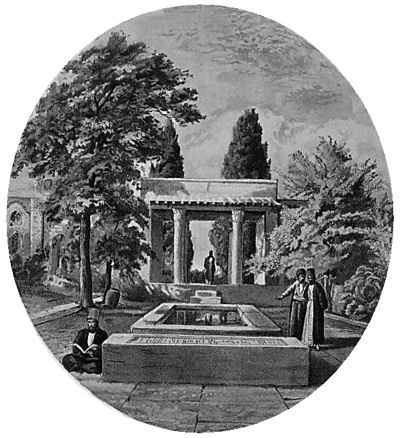 THE TOMB OF OMAR
From an old painting by an unknown artist
THE SUFISTIC QUATRAINS OF
OMAR KHAYYAM
IN DEFINITIVE FORM
INCLUDING THE TRANSLATIONS OF
EDWARD FITZGERALD
(101 quatrains)
With Edward Heron-Allen's Analysis
E.H. WHINFIELD
(500 quatrains)
J.B. NICOLAS
(464 quatrains)
WITH PREFACES BY EACH TRANSLATOR AND A
GENERAL INTRODUCTION DEALING WITH
OMAR'S PLACE IN SUFISM, BY
ROBERT ARNOT, M.A.
Author of "The Vine in Symbolism"
M. WALTER DUNNE, PUBLISHER,
NEW YORK & LONDON
Copyright, 1903,
BY
M. WALTER DUNNE,
PUBLISHER
ILLUSTRATIONS
| FACING PAGE | |
| The Tomb of Omar From an old painting by an unknown artist. | Frontispiece |
| The Approach To Naishapur From a painting by I.R. Herbert. | 100 |
| Sufi Mystics Gathered for Meditation From an old painting by a Pushtu artist. | 210 |
TABLE OF CONTENTS
| PAGE | |
| General Introduction | xi |
| Introduction to the First Edition of Edward Fitzgerald's Translation of the Quatrains of Omar Khayyam | 1 |
| The Complete Fitzgerald First Edition | 13 |
| Kuza-Nama | 25 |
| Notes | 29 |
| An Analysis of Edward Fitzgerald's Translation (Fifth Edition), by Edward Heron-Allen | 35 |
| Preface | 37 |
| Explanation of References | 42 |
| Analysis of Edward Fitzgerald's Quatrains | 44 |
| Appendix | 107 |
| Variations Between the Second, Third and Fourth Editions of Fitzgerald's Translation | 115 |
| Stanzas Which Appear in the Second Edition Only | 122 |
| Comparative Table of Stanzas in the Four Editions Of Fitzgerald | 124 |
| Note | 127 |
| The Quatrains of Omar Khayyam Translated by E.H. Whinfield, M.A. | 129 |
| Introduction | 131 |
| Note | 139 |
| E.H. Whinfield Translation | 141 |
| The Quatrains of Omar Khayyam Translated into Prose from the French Version of Monsieur J.B. Nicolas | 267 |
| Preface | 269 |
| Translation of the Nicolas Text | 279 |
| Footnotes |
GENERAL INTRODUCTION
The earliest reference to Omar Khayyam dates from the middle of the seventh century of the Hijra.[1] Mohammad Shahrazuri, author of a little-used history of learned men, bearing the title of «Nazhet-ul-Arwah,» devotes to Khayyam the following passage:
«'Omar Al-Khayyami was a Nishapuri by birth and extraction. He [may be regarded as] the successor of Abu 'Ali (Avicenna) in the various branches of philosophic learning; but he was a man of reserved character and disliked entertaining (sayyik al-'atan). While he was in Ispahan he perused a certain book seven times and then he knew it by heart. On his return to Nishapur he dictated it [from memory] and on comparing it with the original copy, it was found that the difference between them was but slight. He was averse both to composition and to teaching. He is the author of a handbook on natural science, and of two pamphlets, one entitled ‹Al-Wujud› (or ‹Real Existence›) and the other ‹Al-Kawn w'al Taklif.›[2] He was learned in the law, in classical Arabic, and in history.
«One day Al-Khayyami went to see the Vezir, Abd-ur-Razzak, the Chief of the Koran Readers. Abu-l-Hasan Al-Ghazzali was with this latter [at the time], and the two were discussing the disagreement of the Koran Readers in regard to a certain verse. [As Omar entered] the Vezir said, ‹Here we have the authority,› and proceeded to ask Al-Khayyami [for his opinion] on the matter. ['Omar] enumerated the various readings of the Readers, and explained the grounds ('ilal) for each one.xii He also mentioned the exceptional readings and the arguments in favor of each, and expressed his preference for one view in particular.
«Al-Ghazzali then said: ‹May God add such men as thee to the number of the learned! Of a truth, I did not think any one of the Koran Readers knew the readings by heart to this extent—much less one of the secular philosophers.›
«As for the sciences, he had mastered both mathematics and philosophy. One day ‹the Proof of Islam›, Al-Ghazzali, came to see him and asked him how it came that one could distinguish one of the parts of the sphere which revolve on the axis from the rest, although the sphere was similar in all its parts. Al-Khayyami pronounced his views, beginning with a certain category; but he refrained from entering deeply into the discussion—and such was the wont of this respected Sheykh. [Their conversation was interrupted by] the call to mid-day prayer, whereupon Al-Ghazzali said, ‹Truth has come in, and lying has gone out.› 'Omar arose and went to visit Sultan Sanjar. The latter was [at the time] a mere child, and was suffering from an attack of smallpox. When he came away the Vezir asked him, ‹How did you find the child, and what did you prescribe for him?› 'Omar answered, ‹The child is in a most precarious state.› An Ethiopian slave reported this saying to the Sultan, and when the Sultan recovered he became inimical to 'Omar and did not like him. Melik-Shah treated him as a boon companion; and Shams-ul-Mulk honored him greatly, and made him sit beside him on his throne.
«It is related that ['Omar] was [one day] picking his teeth with a toothpick of gold, and was studying the chapter on metaphysics from [Avicenna's] ‹Book of Healing.› When he reached the section on ‹The One and the Many› he placed the toothpick between the two leaves, arose, performed his prayers and made his last injunctions. He neither ate nor drank anything [that day]; and when he performed the last evening prayer, he bowed himself to the ground and said as he bowed: ‹Oh, God! verily I have known Thee to the extent of myxiii power: forgive me, therefore. Verily my knowledge of Thee is my recommendation to Thee.› And [so saying], he died; may God have pity on him!»
We may look upon Omar as a deeply learned man, following his own convictions, who, tortured with the question of existence, and finding no solution to life in Musulman dogmas, worked out for himself a regular conception of life based on Sufistic Mysticism; a man who, without discarding belief, smiled ironically at the inconsistencies and peculiarities of the Islam of his time, which left many minds dissatisfied in the fourth and fifth centuries, needing as it did vivification. It found this in the person of Ghazzali, who in this movement assigned the proper place to the Mystic element. Omar was a preacher of moral purity and of a contemplative life; one who loved his God and struggled to master the eternal, the good, and the beautiful.
In this manner also is Omar portrayed in the various early biographical notices: a defender of «Greek Science,» famous for his knowledge of the Koran and the Law, and at the same time a «stinging serpent» to the dogmatic; a wit and a mocker, a bitter and implacable enemy of all hypocrisy; a man who, while curing others of the wounds of worldly triviality, impurity, and sinful vanity, himself only with almost his last breath closed the philosophic book on «Healing» and turned with a touching prayer to the One God, the Infinite, whom he had been striving to comprehend with all the strength of his mind and heart. Khayyam's lively protests and his heated words in freedom's cause brought upon him many bitter moments in his life and exposed him to numerous attacks at the hands of the mullahs, especially those of the Shiite community.
Besides these, then as now (apart from hypocrites), persons were not wanting who, failing to understand Omar, regarded him as an unbeliever, atheist, and materialist. But in the course of centuries the people of Persia and India, realizing, perhaps instinctively, the injustice of former reproaches, have taken to publishing and reading Omar Khayyam in collections side by side with Abu-Said,xiv Abd-Allah Ansari, and Attar—that is to say, with Sufi Mystics of the purest water, men whose moral and religious reputations were spotless.
Rightly to understand Omar some knowledge of Sufism and its tenets is necessary. Sufism is a mystical doctrine which had its birth on the Arabian coast, and succeeded in implanting itself there to the point of putting a decisive check upon the orthodox philosophy. The etymology of the name is difficult to find. According to some, it comes from the word suf (wool, a woolen garment) because the first persons to adopt this doctrine clothed themselves in wool.
We can give, as a proof, in support of this etymology, the fact that the Persians call their dervishes Sufis, pechmineh pôch (clothed in wool). The name could also come from the Arabic safou (purity) or the Greek σοφία (wisdom). Again, some Arabic authors call by the name of Soufa an Arabic tribe that separated themselves from the world in the ante-Islamic period, consecrating themselves to the keeping of the temple of Mecca. A man who professed the Mystic principles of tasawouf (the spiritual life) they called a «Sufi.»
The origin of Musulman Mysticism is a question entailing some controversy, for whoever knows the detailed ritual and the dogmatic coldness of the Koran finds it impossible to reconcile Islamic dogma with any idea of Mysticism whatsoever. In vain does one seek to find an example of Mystical teaching in this aphorism attributed to Mahomet: «It is when he prays that the faithful one is nearest God,» as Islamism holds to a definite separation between the Divinity and the world, between the Creator and the thing created. The religious customs that Mahomet instituted and the moral action that he taught served only to merit the good-will of the Divinity; at the utmost he only believed that he would be permitted to see Him face to face.
Whence comes then this Mystical idea which, for so many centuries, has occupied all the minds and absorbed all the intellectual force of the Musulman world? Two different origins can be given for it: the idea of emanationxv from and return to the divine essence whence it came—what we call Neo-platonism. Added to this are Contemplation and Annihilation, which come to it through Persia and the Vedantic school as intermediaries, bringing with it Pantheism, which made its way late into Sufism, and almost solely among the Persians. Also, it could be said that originally Sufism owed its principles to the Alexandrian school.
The Arabs, who studied and translated the greater part of Aristotle, knew Plato only by name; but they came under his influence and received his doctrines, strongly impregnated with the Mysticism of the Kabbala, through the Alexandrians and especially through Philon. To annihilate reason, or at least to subordinate it to feeling; to attack liberty, in order to subject the whole of life to love; and, furthermore, the blind abandoning of self—such is the aim of Sufism, as it is of all Mystic philosophy.
The doctrine of the Sufis has been set forth in a great number of treatises, notably that of Sohrawdi. God alone exists; He is in everything and everything is in Him. All beings emanate from Him, without being really distinct from Him. The world exists for all eternity; the material is only an illusion of the senses. Sufism is the true philosophy of Islamism, «which is the best of religions,» but religions have only a relative importance and serve but to guide us toward the Reality.
God is the author of the acts of the human race; it is He who controls the will of man, which is not free in its action. Like all animals man possesses an original mind, an animal or living mind, a mind instinctive, but he has also a human mind, breathed into him by God, and of the same character as the original and constructive element itself. The concomitant mind comprehends the original element and the human mind; it extends itself over the triple domain: animal, vegetable, and mineral. The soul, which existed before the body, is confined in the body as in a cage; death, then is, the object of the Sufi's desires, since it returns him to the bosom of the Divinity. This metempsychosis permits the soul which has not fulfilledxvi its destiny here below to be purified and worthy of a re-union with God. This spiritual union all can strive for ardently, but all cannot attain, because it is a product of the grace of God.
The Sufi, during his sojourn in the body, is uniquely occupied in meditating upon his unity with God (Wahdanija), the reminiscence of the names of God (Zikr), and the progressive advancement in the tarika or journey of life, up to his unification with God.
What is the Sufi journey, then? Human life has been likened to a voyage, where the traveler is seeking after God. The aim of the voyage is to attain to a knowledge of God, for human existence is a period of banishment for the soul, which cannot return to God until it has passed through many successive stages. The natural state of man is called nasout (humanity); the disciple should observe the law and conform to all the rites of believers. The other stages are: the nature of the angels (malakout), where one follows the way to purity, the possession of power (djabrout), the degree to which knowledge corresponds (m'arifa), and finally, extinction or absorption in the Deity, the degree to which truth corresponds. The voyager agrees to renouncement, which is of two kinds: external and internal. The first is the renouncement of riches and worldly honors; the second is the renouncement of profane desires. And he should especially guard against idolatry, which for some is the adoration of worldly achievement, for others a too assiduous practice of praying and fasting.
To arrive at this aim, the voyager has three necessary aids: attraction (indïïdhah), the act of God which draws all men who have that tendency or inclination to Him; devotion (ibâda), continuing the journey by two roads—towards God and in God, the first limited, the second without limit; finally, elevation (ouroudi). But the voyage cannot be accomplished alone; it is necessary to have a guide or a monitor taken from the second class (ibâda). The believer who, after having been tâlib (an educated man doubting the reality of God) and mourid (desirous of following out his quest), becomes axvii salik (traveler), places himself under the authority of a Sufi guide who teaches him to serve God until, through divine influence, he attains to the ichk (love) stage. Divine love, removing all mundane desires from his heart, causes him to arrive at zouhd (isolation); he then leads a contemplative life, passes through the m'arifa degree, and awaits the direct illumination of wadja (ecstasy).
After having received a revelation of the true nature of God (the hakika stage) he arrives at the wasl stage (union with God); he cannot go further; death alone remains, by which he will arrive at the final degree, absorption in the Divinity. The Zikr are only various forms of devotion invented by the Sufi guides to develop the spiritual life. The conduct of the disciple in the presence of his master is determined by rules which differ little from those imposed upon all dervishes.
Some authors distinguish, in the Sufi voyage, seven stages, corresponding to the degrees in the celestial sphere, in order to have the soul received there after death. But, protest metaphysicians, the soul cannot return to a determined place, since it does not come from a determined place. Celestial intelligence, to which corresponds the degree of intelligence reached by man, will absorb the soul after its separation from the body.
The Sufis attribute a high antiquity to their doctrines. They do not hesitate to refer them to as far back as Abraham; they pretend that one of the founders of their sect was own son-in-law to the prophet Ali, son of Abou-Tâlib. Finally, «there came a pious woman from Jerusalem, by the name of Rabia, whose words recall the Christian Mysticism.»
The first person to take the name of Sufi was Abou-Hachim of Koufa. The first convent or Khanakah was founded in Khorasan by Abou-Said, the Persian, although the prophet had prohibited monkish life in Islam. Another convent was established at Ramia, in Syria, and Saladin founded one in Egypt. Sufism then was divided into two schools: The Persian Bestâmi (a.d. 875) inclined towards Pantheism; Djonaid, of Bagdad, preached a system reconcilable with Musulman dogmatism. One of the mostxviii celebrated doctors of this school was Halladj, burnt alive in a.d. 922. They discoursed upon Sufism under the Kalifs Al-Motazz and Al-Mohtadi, and preached it under Al-Motamid. The principal Sufi writers are: Mohammed Salami an Nichabouri (a.d. 1021), El-Kochairi (a.d. 1072), Ghazli (a.d. 1111), Sohrawdi (a.d. 1234), Ferid-ed-din Attar (a.d. 1230), Djami (a.d. 1492), and Ech-Cha'rani (a.d. 1565).
This Mysticism, so sweet and so full of sentiment, exhales itself in poesy, and is as much stamped with tenderness and resignation as it is overflowing with sensuality and drunkenness. The best and most illustrious of the Persian poets are of this sect: Djelal-ed-din er-Roumi, author of the «Mesnewi», Djami, author of «Salaman ou-Absa», Ferid-ed-din Attar, author of «Mantik-ut-tair»; S'adi, Hafiz de Chiraz, Bayazid-al-Bestami.
Just as Sufis leave the true faith for its semblance, so they also exchange the external features of all things for the internal (the corporeal for the spiritual) and give a spiritual significance to outward forms. They behold objects of a precious nature in their natural character, and for this reason, the greater part of their words have a spiritual and visionary meaning.
For instance, when, like Omar, they mention wine, they mean a knowledge of God, which, extensively considered, is the love of God. Wine, viewed extensively, is also love: love and affection are here the same thing. The wine-shop with them means the murshid i kiamil (spiritual director), for his heart is said to be the depository of the love of God; the wine-cup is the telkin (the pronunciation of the name of God in a declaration of faith as: There is no God but Allah), or it signifies the words which flow from the murshid's mouth respecting divine knowledge, and which, heard by the salik (the Dervish, or one who pursues the true path), intoxicates his soul, and divests his mind (of passions) giving him pure, spiritual delight.
The sweetheart or Beloved means the preceptor, because, when any one sees his beloved he admires her proportions, with a heart full of love. The Dervish beholdsxix the secret knowledge of God which fills the heart of his spiritual preceptor (murshid), and through it receives a similar inspiration, and acquires a full perception of all that he possesses, just as the pupil learns from his master. As the lover delights in the presence of his sweetheart, so the Dervish rejoices in the company of his beloved preceptor. The sweetheart is the object of a worldly affection; but the preceptor commands a spiritual attachment.
The curls or ringlets of the beloved are the grateful praises of the preceptor, tending to bind the affections of the Dervish-pupil; the moles on her face signify that when the pupil, at times, beholds the total absence of all worldly wants on the part of the preceptor, he also abandons all the desires of both worlds—he, perhaps, even goes so far as to desire nothing else in life than his preceptor; the furrows on the brow of the beloved one, which they compare to verses of the Koran, mean the light of the heart of the murshid: they are compared to the verses of the Koran, because the attributes of God, in accordance with the injunction of the Prophet: «Be ye endued with divine qualities,» are possessed by the sheikh (or murshid).
Perhaps I can do no better than to quote one of the foremost authorities on Sufism[3] in regard to Omar's teachings.
«Seldom has a poet suffered from his friends and his foes as has Omar Khayyam. ‹He has been regarded,› says a writer, ‹as a free-thinker, a subverter of faith; an atheist and materialist; a pantheist and a scoffer at Mysticism; an orthodox Musulman; a true philosopher, a keen observer, a man of learning; a bon vivant, a profligate, a dissembler and a hypocrite, and a blasphemer—nay, more, an incarnate negation of positive religion and of all moral beliefs; a gentle nature, more given to the contemplation of things divine than worldly enjoyments; an epicurean sceptic; the Persian Abu-l-Ala, Voltaire, and Heine in one.› The writer has in view the well-known criticisms of Von Hammer, Renan, Ellis, Nicolas, Garcinxx de Tassy, Whinfield, Aug. Muller, etc. He might have added Vedder's curious misunderstanding of the ‹Beloved,› making him a damsel and a playtoy, and the thousand and one small ideas set forth by Omarian Societies.
«All this criticism is curious because it is so completely out of harmony with the facts of Omar's life. It is true that no complete, authentic manuscript of Omar's is known, and equally true that no comprehensive biography is known; but detailed information has come down to us from his contemporaries. From these notes enough can be gathered to show that Omar was a great man indeed, one who clearly and forcibly shows the four sides of a perfect character.
«A perfect character is first and fundamentally powerful. It is based upon the One, be it in idea or in action. Next, it is so simple and direct that all extraneous thoughts and purposes are unknown to it. These two sides condition one another. No power without simplicity and no directness without power. The third side of a great character is love or human feeling; a fullness that seeks to draw all men to the One, and the fourth and last characteristic is harmony or a welding together into One of all these four. The last characteristic is, of course, an impossibility where the others do not exist; nor can the others attain any vividness or fullness without love.
«A perfect character is rare. We see, however, glimpses of it here and there. Omar Khayyam was a type of perfect character. He is full of the One; he knows of nothing but the One; he burns to draw his fellow-men to the One; he belongs nowhere but in the One, in whom he indeed can be said to move, live, and have his being. In the One he attained Wholeness, harmony. Omar's philosophy is that of the Sufis. In that, too, he is consistent. The one is Truth; Truth is the reality of things, Truth burns to draw men to Itself; Truth is the Law or ‹Universe.› His method is Symbolism, viz.: he chooses the transparencies of Nature in order to show his hearers how Truth or Wisdom and Love or Devotion everywhere appear to be the reality behind ‹the magic Shadow-shapesxxi that come and go.› His most prominent symbols are Wine and Love; Roses, Springtime, and Death.
«Omar's ethics are not those of Mohammedanism. He advocates Resignation, to be sure, but not Mohammedan fatalism as popularly understood. His morals spring from his conception of the fullness of the One, and as such they are in harmony with the most universal notions of mankind. In one word, Omar's theology, philosophy, method, and morals are Sufistic, Sufism taken in the highest sense as the unifying notion for Wholeness, Love, Truth, and Power. A study of Sufism will reveal the real Omar—hitherto but little known, if known at all.
* * * * * * *
«No one has attempted, so far as I know, to classify the various Sufistic systems. It is not so difficult to do so when a key can be found to them. The best key is that four-foldness which manifests itself in all human character, endeavor, and work. Corresponding to the four-foldness of character delineated above, I shall now take the terms Life, Love, Light, and Law and say that Al-Ghazzali and Jelaladdin represent the first and, as a proof, point to their constant emphasis of will as being the dominant power of existence, and the prominence they give to moral worth. The type of Love, in the form of poetry and feeling, is represented by Hafiz and Jami. The third group is fully and completely filled by Shabistani, the author of ‹Gulshan-i-Raz.› It is Light, and its form is Philosophy, Truth, and Understanding. The last, the fourth, sums up in a measure, the three preceding, and is also a clearly defined group by itself. It is Law, Order, Unity, and Reality. There is more independence in it than in any of the others, because it is the nearest approach known in existence to Wholeness or Unity. It contains the opposites of existence, both cosmic and human, viz.: the protest of the Mystic and also his affirmation, and the new Hope he represents.
«Omar Khayyam belongs to this fourth group. I do not say he alone fills it. But he exhibits that Independence and Protest which is the first and outward characteristicxxii of it. He is also from time to time soaring into the realms of the Truth or Unity, in a way not found in any other Sufi poet or doctor.
«Under the garb of the Mystic's favorite method of Doubt and Protest, the Sufi (Omar) pictures the process of the Awakening of the Soul. That is the purpose of the ‹Magic Shadow-shapes that come and go› in the Rubaiyat of Omar Khayyam. His pictures are sufficiently transparent for us to see The Reality Behind.
«While so much is claimed for Omar, it must not be forgotten that it has not been said that he is the only perfect Sufi. It is not our intention to say or to intimate that. Omar is great enough when we attribute to him the office of an Awakener; not merely that of a John the Baptist, but the office of one who is himself full of the Awakening he preaches. Such an one is a unique character, and is truly an At-oner, one who heals all wounds and binds up broken limbs.»
I have already stated, if not in actual words, at least by inference, that Khayyam's philosophical and religious opinions were in certain essential points based upon the teaching of the Vedantas. He must have been familiar with the general scope of their philosophy, although attaching himself, as we have seen, to the ranks of the Sufi Mystics. Sufism and Babism are probably the most widely spread doctrines current in modern Persia, and after all are but forms of Vedantic pantheism despoiled of real significance by the effort to accommodate themselves to the creed of Islam. We learn from El Kifti that Khayyam «exhorted to the seeking of the One, the Ruler, by the purification of bodily movements, for the cleansing of the human soul,» an unmistakable exposition of Sufi practices, although based originally upon the customs of the Vedantic sages.
He certainly did not practice asceticism and other quasi-religious forms, which had been grafted upon the austere simplicity of the original Vedantic creed, but he did inculcate the necessity of acquiring «the knowledge of the unity of the soul with God»—the one thing important—whichxxiii can only be achieved by the renouncement of desire, the purification of the soul from the lusts of the world, and the practice of kindliness, goodness, universal sympathy with mankind, and the patience which brings perfect work.
That Omar was a man of many moods is evident. His poetic faculties, acted upon by an intelligence that was profound, and by a wit as cutting as the tulwar of a Persian soldier, swayed him hither and thither upon the sea of daily doubts and fears which are part of man's existence. Yet, in his way, he was a beacon light, not only in the history of Sufi Mysticism, but in the annals of God-seeking. I can find no better yoke-fellow for him than Luther, like whom he was indeed an Apostle of Protest.
THE FIRST EDITION OF
EDWARD FITZGERALD'S TRANSLATION
OF THE
QUATRAINS OF OMAR KHAYYAM
OMAR KHAYYAM
THE
ASTRONOMER-POET OF PERSIA
Omar Khayyam was born at Naishapur in Khorassan in the latter half of our eleventh, and died within the first quarter of our twelfth Century. The slender story of his life is curiously twined about that of two other very considerable figures in their time and country: one of whom tells the story of all three. This was Nizam ul Mulk, Vizyr to Alp Arslan the son, and Malik Shah the grandson, of Toghrul Beg the Tartar, who had wrested Persia from the feeble successor of Mahmud the Great, and founded that Seljukian Dynasty which finally roused Europe into the Crusades. This Nizam ul Mulk, in his «Wasiyat»—or «Testament»—which he wrote and left as a memorial for future statesmen—relates the following, as quoted in the «Calcutta Review,» No. lix., from Mirkhond's «History of the Assassins.»
«‹One of the greatest of the wise men of Khorassan was the Imam Mowaffak of Naishapur, a man highly honoured and reverenced—may God rejoice his soul; his illustrious years exceeded eighty-five, and it was the universal belief that every boy who read the Koran or studied the traditions in his presence, would assuredly attain to honour and happiness. For this cause did my father send me from Tus to Naishapur with Abd-us-samad, the doctor of law, that I might employ myself in study and learning under the guidance of that illustrious teacher. Towards me he ever turned an eye of favour and kindness, and as his pupil I felt for him extreme affection2 and devotion, so that I passed four years in his service. When I first came there, I found two other pupils of mine own age newly arrived, Hakim Omar Khayyam, and the ill-fated Ben Sabbah. Both were endowed with sharpness of wit and the highest natural powers; and we three formed a close friendship together. When the Imam rose from his lectures, they used to join me, and we repeated to each other the lessons we had heard. Now Omar was a native of Naishapur, while Hasan Ben Sabbah's father was one Ali, a man of austere life and practice, but heretical in his creed and doctrine. One day Hasan said to me and to Khayyam, «It is a universal belief that the pupils of the Imam Mowaffak will attain to fortune. Now, even if we all do not attain thereto, without doubt one of us will, what then shall be our mutual pledge and bond?» We answered, «Be it what you please.»—«Well,» he said, «let us make a vow, that to whomsoever this fortune falls, he shall share it equally with the rest, and reserve no pre-eminence for himself.»—«Be it so,» we both replied, and on those terms we mutually pledged our words. Years rolled on, and I went from Khorassan to Transoxiana, and wandered to Ghazni and Cabul; and when I returned, I was invested with office, and rose to be administrator of affairs during the Sultanate of Sultan Alp Arslan.›
«He goes on to state, that years passed by, and both his old school-friends found him out, and came and claimed a share in his good fortune, according to the school-day vow. The Vizier was generous and kept his word. Hasan demanded a place in the government, which the Sultan granted at the Vizier's request; but, discontented with a gradual rise, he plunged into the maze of intrigue of an Oriental court, and, failing in a base attempt to supplant his benefactor, he was disgraced and fell. After many mishaps and wanderings, Hasan became the head of the Persian sect of the Ismailians—a party of fanatics who had long murmured in obscurity, but rose to an evil eminence under the guidance of his strong and evil will. In a.d. 1090, he seized the castle of Alamut, in the province of Rudbar,3 which lies in the mountainous tract south of the Caspian Sea; and it was from this mountain home he obtained that evil celebrity among the Crusaders as the OLD MAN OF THE MOUNTAINS, and spread terror through the Mohammedan world; and it is yet disputed whether the word Assassin, which they have left in the language of modern Europe as their dark memorial, is derived from the hashish, or opiate of hemp-leaves (the Indian bhang), with which they maddened themselves to the sullen pitch of Oriental desperation, or from the name of the founder of the dynasty, whom we have seen in his quiet collegiate days, at Naishapur. One of the countless victims of the Assassin's dagger was Nizam ul Mulk himself, the old school-boy friend.[4]
«Omar Khayyam also came to the Vizier to claim his share; but not to ask for title or office. ‹The greatest boon you can confer on me,› he said, ‹is to let me live in a corner under the shadow of your fortune, to spread wide, the advantages of Science, and pray for your long life and prosperity.› The Vizier tells us, that, when he found Omar was really sincere in his refusal, he pressed him no further, but granted him a yearly pension of 1200 mithkals of gold, from the treasury of Naishapur.»
«At Naishapur thus lived and died Omar Khayyam, ‹busied,› adds the Vizier, ‹in winning knowledge of every kind, and especially in Astronomy, wherein he attained to a very high pre-eminence. Under the Sultanate of Malik Shah he came to Merv, and obtained great praise for his proficiency in science, and the Sultan showered favours upon him.›
«When Malik Shah determined to reform the calendar, Omar was one of the eight learned men employed to do it; the result was the Jalali era (so called from Jalal-ud-din one of the king's names)—‹a computation of time,›4 says Gibbon, ‹which surpasses the Julian, and approaches the accuracy of the Gregorian style.› He is also the author of some astronomical tables, entitled ‹Ziji-Malik-skahi,›» and the French have lately republished and translated an Arabic treatise of his on algebra.
«His Takhallus or poetical name (Khayyam) signifies a Tentmaker, and he is said to have at one time exercised that trade, perhaps before Nizam ul Mulk's generosity raised him to independence. Many Persian poets similarly derive their names from their occupations; thus we have Attar, ‹a druggist,› Assar, ‹an oil presser,› etc.[5] Omar himself alludes to his name in the following whimsical lines:—
Has fallen in grief's furnace and been suddenly burned;
The shears of Fate have cut the tent ropes of his life,
And the broker of Hope has sold him for nothing!›
«We have only one more anecdote to give of his life, and that relates to the close; it is told in the anonymous preface which is sometimes prefixed to his poems; it has been printed in the Persian in the appendix to Hyde's ‹Veterum Persarum Religio,› p. 499; and D'Herbelot alludes to it in his Bibliothèque, under Khiam:[6]—
«‹It is written in the chronicles of the ancients that this King of the Wise, Omar Khayyam, died at Naishapur in the year of the Hegira 517 (a.d. 1123); in science he was unrivalled,—the very paragon of his age. Khwajah Nizami of Samarcand, who was one of his pupils, relates the following story: «I often used to hold conversations with my teacher Omar Khayyam, in a garden; and one day he said to me, ‹My tomb shall be in a spot where the north wind may scatter roses over it.› I wondered at the words he spake, but I knew that his were no idle5 words.[7] Years after, when I chanced to revisit Naishapur, I went to his final resting-place, and lo! it was just outside a garden, and trees laden with fruit stretched their boughs over the garden wall, and dropped their flowers upon his tomb, so that the stone was hidden under them.»›»
Thus far—without fear of trespass—from the «Calcutta Review.» The writer of it, on reading in India this story of Omar's grave, was reminded, he says, of Cicero's account of finding Archimedes' tomb at Syracuse, buried in grass and weeds. I think Thorwaldsen desired to have roses grow over him; a wish religiously fulfilled for him to the present day, I believe. However, to return to Omar.
Though the Sultan «shower'd favours upon him,» Omar's Epicurean audacity of thought and speech caused him to be regarded askance in his own time and country. He is said to have been especially hated and dreaded by the Sufis, whose practice he ridiculed, and whose faith amounts to little more than his own, when stript of the Mysticism and formal recognition of Islamism under which Omar would not hide. Their poets, including Hafiz, who are (with the exception of Firdausi) the most considerable in Persia, borrowed largely, indeed, of Omar's material, but turning it to a mystical use more convenient to themselves and the people they addressed;6 a people quite as quick of doubt as of belief; as keen of bodily sense as of intellectual; and delighting in a cloudy composition of both, in which they could float luxuriously between heaven and earth, and this world and the next, on the wings of a poetical expression, that might serve indifferently for either Omar was too honest of heart as well as of head for this. Having failed (however mistakenly) of finding any Providence but destiny, and any world but this, he set about making the most of it; preferring rather to soothe the soul through the senses into acquiescence with things as he saw them, than to perplex it with vain disquietude after what they might be. It has been seen, however, that his worldly ambition was not exorbitant; and he very likely takes a humorous or perverse pleasure in exalting the gratification of sense above that of the intellect, in which he must have taken great delight, although it failed to answer the questions in which he, in common with all men, was most vitally interested.
For whatever reason, however, Omar, as before said, has never been popular in his own country, and therefore has been but scantily transmitted abroad. The MSS. of his Poems, mutilated beyond the average casualties of Oriental transcription, are so rare in the East as scarce to have reached westward at all, in spite of all the acquisitions of arms and science. There is no copy at the India House, none at the Bibliothèque Nationale of Paris. We know but of one in England: No. 140 of the Ouseley MSS. at the Bodleian, written at Shiraz, a.d. 1460. This contains but 158 Rubaiyat. One in the Asiatic Society's Library at Calcutta (of which we have a copy) contains (and yet incomplete) 516, though swelled to that by all kinds of repetition and corruption. So Von Hammer speaks of his copy as containing about 200, while Dr. Sprenger catalogues the Lucknow MS. at double that number.[8] The scribes, too, of the Oxford7 and Calcutta MSS. seem to do their work under a sort of protest; each beginning with a tetrastich (whether genuine or not), taken out of its alphabetical order; the Oxford with one of apology; the Calcutta with one of expostulation, supposed (says a notice prefixed to the MS.) to have arisen from a dream, in which Omar's mother asked about his future fate. It may be rendered thus—
In Hell, whose fires thyself shall feed in turn;
How long be crying, ‹Mercy on them, God!›
Why, who art Thou to teach, and He to learn?»
The Bodleian quatrain pleads Pantheism by way of Justification.
Have loosely strung the Jewel of Good Deed,
Let this one thing for my Atonement plead:
That One for Two I never did mis-read.»
The reviewer,[9] to whom I owe the particulars of Omar's life, concludes his review by comparing him with Lucretius, both as to natural temper and genius, and as acted upon by the circumstances in which he lived. Both indeed were men of subtle, strong, and cultivated intellect, fine imagination, and hearts passionate for truth and justice; who justly revolted from their country's false religion, and false, or foolish, devotion to it, but who fell short of replacing what they subverted by such better hope as others, with no better revelation to guide them, had yet made a law to themselves. Lucretius, indeed, with such material as Epicurus furnished, satisfied himself with the theory of a vast machine fortuitously constructed, and acting by a law that implied no legislator; and so composing himself into a Stoical rather than Epicurean severity of attitude, sat down to contemplate the mechanical drama of the Universe which he was part actor in; himself and all about him (as in his own sublime description of the Roman Theatre) discolored with the lurid8 reflex of the curtain suspended between the spectator and the sun. Omar, more desperate, or more careless of any so complicated system as resulted in nothing but hopeless necessity, flung his own genius and learning with a bitter or humorous jest into the general ruin which their insufficient glimpses only served to reveal; and, pretending sensual pleasure as the serious purpose of life, only diverted himself with speculative problems of Deity, Destiny, Matter and Spirit, Good and Evil, and other such questions, easier to start than to run down, and the pursuit of which becomes a very weary sport at last!
With regard to the present translation. The original Rubaiyat (as, missing an Arabic guttural, these Tetrastichs are more musically called) are independent stanzas, consisting each of four lines of equal, though varied, prosody; sometimes all rhyming, but oftener (as here imitated) the third line a blank. Somewhat as in the Greek alcaic, where the penultimate line seems to lift and suspend the wave that falls over in the last. As usual with such kind of Oriental verse, the Rubaiyat follow one another according to alphabetic rhyme—a strange succession of grave and gay. Those here selected are strung into something of an eclogue, with perhaps a less than equal proportion of the «Drink and make-merry» which (genuine or not) recurs over-frequently in the original. Either way the result is sad enough: saddest perhaps when most ostentatiously merry: more apt to move sorrow than anger toward the old Tentmaker, who, after vainly endeavouring to unshackle his steps from destiny, and to catch some authentic glimpse of To-morrow, fell back upon To-day (which has outlasted so many To-morrows!) as the only ground he had got to stand upon, however momentarily slipping from under his feet.
While the second Edition of this version of Omar was preparing, M. Nicolas, French Consul at Resht, published a very careful and very good edition of the text, from a lithograph copy at Teheran, comprising 464 Rubaiyat, with translation and notes of his own.
M. Nicolas, whose edition has reminded me of several things, and instructed me in others, does not consider Omar to be the material Epicurean that I have literally taken him for, but a Mystic, shadowing the Deity under the figure of wine, wine-bearer, etc., as Hafiz is supposed to do; in short, a Sufi Poet like Hafiz and the rest.
I cannot see reason to alter my opinion, formed as it was more than a dozen years ago[10] when Omar was first shown me by one to whom I am indebted for all I know of Oriental, and very much of other, literature. He admired Omar's genius so much, that he would gladly have adopted any such interpretation of his meaning as M. Nicolas' if he could.[11] That he could not, appears by his paper in the «Calcutta Review» already so largely quoted; in which he argues from the Poems themselves, as well as from what records remain of the Poet's Life.
And if more were needed to disprove M. Nicolas' theory, there is the Biographical Notice which he himself has drawn up in direct contradiction to the interpretation of the Poems given in his notes. Indeed I hardly knew poor Omar was so far gone till his apologist informed me. For here we see that, whatever were the wine that Hafiz drank and sang, the veritable juice of the grape it was which Omar used, not only when carousing with his friends, but (says M. Nicolas) in order to excite himself to that pitch of devotion which others reached by cries and «hurlemens.» And yet, whenever wine, wine-bearer, etc., occur in the text—which is often enough—M. Nicolas carefully annotates «Dieu,» «La Divinité,» etc.: so carefully indeed that one is tempted to think that he was indoctrinated by the Sufi with whom he read the Poems. A Persian would naturally wish to vindicate a distinguished countryman: and a Sufi to enrol him in his own sect, which already comprises all the chief poets in Persia.
What historical authority has M. Nicolas to show that Omar gave himself up «avec passion à l'étude de la philosophie des Soufis»? The doctrines of Pantheism, Materialism, Necessity, etc., were not peculiar to the Sufi; nor to Lucretius before them; nor to Epicurus before him; probably the very original irreligion of thinking men from the first; and very likely to be the spontaneous growth of a philosopher living in an age of social and political barbarism, under shadow of one of the Two-and-Seventy Religions supposed to divide the world. Von Hammer (according to Sprenger's «Oriental Catalogue») speaks of Omar as «a Free-thinker and a great opponent of Sufism»; perhaps because, while holding much of their doctrine, he would not pretend to any inconsistent severity of morals. Sir W. Ouseley has written a note to something of the same effect on the fly-leaf of the Bodleian MS. And in two Rubaiyat of M. Nicolas' own Edition Suf and Sufi are both disparagingly named.
No doubt many of these Quatrains seem unaccountable unless mystically interpreted; but many more as unaccountable unless literally. Were the Wine spiritual, for instance, how wash the Body with it when dead? Why make cups of the dead clay to be filled with—«La Divinité»—by some succeeding Mystic? M. Nicolas himself is puzzled by some «bizarres» and «trop Orientales» allusions and images—«d'une sensualité quelquefois révoltante» indeed—which «les convenances» do not permit him to translate; but still which the reader cannot but refer to «La Divinité».[12] No doubt also many of the11 Quatrains in the Teheran, as in the Calcutta, Copies, are spurious; such Rubaiyat being the common form of epigram in Persia. But this, at best, tells as much one way as another; nay, the Sufi, who may be considered the scholar and man of letters in Persia, would be far more likely than the careless epicure to interpolate what favours his own view of the poet. I observe that very few of the more mystical Quatrains are in the Bodleian MS. which must be one of the oldest, as dated at Shiraz, a.h. 865, a.d. 1460. And this, I think, especially distinguishes Omar (I cannot help calling him by his—no, not Christian—familar name) from all other Persian poets: That, whereas with them the poet is lost in his song, the man in allegory and abstraction, we seem to have the man—the bonhomme—Omar himself, with all his humours and passions, as frankly before us as if we were really at table with him, after the wine had gone round.
I must say that I, for one, never wholly believed in the mysticism of Hafiz. It does not appear there was any danger in holding and singing Sufi Pantheism, so long as the poet made his salaam to Mohammed at the beginning and end of his song. Under such conditions Jelaluddin, Jami, Attar, and others sang; using wine and beauty indeed as images to illustrate, not as a mask to hide, the Divinity they were celebrating. Perhaps some allegory less liable to mistake or abuse had been better among so inflammable a people: much more so when, as some think with Hafiz and Omar, the abstract is not only likened to, but identified with, the sensual Image; hazardous, if not to the devotee himself, yet to his weaker brethren; and worse for the profane in proportion as the devotion of the initiated grew warmer. And all for what? To be tantalized with images of sensual enjoyment which must be renounced if one would approximate a God, who according to the doctrine, is sensual matter as well as spirit, and into whose universe one expects unconsciously to merge after death, without hope of any posthumous beatitude in another world to compensate for all one's self-denial in this. Lucretius'12 blind Divinity certainly merited, and probably got, as much self-sacrifice as this of the Sufi; and the burden of Omar's song—if not «Let us eat»—is assuredly—«Let us drink, for to-morrow we die!» And if Hafiz meant quite otherwise by a similar language, he surely miscalculated when he devoted his life and genius to so equivocal a psalmody as, from his day to this, has been said and sung by any rather than spiritual worshippers.
However, as there is some traditional presumption, and certainly the opinion of some learned men, in favour of Omar's being a Sufi—and even something of a saint—those who please may so interpret his wine and cup-bearer. On the other hand, as there is far more historical certainty of his being a philosopher, of scientific insight and ability far beyond that of the age and country he lived in; of such moderate worldly ambition as becomes a philosopher, and such moderate wants as rarely satisfy a debauchee. Other readers may be content to believe with me that, while the wine Omar celebrates is simply the juice of the grape, he bragged more than he drank of it, in very defiance perhaps of that spiritual wine which left its votaries sunk in hypocrisy or disgust.
EDWARD FITZGERALD.
THE FITZGERALD FIRST EDITION
[The first Edition of the translation of Omar Khayyam, which appeared in 1859, differs so much from those which followed, that it has been thought better to print it in full, instead of merely attempting to record the differences.]
Has flung the Stone that puts the Stars to Flight:
And Lo! the Hunter of the East has caught
The Sultan's Turret in a Noose of Light.
I heard a Voice within the Tavern cry,
«Awake, my Little ones, and fill the Cup
Before Life's Liquor in its Cup be dry.»
The Tavern shouted—«Open then the Door!
You know how little while we have to stay,
And, once departed, may return no more.»
The thoughtful Soul to Solitude retires,
Where the White Hand of Moses on the Bough
Puts out, and Jesus from the Ground suspires.
14
And Jamshyd's Sev'n-ring'd Cup where no one knows;
But still the Vine her ancient Ruby yields,
And still a Garden by the Water blows.
High piping Pehlevi, with «Wine! Wine! Wine!
Red Wine!»—the Nightingale cries to the Rose
That yellow Cheek of her's to incarnadine.
The Winter Garment of Repentance fling:
The Bird of Time has but a little way
To fly—and Lo! the Bird is on the Wing.
Woke—and a thousand scatter'd into Clay:
And this first Summer Month that brings the Rose
Shall take Jamshyd and Kaikobad away.
Of Kaikobad and Kaikhosru forgot:
Let Rustum lay about him as he will,
Or Hatim Tai cry Supper—heed them not.
15
That just divides the desert from the sown,
Where name of Slave and Sultan scarce is known,
And pity Sultan Mahmud on his Throne.
A Flask of Wine, a Book of Verse—and Thou
Beside me singing in the Wilderness—
And Wilderness is Paradise enow.
Others—«How blest the Paradise to come!»
Ah, take the Cash in hand and waive the Rest;
Oh, the brave Music of a distant Drum!
Laughing,» she says, «into the World I blow:
At once the silken Tassel of my Purse
Tear, and its Treasure on the Garden throw.»
Turns Ashes—or it prospers; and anon,
Like Snow upon the Desert's dusty Face
Lighting a little Hour or two—is gone.
16
And those who flung it to the Winds like Rain,
Alike to no such aureate Earth are turn'd
As, buried once, Men want dug up again.
Whose Doorways are alternate Night and Day,
How Sultan after Sultan with his Pomp
Abode his Hour or two, and went his way.
The Courts where Jamshyd gloried and drank deep;
And Bahram, that great Hunter—the Wild Ass
Stamps o'er his Head, and he lies fast asleep.
The Rose as where some buried Cæsar bled;
That every Hyacinth the Garden wears
Dropt in its Lap from some once lovely Head.
Fledges the River's Lip on which we lean—
Ah, lean upon it lightly! for who knows
From what once lovely Lip it springs unseen!
17
To-day of past Regrets and future Fears—
To-morrow?—Why, To-morrow I may be
Myself with Yesterday's Sev'n Thousand Years.
That Time and Fate of all their Vintage prest,
Have drunk their Cup a Round or two before,
And one by one crept silently to Rest.
They left, and Summer dresses in new Bloom,
Ourselves must we beneath the Couch of Earth
Descend, ourselves to make a Couch—for whom?
Before we too into the Dust descend;
Dust into Dust, and under Dust, to lie,
Sans Wine, sans Song, sans Singer, and—sans End!
And those that after a To-morrow stare,
A Muezzin from the Tower of Darkness cries
«Fools! your Reward is neither Here nor There!»
18
Of the Two Worlds so learnedly, are thrust
Like foolish Prophets forth; their Words to Scorn
Are scatter'd and their Mouths are stopt with Dust.
To talk; one thing is certain, that Life flies;
One thing is certain, and the Rest is Lies;
The Flower that once has blown for ever dies.
Doctor and Saint, and heard great Argument
About it and about: but evermore
Came out by the same Door as in I went.
And with my own hand labour'd it to grow:
And this was all the Harvest that I reap'd—
«I came like Water, and like Wind I go.»
Nor whence, like Water willy-nilly flowing:
And out of it, as Wind along the Waste,
I know not whither, willy-nilly blowing.
19
And, without asking, whither hurried hence!
Another and another Cup to drown
The Memory of this Impertinence!
I rose, and on the Throne of Saturn sate,
And many Knots unravel'd by the Road;
But not the Knot of Human Death and Fate.
There was a Veil past which I could not see
Some little Talk awhile of Me and Thee
There seem'd—and then no more of Thee and Me.
Asking, «What Lamp had Destiny to guide
Her little Children stumbling in the Dark?»
And—«A blind Understanding!» Heav'n replied.
My Lip the secret Well of Life to learn:
And Lip to Lip it murmur'd—«While you live
Drink!—for once dead you never shall return.»
20
Articulation answer'd, once did live,
And merry-make; and the cold Lip I kiss'd
How many Kisses might it take—and give!
I watch'd the Potter thumping his wet Clay:
And with its all obliterated Tongue
It murmur'd—«Gently, Brother, gently, pray!»
How Time is slipping underneath our Feet:
Unborn To-morrow, and dead Yesterday,
Why fret about them if To-day be sweet!
One Moment, of the Well of Life to taste—
The Stars are setting and the Caravan
Starts for the Dawn of Nothing—Oh, make haste!
Of This and That endeavour and dispute?
Better be merry with the fruitful Grape
Than sadden after none, or bitter, Fruit.
21
For a new Marriage I did make Carouse:
Divorced old barren Reason from my Bed,
And took the Daughter of the Vine to Spouse.
And «Up-and-down» without, I could define,
I yet in all I only cared to know,
Was never deep in anything but—Wine.
Came stealing through the Dusk an Angel Shape
Bearing a Vessel on his Shoulder; and
He bid me taste of it; and 'twas—the Grape!
The Two-and-Seventy jarring Sects confute:
The subtle Alchemist that in a Trice
Life's leaden Metal into Gold transmute.
That all the misbelieving and black Horde
Of Fears and Sorrows that infest the Soul
Scatters and slays with his enchanted Sword.
22
The Quarrel of the Universe let be:
And, in some corner of the Hubbub coucht,
Make Game of that which makes as much of Thee.
'Tis nothing but a Magic Shadow-show,
Play'd in a Box whose Candle is the Sun,
Round which we Phantom Figures come and go.
End in the Nothing all Things end in—Yes—
Then fancy while Thou art, Thou art but what
Thou shalt be—Nothing—Thou shalt not be less.
With old Khayyam the Ruby Vintage drink:
And when the Angel with his darker Draught
Draws up to Thee—take that, and do not shrink.
Where Destiny with Men for Pieces plays:
Hither and thither moves, and mates, and slays,
And one by one back in the Closet lays.
23
But Right or Left as strikes the Player goes;
And He that toss'd Thee down into the Field,
He knows about it all—He knows—HE knows!
Moves on: nor all thy Piety nor Wit
Shall lure it back to cancel half a Line,
Nor all thy Tears wash out a Word of it.
Whereunder crawling coop't we live and die,
Lift not thy hands to It for help—for It
Rolls impotently on as Thou or I.
And then of the Last Harvest sow'd the Seed
Yea, the first Morning of Creation wrote
What the Last Dawn of Reckoning shall read.
Over the shoulders of the flaming Foal
Of Heav'n Parwin and Mushtara they flung,
In my predestined Plot of Dust and Soul
24
If clings my Being—let the Sufi flout;
Of my Base Metal may be filed a Key,
That shall unlock the Door he howls without,
Kindle to Love, or Wrath consume me quite,
One glimpse of It within the Tavern caught
Better than in the Temple lost outright.
Beset the Road I was to wander in,
Thou wilt not with Predestination round
Enmesh me, and impute my Fall to Sin?
And who with Eden didst devise the Snake;
For all the Sin wherewith the Face of Man
Is blacken'd, Man's Forgiveness give—and take
* * * * * * *
KUZA-NAMA
Of Ramazan, ere the better Moon arose,
In that old Potter's Shop I stood alone
With the clay Population round in Rows.
Some could articulate, while others not:
And suddenly one more impatient cried—
«Who is the Potter, pray, and who the Pot?»
My substance from the common Earth was ta'en,
That he who subtly wrought me into Shape
Should stamp me back to common Earth again.»
Would break the Bowl from which he drank in Joy;
Shall He that made the Vessel in pure Love
And Fancy, in an after Rage destroy!»
26
A vessel of a more ungainly Make:
«They sneer at me for leaning all awry;
What! did the Hand then of the Potter shake?»
And daub his Visage with the smoke of Hell;
They talk of some strict Testing of us—Pish!
He's a Good Fellow, and 'twill all be well.»
«My Clay with long oblivion is gone dry:
But, fill me with the old familiar Juice,
Methinks I might recover by-and-bye!»
One spied the little Crescent all were seeking:
And then they jogg'd each other, «Brother, Brother!
Hark to the Porter's Shoulder-knot a creaking!»
* * * * * * *
And wash my Body whence the Life has died,
And in a Windingsheet of Vine-leaf wrapt,
So bury me by some sweet Garden-side.
27
Of Perfume shall fling up into the Air,
As not a True Believer passing by
But shall be overtaken unaware.
Have done my Credit in Men's Eye much wrong:
Have drown'd my Honour in a shallow Cup,
And sold my Reputation for a Song.
I swore—but was I sober when I swore?
And then and then came Spring, and Rose-in-hand
My thread-bare Penitence apieces tore.
And robb'd me of my Robe of Honour—well,
I often wonder what the Vintners buy
One half so precious as the Goods they sell.
That Youth's sweet-scented Manuscript should close!
The nightingale that in the Branches sang,
Ah, whence, and whither flown again, who knows!
28
To grasp this sorry Scheme of Things entire,
Would not we shatter it to bits—and then
Re-mould it nearer to the Heart's Desire!
The Moon of Heav'n is rising once again:
How oft hereafter rising shall she look
Through this same Garden after me—in vain!
Among the Guests Star-scatter'd on the Grass,
And in thy joyous Errand reach the Spot
Where I made one—turn down an empty Glass!
TAMAM SHUD.
NOTES.
(Stanza II.) The «False Dawn»; Subhi kazib, a transient Light on the Horizon about an hour before the Subhi sadik, or True Dawn; a well-known Phenomenon in the East.
(IV.) New Year. Beginning with the Vernal Equinox, it must be remembered; and (howsoever the old Solar Year is practically superseded by the clumsy Lunar Year that dates from the Mohammedan Hegira) still commemorated by a Festival that is said to have been appointed by the very Jamshyd whom Omar so often talks of, and whose yearly Calendar he helped to rectify.
«The sudden approach and rapid advance of the Spring,» says Mr. Binning,[13] «are very striking. Before the Snow is well off the Ground, the Trees burst into Blossom, and the Flowers start forth from the Soil. At Now Rooz [their New Year's Day] the Snow was lying in patches on the Hills and in the shaded Valleys, while the Fruit-trees in the Gardens were budding beautifully, and green Plants and Flowers springing up on the Plains on every side—
An odorous Chaplet of sweet Summer buds
Is, as in mockery, set›—
Among the Plants newly appeared I recognised some old Acquaintances I had not seen for many a Year: among these, two varieties of the Thistle—a coarse species of Daisy like the ‹Horse-gowan›—red and white Clover—the Dock—the blue Corn-flower—and that vulgar Herb the Dandelion rearing its yellow crest on the Banks of the Water-courses.» The Nightingale was not yet heard, for the Rose was not yet blown; but an almost identical Blackbird and Wood-pecker helped to make up something of a North-country Spring.
«The White Hand of Moses.» Exodus iv. 6; where Moses draws forth his Hand—not, according to the Persians, «leprous as Snow,» —but white, as our May-blossom in Spring perhaps. According to them also the Healing Power of Jesus resided in His Breath.
(V.) Iram, planted by King Shaddad, and now sunk somewhere in the Sands of Arabia. Jamshyd's Seven-ring'd Cup was typical of the 7 Heavens, 7 Planets, 7 Seas, etc., and was a Divining Cup.
(VI.) Pehlevi, the old Heroic Sanskrit of Persia. Hafiz also speaks of the Nightingale's Pehlevi, which did not change with the People's.
I am not sure if the fourth line refers to the Red Rose looking sickly, or to the Yellow Rose that ought to be Red; Red, White, and Yellow Roses all common in Persia. I think that Southey in his «Common-Place Book,» quotes from some Spanish author about the Rose being White till 10 o'clock; «Rosa Perfecta» at 2; and «perfecta incarnada» at 5.
(X.) Rustum, the «Hercules» of Persia, and Zal his Father, whose exploits are among the most celebrated in the Shahnama. Hatim Tai, a well-known type of Oriental generosity.
(XIII.) A Drum—beaten outside a Palace.
(XIV.) That is, the Rose's Golden Centre.
(XVIII.) Persepolis: call'd also Takht.i-Jamshyd—The Throne of Jamshyd, «King Splendid,» of the mythical Peshdadian Dynasty, and supposed (according to the Shahnama) to have been founded and built by him. Others refer it to the Work of the Genie King, Jan Ibn Jan—who also built the Pyramids—before the time of Adam.
Bahram Gur—Bahram of the Wild Ass—a Sassanian Sovereign—had also his Seven Castles (like the King of Bohemia!) each of a different Colour; each with a Royal Mistress within; each of whom tells him a Story, as told in one of the most famous Poems of Persia, written by Amir Khusraw: all these Seven also figuring (according to Eastern Mysticism) the Seven Heavens; and perhaps the Book itself that Eighth, into which the mystical Seven transcend, and within which they revolve. The Ruins of Three of those Towers are yet shown by the Peasantry; as also the swamp in which Bahram sunk like the Master of Ravenswood while pursuing his Gur.
And Kings the forehead on his threshold drew—
I saw the solitary Ringdove there,
And «Coo, coo, coo,» she cried; and «Coo, coo, coo.»
This Quatrain Mr. Binning found, among several of Hafiz and others, inscribed by some stray hand among the ruins of Persepolis. The Ringdove's ancient Pehlevi Coo, Coo, Coo, signifies also in Persian, «Where? Where? Where?» In Attar's «Bird-parliament» she is reproved by the Leader of the Birds for sitting still, and for ever harping on that one note of lamentation for her lost Yusuf.
Apropos of Omar's Red Roses in Stanza xix., I am reminded of an old English superstition, that our Anemone Pulsatilla, or purple «Pasque Flower» (which grows plentifully about the Fleam Dyke, near Cambridge), grows only where Danish blood has been spilt.
(XXI.) A thousand years to each Planet.
(XXXI.) Saturn, Lord of the Seventh Heaven.
(XXXII.) Me-and-Thee: some dividual Existence or Personality distinct from the Whole.
(XXXVII.) One of the Persian Poets—Attar, I think—has a pretty story about this. A thirsty Traveller dips his hand into a Spring of Water to drink from. By and by comes another who draws up and drinks from an earthen Bowl, and then departs, leaving his Bowl behind him. The first Traveller takes it up for another draught; but is surprised to find that the same Water which had tasted sweet from his own hand tastes bitter from the earthen Bowl. But a Voice—from Heaven, I think—tells him the clay from which the Bowl is made was once Man; and, into whatever shape renewed, can never lose the bitter flavour of Mortality.
(XXXIX.) The custom of throwing a little Wine on the ground before drinking still continues in Persia, and perhaps generally in the East. Mons. Nicolas considers it «un signe de libéralité, et en même temps un avertissement que le buveur doit vider sa coupe jusqu' à la dernière goutte.» Is it not more likely an ancient Superstition; a Libation to propitiate Earth, or make her an Accomplice in the illicit Revel? Or, perhaps, to divert the Jealous Eye by some sacrifice of superfluity, as with the Ancients of the West? With Omar we see something more is signified; the precious Liquor is not lost, but sinks into the ground to refresh the dust of some poor Wine-worshipper foregone.
Thus Hafiz, copying Omar in so many ways: «When thou drinkest Wine pour a draught on the ground. Wherefore fear the Sin which brings to another Gain?»
(XLIII.) According to one beautiful Oriental Legend, Azrael accomplishes his mission by holding to the nostril an Apple from the Tree of Life.
This and the two following Stanzas would have been withdrawn, as somewhat de trop, from the Text, but for advice which I least like to disregard.
(LI.) Prom Mah to Mahi; from Fish to Moon.
(LVI.) A Jest, of course, at his Studies. A curious mathematical Quatrain of Omar's has been pointed out to me; the more curious because almost exactly parallel'd by some Verses of Bishop Donne's, that are quoted in Izaak Walton's Lives! Here is Omar: «You and I are the image of a pair of compasses; though we have two heads (sc. our feet) we have one body; when we have fixed the centre for our circle, we bring our heads (sc. feet) together at the end.» Dr. Donne:—
As stiff twin-compasses are two;
Thy Soul, the fixt foot, makes no show
To move, but does if the other do.
Yet when my other far does roam,
Thine leans and hearkens after it,
And grows erect as mine comes home.32
Like the other foot obliquely run;
Thy firmness makes my circle just,
And me to end where I begun.
(LIX.) The Seventy-two Religions supposed to divide the World, including Islamism, as some think: but others not.
(LX.) Alluding to Sultan Mahmud's Conquest of India and its dark people.
(LXVIII.) Fanusi khiyal, a Magic-lantern still used in India; the cylindrical Interior being painted with various Figures, and so lightly poised and ventilated as to revolve round the lighted Candle within.
(LXX.) A very mysterious Line in the Original:—
breaking off something like our Wood-pigeon's Note, which she is said to take up just where she left off.
(LXXV.) Parwin and Mushtari—The Pleiads and Jupiter.
(LXXXVII.) This Relation of Pot and Potter to Man and his Maker figures far and wide in the Literature of the World, from the time of the Hebrew Prophets to the present; when it may finally take the name of «Pot theism,» by which Mr. Carlyle ridiculed Sterling's «Pantheism.» My Sheikh, whose knowledge flows in from all quarters, writes to me—
«Apropos of old Omar's Pots, did I ever tell you the sentence I found in Bishop Pearson on the Creed? ‹Thus are we wholly at the disposal of His will, and our present and future condition framed and ordered by His free, but wise and just, decrees. Hath not the potter power over the clay, of the same lump to make one vessel unto honour, and another unto dishonour? (Rom. ix. 21.) And can that earth-artificer have a freer power over his brother potsherd (both being made of the same metal), than God hath over him, who, by the strange fecundity of His omnipotent power, first made the clay out of nothing, and then him out of that?›»
And again—from a very different quarter—«I had to refer the other day to Aristophanes, and came by chance on a curious Speaking-pot story in the Vespæ, which I had quite forgotten.
Φιλοκλέων. Ἄκουε, μὴ φεῦγ'· ἐν Συβάρει γυνή ποτε 1. 1435
κατέαξ' ἐχῖνον.
Κατήγορος. Ταῦτ' ἐγὼ μαρτύρομαι.
Φι. Οὑχῖνος οὖν ἔχων τιν' ἐπεμαρτύρατο·
Εἶθ' ἡ Συβαρῖτις εἶπεν, εἰ ναὶ τὰν κόραν
τὴν μαρτυρίαν ταύτην ἐάσας, ἐν τάχει
ἐπίδεσμον ἐπρία, νοῦν ἂν εἶχες πλείονα.
«The Pot calls a bystander to be a witness to his bad treatment. The woman says, ‹If, by Proserpine, instead of all this «testifying»33 (comp. Cuddie and his mother in «Old Mortality!») you would buy yourself a rivet, it would show more sense in you!› The Scholiast explains echinus as ἀγγος τι ἐκ κεράμον.»
One more illustration for the oddity's sake from the «Autobiography of a Cornish Rector,» by the late James Hamley Tregenna. 1871.
«There was one old Fellow in our Company—he was so like a Figure in the ‹Pilgrim's Progress› that Richard always called him the ‹Allegory,› with a long white beard—a rare Appendage in those days—and a Face the colour of which seemed to have been baked in, like the Faces one used to see on Earthenware Jugs. In our Country-dialect Earthenware is called ‹Clome›; so the Boys of the Village used to shout out after him—‹Go back to the Potter, old Clome-face, and get baked over again.› For the ‹Allegory,› though shrewd enough in most things, had the reputation of being saift-baked, i.e., of weak intellect.»
(XC.) At the Close of the Fasting Month, Ramazan (which makes the Musulman unhealthy and unamiable), the first Glimpse of the New Moon (who rules their division of the Year) is looked for with the utmost Anxiety, and hailed with Acclamation. Then it is that the Porter's Knot may be heard—toward the Cellar. Omar has elsewhere a pretty Quatrain about the same Moon—
And a young Moon requite us by and by:
Look how the Old one, meagre, bent, and wan
With Age and Fast, is fainting from the Sky!»
35
AN ANALYSIS OF
EDWARD FITZGERALD'S TRANSLATION
OF THE
QUATRAINS OF OMAR KHAYYAM
(Fifth Edition)
By EDWARD HERON-ALLEN
PREFACE
The object with which this volume has been compiled has been to set at rest, once and for ever, the vexed question of how far Edward FitzGerald's incomparable poem may be regarded as a translation of the Persian originals, how far as an adaptation, and how far as an original work. In the Introduction to my recently published translation of the Ouseley MS. in the Bodleian Library at Oxford, and more particularly in the Essay which terminates the second edition of that work, I have dwelt at considerable length upon the history of Edward FitzGerald's poem and the influences of various Oriental works which are traceable in it. As it is doubtful whether the present volume will reach the hands of, or at any rate be critically considered by, any students of the poem who have not already had access to my former work, I do not think that it would be either expedient or useful to repeat in this place the information which is collected there, but a short history of the major portion of Edward FitzGerald's material is necessary, for the purpose of showing why this question of translation, adaptation, or original composition should have been a question open to lengthy argument, and why it has been impossible to set it at rest until the present time, when forty years have elapsed since first Edward FitzGerald's poem attracted the attention of those great scholars and poets who rescued it, as recounted in the threadbare anecdote, from the oblivion of the penny box.
The influence of the Ouseley MS. upon the poem forms the subject of the volume to which I have referred, and, save in so far as it recurs in the parallels which give excuse38 for the present work, may be dismissed, but the doubts which have sprung up as to the extent to which Edward FitzGerald took, as his editor, Mr. Aldis Wright, says, «great liberties with the original,» have arisen in consequence of the vicissitudes which have befallen the rest of the material from which the poet worked during the construction of his first edition. We know that Prof. Cowell made a copy of the Ouseley MS. for Edward FitzGerald just before he went to India in August, 1856. In another letter he says «I got a copy made for him from the one MS. in the Bengal Asiatic Society's Library at Calcutta soon after I arrived in November, 1856. It reached FitzGerald June 14th, 1857, as I learn by a note in his writing. Some time after this I sent him a copy of that rare Calcutta printed edition which I got from my Munshi.» To possess oneself therefore of full information as to what material Edward FitzGerald really worked from in making the original edition of his poem, it was necessary to consult, line by line, and word by word, the Calcutta MS. (noted as No. 1548 in the Bengal Asiatic Society's Library) and the Calcutta printed edition of 1836,—in addition, of course, to the Ouseley MS. Prof. Cowell most generously placed at my disposal his copy of the Calcutta MS., but, as he himself has recorded, the copy was made by an inferior scribe in a hand which is exceedingly difficult to read. I therefore communicated with Mr. A.T. Pringle, Director of Indian Records in the Home Department at Calcutta, himself a keen and critical student of Omar Khayyam, with a view to getting either a photographic reproduction, or a clean copy of this MS. made for me. Careful search and widely spread enquiry brought to light the fact that the MS. was lost, stolen, or strayed, so that Prof. Cowell's copy was the only record left of this portion of Edward FitzGerald's material. This copy I sent out to India, and had copied by a good writer, a copy being made at the same time to replace that which had been stolen.
I next addressed myself to the discovery of «that rare Calcutta printed edition,» of whose existence, after searching in vain every European State library and many others,39 and every library in India of which I could learn, I began to have grave doubts, thinking that Prof. Cowell had inadvertently confused it with an edition lithographed simultaneously at Calcutta and Teheran in 1836. In the summer, however, when I had given up all hope, one of Mr. Pringle's clerks picked up a copy of the long sought book in the Bazar at Calcutta, printed from type at Calcutta in 1836. A circumstance that greatly adds to the interest of this discovery, whilst at the same time it very greatly lessened my labours, lies in the fact that this edition is evidently printed from the lost Calcutta MS. itself, both introduction and quatrains being identical in readings and sequence. A few quatrains, including the repetitions, forming part of the MS. and nearly all those written in the margins of the MS. are omitted, but nearly all of these are added as an appendix to the book, the printer explaining in a short note that they were found in a bayaz (or book of extracts), and were added in that place instead of in their diwan (or alphabetical) order on account of their more than ordinarily antinomian tendency. A very interesting question arises hereon, whether these latter were printed into the book from the margins of the MS. after being purposely or accidentally omitted, or whether they were written on to the margin of the MS. from this book at some date between 1836 and 1856. I think that the former is the more likely explanation, but in the absence of the MS. this question cannot be solved.
I find myself therefore in the interesting position of having the whole of FitzGerald's material before me; and though (so perfectly did Edward FitzGerald identify himself with his author's habit of mind) many other MSS. contain quatrains that closely resemble his marvellous paraphrase, there is nothing written by or attributed to Omar Khayyam which served FitzGerald for inspiration in making his first edition, other than what is to be found in the three, or rather two, texts above referred to. I have spoken already (and at length, in the Terminal Essay to my former volume) of the influences exerted by other Oriental poets upon his work, and especially that of the Mantik ut-tair, or Parliament of Birds of40 Ferid ud din Attar; where it was direct or exclusive I have set it down in the parallels which follow. The result of my observations may be summarised as follows:
Of Edward FitzGerald's quatrains, forty-nine are faithful and beautiful paraphrases of single quatrains to be found in the Ouseley or Calcutta MSS., or both.[14]
Forty-four are traceable to more than one quatrain, and therefore may be termed «composite» quatrains.
Two are inspired by quatrains found by FitzGerald only in Nicolas' text.
Two are quatrains reflecting the whole spirit of the original poem.
Two are traceable exclusively to the influence of the Mantik ut-tair of Ferid ud din Attar.
Two quatrains primarily inspired by Omar were influenced by the Odes of Hafiz.
And three, which appeared only in the first and second editions and were afterwards suppressed by Edward FitzGerald himself, are not—so far as a careful search enables me to judge—attributable to any lines of the original texts. Other authors may have inspired them, but their identification is not useful in this case.
The «fillip,» so to speak, given to FitzGerald's interest in the ruba'iyat, by the publication of Monsieur J.B. Nicolas' text and translation of 464 «Les Quatrains de Khèyam» (Paris, 1867), must not be lost sight of, and may be held responsible for many, if not most of the variations and additions that differentiate the second, third, and fourth editions from the first. This volume, as FitzGerald himself records in his Introduction to the second and subsequent editions, «reminded him of several things and instructed him in others.» Two of FitzGerald's later quatrains at least (Nos. 46 and 98) come from that text, and these I have never seen in any MS. text; and, in seeking the parallels to the present volume, I have collated exactly 5,235 ruba'iyat in the original Persian.41 I have appended to every Persian ruba'i in the following pages, references to the texts in which I have found the same ruba'i, in the identical form, or more or less varied, and it will be observed that, for the most part, the ruba'iyat which inspired FitzGerald are those which have so appealed to the Oriental mind as to be represented in nearly all the MSS. and texts under examination. The Ouseley MS. being the first text that occupied FitzGerald's attention, where his inspirational lines occur both in that MS. and the Calcutta MS., I have given the Ouseley MS. version, noting any important variations to be found in the Calcutta MS. It will be observed that FitzGerald's tendency, after the second edition, was to eliminate quatrains which were merely suggested by the general tone and sentiment of the original poem, and not the reflection or translation of particular and identifiable ruba'iyat. The reader is especially recommended, when studying these parallels, to turn to the corresponding quatrain in the first edition, for FitzGerald often diverged further from the originals in making his subsequent variations—notably, for instance, in the first and forty-eighth quatrains.
With regard to my own translations of the originals in the following pages, I may remark that the excessive baldness of the translation is intentional, for I deemed it better to put before the lovers of FitzGerald's poem the closest and most unpolished English rendering, rather than to attempt to clothe the literal meaning of the originals in graceful phraseology.
I desire to record in this place my most cordial thanks, for the invaluable assistance they have given me in the preparation of this volume, to Mr. A.T. Pringle, Professor E.B. Cowell, and Dr. E. Denison Ross, and to Mr. Aldis Wright, Edward FitzGerald's literary executor, and his publishers Messrs. Macmillan, for their very kind permission to reproduce in this volume the poem which has brought it into existence.
EDWARD HERON-ALLEN.
EXPLANATION OF THE REFERENCES IN THE FOLLOWING PARALLELS
The following are the alternative texts and translations referred to in the following parallels:—
O.—The Ouseley MS. No. 140 in the Bodleian Library at Oxford, dated a.h. 865 (a.d. 1460), containing 158 ruba'iyat. A facsimile and translation with notes, etc., were published by H.S. Nichols, Ltd. (London, 1898).
C.—The Calcutta MS. No. 1548 in the Bengal Asiatic Society's Library at Calcutta, containing 510 ruba'iyat. The original has been lost or stolen, but a copy has been made from the copy made for Edward FitzGerald at the instance of Prof. Cowell.
L.—The Lucknow lithograph. The edition referred to is that of a.h. 1312 (a.d. 1894), containing 770 ruba'iyat.
W.—The text and metrical translation published by E.H. Whinfield (London, Trübner, 1883), containing 500 ruba'iyat.
N.—The text and prose translation published by J.B. Nicolas (Paris, Imprimerie Impériale, 1867), containing 464 ruba'iyat.
S.P.—The text lithographed at St. Petersburg, a.h. 1308 (a.d. 1888), containing 453 ruba'iyat. Almost identical with N.
B.—A collection of poems lithographed at Bombay, a.h. 1297 (a.d. 1880), containing 756 ruba'iyat of Omar. Almost identical with L.
B. ii.—The MS. in the Public Library at Bankipur, dated a.h. 961-2 (a.d. 1553-4), containing 604 ruba'iyat.
P.—The MS. in the Bibliothèque Nationale, Paris. Supplément Persan, No. 823, ff. 92-113. Dated a.h. 934 (a.d. 1527), containing 349 ruba'iyat.
P. ii.—Seven ruba'iyat written upon blank pages of MS. of the Diwan of Emad. Dated a.h. 786 (a.d. 1384). Bibliothèque Nationale, Paris. Supplément Persan, No. 745. The handwriting is of the end of the 9th or beginning of the 10th century of the Hijrah.
P. iii.—Six ruba'iyat written in a handwriting of the 11th century of the Hijrah, on fol. 104 of a MS. collection of poems. Bibliothèque Nationale, Paris. Supplément Persan, No. 793.
P. iv.—The MS. in the Bibliothèque Nationale, Paris. Supplément Persan, No. 826, ff. 391-394. Dated a.h. 937 (a.d. 1530), containing 76 ruba'iyat.
P. v.—The MS. in the Bibliothèque Nationale, Paris. Ancien Fonds., No. 349, ff. 181-210. Dated a.h. 920 (a.d. 1514), containing 213 ruba'iyat.
T.—The MS. in the Library of the Nawab of Tonk. Apparently copied about a.d. 1840 principally from C., containing 369 ruba'iyat.
E.C.—The quatrains translated by Prof. E.B. Cowell in his article in the «Calcutta Review,» No. 59, March, 1858, p. 149.
De T.—The ten quatrains translated from the Ouseley MS. by Garcin de Tassy in his «Note sur les Ruba'iyat d'Omar Khaïyām.» (Paris, Imprimerie Impériale, 1857.)
V.—The metrical translation by John Payne, published by the Villon Society (London, 1898), containing 845 quatrains.
ANALYSIS OF
EDWARD FITZGERALD'S QUATRAINS
The Stars before him from the Field of Night,
Drives Night along with them from Heav'n, and strikes
The Sultan's Turret with a Shaft of Light.
This version of the opening quatrain is gradually evolved through the four editions. The quatrain, which, in the first edition runs:
Has flung the Stone that puts the Stars to Flight:
And lo! the Hunter of the East has caught
The Sultan's Turret in a Noose of Light.
is inspired by C. 134.
Kai Khosru of the day, he throws a stone into the bowl:
Drink wine! for the Herald of the Dawn, rising up,
Hurls into the days the cry of «Drink ye!»
Ref.:[15]L. 235, B. 232, C. 134, P. 320, T. 138.—W. 233, V. 242.
It is not surprising that Mr. Aldis Wright, in his editorial note at the end of Messrs. Macmillan's definitive edition (London, 1890), states that «the first stanza is entirely his own,» for, in this precise form the ruba'i is only to be found in the Calcutta MS. and in a recently discovered MS. copied largely from it and belonging to the Nawab of Tonk. The matter rests upon the word «stone» in the second line. The word means «to fling a stone into a cup or pot,» which is the signal for «striking camp» among tribes of nomad Arabs. All the other texts I have seen read wine for stone which has made the translators (Whinfield and Payne) properly render the passage «pours wine into the cup.»
Methought a Voice within the Tavern cried,
«When all the Temple is prepared within,
«Why nods the drowsy Worshipper outside?»
The inspiration for this quatrain is to be found in C. 5:
«Ho! our crazy, tavern-haunting profligate[16]
«Arise! that we may fill the measure with wine,
«Ere they fill up our measure (of life).»
Ref.: L. 1, B. 1, C. 5, B. ii. 1, T. 3.—W. 1, N. 1, V. 1.
In FitzGerald's quatrain there is traceable the influence of one of the odes of Hafiz, translated by Prof. Cowell (in «Fraser's Magazine,» September, 1854), which he greatly admired. The lines in question run:
The influence of these lines is carried on into the next quatrain.
The Tavern shouted—«Open then the Door!
You know how little while we have to stay,
And, once departed, may return no more.»
The inspiration for this quatrain is found in four ruba'iyat of the Calcutta MS., viz.: 641, 207 (ll. 3 and 4), 273, 247.
Here are we, and the wine, and the street of the vintners, O Saki,
What time is this for devotions? Be silent, O Saki,
Let be the traditions,[18] and drink to the dregs, O Saki.
Ref.: L. 685, B. 676, C. 461, S.P. 448, B. ii. 599.—W. 483, N. 454, V. 737.
It is clear that so long (and no longer) thou wilt remain in this world.
Ref.: L. 281, B. 277, C. 207.—V. 285.
Softly, softly drink wine, and play the harp
For those who are asleep do not find much,
And none of those who are gone will ever come back.
Ref.: L. 431, B. 427, P. 289, C. 273, B. ii. 307, T. 173, P. v. 163.—N. 235,
V. 469.
Fill up the crystal cup with ruby wine.
For this moment (of existence) that is lent thee in this corner of mortality
Thou may'st seek long, but thou shalt not find it again.
Ref.: L. 402, B. 398, P. 224, S.P. 213, C. 247, B. ii. 282, P. iv. 21.—N. 214, V. 425.
The thoughtful Soul to Solitude retires,
Where the White Hand of Moses on the Bough
Puts out, and Jesus from the Ground suspires.
This quatrain is translated from two ruba'iyat in the Ouseley MS., 13 and 80.
Ref.: P. 194, O. 13.—W. 116.
Ref.: O. 80, L. 272, B. 268, C. 204, S.P. 186, P. 157.—W. 201, N. 186, V. 276.
And Jamshyd's Sev'n-ring'd Cup where no one knows;
But still a Ruby kindles in the Vine,
And many a Garden by the Water blows.
This is a very composite quatrain, which cannot be claimed as a translation of all, or the main part of any, of the C. or O. quatrains. All the texts, as indeed all Persian poetry, are filled with references of which we find an echo here. In the authorities at our disposal, Jamshyd is referred to in C. 254. The Ruby in the Wine occurs in O. 39, 87, 149, and in C. 296, 304, 413, and 460. The Garden by the Water occurs in O. 151 (C. 415), and in C. 44 and 417. I have never found any reference to the Garden of Iram in quatrains attributed to Omar Khayyam.[23]
High-piping Pehlevi, with «Wine! Wine! Wine!
Red Wine!»—the Nightingale cries to the Rose
That sallow cheek of hers to 'incarnadine.
This quatrain (eliminating the reference to David[24]) is translated from O. 67.
Ref.: O. 67, L. 291, B. 287, S.P. 153, P. 230.—W. 174, N. 153, V. 294.
Your Winter-garment of Repentance fling:
The Bird of Time has but a little way
To flutter—and the Bird is on the Wing.
This is another composite quatrain, and the similarity of its sentiment to that of No. 94 (post) makes it somewhat difficult to allocate the parallels to it. The first two lines come from two quatrains in C. 431 and 460 (ll. 1 and 2).
Repenting of the brimful goblet, and the cup;
(But) now that the season of roses has come, I cannot grieve,
Give penitence for repentance[27] in the season of roses, O Lord!
Ref.: C. 431, L. 655, B. 647, B. ii. 510.—W. 425, V. 704.
Abandon the practices of the zealot, O Saki.
Ref.: C. 460, L. 684, B. 675, B. ii. 540.—V. 736.
The image of the flight of time permeates the whole of the quatrains. The precise image that FitzGerald uses in ll. 3 and 4 I find in the 24th distich of the Mantik ut-tair of Ferid ud din Attar.
The bird of the sky flutters along its appointed path.
VIII.*[28]
Whether the Cup with sweet or bitter run,
The Wine of Life keeps oozing drop by drop,
The Leaves of Life keep falling one by one.
This quatrain is taken mainly from O. 47 (C. 123). It does not occur in the first edition, and FitzGerald was evidently «reminded of it» by Nicolas, in whose reading of the text, alone, the town of Naishapur is mentioned instead of Balkh. Balkh and Babylon are constantly interchanged in Persian belles lettres.
When the cup is full, what matter if it be sweet or bitter?[29]
Drink wine, for often, after thee and me, this moon
Will pass on from the last day of the month to the first, and from the first to the last.
Ref.: O. 47, L. 299, B. 226, C. 123, S.P. 105, P. 51, T. 99.—W. 134, N. 105, E.C. 2, V. 236.
If closer reference for line 3 be required, it may be found in N. 18, ll. 3 and 4.
Or the soul of wine oozes over the rim of the cup.
Ref.: L. 35, B. 32, S.P. 18.—W. 21, N. 18, V. 33.
«The leaves of life» recur constantly either as leaves of a tree, or of a book. FitzGerald's inspiration comes from C. 377, ll. 1 and 2. (Vide also sub. No. 9.)
And fall like the leaf of the vine, from the branch.
Ref.: C. 377, L. 574, B. 567, S.P. 265, B. ii. 353, T. 249.—W. 309, N. 266, V. 614.
Yes, but where leaves the Rose of Yesterday?
And this first Summer month that brings the Rose
Shall take Jamshyd and Kaikobad away.
This quatrain owes its origin to three separate ruba'iyat, viz.: O. 135 (ll. 3 and 4) C. 500 (ll. 1 and 2), C. 481 (ll. 3 and 4).
Have been scattered to earth and have become dust.
Ref.: O. 135, L. 671, B. 663, S.P. 366, B. ii. 483, T. 277.—W. 414, N. 370, V. 720.
The leaves of our life are continually folded.
Ref.: C. 500, L. 745, B. 731, P. 242, S.P. 397, B. ii. 531.—W. 444, N. 402, V. 797.
This coming of the first-summer-month and departing of the month December.
Ref.: C. 481, L. 712, B. 701, S.P. 449, P. 216, B. ii. 603.—W. 484, N. 455, V. 764.
With Kaikobad the Great, or Kaikhosru?
Let Zal[32] and Rustum bluster as they will,
Or Hatim call to supper—heed not you.
The first two lines of this quatrain echo two fragments from the MSS. O. 139 (ll. 3 and 4), and C. 57 (ll. 1 and 2).
The tile that covers the jar is better than the crown of Kai Khosru.
Ref.: O. 136, L. 650, B. 642, S.P. 378, P. 246, B. ii. 511, P. v. 178.—N. 382, V. 609.
And is better than the Throne of Kobad and the Empire of Tus.
Ref.: C. 57, L. 122, B. 119, S.P. 61, P. 297.—W. 64, N. 61, V. 121.
The last two lines are translated from C. 503 (ll. 3 and 4).
Be not grateful though Hatim Tai befriend thee.[34]
Ref.: C. 503, L. 746, B. 732. S.P. 411, P. 150, B. ii. 552, P. iv. 23.—W. 455, N. 416, V. 798.
That just divides the desert from the sown,
Where name of Slave and Sultan is forgot—
And Peace to Mahmud on his golden Throne!
A Jug of Wine, a Loaf of Bread—and Thou
Beside me singing in the Wilderness—
Oh, Wilderness were Paradise enow!
This pair of quatrains must be considered together. They owe their origin to O. 155 and O. 149.
A gourd of wine, and a thigh-bone of mutton,
And then, if thou and I be sitting in the wilderness,—
That were a joy not within the power of any Sultan.
Ref.: O. 155, C. 474, L. 697, B. 688, S.P. 442, P. 229, B. ii. 591. T. 292, P. iv. 24, P. v. 109.—W. 479, N. 448, V. 749.
Just enough to keep me alive,[35] and half a loaf is needful,
And then, that thou and I should sit in the wilderness,
Is better than the kingdom of a Sultan.
Ref.: O. 149, S.P. 408.—W. 452, N. 413, E.C. 13.
Sigh for the Prophet's Paradise to come;
Ah, take the Cash, and let the Credit go
Nor heed the rumble of a distant Drum!
The original of this quatrain is found in O. 34.
I say that the juice of the grape is pleasant.
Hold fast this cash and keep thy hand from that credit,
For the noise of drums, brother, is pleasant from afar.
Ref.: O. 34, C. 51, L. 95, B. 91, P. iii. 3, P. 323, P. v. 36.—W. 108, V. 95.
C. 156 is almost identical in sentiment:
That there, there will be pure wine and honey and sugar,
Fill up the wine-cup and place it in my hand,
(For) ready cash is better than a thousand credits.
Ref.: C. 156, L. 297, B. 293, S.P. 169, B. ii. 223, T. 141.—N. 169, V. 300.
C. 288 reproduces the same image, and we have a parallel for ll. 1 and 2 in ll. 1 and 2 of C. 225.
And are consumed in the search after houris and palaces.[37]
Ref.: C. 225, L. 279, B. 275, S.P. 167, T. 163.—W. 184, N. 167, V. 283.
O. 40 may also be cited for the closeness of its parallel both to this, and to the preceding quatrain:
Appointed me to dwell in heaven or in dreadful hell,
(But) some food, and an adored one, and wine[38] upon the green bank of a field—
All these three are present cash to me: thine be the promised heaven!
Ref.: O. 40, L. 89, B. 85, C. 107, S.P. 92, T. 84, P. v. 176.—W. 94, N. 92, V. 89.
Laughing,» she says, «into the world I blow,
At once the silken tassel of my Purse
Tear, and its Treasure on the Garden throw.»
This quatrain is translated from C. 383
Laughing, laughing, have I blown into the world,
I snatched the noose-string from off the head of my purse and I am gone!
I flung into the world all the ready money that I had.
Ref.: C. 383 only.
And those who flung it to the winds like Rain,
Alike to no such aureate Earth are turn'd
As, buried once, Men want dug up again.
The inspiration for this quatrain comes from O. 68.
Give orders that they bring thee rose-coloured wine;
Thou art not treasure, O heedless dunce! that thee
They hide in the earth and then dig up again.[39]
Ref.: O. 68, C. 151, L. 277, B. 273, S.P. 156, P. 336, P. v. 11.—W. 175, N. 156, E.C. 31, V. 281.
Turns Ashes—or it prospers; and anon,
Like Snow upon the Desert's dusty Face,
Lighting a little hour or two—is gone.
The inspiration for this quatrain is to be found in C. 266.
And the whole world from end to end as you desire it,
And then, like snow in the desert, upon its surface
Resting for two or three days, understand yourself to be gone!
Ref.: C. 266, L. 420, B. 416, P. 144, B. ii. 260, T. 168.—V 443.
Whose Portals are alternate Night and Day,
How Sultan after Sultan with his Pomp
Abode his destined Hour, and went his way.
This quatrain owes its origin to C. 95.
Is the resting-place of the piebald horse of night and day;
It is a pavilion which has been abandoned by an hundred Jamshyds;
It is a palace that is the resting-place of an hundred Bahrams.[40]
Ref.: C. 95, L. 203, B. 200, S.P. 67, P. 120, B. ii. 42, T. 79 and 357.—W. 70, N. 67, V. 199.
The Courts where Jamshyd gloried and drank deep:
And Bahram, that great Hunter—the Wild Ass
Stamps o'er his Head, but cannot break his Sleep.
The original of this quatrain is C. 99.
The foxes whelp, and the lions take their rest;
Bahram who was always catching (gur) wild asses,—
To-day behold that the (gur) grave has caught Bahram.
Ref.: C. 99, L. 210, B. 207, S.P. 69, P. 48 and 139, B. ii. 51, T. 82 and 294, P. iv. 12, P. v. 156.—W. 72, N. 69, V. 205.
The Rose as where some buried Cæsar bled
That every Hyacinth the Garden wears
Dropt in her Lap from some once lovely Head.
The original of this quatrain is found in O. 43.
It has come from the redness of the blood of a king;
Every violet shoot that grows from the earth
Is a mole[41] that was (once) upon the cheek of a beauty.
Ref.: O. 43, C. 47, L. 110, B. 106, B. ii. 105, T. 304, P. v. 159.—W. 104, E.C. 4, V. 109.
Fledges the River-lip on which we lean—
Ah, lean upon it lightly! for who knows
From what once lovely Lip it springs unseen!
The original of this quatrain was C. 44.
You may say, grows from the lip of one angel-natured;
Beware not to set foot contemptuously upon the verdure,
For that verdure grows from the clay of one tulip-cheeked.
Ref.: C. 44, L. 62, B. 59, S.P. 59, P. 64, T. 349, P. iv. 20.—W. 62, N. 59, V. 61.
To-day of past Regrets and future Fears:
To-morrow!—Why, To-morrow I may be
Myself with Yesterday's Sev'n thousand Years.
This quatrain is translated from C. 348.
Let us take advantage of these few ready-money moments,
When, to-morrow, we depart from the face of the earth
We shall be equal with those who went seven thousand years ago.
Ref.: C. 348, L. 546, B. 540, S.P. 268, P. 122, B. ii. 351, T. 233, P. v. 96.—W. 312, N. 269, V. 586.
That from his Vintage rolling Time hath prest,
Have drunk their Cup a Round or two before,
And one by one crept silently to rest.
The inspiration for this quatrain is found in C. 185.
One by one they have sunk low at the foot of Death.
In the fellowship of souls they were cup-companions,
A turn or two before me they became drunk.
Ref.: C. 185, L. 381, B. 377, P. ii. 4, B. ii. 141.—W. 219, V. 379.
They left, and Summer dresses in new bloom,
Ourselves must we beneath the Couch of Earth
Descend—ourselves to make a Couch—for whom?
The main inspiration of this quatrain comes from C. 388.
Be at peace, and pass through the world with happiness.
If the nature of the world were constant
The turn of others would not have descended to you yourself.[42]
Ref.: C. 388, L. 585, B. 578, S.P. 322, P. 159 and 178, B. ii. 430, T. 264, P. iv. 29 and 62.—W. 366, N. 325, V. 632.
Combined with the suggestion contained in this ruba'i, we find the echo of a sentiment that recurs continually in the originals, e.g., C. 82 (ll. 3 and 4) and O. 129 (ll. 3 and 4).
Until the verdure (springing) from my clay shall become a pleasure-ground—for whom?
Ref.: C. 82, L. 191, B. 188, S.P. 70, P. 305, B. ii. 36, T. 63 and 351.—W. 73, N. 70, V. 187.
Ere that greensward shall grow from my dust and thine.
Ref.: O. 129, C. 416, L. 634, B. 626, S.P. 345, P. 47, B. ii. 464, P. v. 131—W. 390, N. 348, E.C. 3, V. 683.
Before we too into the Dust descend;
Dust into Dust, and under Dust to lie,
Sans Wine, sans Song, sans Singer, and—sans End!
The inspiration for this quatrain is found in the following (O. 76 and 35).
Nor an idle grief to occupy thy days,
Forsake not the book and the lover's lips and the green bank of the field,
Ere that the earth enfold thee in its bosom.
Ref.: O. 76, C. 173, L. 315, B. 311, P. 189, B. ii. 233, T. 121, P. v. 39.—de T. 9, V. 317.
Without an intimate, a friend, a comrade, or a mate.
Ref.: O. 35, C. 80, L. 188, B. 185, P. 284, T. 60.—W. 107, V. 184.
And those that after some To-morrow stare,
A Muezzin from the Tower of Darkness cries,
«Fools! your Reward is neither Here nor There.»
The inspiration for this quatrain is in C. 396.
Others stand stupefied between doubt and certainty,
Suddenly a Muezzin, from his lurking place, cries out
«O Fools! the Road[43] is neither here nor there.»
Ref.: C. 396, L. 591, B. 584, S.P. 324, P. iii. 6, P. 65.—W. 376, N. 337, V. 638.
Of the Two Worlds so wisely—they are thrust
Like foolish Prophets forth; their Words to scorn
Are scatter'd, and their Mouths are stopt with dust.
This quatrain is taken from O. 140 and C. 236.
Have fallen asleep, O Saki, in the dust (or khwab sleep) of self-esteem,
Go thou and drink wine, and hear the truth from me,
Whatever they have said, O Saki, is but wind!
Ref.: O. 140, C. 453, L. 687, B. 678, S.P. 380, P. 260, B. ii. 525, T. 279, P. v. 22.—W 428, N. 384, V. 739.
Spur the Burak of their thoughts up to the highest heaven,[44]
In the study of your being, like heaven itself
Their heads are turned, and overset, and spinning.
Ref.: C. 236, L. 326, B. 322, S.P. 120, T. 155, W. 147, N. 120, V. 328.
Doctor and Saint, and heard great argument
About it and about: but evermore
Came out by the same door wherein I went.
And with mine own hand wrought to make it grow;
And this was all the Harvest that I reap'd—
«I came like Water, and like Wind I go.»
These two quatrains must be considered together. They are inspired by O. 121, C. 281, and O. 72.
For a while we were contented with our proficiency;
Behold the end of the discourse:—what happened to us?
We came like water and we went like wind.
Ref.: O. 121, L. 544, B. 538, B. ii. 420, P. v. 99.—W 353, V. 584.
That from below I might soar to the heights above;
But, not finding there any intimate friend,
I came out by the same door wherein I went.[45]
Ref.: C. 281, L. 429, B. 425, S.P. 224, P. 30, B. ii. 295, T. 184.—W. 264, N. 225, V. 467.
A quatrain that probably contributed to FitzGerald's verse is:
No one has set foot beyond the orbit (of human under-standing),
Since, so far as I can see, from tyro to teacher,
Impotent are the hands of all men born of women.
Ref.: O. 72, C. 176, L. 357, B. 353, S.P. 175, B. ii. 211, P. v. 210—W. 190, N. 175, V. 356.
Nor Whence, like Water willy-nilly flowing;
And out of it, as Wind along the Waste,
I know not Whither, Willy-nilly blowing.
The inspiration for this quatrain is to be found in the following: C. 235 and O. 20 (ll. 1 and 2).
What do I gain from my life save my amazement at it?
We went away against our will, and we know not what was
The purpose of this coming, and going, and being.
Ref.: C. 235, L. 324, B. 320, S.P. 117, T. 153.—W. 145, N. 117, V. 326.
Another day passes out of the period of my existence.[46]
Ref.: O. 20, C. 23 and 55, L. 84, B. 80, S.P. 22, P. ii. 2, P. 162, B. ii. 24 and 88, T. 22 and 305, P. v. 140 and 186, W. 26, N. 22 and 42, V. 83.
And, without asking, Whither hurried hence!
Oh, many a Cup of this forbidden Wine
Must drown the memory of that insolence!
This quatrain owes its origin to two ruba'iyat in O., viz., 21 and 151.
And that my undesired departure hence is a purpose fixed (for me),
Get up and gird well thy loins, O nimble cup-bearer,
For I will wash down the misery of the world in wine.
Ref.: O. 21, C. 49, L. 94, B. 90, B. ii. 86, P. v. 123.—W. 110, V. 94.
And, likewise, could I control my going, how should I have gone?
There could have been nothing better than that in this world
I had neither come, nor gone, nor lived?
Ref.: O. 157, C. 494, L. 732, B. 720, P. 88, B. ii. 590 and 593, P. iv. 17, P. v. 130.—W. 490, E.C. 30, N. 450, V. 785.
I rose, and on the Throne of Saturn sate,
And many a Knot unravel'd by the Road;
But not the Master-knot of Human Fate.
This quatrain is translated from C. 314.
I solved all the problems of heaven;
I escaped from the bondage of all trickery and deceit,
All obstacles were removed save only the Bond of Fate.
Ref.: C. 314, L. 491, B. 487, B. ii. 338, T. 215.—W. 303, V. 531.
There was the Veil through which I might not see:
Some little talk awhile of Me and Thee
There was—and then no more of Thee and Me.
The main inspiration of this quatrain is found in C. 387.
And neither thou nor I can de-cypher this riddle;
There is a talk behind the Curtain[48] of me and thee
But when the Curtain falls neither thou nor I are there.
Ref.: C. 387, L. 581, B. 574, P. 33, B. ii. 421, T. 260.—W. 389, V. 628.
We also see in the quatrain the influence of O. 29 and C. 193, ll. 1 and 2.
The mind of no one is cognizant of what is there:[49]
Ref.: O. 29, C. 56, L. 61, B. 58, S.P. 43, P. 63, B. ii. 103, P. v. 188.—W. 47, N. 44, V. 60.
No one is master of the Secret of Destiny.
Ref.: C. 193, L. 345, B. 341, S.P. 177, B. ii. 212.—W 192, N. 177, V. 346.
In flowing Purple, of their Lord forlorn;
Nor rolling Heaven, with all his Signs reveal'd
And hidden by the sleeve of Night and Morn.
This is the quatrain (not No. 31 as stated by Mr. Aldis Wright in his Editorial Note) taken by Edward FitzGerald from the Mantik ut-tair of Ferid ud din Attar. The story which inspired it begins at distich No. 972, and is as follows:
And said «O sea, why are you blue?
Why do you wear the robe of mourning?
There is no fire, why do you boil?»
The sea made answer to that good-hearted one,
«I weep for my separation from the Friend,
Since by reason of my impotence I am not worthy of Him,
I have made my robe blue on account of my sorrow for Him.»
The Veil, I lifted up my hands to find
A lamp amid the Darkness; and I heard,
As from Without—«The Me within Thee Blind!»
That Edward FitzGerald was not following any particular ruba'iyat of the original MSS. is clearly indicated by the great variation observable in the forms that this quatrain successively assumed in the first, second and third editions. It suggests an exposition of the Sufi doctrine of the emanation of the mortal Creature from God the Creator, and his reabsorption into God. There is a quatrain in L. (No. 641) and in B. ii. (No. 457) which is akin to it, but FitzGerald was not acquainted with these texts. (It is No. 400 in W.) I have no doubt that FitzGerald's 34th quatrain was suggested to him by two intricate passages in the Mantik ut-tair, commencing respectively at distich 3090 and distich 3735. The first of these may be translated:
«The Creator of the World spoke thus to David from behind the Curtain of the Secret: ‹For everything in the world, good or bad, visible or invisible, thou canst find a substitute, but for Me, thou canst find neither substitute nor equal. Since nothing can be substituted for Me, do not cease to abide in Me. I am thy Soul, destroy not thou thy Soul, I am necessary to thee, O thou my servant. Seek not to exist apart from Me.›»
The second passage reads: «Since long ago, really, I am thee, and thou art Me, we two are but One. Art thou Me, or am I thee? is there any duality in the matter? Either I am thee, or thou art Me, or thou, thou art thyself. Since thou art Me and I am thee for ever, our two bodies are One: Salutation!»
I lean'd, the Secret of my Life to learn;
And Lip to Lip it murmur'd—«While you live,
«Drink!—for, once dead, you never shall return.»
This quatrain is translated from O. 100:
To enquire from it how long life might be attained;
It joined its lip to mine and whispered,
«Drink wine! for to this world thou returnest not.»
Ref.: O. 100, C. 283, L. 446, B. 442, P. 99, B. ii. 303, T. 185, P. v. 193.—W. 274, E.C. 25, V. 482.
C. 489 is a mystic and doctrinal quatrain containing the same injunction.
There is no returning for you; when you are gone, you are gone!
Ref.: C. 489, L. 723, B. 712, S.P. 385, B. ii. 526, P. iv. 67, P. v. 104—W. 431, N. 389, V. 775.
Articulation answer'd, once did live,
And drink; and Ah! the passive Lip I kiss'd,
How many Kisses might it take—and give!
The inspiration for this quatrain occurs in O. 9.
And was in pursuit of one of comely face;[50]
This handle that thou seest upon its neck
Is an arm that once lay around the neck of a friend.
Ref.: O. 9, C. 48 and 426, L. 81, B. 77, S.P. 28, P. 108, B. ii. 28, P. v. 142.—W. 32, N. 28, E.C. 5, V. 80.
To watch a Potter thumping his wet Clay;
And with its all-obliterated Tongue
It murmur'd—«Gently, Brother, gently, pray!»
The original of this quatrain is O. 89.
He was violently pounding some fresh clay,
And that clay said to him in mystic language,
«I was once like thee—so treat me well.»
Ref.: O. 89, C. 261, L. 411, B. 407, S.P. 210, P. 100, B. ii. 274, P. iv. 71, P. v. 198.—W. 252, N. 211, V. 434.
Down Man's successive generations roll'd
Of such a clod of saturated Earth
Cast by the maker into Human mould?
This quatrain, which is in the nature of a reflection upon the three preceding ones, conveys an idea which is constantly recurrent in the ruba'iyat. Edward FitzGerald himself records, in a note, that, in composing this quatrain, he had in mind a very beautiful story in the Mantik ut-tair of the water of a certain well which, ordinarily sweet, became bitter when drawn in a vessel made from clay which once had been a man. For its inclusion in this poem FitzGerald had the support of two (among many) quatrains from C. 475 and 488.
In the shadow of the wheel I saw that the master, with his feet,
Made handles and covers for goblets and jars,
Out of the skulls of kings and the feet of beggars.
Ref.: C. 475, L. 698, B. 689, S.P. 426, P. 103, B. ii. 576.—W. 466, N. 431, V. 750.
Every moment shewed some new skill with clay;
I saw, though men devoid of vision saw it not,
My ancestors' dust on the hands of every potter.
Ref.: C. 488, L. 721, B. 710, P. 101, B. ii. 543.—W 493, V. 773.
For Earth to Drink of, but may steal below
To quench the fire of Anguish in some Eye
There hidden—far beneath and long ago.
This quatrain is taken from ll. 1 and 2 of O. 81
Quenches the fire of anguish in some burning eye.
Ref.: O. 81, C. 180, L. 367, B. 363, S.P. 188, P. 231, B. ii. 241, P. v. 187.—W. 203, N. 188, V. 366.
Of Heav'nly Vintage from the soil looks up,
Do you devoutly do the like, till Heav'n
To Earth invert you—like an empty Cup.
The original of this quatrain is C. 37.
If you get a (happy) opportunity with a moon-faced one,
Drink wine with cheerfulness, for this worn-out sky
Will suddenly invert you to the level of the earth.
Ref.: C. 37, L. 136, B. 133, S.P. 39, B. ii. 84, T. 40 and 311.—W 44, N. 40, V. 135.
To-morrow's tangle to the winds resign,
And lose your fingers in the tresses of
The Cypress-slender Minister of Wine.
The sentiment of this quatrain is very recurrent. I think that FitzGerald's first inspiration comes from O. 73.
Sever the bonds of thy dependence upon the good and bad of life,
Take wine in hand and (play with) the curls of a loved one; for quickly
All passeth away—and these few days will not remain.
Ref.: O. 73, C. 179, L. 256, B. 253, S.P. 176.—W. 191, N. 176, V. 262.
Ll. 3 and 4 of O. 118 suggest the quatrain also.
And play with long ringlets and the handle of the lute.
Ref.: O. 118, L. 571, B. 564, S.P. 293, B. ii. 391.—W. 332, N. 294, V. 611.
Ll. 1 and 2 of O. 131 are also in point:
And twine thy fingers in the curly locks of a loved one—'tis better thus.
Ref.: O. 131, C. 443, L. 670, B. 662, S.P. 356, P. 296, B. ii. 480, T. 276, P. v. 158.—W. 426, N. 359, V. 719.
FitzGerald was probably «reminded of» these by Nicolas whose quatrains 48, 155, and 359 (C. 443) convey the same idea.
End in what All begins and ends in—Yes;
Think then you are To-day what Yesterday
You were—To-morrow you shall not be less.
The inspiration for this quatrain is contained in the following, O. 102 and C. 412.
If thou reposest with one tulip-cheeked, be happy,
Since the end of all things is that thou wilt be naught,
Whilst thou art, imagine that thou art not—be happy!
Ref.: O. 102, C. 291, L. 454, B. 450, S.P. 241, P. 202, B. ii. 322, T. 192 and 296, P. iv. 26, P. v. 5.—W. 282, N. 242, V. 493.
Be not hard upon the morrow that has not come,
Think not about thine own coming or departure,
Drink wine now, and fling not thy life to the winds.
Ref.: C. 412, L. 619, B. 611, P. 116, B. ii. 444, P. v. 121.—V. 666.
At last shall find you by the river-brink,
And, offering his Cup, invite your Soul
Forth to your Lips to quaff—you shall not shrink.
This quatrain owes its origin to C. 256.[53]
There is a cup which, in due time, they will cause all to drink;
When thy turn comes, do not utter lamentations,
Drink wine gaily for it has come to be thy turn.
Ref.: C. 256, L. 408, B. 404, B. ii. 273.—W. 254, V. 431.
And naked on the Air of Heaven ride,
Were't not a Shame—were't not a Shame for him
In this clay carcase crippled to abide?
This quatrain is translated from O. 145.
Thou, naked spirit, canst soar in the heavens,
The Empyrean is thy sphere—let it be thy shame,
That thou comest and art a dweller within the confines of earth.[54]
Ref.: O. 145, C. 447, L. 707, B. 697, S.P. 389, P. 111, B. ii. 523.—W. 436, N. 394, E.C. 7, V. 759.
A Sultan to the realm of Death addrest;
The Sultan rises, and the dark Ferrash
Strikes, and prepares it for another Guest.
This quatrain is translated from C. no. 110.
The soul is a Sultan and the halting-place is the perishable world,
The ferrash of fate, preparing for the next halting-place,
Will overthrow this tent when the Sultan has arisen.[55]
Ref.: C. 110, L. 100, B. 96, S.P. 80, B. ii. 95, T. 86, P. v. 172.—W. 82, N. 80, V. 100.
Account, and mine, should know the like no more;
The Eternal Saki from that Bowl has pour'd
Millions of Bubbles like us, and will pour.
FitzGerald was indebted for this quatrain to N. 137. The original ruba'i is not in O. or C.
Has spread its tent and closed the door upon all discussion,
In the goblet of existence, like bubbles of wine
The Eternal Saki brings to light a thousand Khayyams.
Ref.: N. 137,[56] W. 161, V. 397.
Oh, but the long, long while the World shall last,
Which of our Coming and Departure heeds
As the Sea's self should heed a pebble-cast.
In this quatrain FitzGerald is «reminded of» O. 26 and 51 by N. 123.
Thou shalt pass behind the Curtain of the Secrets of God.
Ref.: O. 26, C. 83, L. 192, B. 189, S.P. 85, B. ii. 110, T. 64, P. v. J 34.—W. 87, N. 85, V. 188.
And by my departure nothing will be added to its beauty and dignity.
Ref.: O. 51, C. 129, L. 232, B. 229, S.P. 157, P. 55, B. ii. 158, T. 104.—W. 176, N. 157, E.C. 17, V. 239.
It will continue to exist without fame or sign of us,
Long ago we existed not, and (the world) was none the worse for it,
Afterwards, when we have ceased to exist, it will be all the same.
Ref.: N. 123, W. 150, V. 395.
Of Being from the Well amidst the waste—
And Lo!—the phantom Caravan has reach'd
The Nothing it set out from—Oh, make haste!
We must consider here the form in which this quatrain first made its appearance in the edition of 1859:
One Moment, of the Well of Life to taste—
The stars are setting, and the Caravan
Starts for the Dawn of Nothing—Oh, make haste!
The inspiration for this richly varied quatrain comes from O. 60.
Mayest thou seize the moment that passes happily!
Cup-bearer, why grieve about the to-morrow of thy patrons?[58]
Give us a cup of wine, for the night wanes.
Ref.: O. 60, C. 135, L. 245, B. 242, P. 223, S.P. 106, B. ii. 146, T. 139.—W. 136, N. 106, V. 251.
Ll. 3 and 4 of C. 368 may also be quoted:
He tasted of Earth for a time and passed away.
Ref.: C. 368, L. 566, B. 559, S.P. 301, B. ii. 404, T. 242.—W. 338, N. 302, V. 606.
About the Secret—quick about it, Friend!
A Hair perhaps divides the False and True—
And upon what, prithee, may life depend?
Yes; and a single Alif were the clue—
Could you but find it—to the Treasure-house,
And peradventure to The Master too;
This pair of quatrains must also be considered together. The idea contained in them is, I think, collected from C. 482 and 19, and from O. 28.
Why grieve so much after vain cares?
If things will not shape themselves according to thy desire,
At any rate be happy in this moment of thy existence.
Ref.: C. 482, L. 714, B. 703, S.P. 414, B. ii. 560.—W. 458, N. 419, V. 766.
And from a state of doubt to that of certainty is but a breath,
Hold thou dear this one precious moment,
For of the outcome of our being there is but a moment.
Ref.: C. 19, L. 131, B. 127, S.P. 20, B. ii. 22, T. 20.—W. 24, N. 20, V. 130.
Teach me if thou art able,»
I said the Alif. My Heart said: «Say no more.
If One is in the house, one letter is enough.»[59]
Ref.: O. 28.—W. 109.
Running Quicksilver-like eludes your pains;
Taking all shapes from Mah to Mahi; and
They change and perish all—but He remains;
In this quatrain FitzGerald has made a masterly conversion of C. 72.
Is sometimes animal and sometimes vegetable,
Do not imagine that it will become non-existent—away with thought!
It is always possessed of its essence though its qualities cease to be.[60]
Ref.: C. 72, L. 179, B. 176, S.P. 73, B. ii. 31, T. 51.—W. 75, N. 73, V. 175.
C. 40 may also be cited.
And this fleet-footed existence is like quicksilver.
Arise! for the wakefulness of good fortune turns to slumber;
Know thou that the fire of youth is (fugitive) like water.
Ref.: C. 40, L. 63, B. 60, S.P. 54, T. 45.—W. 57, N. 54, V. 62.
«From Mah to Mahi»—i.e., from Moon to Fish is a common Oriental metaphor for universality. See FitzGerald's note on this subject, and the Terminal Essay to my former volume, p. 309.
Immerst of Darkness round the Drama roll'd
Which, for the Pastime of Eternity,
He doth Himself contrive, enact, behold.
This quatrain is translated from C. 479.
Sometimes thou appearest in the forms of created beings,
Thou exhibitest this spectacle to thyself.
Thou art thyself both the real thing seen and the spectator.
Ref.: C. 479, L. 705, B. 695, S.P. 437.—W. 475, N. 443, V. 757.
Of Earth, and up to Heav'n's unopening Door,
You gaze To-day, while You are You—how then
To-morrow, when You shall be You no more?
The original of this quatrain is C. 24.
In death it would know all the secrets of God:
If to-day thou knowest nothing, being with thyself,
What wilt thou know to-morrow when thou abandonest thyself?
Ref.: C. 24, L. 78, B. 74, S.P. 49, P. 85, B. ii. 106, T. 25.—W. 52, N. 49. V. 77.
Of this and That endeavour and dispute;
Better be jocund with the fruitful Grape
Than sadden after none, or Bitter, Fruit.
The inspiration for this quatrain comes from O. 50 and O. 107:
Ref.: O. 50, L. 262, T. 102, P. v. 164.—W. 216, V. 267.
Now is the time of joy, there is no substitute for wine!
Both theory and practice have passed beyond my ken,
(But) Wine unties the knot of every difficulty.
Ref.: O. 107, C. 312, L. 489, B. 485, B. ii. 341, T. 213, P. v. 207.—W. 304, V. 259.
I made a Second Marriage in my house;
Divorced old barren Reason from my Bed,
And took the Daughter of the Vine to Spouse.
This quatrain is translated from C. 175.
Ref.: C. 175, L. 267, B. 263, P. 288, P. v. 209.—V. 271.
And «Up-and-down» by Logic I define,
Of all that one should care to fathom, I
Was never deep in anything but—Wine.
This quatrain is translated from O. 120:
Ref.: O. 120, L. 523, B. 518, S.P. 299, P. 265, B. ii. 409, P. v. 38.—W. 336, N. 300, V. 563.
Reduced the Year to better reckoning?—Nay,
'Twas only striking from the Calendar
Unborn To-morrow and dead Yesterday.
This quatrain owes its inspiration to C. 381 and O. 20, ll. 3 and 4:
God knows I am not what they have called me;
But, as I have come into this nesting place of sorrow,
In the end I am in a still worse plight, for I know not who I am.
Ref.: C. 381, L. 580, B. 573, B. ii. 383, T. 259.—W. 350, V. 619.
The day that has not yet come, and the day that is past.
Ref.: O. 20, C. 23 and 55, L. 84, S.P. 22, B. 80, P. 162, B. ii. 24 and 88, P. ii. 2, T. 22 and 305, P. v. 140 and 186.—W. 26, N. 22 and 42, V. 83.
Came shining through the Dusk an Angel Shape
Bearing a vessel on his Shoulder; and
He bid me taste of it; and 'twas—the Grape!
This quatrain is a refined version of C. 297.
I saw a drunken old man bearing a vessel on his shoulder.
I said, «Old man, does not God make thee ashamed?»
He replied, «God is merciful, go, drink wine!»
Ref.: C. 297, L. 462, B. 458, S.P. 243, P. 278, T. 197.—W. 284, N. 244, V. 501.
The Two-and-Seventy jarring Sects confute;
The sovereign Alchemist that in a trice
Life's leaden metal into Gold transmute;
This quatrain is translated from O. 77.
And will banish thought of the Seventy-two Sects;
Avoid not the Alchemist,[70] from whom
Thou takest one draught, and he banishes a thousand calamities.
Ref.: O. 77, C. 165, L. 305, B. 301, S.P. 179, P. 283, T. 112, P. v. 152.—W. 194, V. 308.
That all the misbelieving and black Horde
Of Fears and Sorrows that infest the Soul
Scatters before him with his whirlwind Sword.
This reference to Mahmoud the Ghasnavide, who made war upon the black infidels of Hindostan, comes from an apologue in the Mantik ut-tair of Ferid ud din Attar, (beginning at distich 3117). The last two lines come from O. 81, ll. 3 and 4.
Is a juice that frees thy heart from a hundred pains.
Ref.: O. 81, C. 180, L. 367, B. 363, S.P. 188, P. 231, B. ii. 241, P. v. 187.—W. 203, N. 188, V. 366.
Blaspheme the twisted tendril as a Snare?
A Blessing, we should use it, should we not?
And if a Curse—Why, then, Who set it there?
The inspiration for this quatrain is contained in O. 75.
My wine-drinking is but a small thing to Him;
God knew on the Day of Creation, that I should drink wine;
If I do not drink wine God's knowledge would be ignorance.
Ref.: O. 75, C. 202, L. 356, B. 352, S.P. 182, P. 324, B. ii. 234, T. 129, P. v. 181.—W. 197, N. 182, V. 355.
Scared by some After-reckoning ta'en on trust,
Or lured with Hope of some Diviner Drink,
To fill the Cup—when crumbled into Dust!
This quatrain is taken from C. 505 and O. 143, ll. 3 and 4.
On the Day of Rewards thou wilt be cast into the fire.»
That is so; but what is worth both the worlds
Is the moment when thou art elated with wine.
Ref.: C. 505, L. 748, B. 734, P. 250, B. ii. 587.—V. 800.
For at that place where heaven is, thou mayst arrive, or mayst not.
Ref.: O. 143, C. 495. L. 733, B. 721, S.P. 379, P. 209, B. ii. 529, P. v. 129.—W. 427, N. 383, V. 786.
One thing at least is certain—This Life flies;
One thing is certain and the rest is Lies;
The Flower that once has blown for ever dies.
The inspiration for this quatrain comes from O. 35 of which ll. 1 and 2 are quoted as parallel to quatrain No. 24 ante.
The tulips that are withered will never bloom again.
Ref.: O. 35, C. 80, L. 188, B. 185, P. 284, T. 60.—W. 107, V. 184.
Before us pass'd the door of Darkness through,
Not one returns to tell us of the Road,
Which to discover we must travel too.
This is a constantly recurring image in the ruba'iyat. C. 36 and 270 may be cited:
It came to pass I wandered in all quarters of the world,
I have not heard from anyone who came from that road,
The road he has travelled, no traveller travels again.
Ref.: C. 36, L. 57, B. 54. T. 39.—W. 129, V. 56.
Where is he that has returned, that he may tell us the secret?
Take heed that in this mansion (by way of metaphor)
Thou leavest nothing, for thou wilt not come back.
Ref.: C. 270, L. 424, B. 420, S.P. 216, P. 121, B. ii. 286, P. v. 9.—W. 258, N. 217, V. 462.
C. 211 and 277 contain the same image.
Who rose before us, and as Prophets burn'd,
Are all but Stories, which, awoke from Sleep,
They told their comrades, and to Sleep return'd.
This quatrain is translated from C. 127.
And from the collection of their perfections have become lights of their fellows,
Have not made a road out of this dark night,
They have told a fable and have gone to sleep.
Ref.: C. 127, L. 261, B. 258, P. 86, T. 101.—W. 209, N. 464, V. 266.
Some letter of that After-life to spell:
And by and by my Soul return'd to me,
And answer'd, «I myself am Heav'n and Hell»:
This quatrain is inspired by O. 15.
Searched for the Tablet and Pen, and for heaven and hell,
At last the Teacher said to me with His enlightened judgment,
«Tablet and Pen, and heaven and hell, are within thyself.»[71]
Ref.: O. 15, L. 59, B. 56, P. 114, B. ii. 69, P. v. 79—W. 114, V. 58.
And Hell the Shadow from a Soul on fire,
Cast on the Darkness into which Ourselves,
So late emerged from, shall so soon expire.
The inspiration for this verse comes from O. 33.
Jihun[72] is a water-course worn by my filtered tears,
Hell is a spark from my useless worries,
Paradise is a moment of time when I am tranquil.
Ref.: O. 33, C. 90, L. 199, B. 196, S.P. 90, P. 148, T. 70, P. v. 183.—W. 92, N. 90, V. 195.
FitzGerald's verse was evidently also influenced by distich 1866 of the Mantik ut-tair.
Of Magic Shadow-shapes that come and go
Round with the Sun-illumined Lantern held
In Midnight by the Master of the Show;
This quatrain is translated from O. 108.
We know to be a sort of magic-lantern:[73]
Know thou that the sun is the flame and the universe is the lamp,
We are like figures that revolve in it.
Ref.: O. 108, C. 332, L. 505, B. 501, S.P. 266, P. 40, B. ii. 356, P. iv. 34.—W. 310, N. 267, E.C. 28, de T. 10, V. 545.
Upon this Chequer-board of Nights and Days;
Hither and thither moves, and checks, and slays,
And one by one back in the Closet lays.
This quatrain is translated from O. 94.
We are the pieces and heaven plays the game,
We are played together in a baby-game upon the chess-board of existence,
And one by one we return to the box of non-existence.
Ref.: O. 94, C. 280, L. 443, B. 439, S.P. 230, P. 31, B. ii. 291, T. 183, P. v. 10.—W. 270, N. 231, E.C. 27, V. 480.
But Here or There as strikes the Player goes;
And He that toss'd you down into the Field,
He knows about it all—HE knows—HE knows!
This quatrain is translated from C. 422.
Go to the right or take the left, but say nothing;[74]
For He who set thee running and galloping
He knows, he knows, he knows, he——.
Ref.: C. 422, L. 633, B. 625, P. 167, B. ii. 462, T. 274.—W. 401, V. 682.
Moves on: nor all your Piety nor Wit
Shall lure it back to cancel half a Line,
Nor all your Tears wash out a Word of it.
The origin of this quatrain is to be found in O. 31
Unhaltingly the Pen (writes) and is heedless of good and bad;
On the First Day He appointed everything that must be—
Our grief and our efforts are vain.
Ref.: O. 31, C. 87, L. 195, B. 192, S.P. 31, B. ii. 60, T. 67, P. v. 211.—W. 35, N. 31, V. 191.
Whereunder crawling coop'd we live and die,
Lift not your hands to It for help—for It
As Impotently moves as you or I.
The inspiration for this quatrain comes from O. 134, ll. 1 and 2, and O. 41.
Under which all the wise have fallen helpless.
Ref.: O. 134, C. 435, L. 657, B. 649, S.P. 360, P. 34, B. ii. 481, P. v. 154.—W. 408, N. 363, V. 706.
The happiness and misery that are predestined for us,
Do not impute them to the heavens, for, in the way of Wisdom,
Those heavens are a thousandfold more helpless than thou art.
Ref.: O. 41, C. 62, L. 80, B. 76, S.P. 95, P. 45.—W. 96, N. 95, V. 79.
And there of the Last Harvest sow'd the Seed:
And the first Morning of Creation wrote
What the Last Dawn of Reckoning shall read.
In this quatrain we trace the influence of O. 31 (quoted in the parallel to quatrain No. 71, ante) and of O. 95.
Why art thou so disquieted with this trouble and abasement?
Resign thy body to destiny and adapt thyself to the times,
For, what the Pen has written, it will not re-write for thy sake.[76]
Ref.: O. 95, L. 430, B. 426, S.P. 215, P. 59, B. ii. 292.—W. 257, N. 216, E.C. 15, V. 468.
To-morrow's Silence, Triumph, or Despair:
Drink! for you know not whence you came, nor why
Drink! for you know not why you go, nor where.
The first half of this quatrain comes from O. 152 and the second half from O. 26, ll. 3 and 4.
And beyond the reach of all thy longings is yesterday,
They appointed with certainty what thou wilt do to-morrow—yesterday!
Ref.: O. 152, C. 473, L. 702, B. ii. 564, P. v. 196.—W. 489, V. 754.
Drink wine!—thou knowest not whither thou shalt go.
Ref.: O. 26, C. 83, L. 192, B. 189, S.P. 85, B. ii. 110, T. 64, P. v. 34.—W 87, N. 85, V. 188.
Over the flaming shoulders of the Foal
Of Heav'n, Parwin and Mushtari they flung,
In my predestined Plot of Dust and Soul.
This quatrain is translated from C. 147.
And settled the laws of Parwin and Mushtari,[77]
This was the lot decreed for me from the Diwan of Fate:
How can I sin? (my sins) are what Fate allotted me as my portion.
Ref.: C. 147, L. 286, B. 282, S.P. 110.—W. 140, N. 110, V. 289.
If clings my Being—let the Dervish flout;
Of my Base metal may be filed a Key,
That shall unlock the Door he howls without.
The sentiment of this quatrain is contained in C. 143.
From the first he dictated to me the lesson of love,
At that time a small filing of the dust of my heart,
He made into a key of the treasure-house of substance.[78]
Ref.: C. 143, L. 311, B. 307, P. 81, T. 134.—V. 314.
Kindle to Love, or Wrath-consume me quite,
One Flash of It within the Tavern caught
Better than in the Temple lost outright.
This quatrain is translated from O. 2.
It is better than if I make my devotions before the Mihrab[79] without Thee.
O Thou, the first and last of all created beings,
Burn me an Thou wilt, cherish me an Thou wilt.
Ref.: O. 2, C. 272, L. 427, B. 423, S.P. 221, P. 7, B. ii. 294, T. 172.—W. 262, N. 222, V. 465.
A conscious Something to resent the yoke
Of unpermitted Pleasure, under pain
Of everlasting Penalties, if broke!
It is not easy to deal with this and the three following quatrains separately, the sentiments of all four being closely interchangeable and largely identical. To avoid confusion, however, I have attempted the task. There are some scores of ruba'iyat that may be said to have contributed their imageries to the quatrain. The main sources of the first of them seem to be C. 85 and N. 226:
Knew by my making what would come of it;
(Since) there is no sin of mine without his order
Why should he seek to burn me at the Day of Resurrection?
Ref.: C. 85, L. 194, B. 191, S.P. 99, P. 18, T. 66.—W. 100, N. 99, V. 190.
Having (nevertheless) ordered and ordained abstinence from it;
Thus between the order and the prohibition we stand helpless,
We mortals are helpless at the permission to slant
(the cup) but not to spill (its contents).[80]
Ref.: N. 226, L. 442, B. 438, S.P. 225, P. 317, B. ii. 297, T. 180.—W. 265, V. 479.
Pure Gold for what he lent him dross-allay'd—
Sue for a Debt he never did contract,
And cannot answer—Oh the sorry trade!
This quatrain would seem to be specially inspired by C. 201 and 433, which are so much alike (ll. 2, 3, and 4 are practically identical in both) that one or the other is obviously the addition of a later scribe.
They produced an hundred wonders from me;[81]
I cannot be better than I am,
For this is how I was turned out of the crucible.
Ref.: C. 201, L. 355, B. 351, T. 128.—W. 221, V. 354.
Beset the Road I was to wander in,
Thou wilt not with Predestined Evil round
Enmesh, and then impute my Fall to Sin!
This quatrain is translated from O. 148.
Thou say'st «I will catch thee if thou settest foot in them,»
In no smallest thing is the world independent of Thee,
Thou orderest all things, and (yet) callest me rebellious!
Ref.: O. 148, B. ii. 546.—W. 432, N. 390.
And ev'n with Paradise devise the Snake:
For all the Sin wherewith the Face of Man
Is blacken'd—Man's forgiveness give—and take!
* * * * * * *
This is a very composite quatrain, round which some controversy has raged. Professor Cowell has given the weight of his authority to the statement that «there is no original for the line about the snake.» This is true in so far as that the image does not occur in Omar, but FitzGerald had seen it in an important apologue in the Mantik ut-tair (beginning at distich 3229) in which we read of the presence of the Snake (Iblis) in Paradise, at the moment of the creation of Adam, and in the course of which, Satan himself addresses God thus:
The created thing is dependent upon Thee since Destiny is in Thy hands;
If malediction be my lot, I do not fear,
There must be poison, everything is not antidote.
The influence of the following is traceable in the quatrains, C. 115, C. 286, and C. 510:
My heart is dark, where is Thy light and clearness?
If, for serving Thee, Thou givest me heaven,
This a reward, but Thy grace and Thy gifts—where are they?
Ref.: C. 115, L. 217, B. 214, S.P. 91, P. 23.—W. 93, N. 91, V. 211.
Protector of all in their hours of helplessness:
Oh, Lord! grant me repentance and accept my excuses,
Oh! Thou who grantest repentance and acceptest the excuses of all.
Ref.: C. 286, L. 449, B. 445, S.P. 235, B. ii. 308, T. 188.—W. 276, N. 236, V. 488.
Professor Cowell attributes FitzGerald's quatrain to the above ruba'i. Vide the Editorial Note previously referred to.
Thou art the keeper of this unstable heaven;
Though I am wicked, thou art my Master,
Who can sin, seeing that thou art the Creator (of all)?
Ref.: C. 510, L. 700, B. 691, S.P. 431, P. 2, B. ii. 584.—W. 471, N. 436, V. 753.
LXXXII.[82]
Slunk hunger-stricken Ramazan away,
Once more within the Potter's house alone
I stood, surrounded by the Shapes of Clay.
That stood along the floor and by the wall;
And some loquacious Vessels were; and some
Listen'd, perhaps, but never talk'd at all.
LXXXVII (post).
FitzGerald constructed these three quatrains from O. 103.
I saw two thousand pots, some speaking, and some silent;
Suddenly one of the pots cried out aggressively:—
«Where are the pot-maker, and the pot-buyer, and the pot-seller?»
Ref.: O. 103, C. 301, L. 470, B. 466, S.P. 242, P. 102, B. ii. 323, T. 202 and 297, P. v. 37.—W. 283, N. 243, E.C. 26, V. 509.
It will be observed that the reading of quatrain 87, l. 4, in the third edition of FitzGerald is close to this original. «Who makes—Who buys—Who sells—Who is the Pot?»
«Hunger stricken Ramazan» is described in C. 198.
Henceforth one cannot linger over the wine;
At the end of Sha'ban I will drink so much wine
That during Ramazan I may be found drunk until the festival (arrives).
Ref.: C. 198, L. 352, B. 348, S.P. 172, P. 347, B. ii. 216, T. 125.—W. 188, N. 172, V. 351. See also the quatrain from the «Notes,» p. 155.
My substance of the common Earth was ta'en
And to this Figure moulded, to be broke,
Or trampled back to shapeless Earth again.»
The sentiment of this quatrain is traceable in C. 293.
And for its beauty gives it a hundred kisses on the brow,
Such a sweet cup, this Potter of the World
Makes, and then shatters it upon the ground.
Ref.: C. 293, L. 456, B. 452, B. ii. 321, T. 194.—W. 290, V. 495.
Would break the Bowl from which he drank in joy;
And he that with his hand the Vessel made
Will surely not in after Wrath destroy.»
The inspiration for this quatrain comes from O. 19.
Their breaking up a drinker cannot approve;[84]
All these heads and feet—with his finger-tips,
For love of whom did he make them?—for hate of whom did he break them?
Ref.: O. 19, C. 64, L. 40, S.P. 37, P. ii. 7, P. 95, B. ii. 77, T. 309.—W. 42, N. 38, V. 220.
Some Vessel of a more ungainly make;
«They sneer at me for leaning all awry:
What! did the Hand then of the Potter shake?»
This quatrain is a perfect reflection and companion of all these Kuza Nama quatrains, but I have not found a ruba'i in O. or C. which can be pointed out as having directly inspired[85] it. It must, I think, be considered together with No. 88.
I think a Sufi pipkin—waxing hot—
«All this of Pot and Potter—Tell me, then,
Who is the Potter pray, and who the Pot?»
LXXXVII. Ante sub LXXXIII.
Of one who threatens he will toss to Hell
The luckless Pots he marr'd in making—Pish!
He's a Good Fellow, and 'twill all be well.»
The inspiration for this quatrain, and I think for No. 86, comes from C. 69 and C. 159:
For what cause does He again disperse them into loss and deficiency?
If they are good, why should He break them?
And if they turn out bad, well, why is there any blame to these forms?
Ref.: C. 69, L. 103, B. 99, P. 94, B. ii. 107.—W. 126, V. 103.
And that that excellent Friend will be hasty;
Nothing but good ever came from the Unalloyed Goodness,
Be happy! for the upshot will be all right!
Ref.: C. 159, L. 316, B. 312, S.P. 178, P. 197.—W. 193, N. 178, V. 318.
My Clay with long Oblivion is gone dry:
But fill me with the old familiar Juice,
Methinks I might recover by and by.»
This quatrain is inspired by C. 188 and O. 116:
And its branches scattered in all directions;
If then they make a flagon of my clay,
When they fill it with wine it will live again.
Ref.: C. 188, S.P. 115.—N. 115.
And am rooted up from the hope of life,
Take heed that thou makest nothing but a goblet of my clay,
Haply when it is full of wine I may revive.
Ref.: O. 116, C. 345, L. 539, B. 534, S.P. 289, P. 227, B. ii. 385, T. 230, P. v. 146.—W. 330, N. 290, V. 579.
The little Moon look'd in that all were seeking:
And then they jogg'd each other, «Brother! Brother!
Now for the Porter's shoulder-knot a-creaking!»
* * * * * * *
This quatrain which concludes the Kuza Nama is inspired by the concluding quatrain of O. 158.
The season of increase, and joy, and storytellers comes;
Now comes that time when «Bottles upon the shoulder!»
They say—for the porters come and are back to back.[86]
Ref.: O. 158.—W. 218.
And wash the Body whence the Life has died,
And lay me, shrouded in the living Leaf,
By some not unfrequented Garden-side.
This quatrain owes its inspiration to C. 12.
Say my funeral service with pure wine,
If thou wishest that thou shouldst see me on the resurrection-day
Thou must seek me in the earth of the tavern threshold.
Ref.: C. 12, L. 13, B. 12, S.P. 7, P. 299, B. ii. 9, T. 12.—W 6, N. 7, V. 11
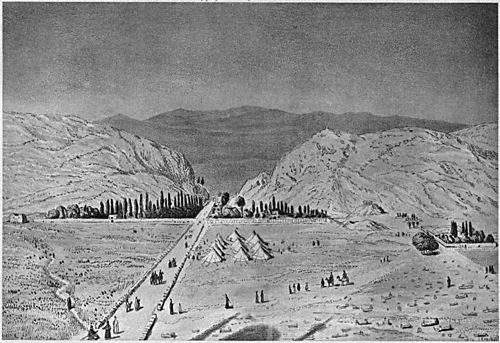
O. 69 may also be quoted:
And make this amber[87] face like a ruby;
When I die, wash me with wine,
And out of the wood of the vine make the planks of my coffin.
Ref.: O. 69, C. 158, L. 308, B. 304, S.P. 109, P. 212, B. ii. 199, T. 143, P. v. 153.—W. 139, N. 109, V. 311.
Of Vintage shall fling up into the Air
As not a True-believer passing by
But shall be overtaken unaware.
This quatrain is translated from C. 16.
Shall rise from the earth when I am beneath it;
So that when a drinker shall pass above my body,
He shall become drunk and degraded from the aroma of my potations.
Ref.: C. 16, L. 28, B. 26, S.P. 14, B. ii. 11.—W. 17, N. 14, V. 27.
Have done my credit in this World much wrong;
Have drown'd my Glory in a shallow Cup,
And sold my Reputation for a Song.
The inspiration for this quatrain comes from C. 170.
I said that all my salvation was attained;
Alas! that those Ablutions[88] are destroyed by my pleasures,
And that Fast of mine is annulled by half a draught of wine.
Ref.: C. 170, L. 366, B. 362, S.P. 162, P. 343, B. ii. 207, T. 118.—W. 180, N. 162, V. 365.
The last line is suggested by O. 22.
I swore—but was I sober when I swore?
And then and then came Spring, and Rose-in-hand
My thread-bare Penitence apieces tore.
This quatrain is inspired by C. 431.
Making repentance of the brimful goblet and cup;
Now that the season of roses[89] has come, I cannot grieve
Give penitence for repentance in the season of roses, O Lord!
Ref.: C. 431, L. 655, B. 647 B. ii. 510.—W. 425, V. 704.
And robb'd me of my Robe of Honour—Well,
I wonder often what the Vintners buy
One half so precious as the stuff they sell.
The original of this quatrain is O. 62.
So long as I have a soul I will not be separated from wine;
I am in perplexity concerning vintners, for they—
What will they buy that is better than what they sell?
Ref.: O. 62, C. 196, L. 350, B. 346, P. 311, B. ii. 167, T. 123, P. iv. 63, P. v. 202.—W. 208, N. 463, E.C. 11, V. 350.
That Youth's sweet-scented manuscript should close!
The Nightingale that in the branches sang,
Ah whence, and whither flown again, who knows!
This quatrain is translated from C. 223.
And that this fresh purple spring is winter-stricken;[90]
That bird of joy, whose name is Youth,
Alas! I know not when it came nor when it went.
Ref.: C. 223, L. 332, B. 328, S.P. 128, B. ii. 155, T. 161.—W. 155, N. 128, V. 334.
One glimpse—if dimly, yet indeed, reveal'd,
To which the fainting Traveller might spring,
As springs the trampled herbage of the field!
This quatrain is inspired by C. 509.
Or that we might come to the end of the road;
Would that from the heart of earth, after a hundred thousand years,
We might all hope to blossom again like the verdure.
Ref.: C. 509, L. 768, B. 754, S.P. 395, B. ii. 522.—W. 442, N. 400, V. 820.
Arrest the yet unfolded Roll of Fate,
And make the stern Recorder otherwise
Enregister, or quite obliterate!
This quatrain in its original form in the second edition was closer to the original Persian.
That we might catch ere closed the Book of Fate,
And make the Writer on a fairer leaf
Inscribe our names, or quite obliterate!
It owes its inspiration to N 457.
And that he should do it now, that I might see him do it;
And either that he should cross my name from the Roll,
Or else raise my condition from want to plenty.[91]
Ref.: N. 457, S.P. 451.—W. 486, V. 841.
To grasp this sorry Scheme of Things entire,
Would not we shatter it to bits—and then
Re-mould it nearer to the Heart's Desire!
* * * * * * *
This quatrain is translated from C. 395.
Would I not do away with the heavens altogether,
Would I not so construct another heaven from the beginning
That, being free, one might attain to the heart's desire?
Ref.: C. 395, L. 594, B. 587, S.P. 337, P. 98, B. ii, 450, T. 268.—W. 379, N. 340, V. 641.
How oft hereafter will she wax and wane;
How oft hereafter rising look for us
Through this same Garden—and for one in vain.
This quatrain in its various forms is inspired by O. 5.
Ref.: O. 5, C. 7, L. 5, S.P. 8, P. 219, B. 4, B. ii. 8, T. 6, P. v. 168.—W. 7, N. 8, E.C. 5, V. 4.
Among the Guests Star-scatter'd on the Grass,
And in your joyous errand reach the spot
Where I made One—turn down an empty Glass!
This quatrain is taken from O. 83 and 84.
It behoves ye warmly to remember your friend;
When ye drink wholesome wine together,
And my turn comes, turn (a goblet) upside down.
Ref.: O. 83.—W. 234, V. 459.
And take delight in one another's charms,
When the Cup-bearer takes (round) in his hand the Mugh[94] wine,
Remember a certain helpless one in your benediction.
Ref.: O. 84, L. 290, B. 286, S.P. 191, P. 226, B. ii. 245.—W. 205, N. 192, V. 293.
APPENDIX.
In addition to the quatrains composing the final form in which we know his poem, there are a few stray quatrains scattered about Edward FitzGerald's Introduction and Notes. There are also two quatrains which appeared in the first edition only, and nine that appeared in the second edition only. I do not think that this work would be complete without an attempt to identify these quatrains in the original texts which inspired them.
IN THE INTRODUCTION.[95]
Page 4.
Has fallen in Grief's furnace and been suddenly burned;
The shears of Fate have cut the tent-ropes of his life,
And the Broker of Hope has sold him for nothing!
The quatrain upon p. 4 is a literal translation by Prof. Cowell of O. 22.
Ref.: O. 22, C. 59, L. 74, B. 70, S.P. 81, P. 205, B. ii. 94, T. 307, P. iv. 65, P. v. 195.—W. 83, N. 81, V. 73.
Page 7.
In Hell, whose fires thyself shall feed in turn;
How long be crying, «Mercy on them, God!»
Why, who art Thou to teach, and He to learn?
The quatrain upon p. 7 is FitzGerald's rendering of C. I.
And oh, thou! from whom the fires of Hell shall blaze,[96]
How long wilt thou keep saying, «Have mercy upon Omar!»
Wilt thou be a teacher of mercy to God?
Ref.: C. 1, L. 769, B. 755, S.P. 453, P. ii. 1, B. ii. 537, T. 1.—W. 488, N. 459, V. 821.
Page 7.
Have loosely strung the Jewel of Good deed,
Let this one thing for my Atonement plead.
That One for Two I never did misread.
The quatrain on p. 7 is FitzGerald's rendering of O. 1.
Ref.: O. 1, C. 274, L. 423, B. 419, P. 4, S.P. 228, B. ii. 302, P. iv. 8.—W. 268, N. 229, V. 461.
IN THE NOTES.
And Kings the forehead on his threshold drew—
I saw the solitary Ringdove there,
And «Coo, coo, coo!» she cried, and «Coo, coo, coo.»
The quatrain in the note to quatrain No. 18 is translated from C. 419.
Kings prostrated themselves upon its threshold;
I saw a dove that, upon its battlements,
Uttered its cry: «Where, where, where, where?»[99]
Ref.: C. 419, L. 627, B. 619, S.P. 347, P. 140, B. ii. 459, P. iv. 13.—W. 392, N. 350, V. 677.
And a young Moon requite us by and by:
Look how the Old one, meagre, bent, and wan
With Age and Past, is fainting from the Sky!
The quatrain in the note to quatrain No. 90 is translated from C. 218.
The means of mirth will all be propitious;
This moon has become lean, bent-figured and thin,
Thou may'st say that it will sink under this trouble.
Ref.: C. 218, B. ii. 186.
IN THE FIRST EDITION.
XXXIII.
Asking, «What Lamp had Destiny to guide
«Her little Children stumbling in the Dark?»
And—«A blind Understanding» Heav'n replied.
XLV.
The quarrel of the Universe let be;
And, in some corner of the Hubbub coucht,
Make Game of that which makes as much of Thee.
XXXVII.
How Time is slipping underneath our Feet?
Unborn To-morrow and dead Yesterday.
Why fret about them if To-day be sweet?
In the first edition we find quatrain No. 33, which, like its distant cousin in the fourth edition (No. 34), appears to have no near parallel in the texts. No. 45 is a quatrain in a like predicament, and it may be for this reason that FitzGerald dropped it out of all subsequent editions.
The only other quatrain peculiar to the first edition is No. 37. This would appear to have been inspired by ll. 3 and 4 of O. 20, quoted in the parallels to quatrain No. 57 and by O. 17, ll. 3 and 4.
Be happy and do not speak of yesterday, for to-day is sweet.
Ref.: O. 17, C. 84, L. 193, B. 190, P. 126, B. ii. 59, T. 65 and 352, P. iv. 68, P. v. 62.—W 112, E.C. 6, V. 189.
IN THE SECOND EDITION.
The quatrains peculiar to the second edition are as follows:
The Thread of present Life away to win—
What? for ourselves, who know not if we shall
Breathe out the very Breath we now breathe in!
This quatrain is inspired by O. 136.
And whether I shall pass this life light-heartedly or not?
Fill up the wine-cup, for I do not know
That I shall breathe out the breath that I am drawing in.
Ref.: O. 136, C. 504 and 427, L. 740, B. 726, S.P. 362, P. 207, B. ii. 484, P. v. 64.—W. 411, N. 366, V. 730.
This was replaced by No. 63 in the fourth and fifth editions, taken from the same original.
The waving Cypress in your Arms enlace,
Before the Mother back into her arms
Fold, and dissolve you in a last embrace.
The sentiment of this quatrain is traceable in C. 189, ll. 1 and 2, and in C. 195.
(When) all bodies will be hidden in the earth.
Ref.: C. 189, L. 393, B. 389, S.P. 160, B. ii. 203.—N. 160, V. 390.
My hand is always grasping the wine cup;
I exact from every part (of me) its allotted function,
Ere that those parts (of me) be mingled with the all.
Ref.: C. 195, L. 349, B. 345, S.P. 163, P. 287, B. ii. 206, T. 122.—W. 181, N. 163, V. 349.
Are in the Prophet's Paradise to stand,
Alack, I doubt the Prophet's Paradise
Were empty as the hollow of one's Hand.
This quatrain is inspired by O. 127 and by C. 60.
Is better than practising the hypocrisy of the zealot;
If the lover and the drunkard are doomed to hell,
Then no one will see the face of heaven.
Ref.: O. 127, L. 608, B. 601, S.P. 339, P. 330, B. ii. 453, P. v. 151.—W. 381, N. 342, V. 655.
FitzGerald was evidently «reminded of» this by N. 64 which is C. 60.
It is a repugnant creed, the heart cannot believe it;
If drunken lovers are doomed to hell,
To-morrow heaven will be bare like the palm of one's hand.
Ref.: C. 60, L. 158, B. 155, S.P. 64, T. 308, P. v. 29.—W. 67, N 64, V. 156.
Of what they will, and what they will not,—each
Is but one Link in an eternal Chain
That none can slip, or break, or over-reach.
For this quatrain I can find neither authority nor inspiration.
I swear I will not call Injustice Grace;
Not one Good Fellow of the Tavern but
Would kick so poor a Coward from the place.
I think the inspiration for this must have been C. 8.
And (at the same time) for fear of his malice number among the good;
If a drunkard shows reluctance in generosity,
All his fellow drunkards hold him to be a mean fellow.
Ref.: C. 8, L. 3, B. ii. 15, T. 9.—V. 416.
Whisper among them; as it were, the stirr'd
Ashes of some all but extinguisht Tongue,
Which mine ear kindled into living Word.
This was a fourth quatrain evolved out of O. 103. Vide quatrains Nos. 82, 83, and 87 ante.
Shall Old Acquaintance Old Acquaintance greet,
Under the Branch that leans above the Wall
To shed his Blossom over head and feet.
This quatrain, interpolated after No. 91 of the fourth edition (= No. 98 of the second edition), is an elaboration founded upon the story told by Nizam ul-Mulk and recorded by FitzGerald in his Introduction.
Of Universe one luckless Human Soul,
Than drop by drop enlarge the Flood that rolls
Hoarser with Anguish as the Ages roll.
This quatrain, interpolated after the quatrain which became No. XCVIII. in the fourth edition, was no doubt inspired by N. 457 (q.v. sub No. 98 ante) and by O. 54.
And grieving only results in deep affliction;
Even through all thy life thou weepest tears of blood,
Not one drop becomes increased beyond what it is.
Ref.: O. 54, B. ii. 144.
VARIATIONS
BETWEEN THE SECOND, THIRD AND FOURTH EDITIONS OF
FITZGERALD'S TRANSLATION OF
OMAR KHAYYAM
STANZA
I. In ed. 2:
Has chased the Session of the Stars from Night;
And, to the field of Heav'n ascending, strikes
The Sultan's Turret with a Shaft of Light.
In the first draft of ed. 3 the first and second lines stood thus
A Signal flung that put the Stars to flight.
II. In ed. 2:
V. In edd. 2 and 3:
IX. In edd. 2 and 3:
X. In ed. 2:
Or Hatim Tai «To Supper!»—heed not you
In ed. 3:
116
STANZA
XII. In ed. 2:
A Flask of Wine, a Book of Verse—and Thou, etc.
XIII. In ed. 2:
Nor heed the music of a distant Drum!
XX. In ed. 2:
XXII. In edd. 2 and 3:
XXVI. In edd. 2 and 3.
XXVII. In ed. 2:
XXVIII. In edd. 2 and 3.
XXX. In ed. 2.
To drug the memory of that insolence!
XXXI. In ed. 2:
XXXII. In edd. 2 and 3:
XXXIII. In ed. 2:
XXXIV. In ed. 2:
The Veil of Universe I cried to find
A Lamp to guide me through the darkness; and
Something then said—«An Understanding blind.»
XXXV. In ed. 2:
117
STANZA
XXXVI. In ed. 2:
XXXVIII. In ed. 2 the only difference is «For» instead of «And» in the first line; but in the first draft of ed. 3 the stanza appeared thus:
Poor Earth from which that Human Whisper came,
The luckless Mould in which Mankind was cast
They did compose, and call'd him by the name.
In ed. 3 the first line was altered to—
XXXIX. In ed. 2:
XL. In ed. 2:
Of Heavenly Vintage lifts her chalice up,
Do you, twin offspring of the soil, till Heav'n
To Earth invert you like an empty Cup.
In the first draft of ed. 3 the stanza is the same as in edd. 3 and 4, except that the second line is—
XLI. In ed. 2 and the first draft of ed. 3:
To-morrow's tangle to itself resign.
XLII. In ed. 2:
End in what All begins and ends in—Yes;
Imagine then you are what heretofore
You were—hereafter you shall not be less.
The first draft of ed. 3 agrees with edd. 3 and 4, except that the first line is—
118
STANZA
XLIII. In ed. 2:
Of Darkness finds you by the river-brink,
And, proffering his Cup, invites your Soul
Forth to your Lips to quaff it—do not shrink.
In the first draft of ed. 3 the only change made was from «proffering» to «offering,» but in ed. 3 the stanza assumed the form in which it also appeared in ed. 4. The change from «the Angel» to «that Angel» was made in MS. by FitzGerald in a copy of ed. 4.
XLIV. In ed. 2:
So long in this Clay suburb to abide!
XLV. In ed. 2:
XLVI. In ed. 2:
Account, should lose, or know the type no more.
XLVII. In ed. 2:
In ed. 3:
XLVIII. In ed. 2:
One Moment, of the Well of Life to taste—
The Stars are setting, and the Caravan
Draws to the Dawn of Nothing—Oh make haste.
In the first draft of ed. 3 the third line originally stood:
the rest of the stanza being as in edd. 3 and 4.
STANZA
XLIX. In ed. 2:
The change from «does» to «may» in the last line was made by FitzGerald in MS.
L. In ed. 2:
LII. In edd. 2 and 3:
LIII. In the first draft of ed. 3:
LIV. In ed. 2:
LV. In ed. 2:
For a new Marriage I did make Carouse.
LVII. In ed. 2:
If so, by striking from the Calendar.
LXII. In ed. 2
LXIII. In ed. 2:
LXV. In edd. 2 and 3:
LXVI. In ed. 2:
And said, «Behold, Myself am Heav'n and Hell.»
LXVII. In ed. 2:
LXVIII. In ed. 2:
Round with this Sun-illumin'd Lantern held.
LXIX. In ed. 2:
LXX. In ed. 2:
120
STANZA
LXXII. In ed. 2 and the first draft of ed. 3:
In edd. 2 and 3:
LXXIX. In ed. 2:
LXXXI. In ed. 2:
Is black with—Man's Forgiveness give—and take!
LXXXIII. In ed. 2:
Whisper among them; as it were, the stirr'd
Ashes of some all but extinguisht Tongue
Which mine ear kindled into living Word.
LXXXIV. In ed. 2:
That He who subtly wrought me into Shape
Should stamp me back to shapeless Earth again?
LXXXV. In ed. 2
Would break the Cup from which he drank in Joy;
Shall He that of His own free Fancy made
The Vessel, in an after-rage destroy!»
LXXXVI. In ed. 2:
LXXXVII. In ed. 2:
And Why? so ready, but the Wherefor not,
One on a sudden peevishly exclaim'd,
«Which is the Potter, pray, and which the Pot?»
121
STANZA
LXXXVIII. In ed. 2:
And daub his Visage with the Smoke of Hell;
They talk of some sharp Trial of us—Pish!
He's a Good Fellow, and 'twill all be well.»
In the first draft of ed. 3. the stanza begins:
Of an old Savage who will toss to Hell
The luckless Pots,» etc.
LXXXIX. In ed. 2:
XC. In ed. 2:
XCI. In ed. 2:
XCIII. In ed. 2:
XCV. In ed. 2:
XCVII. In ed. 2:
XCVIII. In ed. 2:
That we might catch ere closed the Book of Fate,
And make The Writer on a fairer leaf
Inscribe our names, or quite obliterate!
XCIX. In ed. 2:
C. In ed. 2:
Looks for us, Sweet-heart, through the quivering Plane:
How oft hereafter rising will she look
Among those leaves—for one of us in vain!
122
STANZA
CI. In ed. 2:
In the first draft of ed. 3 «Foot» is changed to «step.»
In ed. 3:
STANZAS WHICH APPEAR IN THE SECOND EDITION ONLY
XIV. Were it not Folly, Spider-like to spin
The Thread of present Life away to win—
What? for ourselves, who know not if we shall
Breathe out the very Breath we now breathe in!
XX. (This stanza is quoted in the note to stanza XVIII.
in the third and fourth editions.)
XXVIII. Another Voice, when I am sleeping, cries,
«The Flower should open with the Morning skies.»
And a retreating Whisper, as I wake—
«The Flower that once has blown for ever dies.»
XLIV. Do you, within your little hour of Grace,
The waving Cypress in your Arms enlace,
Before the Mother back into her arms
Fold, and dissolve you in a last embrace.
LXV. If but the Vine and Love-abjuring Band
Are in the Prophet's Paradise to stand,
Alack, I doubt the Prophet's Paradise
Were empty as the hollow of one's Hand.
LXXVII. For let Philosopher and Doctor preach
Of what they will, and what they will not—each
Is but one Link in an eternal Chain
123That none can slip, or break, or over-reach.
LXXXVI. Nay, but, for terror of his wrathful Face,
I swear I will not call Injustice Grace,
Not one Good Fellow of the Tavern but
Would kick so poor a Coward from the place.
XC. And once again there gather'd a scarce heard
Whisper among them; as it were, the stirr'd
Ashes of some all but extinguisht Tongue,
Which mine ear kindled into living Word.
(In the third and fourth editions stanza LXXXIII. takes the place of this.)
XCIX. Whither resorting from the vernal Heat
Shall Old Acquaintance Old Acquaintance greet,
Under the Branch that leans above the Wall
To shed his Blossom over head and feet.
(This was retained in the first draft of ed. 3.)
CVII. Better, oh better, cancel from the Scroll
Of Universe one luckless Human Soul,
Than drop by drop enlarge the Flood that rolls
Hoarser with Anguish as the Ages Roll.
QUATRAINS OF OMAR KHAYYAM
COMPARATIVE TABLE OF STANZAS IN THE
FOUR[100] EDITIONS OF FITZGERALD
| Ed. 1 | Ed. 2 | Edd. 3 and 4 |
| I | I | I |
| II | II | II |
| III | III | III |
| IV | IV | IV |
| V | V | V |
| VI | VI | VI |
| VII | VII | VII |
| VIII | IX | IX |
| IX | X | X |
| X | XI | XI |
| XI | XII | XII |
| XII | XIII | XIII |
| XIII | XV | XIV |
| XIV | XVII | XVI |
| XV | XVI | XV |
| XVI | XVIII | XVII |
| XVII | XIX | XVIII |
| XVIII | XXIV | XIX |
| XIX | XXV | XX |
| XX | XXI | XXI |
| XXI | XXII | XXII |
| XXII | XXIII | XXIII |
| XXIII | XXVI | XXIV |
| XXIV | XXVII | XXV |
| XXV | XXIX | XXVI |
| XXVI | LXVI | LXIII |
| XXVII | XXX | XXVII |
| XXVIII | XXXI | XXVIII |
| XXIX | XXXII | XXIX |
| XXX | XXXIII | XXX125 |
| XXXI | XXXIV | XXXI |
| XXXII | XXXV | XXXII |
| XXXIII | XXXVII | XXXIV |
| XXXIV | XXXVIII | XXXV |
| XXXV | XXXIX | XXXVI |
| XXXVI | XL | XXXVII |
| XXXVII | ||
| XXXVIII | XLIX | XLVIII |
| XXXIX | LVI | LIV |
| XL | LVII | LV |
| XLI | LVIII | LVI |
| XLII | LX | LVIII |
| XLIII | LXI | LIX |
| XLIV | LXII | LX |
| XLV | ||
| XLVI | LXXIII | LXVIII |
| XLVII | XLV | XLII |
| XLVIII | XLVI | XLIII |
| XLIX | LXXIV | LXIX |
| L | LXXV | LXX |
| LI | LXXVI | LXXI |
| LII | LXXVIII | LXXII |
| LIII | LXXIX | LXXIII |
| LIV | LXXXI | LXXV |
| LV | LXXXII | LXXVI |
| LVI | LXXXIII | LXXVII |
| LVII | LXXXVII | LXXX |
| LVIII | LXXXVIII | LXXXI |
| LIX | LXXXIX | LXXXII |
| LX | XCIV | LXXXVII |
| LXI | XCI | LXXXIV |
| LXII | XCII | LXXXV |
| LXIII | XCIII | LXXXVI |
| LXIV | XCV | LXXXVIII |
| LXV | XCVI | LXXXIX |
| LXVI | XCVII | XC |
| LXVII | XCVIII | XCI |
| LXVIII | C | XCII |
| LXIX | CI | XCIII126 |
| LXX | CII | XCIV |
| LXXI | CIII | XCV |
| LXXII | CIV | XCVI |
| LXXIII | CVIII | XCIX |
| LXXIV | CIX | C |
| LXXV | CX | CI |
| VIII | VIII | |
| XIV | ||
| Note on | ||
| XX | XVIII | |
| XXVIII | ||
| XXXVI | XXXIII | |
| XLI | XXXVIII | |
| XLII | XXXIX | |
| XLIII | XL | |
| XLIV | ||
| XLVII | XLVI | |
| XLVIII | XLVII | |
| L | XLIX | |
| LI | L | |
| LII | LI | |
| LIII | LII | |
| LIV | LIII | |
| LV | XLI | |
| LIX | LVII | |
| LXIII | LXI | |
| LXIV | LXII | |
| LXV | ||
| LXVII | LXIV | |
| LXVIII | LXV | |
| LXIX | XLIV | |
| LXX | XLV | |
| LXXI | LXVI | |
| LXXII | LXVII | |
| LXXVII | ||
| LXXX | LXXIV | |
| LXXXIV | LXXVIII | |
| LXXXV | LXXIX127 | |
| LXXXVI | ||
| XC | LXXXIII | |
| XCIX | ||
| CV | XCVII | |
| CVI | XCVIII | |
| CVII |
NOTE
It must be admitted that FitzGerald took great liberties with the original in his version of Omar Khayyam. The first stanza is entirely his own, and in stanza XXXI. of the fourth edition (XXXVI. in the second) he has introduced two lines from Attar. (See «Letters,» p. 251.) In stanza LXXXI. (fourth edition), writes Professor Cowell, «There is no original for the line about the snake: I have looked for it in vain in Nicolas; but I have always supposed that the last line is FitzGerald's mistaken version of Quatr. 236 in Nicolas's ed. which runs thus:
Who graspest every one's hand in the hour of weakness,
O God, give me repentance and accept my excuses,
O thou who givest repentance and acceptest the excuses of every one.
«FitzGerald mistook the meaning of giving and accepting as used here, and so invented his last line out of his own mistake. I wrote to him about it when I was in Calcutta; but he never cared to alter it.»
THE
QUATRAINS OF OMAR KHAYYAM
TRANSLATED BY
E.H. WHINFIELD, M.A.
INTRODUCTION
Omar is a poet who can hardly be translated satisfactorily otherwise than in verse. Prose does well enough for narrative or didactic poetry, where the main things to be reproduced are the matter and substance, but it is plainly contra-indicated in the case of poetry like Omar's, where the matter is little else than «the commonplaces of the lyric ode and the tragic chorus,» and where nearly the whole charm consists in the style and the manner, the grace of the expression and the melody of the versification. A literal prose version of such poetry must needs be unsatisfactory, because it studiously ignores the chief points in which the attractiveness of the original consists, and deliberately renounces all attempt to reproduce them.
In deciding on the form to be taken by a new translation of Omar, the fact of the existence of a previous verse translation of universally acknowledged merit ought not, of course, to be left out of account. The successor of a translator like Mr. Fitzgerald, who ventures to write verse, and especially verse of the metre which he has handled with such success, cannot help feeling at almost every step that he is provoking comparisons very much to his own disadvantage. But I do not think this consideration ought to deter him from using the vehicle which everything else indicates as the proper one.
As regards metre, there is no doubt that the quatrain of ten-syllable lines which has been tried by Hammer, Bicknell, and others, and has been raised by Mr. Fitzgerald almost to the rank of a recognised English metre, is the best representative of the Ruba'i. It fairly satisfies Conington's canon, viz., that there ought to be some degree of metrical conformity between the measure of the original and the translation, for though it does not132 exactly correspond with the Ruba'i, it very clearly suggests it. In particular, it copies what is perhaps the most marked feature of the Ruba'i,—the interlinking of the four lines by the repetition in the fourth line of the rhyme of the first and second. Mr Swinburne's modification of this metre, in which the rhyme is carried on from one quatrain to the next, is not applicable to poems like Omar's, all of which are isolated in sense from the context. Alexandrines would, of course, correspond more nearly than decasyllables with Ruba'i lines in number of syllables, and they have been extensively used by Bodenstedt and other German translators of the metre but, whatever may be the case in German, they are apt to read very heavily in English, even when constructed by skilful verse-makers, and an inferior workman can hardly hope to manage them with anything like success. The shorter length of the decasyllable line is not altogether a disadvantage to the translator. Owing to the large number of monosyllables in English, it is generally adequate to hold the contents of a Persian line a syllable or two longer; and a line erring, if at all, on the side of brevity, has at any rate the advantage of obliging the translator to eschew modern diffuseness, and of making him try to copy the «classical parsimony,» the archaic terseness and condensation of the original.
The poet Cowper has a remark on translation from Latin which is eminently true also of translation from Persian. He says, «That is epigrammatic and witty in Latin which would be perfectly insipid in English.... If a Latin poem is neat, elegant, and musical, it is enough, but English readers are not so easily satisfied.» Much of Omar's matter, when literally translated, seems very trite and commonplace, many of the «conceits,» of which he is so fond, very frigid, and even his peculiar grotesque humour often loses its savour in an English replica. The translator is often tempted to elevate a too grovelling sentiment, to «sharpen a point» here and there, to trick out a commonplace with some borrowed modern embellishment. But this temptation is one to be resisted as far as possible. According to the Hadis, «The business of a133 messenger is simply to deliver his message,» and he must not shrink from displaying the naked truth. A translator who writes in verse must of course claim the liberty of altering the form of the expression over and over again, but the substituted expressions ought to be in keeping with the author's style, and on the same plane of sentiment as his. It is beyond the province of a translator to attempt the task of «painting the lily.» But it is easier to lay down correct principles of translation than to observe them unswervingly in one's practice.
As regards subject matter, Omar's quatrains may be classed under the following six heads:—
I. Shikayat i rozgar—Complaints of «the wheel of heaven,» or fate, of the world's injustice, of the loss of friends, of man's limited faculties and destinies.
II. Hajw—Satires on the hypocrisy of the «unco' guid,» the impiety of the pious, the ignorance of the learned, and the untowardness of his own generation.
III. Firakiya and Wisaliya—Love-poems on the sorrows of separation and the joys of reunion with the Beloved, earthly or spiritual.
IV. Bahariya—Poems in praise of spring, gardens, and flowers.
V. Kufriya—Irreligious and antinomian utterances, charging the sins of the creature to the account of the Creator, scoffing at the Prophet's Paradise and Hell, singing the praises of wine and pleasure—preaching ad nauseam, «eat and drink (especially drink), for to-morrow ye die.»
VI. Munajat—Addresses to the Deity, now in the ordinary language of devotion, bewailing sins and imploring pardon, now in Mystic phraseology, craving deliverance from «self,» and union with the «Truth» (Al Hakk), or Deity, as conceived by the Mystics.
The «complaints» may obviously be connected with the known facts of the poet's life, by supposing them to have been prompted by the persecution to which he was subjected on account of his opinions. His remarks on the Houris and other sacred subjects raised such a feeling against him that at one time his life was in danger,134 and the wonder is that he escaped at all in a city like Naishapur, where the odium theologicum raged so fiercely as to occasion a sanguinary civil war. In the year 489 a.h., as we learn from Ibn Al Athir,[101] the orthodox banded themselves together under the leadership of Abul Kasim and Muhammad, the chiefs of the Hanefites and the Shafeites, in order to exterminate the Kerramians or Anthropomorphist heretics, and succeeded in putting many of them to death, and destroying all their establishments. It may be also that after the death of his patron, Nizam ul Mulk, Omar lost his stipend and was reduced to poverty.
The satires probably owed their origin to the same cause. Rien soulage comme la rhetorique, and if Omar could not relieve his feelings by open abuse of his persecutors, he made up for it by the bitterness of his verses. The bitterness of his strictures on them was no doubt fully equalled by the rancour of their attacks upon him.
The love-poems are samples of a class of compositions much commoner in later poets than in Omar. Most of them probably bear a mystical meaning, for I doubt if Omar was a person very susceptible of the tender passion. He speaks with appreciation of «tulip cheeks» and «cypress forms,» but apparently recognises no attractions of a higher order in his fair friends.
The poems in praise of scenery again offer a strong contrast to modern treatment of the same theme. The only aspects of nature noticed by Omar are such as affect the senses agreeably—the bright flowers, the song of the nightingale, the grassy bank of the stream, and the shady garden associated in his mind with his convivial parties. The geographer translated by Sir W. Ouseley says of Naishapur, «The city is watered by a subterranean canal, which is conveyed to the fields and gardens, and there is a considerable stream that waters the city and the villages about it—this stream is named Saka. In all the provinces of Khorassan there is not any city larger than Naishapur, nor any blessed with a more pure and temperate air. » No135 doubt it was some of these gardens that called forth Omar's encomiums.
But it is in the Kufriya, or antinomian quatrains, and in the Munajat, or pious aspirations, that the most remarkable and characteristic features of Omar's poetry are exhibited. The glaring contrast between these two classes of his poetry has led his readers to take very opposite views of him, according as they looked at one or the other side of the shield. European critics, like his contemporaries, mostly consider him an infidel and a voluptuary «of like mind with Sardanapalus.» On the other hand, the Sufis have contrived to affix mystical and devotional meanings even to his most Epicurean quatrains; and this method of interpretation is nowadays as universally accepted in Persia and India as the Mystical interpretation of the Canticles is in Europe. But neither of these views can be accepted in its entirety. Even if the Sufi symbolism had been definitely formulated as early as Omar's time, which is very doubtful, common sense would forbid us to force a devotional meaning on the palpably Epicurean quatrains; and, on the other hand, unless we are prepared to throw over the authority of all the manuscripts, including the most ancient ones, we must reckon with the obviously Mystical and devotional quatrains. The essential contradiction in the tone and temper of these two sections of Omar's poetry cannot be glossed over, but calls imperatively for explanation.
His poems were obviously not all written at one period of his life, but from time to time, just as circumstances and mood suggested, and under the influence of the thoughts, passions, and desires which happened to be uppermost at the moment. It may be that the irreligious and Epicurean quatrains were written in youth, and the Munajat in his riper years. But this hypothesis seems to be disproved by Sharastani's account of him, which is quite silent as to any such conversion or change of sentiment on his part, and also by the fact that he describes himself from first to last as a «Dipsychus» in grain, a halter between two opinions, and an «Acrates,» or back-slider, in his practice.
If his poems be considered not in the abstract, but in the light of history, taking into account his mental pedigree and his intellectual surroundings, a more plausible explanation of his inconsistencies readily presents itself. In his youth, as we know, he sat at the feet of the Suni theologian Imam Muaffik, and he was then no doubt thoroughly indoctrinated with the great Semitic conception of the One God, or, to use the expressive term of Muhammadan theology, «the Only Real Agent» (Fa' il i Hakiki). To minds dominated by the overwhelming sense of Almighty Power, everywhere present and working, there seems no room for Nature, or human will, or chance, or any other Ahriman whatsoever, to take the responsibility of all the evils in the world, the storms and the earthquakes, the Borgias and the Catilines. The «Only Real Agent» has to answer for all. In the most ancient document of Semitic religious speculation now extant, the Book of Job, we find expostulations of the boldest character addressed to the Deity for permitting a righteous man to be stricken with unmerited misfortunes, though the writer ultimately concludes in a spirit of pious agnosticism and resignation to the inscrutable dispensations of Providence. In the Book of Ecclesiastes again, the same problems are handled, but in a somewhat different temper. The «weary king Ecclesiast» remarks that there is one event to all, to him that sacrificeth and him that sacrificeth not—that injustice and wrong seem eternally triumphant, that God has made things crooked, and none can make them straight; and concludes now in favour of a sober «carpe diem» philosophy, now in favour of a devout «fear of the Lord.» Of course the manner in which the serious Hebrew handles these matters is very different from the levity and flippancy of the volatile Persian, but it can hardly be denied that the Ecclesiast and Omar resemble one another in the double and contradictory nature of their practical conclusions.
No sooner was Islam established than the same problem of the existence of evil in the handiwork of the Almighty Author and Governor of all began to trouble the Moslem theologians, and by their elaboration of the doctrine of137 Predestination they managed to aggravate its difficulties.
One of the chief «roots» of their discussions was how to reconcile the Divine justice and benevolence with the Divine prescience,—the predestination of some vessels to honour, and others to dishonour,—the pre-ordainment of all things by a kind of mechanical necessity (Jabr), leaving no possibility of the occurrence of any events except those which actually do occur. The consideration of one corollary of a similar doctrine moved the pious and gentle Cowper to use language of indignant dissent; and there is high theological authority for the view that it is calculated «to thrust some into desperation,» but to stimulate the piety of others. Omar is constantly dwelling on this doctrine, and he seems to be affected by it in the double way here mentioned.
Other influences which acted on Omar must not be left out of account. Born as he was in Khorassan, «the focus of Persian culture,» he was no doubt familiar with speculations of the Moslem philosophers, Alkindi, Alfarabi, and Avicenna,[102] the last of whom he may possibly have seen. And though, think he was not himself a Sufi, in the sense of being affiliated to any Sufi order, he can hardly have been unaffected by the mysticism of which his predecessor in Ruba'i writing, Abu Sa'id bin Abul Khair, his patron Nizam ul Mulk, and his distinguished countryman Imam Ghazali were all strong adherents. His philosophical studies would naturally stimulate his sceptical and irreligious dispositions, while his Mystic leanings would operate mainly in the contrary direction.
If this explanation of the inconsistencies in his poetry be correct, it is obvious that the parallel often sought to be traced between him and Lucretius has no existence. Whatever he was, he was not an Atheist. To him, as to other Muhammadans of his time, to deny the existence of the Deity would seem to be tantamount to denying the existence of the world and of himself. And the conception of «laws of nature» was also one quite foreign to his138 habits of thought. As Deutsch says, «To a Shemite, Nature is simply what has been begotten, and is ruled absolutely by One Absolute Power.»
Hammer compares him to Voltaire, but in reality he is a Voltaire and something more. He has much of Voltaire's flippancy and irreverence. His treatment of the doctrine of the Resurrection of the Body, for instance, which Muhammad took from Christianity, and travestied by the embellishments he added to it, is altogether in Voltaire's manner. And his insistence on the all importance of kindness and charity recalls the better side of Voltaire's character, viz., his kindness to Calas, and the other victims of ecclesiastical persecution. But Omar also possessed, what Voltaire did not, strong religious emotions, which at times overrode his rationalism, and found expression in those devotional and Mystical quatrains, which offer such a strong contrast to the rest of his poetry.
E.H. WHINFIELD
NOTE
The text has been framed from a comparison of the following authorities:—
I. The Bodleian manuscript, No. 140 of the Ouseley Collection,
containing 158 quatrains.
II. The Calcutta Asiatic Society's manuscript, No. 1548, containing
516 quatrains.
III. The India Office manuscript, No. 2420, ff. 212 to 267, containing
512 quatrains.
IV. The Calcutta edition of 1252 a.h., containing 438 quatrains,
with an appendix of 54 more, which the editor says he found in a
Bayaz, or common-place book, after the others had been printed.
V. The Paris edition of M. Nicolas, containing 464 quatrains.
VI. The Lucknow lithographed edition, containing 763 quatrains.
VII. A fragment of an edition begun by the late Mr. Blochmann,
containing only 62 quatrains.
QUATRAINS OF OMAR KHAYYAM
«Arise my brethren of the revellers' guild,
That I may fill our measure, full of wine
Or e'er the measure of our days be filled.»
1. Bl. C. L. N. A. I. J. Bl. considers this quatrain Mystical.
Forth from the harem in this manner, who?
To him who in thy absence burns as fire,
And trembles like hot air, who was it, who?
2. Bl. C. L. N. A. I. J. Bl. says the omission of the copulative wa in line 4 of the original is characteristic of Khayyam. In line 4 I follow Blochmann's rendering. It may mean, «when the wind blows.»
And all the gain we get is grief and woe,
And then, leaving life's riddles all unsolved,
And burdened with regrets, we have to go.
Wish me God-speed, and get your preaching done;
I walk aright, 'tis you who see awry;
Go! heal your purblind eyes, leave me alone.
Resolve my weary heart's perplexity,
And fill my goblet, so that I may drink,
Or e'er they make their goblets out of me.
5. Bl. C. L. N A. I. J. The heart is supposed to be the seat of reason. «Or ever» and «or e'er» are both found in Elizabethan English. Abbot, Shakespearian Grammar, p. 89.
For obit chant a bacchanalian stave,
And, if you need me at the day of doom,
Beneath the tavern threshold seek my grave.
Rejoice thy heart to-day, and banish sorrow
With moonbright wine, fair moon, for heaven's moon.
Will look for us in vain on many a morrow.
7. Bl. C. L. N. A. B. I. J. Line 2 is in metre 14.
And flown with wine, and reprobates, like me;
When sober, I find everything amiss,
But in my cups cry, «Let what will be, be.»
8. Bl. L. N. Line 3 is in metre 13.
Their hearts upon this house of vanities?
Whene'er they think to rest them from their toils,
Death takes them by the hand, and says, «Arise.»
But on its pages seldom care to pore;
The lucid lines engraven on the bowl,—
That is the text they dwell on evermore.
10. Bl. L. N. A. B. I. J. Lines were engraven on the bowl to measure out the draughts. Bl.
Had I but grace, I would abstain like you,
And mark me, vaunting zealot, you commit
A hundredfold worse sins than drunkards do.
I know not why the heavenly Artisan
Hath set these tulip cheeks and cypress forms
To deck the mournful halls of earth's divan.
My stock-in-trade no profit here below,
And you, who call me tavern-haunter, know
There is indeed no tavern here below
13. Bl. C. L. N. A. I. J. The anacoluthon in line 3, and the missing rhyme before the burden, in line 4, are characteristic of Khayyam. Bl.
«Why dost thou worship this dead stone, fair sir?
'Tis because He who gazeth through thine eyes,
Doth some part of His charms on it confer.»
14. L. Meaning, all is of God, even idols.
Nor kindle fumes of wrath his peace to smother;
Dost thou desire to taste eternal bliss,
Vex thine own heart, but never vex another!
15. L. b. Line 1 is in metre 14.
Allah created heaven and likewise hell;
Thou hast thy court in heaven, and I have naught,
Why not admit me in thy courts to dwell?
16. Bl. L. The person addressed is the prophet Muhammad. The Sufis were fond of dwelling on the opposition between the beautiful and the terrible attributes of Deity.
Its bouquet shall exhale from out my tomb,
And every one that passes by shall halt,
And reel and stagger with that mighty fume.
Glad winner, lead thy paragon apart!
A hundred Ka'bas equal not one heart,
Seek not the Ka'ba, rather seek a heart!
18. Bl. C. L. N. A. I. J. Line 2, «In the presence seize the perfect heart.»
And with rapt heart unconsciousness attain,
Behold what wondrous miracles are wrought,
Songs flow as water from my burning brain.
Thou wilt not see again this life of thine;
So, as the world becomes the spoil of time,
Offer thyself to be the spoil of wine!
And risk our lives to gain the smiles of wine;
The henchman grasps the flagon by its throat
And squeezes out the lifeblood of the vine.
21. L. N. Line 3 is in metre 19.
Pawning for wine, heart, soul, and all I wear,
Without a hope of bliss, or fear of bale,
Rapt above water, earth, and fire, and air.
If this brook leaves its channel dry and bare»;
To whom the duck, «When I am dead and roasted
The brook may run with wine for aught I care.»
23. L. Meaning, «Après nous le déluge».
A breath from infidelity to faith;
O precious breath! enjoy it while you may,
'Tis all that life can give, and then comes death.
'Twas e'er your wont to show yourself unkind;
And, cruel earth, if they should cleave your breast,
What store of buried jewels they would find!
25. Bl. C. L. N. A. I. J. «Wheel of heaven,» i.e., destiny, fortune. Sir Thomas Browne talks of the «wheel of things.»
Sweeps by, like torrent stream or desert blast,
Howbeit, of two days I take no heed,—
The day to come, and that already past.
That ruby bears a stamp thou canst not see
The tale of love some other tongue must tell,
All our conjectures are mere phantasy.
27. Meaning, real love of God differs from the popular idea of it. Bl.
I quaff enchanting wine, and list to fife;
Chide not at wine for all its bitter taste,
Its bitterness sorts well with human life!
And daily change of fortune to sustain,
Into this body wherefore didst thou come,
Seeing thou must at last go forth again?
Counting on morrows breedeth naught but sorrow;
Oh! squander not this breath that heaven hath lent thee,
Nor make too sure another breath to borrow!
Take thy good fortune, and thy bad withal;
Know for a surety each must play his game,
As from heaven's dice-box fate's dice chance to fall.
31. Bl. C. L. N. A. I. J. Naksh, the dots on dice.
And bonds of beauty's tresses once embraced,
This handle, which you see upon its side,
Has many a time twined round a slender waist!
And on its business ever rolled the sky;
See you tread gently on this dust—perchance
'Twas once the apple of some beauty's eye.
'Tis prayer that church-bells chime unto the air,
Yea, Church and Ka'ba, Rosary and Cross
Are all but divers tongues of world-wide prayer.
34. Bl. C. L. N. A. I. J. Meaning, forms of faith are indifferent.
By pen, unheeding bliss or misery,
Yea, writ upon the tablet once for all,
To murmur or resist is vanity.
35. C. L. N. A. B. I. J. Meaning, fate is heartless and resistless.
Which to all, good and bad, I cannot tell;
My words are dark, but I cannot unfold
The secrets of the «station» where I dwell.
36. Bl. C. L. N. A. I. J. Hale, a state of ecstasy.
Of such a broom has swept our dwelling clear
Forth from the tavern comes a sage and cries,
«Drink! for ye all must sleep through ages drear»
37. Bl. L. N. Meaning, Mullahs' fables will not go down with us.
But to God's will we can but be resigned,
The deepest wiles my cunning e'er devised,
To balk resistless fate no way could find.
38. L. N. Meaning, weakness of human rule compared to the strength of Divine decrees.
Upon trustworthy foes respect bestow;
Hold healing poison for an antidote,
And baneful sweets for deadly eisel know.
39. L. N. These gnomical epigrams are not common in Khayyam.
No sight so clear but craves Thy face to see;
And though perchance Thou carest not for them,
No soul is there but pines with care for Thee.
40. C. L. N. A. I. J. Jigar, the liver, was considered to be the seat of love.
And drunkenness doth drown my sense outright;
There is a middle state, it is my life,
Not altogether drunk, nor sober quite.
41. C. N. I. Masti o: scan mastiyo. The Epicurean golden mean. See Ecclesiastes, vii, 16, 17.
In wanton freak let ruin overtake them,
So many shapely feet and hands and heads,—
What love drives Him to make, what wrath to break them?
42. C. N. A. B. I. J. Pryalae, a cup. So Job, «Thy hands have made me, yet thou dost destroy me.»
Death yields the tree of immortality;
Since 'Isa breathed new life into my soul,
Eternal death has washed its hands of me!
43. L. N. Meaning, the Sufi doctrine of Baka ba'd ul fana. See Gulshan i Raz, p. 31.152
And, with a tulip-cheeked companion, sup
With joy your wine, or e'er this azure wheel
With some unlooked-for blast upset your cup.
So vaunt not human powers, but hold your peace;
Here must we stay, weighed down with grief for this,
That we were born so late, so soon decease.
45. C. L. N. A. I. J. Meaning, the futility of striving against predestination. Ank, for anki. Bl., Prosody 13.
What boots it thus to mourn? Rather be glad.
He that sins not can make no claim to mercy,
Mercy was made for sinners—be not sad.
46. C. L. N. A. B. I. See note on No. 130
To see beyond man's sight is all too frail;
Yea! earth's dark bosom is his only home;—
Alas! 'twere long to tell the doleful tale.
Yea, and with all my wit deep question made,
But found no moon with face so bright as thine,
No cypress in such stateliness arrayed.
Hell's terrors and heaven's lures men's bosoms rule,
But they who master Allah's mysteries,
Sow not this empty chaff their hearts to fool.
49. C. L. N. A. B. I. J. Meaning, souls re-absorbed in the Divine essence have no concern with the material heaven and hell.
And all you say, and all you hear is naught,
Naught the four quarters of the mighty earth,
The secrets treasured in your chamber naught.
50. L. N. Meaning, all is illusion (Maya).
In sleep? Can sleep make pleasure's roses bloom?
For gather not with death's twin-brother sleep,
Thou wilt have sleep enough within thy tomb!»
51. C. L. N. A. B. I. J. So Homer, Kasignetos thanatoio.
At death 'twould know God's secrets too, I trow;
But, if you know naught here, while still yourself,
To-morrow, stripped of self, what can you know?
52. C. L. N. A. I. In line 2 scan Ilahi. Bl., Prosody, p. 7.
And darkness dim the bright stars' galaxy,
I'll seize the Loved One by His skirt, and cry,
«Why hast Thou doomed these guiltless ones to die?»
53. C. L. N. A. I. J. See Koran, lxxxii. 1. Note the alif i wasls in lines 1 and 2. In line 4 scan kata lat, transposing the last vowel. Bl., Prosody, p. ii.
To comprehend it is to fools denied,
See then to what hard case Thou doomest men,
Our hopes from one and all perforce we hide.
54. C. L. N. A. B. I. There is a variation of this, beginning Asrar i jahan.
And a safe resting-place be here denied us,
So long as the bright wine-cup stands between us,
We have the very Truth at hand to guide us.
55. C. L. N. A. I. In line 3 scan mayast. Bl., Prosody, p. 13, and note tashdid on hakk dropped. Ibid, p. iv.
But then my business never went aright;
Since wine could not accomplish my desire,
I have abandoned and forsworn it quite.
Wake! fortune's waking is as fleeting dreams;
Quicksilver-like our days are swift of foot,
And youthful fire subsides as torrent streams.
57. C. L. N. A. I. J. In line 3 scan bedariyi.
Not Solomons, but ants of low degree;
Here are but faces wan and tattered rags,
No store of Cairene cloth or silk have we.
58. L. N. For the story of Solomon and the ants, see Koran, xxvii., 18. Kasab, linen made in Egypt.
My creed to shun the theologic fray;
I wedded Luck, and offered her a dower,
She said, «I want none, so thy heart be gay.»
Allah! of what clay didst thou form me so?
Like sceptic monk, or ugly courtesan,
No hopes have I above, no joys below.
60. C. L. N. A. I. J. Ummed has the tashdid ob metrum. Bl., Prosody 9. Line 2 is in metre 17. Gil i mara for gil i man ra, Vullers, pp. 173 and 193.
With clamour, barking for mere wantonness;
Foxes are they, and sleep the sleep of hares;
Crafty as wolves, as tigers pitiless.
61. C. L. N. A. I. J. «Sleep of hares,» deceit.
As down upon a cherub's lip might seem,
Or growth from dust of buried tulip cheeks;
Tread not that turf with scorn, or light esteem!
62. C. L. N. A. I. J. Juyiy: the ya of juy is hamzated because followed by another ya. Vullers, p. 24.
Whether in mosque or synagogue they dwell,
Have their names written in the book of love,
Unvexed by hopes of heaven or fears of hell.
63. C. L. N. A. I. J. Compare Hafiz, Ode 79: «Wherever love is, there is the light of the Beloved's face.»
Throne of Kobad and crown of Kai Kawus;
Sweeter are sighs that lovers heave at morn,
Than all the groanings zealot breasts produce.
64. C. L. N. A. I. J. Kawus is the old spelling.
Like heathens to my idol I confide me;
Yea, when I perish of a drunken bout,
I'll call on wine, whatever doom betide me.
To riot, or transgress the law divine,
No! to attain unconsciousness of self
Is the sole cause I drink me drunk with wine.
66. C. L. N. A. I. J. Perhaps a hit at the orthodox Sufis.
Believe it not, 'tis but a foolish scare;
Heaven will be empty as this hand of mine,
If none who love good drink find entrance there.
67. C. L. N. A. I. J. Line 4 is in metre 17.
To drink in Rajah, likewise in Sha'ban,
God and the Prophet claim those months as theirs;
Was Ramazan then made for thirsty man?
68. C. L. N. A. I. J. The point, of course, is that Ramazan is the Mahammadan Lent.
Our simple pastimes we must now forego,
The wine we have in store we must not drink,
Nor on our mistresses one kiss bestow.
69. L. N. Does Sada mean the winter feast?
A pied pavilion of night and day;
A feast whereat a thousand Jamshids sat,
A couch whereon a thousand Bahrams lay.
70. Bl. C. L. N. A. I. J. Wamanda, «leavings.»
To grasp your goblets be not so remiss,
Drink while you may! Time is a treacherous foe,
You may not see another day like this.
71. Bl. C. L. N. A. I. J. Bar bar «blooming, on the branch,» i.e., you are still young. Bl.
The wild roes drop their young, and tigers stray;
And that great hunter king—ah! well-a-day!
Now to the hunter death is fallen a prey.
72. Bl. C. L. N. A. I. J. Daro: see Bl., Pros. 11.
Without this drink, the flowers could never bloom!
As now these flowerets yield delight to me,
So shall my dust yield flowers,—God knows for whom.
73. Bl. C. L. N. A. I. J. In line 4 ta is the «ta i tajahul,» meaning, «I do not know whether,» «perhaps.» Bl.
Drink then from bowls served up in quick relays;
Suppose on common days you drink one bowl,
To-day drink two, for 'tis the prince of days.
74. Bl. C. L. N. A. I. J. Friday is the day «of assembly,» or Sabbath.
And to take shapes of plants and creatures deigns
But deem not that its essence ever dies,
Its forms may perish, but its self remains.
75. Bl. C. L. N. A. I. J. On this Bl. notes «The Arabic form hayawan is required by the metre.» And Suwar is the Arabic plural, used as a singular. Bl., Prosody 5. Wine means the divine «Noumenon.» Gulshan i Raz, 825.
For my well-being not a soul doth care;
With hands fate makes me lift up in despair,
I grasp men's skirts, but find no succour there.
76. Bl. C. L. N. A. I. J. Scan tayifa.
Seems to clear wisdom's eyes an enemy;
Choose not your friends from this rude multitude,
Their converse is a plague 'tis best to fly.
77. Bl. C. L. N. A. I. J. The MSS. transpose the lines.
This particoloured vault of heaven is naught;
Our sojourn in this seat of life and death
Is but one breath, and what is that but naught?
78. Bl. L. N. Shakl i mujassam, «the earth.» Bl.
A green bank by a stream, with minstrelsy;—
Toil not to find a better Paradise
If other Paradise indeed there be!
79. Bl. C. L. N. A. I. J. Dozakh i farsuda, «an old hell,» i.e., vain things which create a hell for you. Bl.
Bearing a wine-cup, and a mat for prayer;
I said, «O Shaikh, what does this conduct mean?»
Said he, «Go drink! the world is naught but air.»
Viewed lily cups, and roses smiling gay,
Cried in ecstatic notes, «O live your life,
You never will re-live this fleeting day.»
81. N. The MSS. have a variation of this beginning, Bulbul chu. Jam . ra. See Bl., Prosody, p. 12.
The Sultan spirit takes for one brief age;
When he departs, comes the tent-pitcher death,
Strikes it, and onward moves, another stage.
82. C. L. N. A. I. J. Manzil, in line 2, «lodging»; in line 3, «stage» Khimaye, a «tent.»
Has fallen into a furnace, and lies burning,
Death's shears have cut his thread of life asunder,
Fate's brokers sell him off with scorn and spurning.
And thither wine, and a fair Houri brought;
And, though the people called me graceless dog,
Gave not to Paradise another thought!
84. C. L. N. A. B. I. J. Batar, a contraction. See Bl., Prosody, p. 10.
And sweet are lute and harp and roundelay;
But for the zealot who ignores the cup,
'Tis sweet when he is twenty leagues away!
85. N. The MSS. have a variation of this. Note Khush.
And the soft murmurs of Irakian flutes,
Were nothing worth: I scan the world and see:
Save pleasure, life yields only bitter fruits.
86. L. N. See an answer to this in No. 97.
And pass the veil, and Allah's secrets know,
Make haste to take your pleasure while you may,
You wot not whence you come, nor whither go.
87. C. L. N. A. I. In line 3 scan nidaniyaz.
To walk in vain desires continually?
Nay, but if heaven vouchsafe no place of rest,
What power to cease our wanderings have we?
88. N. In line 3 scan jayiga. Bl., Prosody, p. 15.
I live encompassed by cup, bowl and flask;
Zealot! if reason be thy guide, then know
That guide of me doth ofttimes guidance ask.
89. C. L. N. A. I. J. In line 1 scan maddahiyi; and compare Horace,
Fecundi calices quem non fecere disertum.»
And thus misjudge me? I am not to blame.
Save weakness for the grape, and female charms,
What sins of mine can any of ye name?
90. C. L. N. A. I. J. This change of persons is called Iltifat. Gladwin, Persian Rhetoric, p. 56.
A helpless pauper will depart, I trow;
Remember who you are, and whence you come.
Consider what you do, and whither go.
91. C. L. N. A. I. Khabarat: see Bl., Prosody, p. v.
And from our tear-stained eyes a Jihun flows;
Hell is a fire enkindled of our griefs;
Heaven but a moment's peace, stolen from our woes.
92. C. L. N. A. B. I. J. This balanced arrangement of similes is called Tirsi'a. Gladwin, p. 5.
My soul is dark—make me Thy light to see!
A heaven that must be earned by painful works,
I call a wage, not a gift fair and free.
93. C. L. N. A. I. J. Arabic words like raza, drop the hamza in Persian, except with the izafat: (Bl., Prosody 14). For this hamza, ya is often used, as here.
Or destine me for heaven? I cannot tell.
Yet will I not renounce cup, lute and love,
Nor earthly cash for heavenly credit sell.
94. C. L. N. A. B. I. In line 4 the izafat is dropped after silent he. Bl., Prosody, p. 15.
Saying, «Renounce this wine, this foe of good»;
But if wine be the foe of holy faith,
By Allah, right it is to drink its blood!
95. C. L. N. A. B. I. J. See Koran, ii. 187.
The weal and woe that heaven's decrees have sent,—
Impute them not to motions of the skies,—
Skies than thyself ten times more impotent.
96. C. L. N. A. I. J. Fate is merely the decree of Allah. For the distinction between kaza and kadar, see Pocock, «Specimen Historiae Arabum,» p. 207.
What all the pomps and riches of the earth?
When I survey the world, I see no good
But goodness, all beside is nothing worth.
97. N. Possibly written on the margin by some pious reader as an answer to No. 86.
Hold life-long fellowship with rule and pain;
Hearts free from worldly cares have store of bliss,
All others seeds of bitter woe contain.
98. L. N. Tajrid, see Gulshan i Raz, p. 8, n.
To waste a single day was never known;
Either he strives to work great Allah's will,
Or else exalts the cup, and works his own.
99. C. L. N. A. B. I. J. Tarabe, query, takhme? giving a line in metre 23.
My future acts, and could each one foretell;
Without His will no act of mine was wrought;
Is it then just to punish me in hell?
100. C. L. N. A. I. Of the Moslem theory of predestination, Khayyam might truly say, «Ten thousand mortals, drowned in endless woe, for doing what they were compelled to do.»
Do not on Friday quit your drinking ways;
Adopt my creed, and count all days the same,
Be worshippers of God, and not of days.
101. L. N. In line 3 scan yakist.
Adam from Paradise why banished He?
Grace to poor sinners shown is grace indeed;
In grace hard earned by works no grace I see.
102. N. The tashdid of rabb is dropped. Bl., Prosody, p. iv.
Her scimitar is sharp to smite, take care!
If e'er she drop a sweetmeat in thy mouth,
'Tis poisonous,—to swallow it forbear!
103. C. L. A. B. I. Hush contracted from hosh.
Know that a mighty monarch's blood was shed
And where the violet rears her purple tuft,
Be sure a black-moled girl hath laid her head.
104. B. L. The MSS. have a variation of this, beginning Har khisht ki.
Cup is the body, and the soul is wine;
These crystal goblets smile with ruddy wine
Like tears, that blood of wounded hearts enshrine.
Fruitage of youth, and balm of age's need:
'Tis the glad time of roses, wine and friends;
Rejoice thy spirit—that is life indeed.
106. L. B. There being no izafat after yaran, sar i mast must agree with hangam.
Without a friend, or wife to cheer your gloom;
Hear what I say, and tell it not again,
«Never again can withered tulips bloom.»
107. C. A. B. I. J. This recalls the chorus in the «Oedipus Coloneus.»
But I say wine is sweeter—taste and see!
Hold fast this cash, and let that credit go,
And shun the din of empty drums like me.
108. C. L. A. B. I. J. Sin, «nuptials.» Like me, i.e., as I do.
To teach her, if I might, the heavenly lore;
I bade her learn the Alif well by heart.
Who knows that letter well need learn no more.
109. B. Alif Kafat, the One (God) is enough. Probably a quotation. Hafiz (Ode 416) uses the same expression: «He who knows the One knows all.»
And go against my wish, a puppet still;
Cupbearer! gird thy loins, and fetch some wine;
To purge the world's despite, my goblet fill.
110. C. L. A. B. I. J. 'Azme, ya i tankir, or tans ifi?
Beshrew this vain task of idolatry;
Call not Khayyam a denizen of hell;
One while in heaven, and one in hell is he.
111. C. L. A. B. I. J. Andar-ba, Bl., Prosody 12.
And thy sweet face adds charm to this fair place;
To-day is sweet, but yesterday is sad,
And sad all mention of its parted grace.
112. C. L. A. B. I. J. Khūsh is pronounced khash or khŭsh. Bl., Prosody, p. 12. Guyi is generally written with hamza and ya, but in some MSS. fatha is substituted for the hamza [?].
And I upon thy lips will hang, O fair;
Yea, pour some wine as rosy as thy cheeks,
My mind is troubled like thy ruffled hair.
Above the skies, from all eternity;
At last the master sage instructed me,
«Pen, tablet, heaven and hell are all in thee.»
114. Allah writes his decrees with the «pen» on the «tablet.» Koran, lxviii. l. See Gulshan i Raz, 1, n.
The path that leads thereto who never struck,
Nor ever shook the bough with strenuous hand;
To-day is lost; hope for to-morrow's luck.
115. L. B. Lit. «Consider to-morrow your first day.»
And lively hearts wend forth, a joyous band,
For 'Isa's breath wakes the dead earth to life,
And trees gleam white with flowers, like Musa's hand.
116. B. Alluding to the life-giving breath of Jesus, and the white hand of Moses. (Exodus, IV. 6.) Bakhushi dastrase (ya i tankir), «an aid to joy,» i.e., Spring.
With love, nor e'er that charming madness knows;
The days misspent with no redeeming love;—
No days are wasted half as much as those!
My heart, and me, his master, he forsakes;
Careless of me he pants and leaps to thee,
And thee his pattern and ensample makes!
118. Bl. C. L. A. I. J. Also ascribed to Abu Sa'id bin Abul Khair. C. writes buyi with two yas, and hamza on the first. The second ya seems to be ya i batni or tausifi, though that is usual only before adjectives. Bl., Prosody, p. 11.
And hear a music passing David's strain:
Think not of past or future, seize to-day,
Then all thy life will not be lived in vain.
And planets seven, of six sides, as we see,
Five senses, and four elements, three souls,
Two worlds, but only one, O man, like thee.
120. L. A summary of the Muhammadan doctrine of «Emanations.» See Gulshan i Raz, p. 21. Three souls, i.e., vegetive, animal and human, as in Aristotle's De Anima. Akhtaram (?), also in Cambridge MS.
Sinai a thousand Musas mount the sky;
How many Cæsars Rome's proud forum crossed!
'Neath Kasra's dome how many monarchs lie!
121. L. J. Time is long and life short.
Earth's flowery carpet seems a dungeon bed;
'Tis his full purse that makes the rose to smile,
While empty-handed violets hang the head.
122. L. Alluding to the golden stamens of the rose. I supply tihi from the Cambridge MS.
And many a budding rose to earth has thrown;
Plume thee not on thy youth and lusty strength,
Full many a bud is blasted ere 'tis blown.
What beings disobey His rule? Not one.
All things that are, are such as He decrees;
And naught is there beside beneath the sun.
124. C. L. A. I. «The Truth» is a Sufi name for the Deity.
Have turned, and will turn yet for many a day;
And just so we, impelled by turns of fate,—
Come here but for a while, then pass away.
125. Bl. L. Guzasht, «It is all over with us.» Bl. «Golden tray,» the Sun.
Why should he cast them out to scorn and shame?
If he has made them well, why should he break them?
Yea, though he marred them, they are not to blame.
126. C. L. A. I. J. In line 4 suwar is an Arabic plural used as a singular. Bl., Prosody, p. 5.
No kindly heart can prove unkind, I trow:
Harshness will alienate a bosom friend,
And kindness reconcile a deadly foe.
127. L. In line 2 scan neykiyash.
Or if the loved one silk or sackcloth wear,
Or lie on down or dust, or rise to heaven?
Yea, though she sink to hell, he'll seek her there.
Yea, journeyed through the world's wide quarters four,
But never heard of pilgrim who returned;
When once they go, they go to come no more.
129. C. L. N. (in part) A. I. J.
Loads of remorse weigh down this back of mine;
Yet, if I sinned not, what would mercy do?
Mercy depends upon these sins of mine.
130. C. Bl. L. A. I. J. Bl. quotes similar sentiments from Nizami and Hafiz. Mercy is God's highest attribute, and sin is required to call it forth.
Thy passion is the passion of Another.
Cover thy head, and think, and thou wilt see,
Thy hand is but the cover of Another.
131. Bl. Meaning God is the Fa'il i hakiki, the only real Agent.
All lore of world to come, save Kausar, spurn;
Your turban pawn for wine, or keep a shred
To bind your brow, and all the remnant burn.
132. N. Kausar, the river of wine in Paradise.
What fruitage of my life in hand retained?
What use is Jamshid's goblet, once 'tis crushed?
What pleasure's torch, when once its light has waned?
133. L. N. Tarf bar bastan,«to reap advantage.»
What sweet or bitter, when the cup runs o'er?
Come drink! full many a moon will wax and wane
In times to come, when we are here no more.
And draw the game with those fair maids of Chin,
You played one glance against the king of Babil
And took his pawns, and knights, and rooks, and queen.
Brood not on troubles of the coming day,
But fill the wine-cup, ere sweet night be gone,
And snatch a pleasant moment, while you may.
136. C. L. N. A. B. I. J. The «rinds» loved a dark night. Bl.
Doth bruise full many a bosom day by day,
And many a ruby lip and musky tress
Doth coffin in the earth, and shroud with clay.
137. C. L. N. A. I. J. So Job, «Is it good unto thee that thou shouldest oppress, that thou shouldest despise the work of thine hands?»
O foolish ones, ye know her tricks and guiles;
Your precious life-time cast not to the winds;
Haste to seek wine, and court a sweetheart's smile.
Make this wan amber face like rubies shine,
And, if I die, use wine to wash my corpse,
And frame my coffin out of planks of vine!
139. C. L. N. A. B. I. Kahraba, «amber,» literally «attractor of straw.»
And launched the Pleiades their race to run,
My lot was fixed in fate's high chancery;
Then why blame me for wrong that fate has done?
140. C. L. N. A. I. J. Also ascribed to Afzul Kashi.
And clumsiest workmen own the finest tools;
And Turki maids, fit to delight men's hearts,
Lavish their smiles on beardless boys in school!
141. N. So Hafiz, «If that Turki maid of Shiraz,» etc.
Answers to all life's problems I had wrought;
But now, grown old and wise, too late I see
My life is spent, and all my lore is naught.
142. N. C. A. and I. give another version of this.
Are fools to bear hypocrisy's hard sway;
Strange! under cover of this saintly show
They live like heathen, and their faith betray.
143. C. L. N A. I. In line 2, note the arrangement of the prepositions. There is a proverb, «The Devil lives in Mecca and Medinah.»
Let pious men this verse reiterate,
«To call God's prescience the cause of sin
In wisdom's purview is but folly's prate.»
144. L. N. Sahl, of «no account.»
From life I gather but a dark surmise,
I go against my will;—thus, why I come,
Why live, why go, are all dark mysteries.
Fire burns my breast, and tears my vision blind;
Yet, when a slave repents, is it not meet
His lord should pardon, and again be kind?
146. L. N. In line 2, az sar guzarad means «drops from the eyes,» and in line 4, «remits the penalty.» This change of meaning is called Tajnis.
Whose high thoughts, like Borak, to heaven are raised,
Strive to know Thee in vain, and like heaven's wheel
Their heads are turning, and their brains are dazed.
147. C. L. N. A. Borak, or Burak, the steed on which Muhammad made his famous nocturnal ascent to heaven.
Why then should wine on earth be deemed a vice?
An Arab in his cups cut Hamzah's girths,—
For that sole cause was drink declared a vice.
148. L. N. Nicolas says this refers to an event which occurred to Hamzah, a relation of Muhammad.
Of all old friends but wine we are bereft,
And that wine new, but still cleave to the cup,
For save the cup, what single joy is left?
Has passed away, yea, and his very name;
Aforetime we were not, and none did heed.
When we are dead and gone, 'twill be the same.
Their secret to search out, and understand,—
My mind misgives me if they ever solve
The scheme on which this universe is planned.
And death's rough hands delight our hearts to tear;
And from the nether world none e'er escapes,
To bring us news of the poor pilgrims there.
Find their own lives a burden sore, but when
They meet with poorer men, not slaves to sense,
They scarcely deign to reckon them as men.
Will ne'er unloose a wretch from his sad plight;
But when it lights upon a smitten heart,
Straightway essays another blow to smite.
154. C. L. N. A. I. Vullers, Section 207.
And all my spring-tide blossoms rent and torn.
Ah, bird of youth! I marked not when you came,
Nor when you fled, and left me thus forlorn.
Think they in wisdom all mankind surpass;
And glibly do they damn as infidel,
Whoever is not, like themselves, an ass.
156. N. So Job, «Ye are the people, and wisdom shall die with you.» Probably addressed to the 'Ulama.
And Pharisaic skirts burnt up with fire,
Still be those tattered frocks and azure robes
Trod under feet of revellers in the mire.
157. C. L. N. A. J. Hafiz (Ode V.) speaks of the blue robes of certain Dervishes as a mark of hypocrisy.
And good or evil of the world attain?
Ye rise like Zamzam, or the fount of life,
And, like them, in earth's bosom sink again.
No kisses to my face will heaven impart
They say, «Repent in time»; but how repent,
Ere Allah's grace hath softened my hard heart?
159. C. L. N. A. I. Meaning, man is powerless to mend his ways without Divine grace.
So that I be a caution unto all,
And knead me into clay with wine, and then
Use me to stop the wine-jar's mouth withal.
Doth close us in so that we cannot see,
In the etern Cupbearer's wine methinks,
There float a myriad bubbles like to me.
While stars keep countless watches in the sky,
And see your ashes moulded into bricks,
To build another's house and turrets high.
162. L. N. C. A. and I. split this into two. In line 1 note izafat dropped after silent he.
Nor flaunt in gold and silken bravery,
Haunt not this ruined earth like gloomy owls,
But wing their way, Simurgh-like, to the sky.
To narrow heads and hearts 'tis never shown;
I blame not them who never felt its force,
For, till they feel it, how can it be known.
For none can make a tarnished name to shine;
Go! bring me wine, for none can now restore
Its pristine sheen to this soiled veil of mine.
165. C. L. N. A. B. I. In line 3 scan masturiyi dissolving the letter of prolongation ya.
In all my life of happiness one jot;
Now my fear is that life may not endure.
Till I have taken vengeance on my lot!
166. C. L. N. A. I. Rozgare, «some time.» In line 3 note the madd of An dropped. Bl., Prosody, p. 11.
And on the world's affairs your lips refrain;
Be, as it were, sans tongue, sans ear, sans eye,
While tongue, and ears, and eyes you still retain.
A little nest wherein to lay his head,
Is slave to none, and no man slaves for him,—
In truth his lot is wondrous well bested.
Or how can sin of mine dishonour Thee?
O pardon, then, and punish not, I know
Thou'rt slow to wrath, and prone to clemency.
'Twere shame to book and pulpit to confine;
Zealot! thou'rt dry, and I am moist with drink,
Yea, far too moist to catch that fire of thine!
170. L. N. I follow Nicolas in taking mani as a possessive pronoun, «mine,» though such a word is not mentioned in any grammar or dictionary. It occurs again in No. 478.
Sharp pricks from fortune's thorns must learn to bear.
See! till this comb was cleft by cruel cuts,
It never dared to touch my lady's hair.
171. C. L. N. A. I. Lyttleton expresses a similar sentiment.
And my heart pant for some fair Houri maid!
They say, «May Allah aid thee to repent!»
Repent I could not, e'en with Allah's aid!
172. C. L. N. A. B. I. J. Note the conjunctive pronoun separated from its noun.
Of all my precious pearls not one is bored;
Alas! there die with me a thousand truths
To which these fools fit audience ne'er accord.
The rains have newly laved the parched parterre;
And Bulbuls cry in notes of ecstasy,
«Thou too, O pallid rose, our wine must share!»
The rosy grape-juice from your wine-cup drain.
You are not gold, that, hidden in the earth,
Your friends should care to dig you up again!
175. C. L. N. A. B. I. J. Note the old form of the imperative.
Nor does my going swell its majesty;
Coming and going put me to a stand,
Ear never heard their wherefore nor their why.
176. C. L. N. A. B. I. J. Voltaire has some similar lines in his poem on the Lisbon earthquake.
Counteth each vein, and numbereth every hair;
Men you may cheat by hypocritic arts,
But how cheat Him to whom all hearts are bare?
And beauty spots to ladies' faces bright;
All Ramazan I have not drunk a drop,
Thrice welcome, then, O Bairam's blessed night!
178. Bairam, the feast on the 1st Shawwal, after Ramazan. In line 2 Khirad seems wrong, the rhyme would suggest Kharo?
With tear-drops big as pearls my breast is wet;
I cannot fill my cranium with wine,
How can it hold wine, when 'tis thus upset?
179. C. L. N. A. I. Note tashdid of durr dropped.
All my desire I surely hoped to find;
Alas! my purity is stained with wine,
My prayers are wasted like a breath of wind.
180. C. L. N. A. I. In line 2 scan Kulliyam. In line 4 note izafat dropped after silent he.
I suffer not my hand to quit the bowl,
I make each part of me his function do,
Or e'er my parts be swallowed in the Whole.
181. C. L. N. A. I. Line 4 alludes to reabsorption in the Divine essence. Note juzwiyam, and tashdid of kull dropped.
And, like a half-spent blaze, lacks light and heat;
True love is his, who for days, months and years,
Rests not, nor sleeps, nor craves for drink or meat.
182. L. N. B. Line 3 is in metre 17.
All Being and Not-being to survey?
Since Death is ever pressing at your heels,
'Tis best to drink or dream your life away.
183. C. L. N. A. I. J. In line 2 scan payi. Being, i.e., the Deity, the only real existence, and Not-being, the nonentity in which His attributes are reflected.
Of Houris, feigned in Paradise to be,
But, when the veil is lifted, they will find
How far they are from Thee, how far from Thee!
And fountains run with wine and oxymel:
If these be lawful in the world to come,
Surely 'tis right to love them here as well.
Base is the churl who looks at wine askance;
Wine is a soul our bodies to inspire,
A truce to this vain talk of temperance!
Her earth-born co-mate she would fain disown,
And quit, did not the stirrup of the law
Upbear her foot from dashing on the stone.
187. N. Meaning, «I would make away with myself, were it not for the Almighty's canon 'gainst self-slaughter.»
Alas, our wine must henceforth banished be;
Well! on Sha'ban's last day I'll drink enough
To keep me drunk till Bairam's jubilee.
188. C. L. N. A. I. Note wa omitted in line 2. Also ascribed to Jalal 'Asad Bardi.
Now flaunt in silk, and now in tatters shrink;
Such changes wisdom holds of slight account
To those who stand on death's appalling brink!
Or one short step beyond his nature travelled?
From pupils to the masters turn your eyes,
And see, each mother's son alike is gravelled.
190. C. L. N. A. B. I. In line 1 note ra put after the genitive, following its noun. 'Ijz. ... «impotence is in the hand of each.» «Beyond his nature,» i.e., beyond the limit of his own thought.
Nor wait on turns of fortune, good or ill;
Be of light heart, as are the skies above,
They roll a round or two, and then lie still.
191. C. L. N. A. B. I. The skies have their allotted term like you, yet do not distress themselves.
Or read the riddle of earth's destinies?
Pondered have I for years threescore and ten,
But still am baffled by these mysteries.
192. C. L. N. A. I. So Job, «The thunder of his power who can understand?»
Our Friend will sternly judge, and doom to hell.
Can aught but good from perfect goodness come?
Compose your trembling hearts, 'twill all be well.
193. C. L. N. A. I. J. Juzi, (?) juz az.
And tangle of the two-and-seventy creeds;
Do not forswear that wondrous alchemy,
'Twill turn to gold, and cure a thousand needs.
194. C. L. N. A. B. I. Muhammad said, «My people shall be divided into seventy-three sects, all of which, save one, shall have their portion in the fire.» Pocock, Specimen 210.
And who you are that drink, and what you drink;
And drink at will, for, these three points observed,
Who but the very wise can ever drink?
195. C. L. N. A. B. I. A hit at the casuistry on the subject of wine.
Yea, two great beakers, brimmed with richest wine;
Old faith and reason thrice will I divorce,
Then take to wife the daughter of the vine.
196. C. N. A. I. A triple divorce is irrevocable. Koran, ii. 230.
For I know Allah will not take offence;
Before time was, He knew that I should drink,
And who am I to thwart His prescience?
With shameless riot, and as beggars die;
Place in my ruby pipe some emerald hemp,
'Twill do as well to blind care's serpent eye.
198. C. L. N. A. I. Scan af'ayi. The emerald is supposed to have the virtue of blinding serpents.
In deep research, nor do they ever toil
To step beyond themselves, but dress them fine,
And plot of credit others to despoil.
199. C. L. N, A. I. Shame chand Vullers (p. 253) takes this ya to be ya i tankir; and Lumsden (ii. 269) says the presence of this letter, between a noun and its attribute, dispenses with the izafat (?). But why not add the izafat, and scan Shamiyi?
Pour in your cups the pure blood of the vine;
The truth, they say, tastes bitter in the mouth,
This is a token that the «Truth» is wine.
200. C. L. N. A. I. J. False dawn, the faint light before sunrise.
And trees, like Musa's hand, grow white with flowers!
As 'twere at 'Isa's breath the plants revive,
While clouds brim o'er, like tearful eyes, with showers.
201. C. L. N. A. B. I. Musa and 'Isa are often written without the alif i maksur. Bl., Prosody 3.
Lord of white silver and red gold to be;
But feast with friends, ere this warm breath of thine
Be chilled in death, and earthworms feast on thee.
Quench fires of grief in many a sad heart's core
Praise be to Allah, who hath sent this balm
To heal sore hearts, and spirits' health restore!
203. C. L. N. A. B. I. In line 1 some MSS. reads bakhak. Didayi garm, «eyes of anguish.» Scan garm atishi (Alif i wasl).
Like us, Thy intimates, who nigh Thee dwell?
Thou say'st, «All sinners will I burn with fire.»
Say that to strangers, we know Thee too well.
In times to come, communion sweet to share,
While the cupbearer pours your old Magh wine,
Call poor Khayyam to mind, and breathe a prayer.
205. L. N. B. Mayi. The second ya is the ya i batni.
Nor yet with soothing voice my fears allayed;
If e'er I found brief respite from my woes,
Back to woe's thrall I was at once betrayed.
And water from a broken crock, like me,
Than lord it over one poor fellow-man,
Or to another bow the vassal knee.
207. C. L. N. A. I. In line 2 note izafat dropped after silent he, Kam az Khude, «one less than yourself.» Vullers, p. 254.
None shall see aught red grape-juice to excel:
O foolish publicans, what can you buy
One half so precious as the goods you sell?
The rank of man's enlighteners attain,
Not even they emerge from this dark night,
But tell their dreams, and fall asleep again.
209. C. L. N. A. I. J. Fisanaye, ya i tankir.
And violets their heavy heads abase,
I love to see the roses' folded buds,
With petals closed against the wind's disgrace.
And sprinkle all the meads with eglantine,
Right so, from out this jug of violet hue,
I pour in lily cups this rosy wine.
211. B. Here read mayi, with one ya, and kasra, because the metre requires a word of only two consonants, and two short vowels, of the wazn mafa.
Which oft has vowed the wine-cup to forego;
And wrecked the mansion long resolve did build,
And rent the vesture penitence did sew!
212. B. Nabid is often written nabiz, probably a survival from the time when dals were dotted. Bl., Prosody 17.
Life's terrors all Death's terrors far outweigh;
This life, that Heaven hath lent me for a while,
I will pay back, when it is time to pay.
213. C. L. A. B. I. B. reads nim for bim in line 2.
Baffle the wise diviners of our age;
Take heed, hold fast the rope of mother wit.
These augurs all distrust their own presage.
214. L. B. A hit at the astrologers.
Who come each night, and go away each morn,
Now on Heaven's skirt, and now in earth's deep pouch,
While Allah lives, shall aye anew be born!
215. L. B. Earth's pouch, i.e., «beneath the earth.» Rezaye. L. reads didaye. Both readings are probably wrong.
Who toil at Being and Nonentity,
Parching your brains till they are like dry grapes,
Be wise in time, and drink grape-juice, like me!
216. B. The vanity of learning.
All present joys, and present griefs eschew;
She says, we are not as the meadow grass,
Which, when they mow it down, springs up anew.
217. C. L. A. B. I. J. Goyid, from goyidan. Ya i maksur followed by another ya is in Persian words always hamzated (Lumsden, i. 29; Vullers, p. 24); and this hamza i maksur is pronounced ye. Ibrahim, Grammar, p. 24.
And feast and song and joy no more we lack;
The wine-skin carriers throng the streets and cry,
«Here comes the porter with his precious pack.»
218. B. I incline to read pusht bast for pusht pusht, which I do not understand.
Has caught them one by one, and trampled low;
They shared life's feast, and drank its wine with me,
But lost their heads, and dropped a while ago.
219. C. L. A. I. Quoted by Badauni, ii. 159.
In streets to beg their bread, and will not work,
Claim to be saints, like Shibli and Junaid,
No Shiblis are they, though well known in Karkh!
220. C. L. A. I. L. Reads bakahna namad, but the line will not scan with that reading. Line 4 is in metre 9. A saint called Ma'ruf i Karkhi, «the famed one of Karkh,» is mentioned in the Nafahat ul Uns. Karkh was a suburb of Bagdad.
He mixed much baser metal with my gold;
Better or fairer I can never be
Than I first issued from his heavenly mould.
And saints who in the mosques sad vigils keep,
Are lost at sea alike, and find no shore,
ONE only wakes, all others are asleep.
222. L. B. One, i.e., the Deity.
And on my heart grief's fire doth ever prey,
And blown am I like wind about the world,
And last my crumbling earth is swept away.
223. L. This introduction of the four elements in one quatrain is called Mutazadd. Gladwin, p. 60.
They pluck life's fruitage, learning who eschew;
Take pattern by the fools who learning shun,
And then perchance shall fortune smile on you.
224. C. L. A. I. Bu contracted from buzad
Each element assumes its primal state,
And all the silken furniture of life
Is then dismantled by the blows of fate.
225. C. L. A. I. Abresham tab', like Hatim tab'.
And tell of Allah stories without number;
Yet never solve the riddle of the skies,
But wag the chin, and get them back to slumber.
226. Possibly a hit at the Mutakallamin, or scholastic theologians.
And glittering drums, that empty sounds repeat,
And humble slaves are they of name and fame,
Acquire a name, and, lo! they kiss thy feet.
227. C. L. A. I. Ba afsos is an epithet, like ba khabar, and hence kharan, the noun qualified by it, takes the izafat. Lumsden, ii. 259. Pur mash'ala, «full of glitter»; compare pur mae in No. 179.
Thou wilt be rated by thy quality;
Get wisdom and fair qualities to-day,
For, as thou art, requited wilt thou be.
And thus his own similitude portrayed;
He set one upside down above our heads,
Which keeps us all continually afraid.
229. C. L. A. I. «One upside down,» i.e., the sky. Kansa is also spelled kasa.
In two short verses which the whole contain:
«From love to Thee I now lay down my life,
In hope Thy love will raise me up again.»
230. C. L. A. I. Scan wakiayi. Here hamza stands for ya i tankir.
A flame, and lives by that whereby it dies;
And beauty is a flame where hearts, like moths,
Offer themselves a burning sacrifice.
231. L. Metre Ramal, No. 50. In line 3 the first syllable is short. See Bl., Prosody, p. 43. In this form the metre is like Horace's «Miserarum est,» etc.
And, though they tread me down, never rebel;
Men say, «Inform us what and where is hell?»
Ill company will make this earth a hell.
232. C. L. A. I. Also ascribed to Hafiz.
And, Khosrau like, his wine-red sheen display;
Arise, and drink! the herald of the dawn
Uplifts his voice, and cries, «Oh, drink to-day!»
Recall your friend to mind, and drop a tear;
And when the circling wine-cups reach his seat,
Pray turn one upside down his dust to cheer.
234. B. A variation of No. 205.
That lavishing of joy and peace, what meant it?
But now thy purpose is to grieve my heart;
What did I do to cause this change? What meant it?
235. B. So Job, «He multiplieth my wounds without cause.»
Treating the body as the spirit's foe,
If they will shut their mouths with lime, like jars,
My jar of grape-juice I will then forego.
236. L. B. B. reads arra, of which I can make no sense. Bar fark niham, «I will put aside»; bar fark (line 4), «on their mouths.»
Striving for pleasures, luxuries, or place,
And quaffed their wine, and now all silent lie,
Enfolded in their parent earth's embrace.
My hapless lot with drunkards will be cast;
If good, may I be numbered with the first,
If bad, find grace and mercy with the last.
Seek pleasure's couch, or wine-cup, as you will;
Allah regards not if you sin, or saint it,
So take your pleasure, be it good or ill.
239. C. L. N. A. I. J. Alluding to the Hadis, «These are in heaven, and Allah regards not their sins, and those in hell, and Allah regards not their good works.» See Gulshan i' Raz, p. 55.
And grants no joys it does not take away;
If those unborn could know the ills we bear,
What think you, would they rather come or stay?
240. C. L. N. A. I. J. This recalls Byron's «Stanzas for Music.»
And jade thy brain to vain perplexity?
Cast off thy care, leave Allah's plans to him,
He formed them all without consulting thee.
Nescient of self, and all beside are they;
Their sundered atoms float about the world,
Like mirage clouds, until the judgment day.
242. C. L. N. A. I. J. In line 4 some MSS. read sharab and change the order of the lines.
Thy mead with pleasure's flowerets spangle o'er;
And know 'tis all as dew, that decks the flowers
For one short night, and then is seen no more!
243. C. L. N. A. I. J. There are several variations of this.
If to the poor his portion you assign,
And never injure one, nor yet abuse,
I guarantee you heaven, and now some wine!
244. C. L. N. A. B. I. J. See Koran, ii. 172: «There is no piety in turning your faces to the east or west, but he is pious who believeth in God ... and disburseth his wealth to the needy,» etc.
My sorrow-laden life drags on apace;
Like rosebud, from the storm I wrap me close,
And blood-spots on my heart, like tulip, trace.
To quaff the cup, with revellers to recline;
A flood of water once laid waste the earth,
Hence learn to lay you waste with floods of wine.
Wealth cannot find Thee, no, nor poverty;
Thou'rt very near us, but our ears are deaf,
Our eyes are blinded that we may not see!
247. N. So Hafiz, Ode 355 (Brockhaus): «How can our eyes behold Thee as Thou art?»
With an ill-tempered, ill-conditioned lout;
He'll make a vile disturbance all night long,
And vile apologies next day, no doubt.
248. C. L. N. A. I. J. In line 3 scan badmastiyo and in line 4 Khwahiyash.
Why toil then after vain desires, and pine
To lade thyself with load of fortune's boons,
Only to drop it with this life of thine?
Pledge all your charming sweethearts as you drink;
'Tis the grape's blood, and this is what it says,
«To you I dedicate my life-blood! drink!»
Of rosy grape-juice take one pint or twain;
Sufis, you say, must not take this or that,
Then go and eat the pebbles off the plain!
251. N. In line 1 and 2 scan yakjawaki and manaki, ak being the diminutive, and ya the ya i tankir, displacing the izafat: Lumsden, ii, 269. Bhang, a narcotic, made from hemp.
Kneading with might and main a lump of clay;
And, lo! the clay cried, «Use me gently, pray;
I was a man myself but yesterday!»
252. C. L. N. A. B. I. J. Hal, ecstasy.
More fragrant than the food of Miriam;
Sweeter are sighs that drunkards heave at morn
Than strains of Bu Sa'id and Bin Adham.
253. C. L. N. A. I. J. Abu Sa'id Abu'l Khair and Ibrahim Bin Adham are both mentioned in the Nafahat ul Uns. «Miriam's food.» See Koran, xix. 24. Note izafat dropped after silent he.
There is a cup, concealed from mortals' view,
Which all must drink in turn; Oh, sigh not then,
But drink it boldly, when it comes to you!
254. C. L. A. I. J. Jawr, a «bumper.»
Go hence you must, as all have gone before;
Then, be you king, or beggar of the streets,
They'll rate you all the same, no less, no more.
Arise, and sever all these ties to life;
All these are bonds to check you on your course.
Arise, and cut these bonds, as with a knife.
256. L. B. So Gulshan i Raz, l. 944.
Why should its empty griefs distress thee so?
Bow down, and bear thy fate, the eternal pen
Will not unwrite its roll for thee, I trow!
257. L. N. B. The «pen» is that with which Allah writes his decrees.
To tell of that long road they travel o'er?
Leave naught undone of what you have to do,
For when you go, you will return no more.
258. C. N. L. A. I. J. Amadaye, ya i tankir.
Like Mahmud and Ayaz, O inhumane!
Come, let us drink, thou grantest not two lives,
When one is spent, we find it not again.
259. L. N. Mahmud, the celebrated king of Ghazni, and Ayaz his favourite. Scan wayaz (alif i wasl).
When is our darkness lightened by wine's ray?
On Sunday, Monday, Tuesday, Wednesday, Thursday,
Friday, and Saturday, both night and day!
260. C. L. N. A. I. J. The jim in panjshamba is dropped in scanning. See Bl., Prosody, p. 10. In line 4 note silent he in shauba scanned long as well as short.
Be still! seek not my peace to undermine!
Thou say'st, «Look not.» I might as well essay
To slant my goblet, and not spill my wine.
261. N. Line 4, a proverb denoting an impossibility.
Than pray in mosques, and fail Thy face to see!
O first and last of all Thy creatures Thou,
'Tis Thine to burn, and Thine to cherish me!
262. C. L. N. A. B. I. J. This is clearly an address to the Deity.
But from the worthless keep your walk remote;
Dare to take poison from a sage's hand,
But from a fool refuse an antidote.
263. L. N. Line 2 is in metre 17.
Up to a higher nest my course to frame,
But, finding here no guide who knows the way,
Fly out by the same door where through I came.
And yet bids us our natures to restrain;
Between these counter rules we stand perplexed,
«Hold the jar slant, but all the wine retain.»
265. L. N. In line 3 scan nahyash. So Lord Brooke in «Mustapha»; Ward's English Poets, i. 370.
To teach that other world's recondite learning;
'Twill not be shown for dull mechanic prayers,
For prayer is naught without true heartfelt yearning.
266. C. L. N. A. I. The formal prayers of Moslems are rather ascriptions of praise, and repetitions of texts, than petitions.
Thy orisons and bootless prayers, and learn
To quaff the cup, and hover round the fair;
Of all who go, did ever one return?
267. C. L. N. A. B. I. J. An answer to the last.
Nor sweeps from off his soul sin's noisome weeds,
Yet will he not despair of heavenly grace,
Seeing that ONE as two he ne'er misreads.
268. C. L. N. A. B. I. J. Tauhid, or Unitarianism, is the central doctrine of Islam. So Hafiz, Ode 465.
And say «Adieu» to the five hours of prayer;
Where'er we see a long-necked flask of wine,
We elongate our necks that wine to share.
269. C. L. N. A. B. I. J. Takbir, or tekbir the formula «Allah akbar,» in saying which the mind should be abstracted from worldly thoughts; hence «renunciation.» See Nicolas.
That great chess-player, Heaven, to entertain;
It moves us on life's chess-board to and fro,
And then in death's dark box shuts up again.
270. L. N. B. Hakikati, see Bl., Prosody 3.
'Tis long to tell, yet will I make it plain;
'Tis but a breath blown from the vasty deeps,
And then blown back to those same deeps again!
271. C. L. N. A. I. J. Some MSS. read naksh. Deeps, i.e., the ocean of Not-being.
Yea, and with drunken Maghs pure wine adored;
I am become beside myself, and rest
In that pure temple, «Am not I your Lord?»
272. C. L. N. A. I. J. Alasto birabbikum, Allah's words to Adam's sons: Koran vii. 171. So in Hafiz, Ode 43 (Brockhaus).
To-day a token of affection gave,
Darting a kind glance from her eyes, she passed,
And said, «Do good and cast it on the wave!»
273. L. N. Meaning, hope not for a return to your love. Nekuyey, «a good act,» ya conjunctive and ya i tankir, Vullers, p. 250.
The hidden cause of length of days to learn;
He leaned his lip to mine, and whispered low,
«Drink! for, once gone, you never will return.»
274. C. L. A. B. I. J. Some MSS. give line 4 differently.
Thou said'st, «Awake! taste the world's good and ill»;
Here we are puzzled by Thy strange command,
From slanted jars no single drop to spill.
275. L. Naught, i.e., Not-being. See note to No. 183.
In time of sorest need who aidest all,
Grant me repentance, and accept my plea,
O Thou who dost accept the pleas of all!
276. C. L. N. A. I. J. Note tashdid on rabb dropped.
Before him lay the skull of Kai Kawus,
And thus he made his moan, «Alas, poor king!
Thy drums are hushed, thy 'larums have rung truce.»
277. C. L. N. A. Tus was near Nishapur.
And for the past, 'tis vanished, as you see;
This ready-money breath set down as gain,
Future and past concern not you or me.
278. C. L. N. A. I. J. In line 1 note izafat dropped after silent he. Compare Horace's Ode to Leuconoe.
What wrecks his firm foundations, when 'tis done,
No man of science ever weighed with scales,
Nor made assay with touchstone, no, not one!
279. L. The vanity of science.
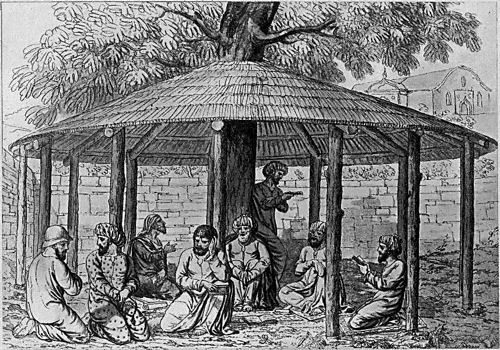
Cast off this false hypocrisy's veneer;
This life a moment is, the next all time,
Sell not eternity for earthly gear!
280. C. L. N. A. B. I. Note ra separated from its noun, as before. Vullers, p. 173.
My heart contracted with perplexity;
I gird me with the Magian zone, and why?
For shame so poor a Musulman to be.
281. C. L. N. A. I. J. In line 1 scan nadaniyi, dissolving the long ya.
And still the charms of tulip cheeks adore;
You'll soon not be, rejoice then that you are,
Think how 'twould be in case you were no more!
Of cups in converse did I chance to see,
And lo! one lifted up his voice, and cried,
«Who made, who sells, who buys this crockery?»
283. C. L. N. A. B. I. J. Men's speculations.
I saw a sage, who a great wine-jug bore;
I said, «O Shaikh, have you no shame?» Said he,
«Allah hath boundless mercy in his store.»
284. C. L. N. A. I. J. Sar mast, a compound, hence izafat omitted. Saboyey, hamza (for conjunctive ya) followed by ya i tankir. See Lumsden, ii. 269.
I, like Elias, find it where I can,
'Tis sustenance for heart and spirit too,
Allah himself calls wine «a boon to man.»
285. C. L. N. A. I. J. Koran, ii. 216. Elias discovered the water of life.
By day and night, with strains of music drink!
Where'er thou lightest on a cup of wine,
Spill just one drop, and take the rest and drink!
286. C. L. N. A. I. J. To spill a drop is a sign of liberality.—Nicolas.
I hold with none but that of loving Thee;
What matter faith, unfaith, obedience, sin?
Thou'rt all we need, the rest is vanity.
287. N. See note on Quatrain 194. Forms of faith are indifferent. See Gulshan i Raz, p. 83.
As for my sins, forgive them by the score;
Let not my faults kindle Thy wrath to flame;
By blest Muhammad's tomb, forgive once more!
288. L. N. B. Rasul-ullah: the construction being Arabic, izafat is needed. Lumsden, ii. p. 251. Also ascribed to Zahir ud-din Faryabi.
And what far-sighted person goes to meet it?
Cheer up! bear not about a world of grief,
Your fate is fixed, and grieving will not cheat it.
With tokens of the Maker's favour crowned;
Yet the world's Potter takes his masterpiece,
And dashes it to pieces on the ground!
290. C. L. A. I. J. So Job, «Is it good unto Thee that Thou shouldest despise the labour of Thine hands?»
A limpid soul in the cup's earthen ware;
No dull, dense person shall be friend of mine
Save wine-cups, which are dense and also rare.
291. L. N. B. Layik . man izafat omitted because of the intervening words. Lumsden, ii. 250.
No ties of salt, you flay me like an eel!
A woman's wheel spins clothes for man and wife,
It does more good than you, O heavenly wheel!
I would make shift to deck it with a thorn;
And if I lacked my prayer-mats, beads, and Shaikh,
'Those Christian bells and stoles I would not scorn.
293. C. L. N. A. I. (under Te). Line 2 is omitted in the translation. So Pope, «For forms and creeds let graceless zealots fight.»
«Let it be open war and shame instead;
The man who scorns bright wine had best beware,
I'll arm me with a stone, and break his head!»
Arise! and drain a morning draught with me!
Away with gloom! full many a dawn will break
Looking for us, and we not here to see!
295. C. L. N A. I. J. Bisyar, «frequently.»
Nor wash in water of remorse's well,
When winds of death shall quench your vital torch,
Beware lest earth your guilty dust expel.
296. L. Possibly written by some pious reader as an answer to Khayyam's scoffs. See note on Quatrain 223.
All wise men know things are not what they seem;
Be of good cheer, and drink, and so shake off
This vain illusion of a baseless dream.
297. L. N. All earthly existence is «Maya»
As roses newly plucked, your wine-cups share,
Or e'er Death's blasts shall rend your robe of flesh
Like yonder rose leaves, lying scattered there!
298. C. L. N. I. J. The Lucknow commentator says daman i gul means the maid's cheek.
Woo the sweet daughter of the grape, no other;
The daughter is forbidden, it is true,
But she is nicer than her lawful mother!
299. N. «Daughter of the grape,» i.e., wine, a translation of an Arabic phrase.
My heart was speaking, but my tongue was dumb;
Beside the water-brooks I died of thirst.
Was ever known so strange a martyrdom?
300. N. Dil rubaye, «that well-known charmer.» Lumsden, ii. 142. Pur sukhan. See note on No. 227.
In concert with the bulbul's symphony;
Wine would not gurgle as it leaves the flask,
If drinking mute were right for thee and me!
Nor yet with lavished gold may it be bought;
But, if you yield your life for fifty years,
From words to «states» you may perchance be brought.
302. L. Line 3, literally, «Unless you dig up your soul, and eat blood for fifty years.» «States» of ecstatic union with the «Truth,» or Deity of the Mystics.
Unto this lowly sphere of earth beneath,
And leapt out free from bonds of fraud and lies,
Yea, every knot was loosed, save that of death!
Pass man's experience, and man's theory;
In joyful seasons naught can vie with wine,
To all these riddles wine supplies the key!
Sinner! despair not, but His mercy trust!
For though to-day you perish in your sins,
To-morrow He'll absolve your crumbling dust.
305. C. L. N. A. I. J. A very Voltairean quatrain.
Unloose me from your chain of tyrannies!
If none but fools your favours may enjoy,
Then favour me,—I am not very wise!
Than I do, though to wine I do give way;
I drink the blood of grapes, you that of men:
Which of us is the more bloodthirsty, pray?
307. C. L. N. A. I. J. Alluding to the selling of justice by Muftis.
For what is past, and what is yet to be;
Our prisoned spirits, lent us for a day,
A while from season's bondage shall go free!
308. C. L. N. A. I. J. 'Ariyati rawan, «this borrowed soul.»
And sheds his outworn life, as trees their leaves,
Full gladly will he sift this world away,
Ere dustmen sift his ashes in their sieves.
I liken to a lamp's revolving shade,
The sun the candlestick, the earth the shade,
And men the trembling forms thereon portrayed.
310. C. L. N. A. B. I. Fanus i khiyal, a magic or Chinese lantern.
Who spun my web of silk and wool? Not I.
Who wrote upon my forehead all my good,
And all my evil deeds? In truth not I.
311. C. L. N. A. I. In line 2 rhyme shows the word to be rishtai, not rushtai.
But count to-day as gain, my brave compeers!
To-morrow we shall quit this inn, and march
With comrades who have marched seven thousand years.
312. C. L. N. A. I. J. Badauni (ii. 337) says the creation of Adam was 7000 years before his time. Compare Hafiz, Ruba'i 10.
Wine keeps heart, faith, and reason too, amused;
Had Iblis swallowed but a single drop,
To worship Adam he had ne'er refused!
313. C. L. (in part) N. A. I. J. See Koran, ii. 31.
Thy sweet Narcissus eyes, and grape-juice pour;
A score of cups is no such great affair,
But 'tis enchanting when we reach three score!
314. N. Narcissus eyes, i.e., languid.
Nor sue for favours from good men, or base;
I have but ONE to lend a helping hand,
He knows, as well as I, my sorry case.
315. C. L. N. A. I. J. A «Haliya» quatrain, lamenting his own condition.
And by my own base lusts I am undone,
Without the wit to abandon worldly hopes,
And wanting sense the world's allures to shun!
And hid beneath it others I descry,
And others, not yet come, or passed away,
People the desert of Nonentity!
317. C. L. N. A. I. J. The sleepers on the earth are those sunk in the sleep of superstition and ignorance.
How can the pilgrim faint whilst Thou art near?
On the last day Thy grace will wash me white,
And make my «black record» to disappear.
318. C. L. N. A. I. J. Lumsden, ii, 72. See Koran, xiii. 47.
And see my disembodied spirit fly;
I tremble not at death, for death is true,
'Tis my ill life that makes me fear to die!
319. C. L. N. A. I. J. «Death is true,» i.e. a certainty. So Sir Philip Sidney (after M. Aurelius), «Since Nature's works be good, and death doth serve as Nature's work, why should we fear to die?»
Our tale of days or years cease to discuss,
And take our jugs, and plenish them with wine,
Or e'er grim potters make their jugs of us!
For that I drink, and am a libertine?
Thou hast thy weary beads, and saintly show,
Leave me my cheerful sweetheart, and my wine!
I think on my ill deeds with shame and pain;
I trust Thou wilt assoil me of my sins,
But even so, my shame must still remain.
One body with two heads, like you and me,
Which wander round one centre, circlewise.
But at the last in one same point agree.
323. C. L. N. A. I. Mr. Fitzgerald quotes a similar figure used by the poet Donne, for which see Ward's «English Poets,» i. 562. The two heads are the points of the compasses.
'Tis folly wine and sweethearts to eschew;
Why ask if earth etern or transient be?
Since you must go, it matters not to you.
But, by great Allah, it is not to pray;
No! but to steal a prayer-mat! When 'tis worn,
I go again, another to purvey.
325. C. L. N. A. B. I. J. To «steal a prayer-mat» is to pray to be seen of men.—Nicolas. A satire on some hypocrite, perhaps himself.
But let us rather rosy wine consume,
The world our murderer is, and wine its blood,
Shall we not then that murderer's blood consume?
326. L. N. See Koran, ii. 187.
And, if I shrink, the penalty to pay;
Though life might satisfy Thy cruelty,
'Twere naught, I'll bear it till the judgment-day!
Our pride of manhood humbled and abated;
Would we were gone! long since have we been wearied
With this world's griefs, and with its pleasures sated.
And with bright wine, and gladness ever dwell!
They say, «May Allah grant thee penitence!»
He grants it not, and, did he, I'd rebel!
329. C. L. N. A. B. I. J. A pun in the original.
And pluck my feathers, and my life-blood drain,
Then mould me to a cup, and fill with wine,
Haply its scent will make me breathe again.
I find its favours shamefully misplaced;
Allah be praised! I see myself debarred
From all its boons, and wrongfully disgraced.
331. C. L. N. A. I. Alam hama, etc., «states entirely gratuitous.» Write baran without a madd. Bl., Prosody, p. 11. Compare Shakespeare, Sonnet 66.
And dash to bits the glass of good repute;
My long-extending hopes I will renounce,
And grasp long tresses, and the charming lute.
I know Thou would'st to mercy be inclined;
Thou sayest, «I will help in time of need»
One needier than I where wilt Thou find?
333. C. L. N. A. I. J. The waw in 'afw is a consonant, and therefore takes kasra for the izafat, without the intervention of conjunctive ya.
Gueber or infidel? Suppose I am?
Each sect miscalls me, but I heed them not,
I am my own, and, what I am, I am.
334. C. L. N. A. I. J. Zan i khud for azan i khud, «my own property.»
And drink I will to-night on Kadr's feast;
And throw my arms about the wine-jar's neck,
And kiss its lip, and clasp it to my breast!
335. C. L. N. A. I. J. Kadr the night of power. Koran, xcvi. 1.
The lore of things above, and things below;
But all this lore will cheerfully renounce,
If one a higher grade than drink can show.
336. L. N. B. Line 1, Being and Not-being, «Grade,» i.e., of learning.
Nor am I grasping, save of cups of wine;
I scruple to adore myself, like you;
For this cause to wine-worship I incline.
337. C. L. N. A. I. J. A hit at the vain and covetous Mollas. Also ascribed to Anwari.
What mankind really are—moulded of clay,
Affliction's clay, and kneaded in distress,
They taste the world awhile, then pass away.
338. C. L. N. A. I. J. Note the archaic form.
And drink in lessons of true manhood there,
And pass our lives in taverns, if perchance
The time mis-spent in mosques we may repair.
339. L. N. This quatrain is probably Mystical.
The precious apple of great wisdom's eye;
The circle of existence is a ring,
Whereof the signet is humanity.
340. C. L. N. A. I. Man is the microcosm. See Gulshan i Raz, p. 15. «The captain jewel of the carcanet.»
Aspire to heaven, and earth's low trammels spurn;
But, when we drop this fleshly clog, 'tis seen
From dust we came, and back to dust return.
Think not I meant it; no! I thought 'twas past;—
That day more weary than a sleepless night,—
And blesséd breakfast-time had come at last!
342. L. N. Roza khwardan, «to avoid fasting.» In line 2, for bekhabar read bakhabar.
But grief's fell hand infused a drop of gall;
Nor dipped my bread in pleasure's piquant salt,
But briny sorrow made me smart withal!
343. C. L. N. A. I. Line 4, literally, «eat a roast of my own liver.»
And with distraught Kalendars pass the day;
O Thou! who know'st things secret, and things known,
Grant me Thy grace, that I may learn to pray!
344. C. L. N. A. I. J. Khafiyyat means «manifest,» as well as «concealed.» Lucknow commentator.
So I eat once a day I don't complain;
And, since earth's kitchen yields no solid food,
I pester no man with petitions vain.
345. C. L. N. A. I. J. In line 3 the Alif in az is not treated as an Alif i wasl. Bl., Pros. 10.
Never for one short moment glad to be!
I served a long apprenticeship to fate,
But yet of fortune gained no mastery.
346. C. L. N. A. I. J. Ek dam zadan, «For one moment.»
I half incline to wrong, and half to right;
The azure-marbled sky looks down on me
A sorry Moslem, yet not heathen quite.
347. C. L. N. A. I. J. Khayyam here describes himself as akrates rather than akolastos, «Video meliora proboque,» etc.
And with due reverence ask him to say,
Why it has pleased him to forbid pure wine,
When he allows his people acid whey?
348 and 349. L. These two quatrains are also found in Whalley's Morababad edition. Mustafa, i.e., Muhammad. So Avicenna. See Renan, Averroes, 171.
He strangely misinterprets my plain rules:
Where have I said that wine is wrong for all?
'Tis lawful for the wise, but not for fools.
But Allah knows full well they greatly err;
I know not even what I am, much less
Why on this earth I am a sojourner!
350. C. L. A. I. J. Filsafat meant the Greek philosophy as cultivated by Persian rationalists, in opposition to theology. Renan, Averroes, p. 91.
The more abase myself, the higher soar;
And, strange! the more I drink of Being's wine,
More sane I grow and sober than before.
For in my mouth rich golden gems I bear»:
I said, «Show me another proof.» Quoth she,
«Behold this blood-stained vesture that I wear!»
352. B. L. Yusuf is the type of manly beauty. The yellow stamens are compared to his teeth. So Jami, in Yusuf wa Zulaikha.
And long ago did master all they know;
Here now the end and issue of it all,
From earth I came, and like the wind I go!
353. L. B. Mr. Fitzgerald compares the dying exclamation of Nizam ul-Mulk, «I am going in the hands of the wind!» Mantik ut Tair, 1. 4620.
With grief we go, although we came with mirth;
Watered with tears, and burned with fires of woe,
And, casting life to winds, we rest in earth!
I compassed sea and land, and viewed the whole;
But, when I asked the wary sage, I learned
That bowl was my own body, and my soul!
355. L. King Jamshid's cup, which reflected the whole world, is the Holy Grail of Persian poetry. Meaning «man is the microcosm.» See note on No. 340. In line 2 scan naghnudem.
And from a knight to a poor pawn translate,
You marshal all your force to tire me out,
You take my rooks with yours, and then checkmate!
356. C. L. A. I. J. The pun on rukh, «cheek,» and rukh, «castle,» is untranslatable.
How can I frame my will to will aright?
Each single act I will must needs be wrong,
Since none but He has power to will aright.
«I'll break the law, and please myself instead,
With blooming youths, and maidens' tulip cheeks
The plain shall blossom like a tulip-bed.»
358. L. N. Rozi, ya i batni, or tankir (?).
Or walk this blood-stained pathway of myself;
This being is not I, it is of Him.
Pray what, and where, and whence is this «myself»?
359. C. L. A. I. J. In line 3 I omit wa after Lu bud. Meaning, Man's real existence is not of himself, but of the «Truth,» the universal Noumenon.
Drag on life's load without my cups I cannot!
I am the slave of that sweet moment, when
They say, «Take one more goblet,» and I cannot!
And thoughts of that dread day of doom eschew,
Bethink you of your latter end; be sure
As time has treated others, so 'twill you!
Getting and spending too much trouble thee!
Arise, and quaff the Etern Cupbearer's wine,
And so from troubles of both worlds be free!
362. C. L. N. A. I. J. So Wordsworth, «The world is too much with us,» etc. The Sufis rejected talab ud dunya, «worldliness,» and talab nl ukharat, «other-worldliness,» for talab nl maula, «disinterested godliness.» So Madame Guyon taught «Holy Indifference.»
Two lucky species of men are known;
One knows all good and ill that are on earth,
One neither earth's affairs, nor yet his own.
363. C. L. N. A. I. J. Taman, «entirely.» The two classes seem to be practical men and mystics.
And hide my failings from the people's hate,
And grant me peace to-day, and on the morrow
Deal with me as Thy mercy may dictate!
364. C. L. N A. I. J. In line 4 scan anchaz.
Its weal and woe with equal mind await:
For, be it weal we meet, or be it woe,
The weal doth pass, and woe too hath its date.
365. C. L. N. A. B. I. J. 'Twill all be one a hundred years hence.
But up! and seize her favours ere they flee;
If fortune always cleaved to other men,
How could a turn of luck have come to thee?
366. C. L. N. A. I. J. This was a saying of Kisra Parviz to his Sultana. Bicknell's Hafiz, p. 73.
Let not heaven's treacherous wheel your heart dismay;
But rest contented in your humble nook,
And watch the games that wheel is wont to play.
Consort with revellers, though they be maligned,
Cast down the gates of abstinence and prayer,
Yea, drink, and even rob, but, oh! be kind!
368. C. L. N. A. B. I. J. A rather violent extension of the doctrine, Mercy is better than sacrifice.
And angels are its senses, who control
Its limbs—the creatures, elements, and spheres;
The ONE is the sole basis of the whole.
369. L. N. So Pope, «All are but parts,» etc.
With true desire to elevate my heart,
Gave me his cup to drink; when I refused,
He said, «Oh, drink to gratify my heart!»
Make it thy care to feed thy soul with glee;
And hold a creed like mine, which is to drain
The cup of wine, not that of misery.
371. So the Ecclesiast, «There is nothing better for a man than that he should eat, and drink, and make his soul enjoy good in his labour.»
This world of vanity from end to end,
You will discover there no other good
Than wine and rosy cheeks, you may depend!
372. N. Note izafat dropped after sahib. Bl., Prosody, p. 14.
I with my wine-cup, and a maiden gay,
So bright it shone, like pearl within its shell,
The watchman cried, «Behold the break of day!»
373. N. Nigare. Here ya may be ya i tankir, the izafat being dispensed with (Lumsden, ii. 269) [?], or perhaps ya i tausifi before the «sifat» marvzum.
Sins of omission and commission too?
Suppose you gain the world, you can but leave it,
You cannot carry it away with you!
He had no home, no faith, no heresy,
No God, no truth, no law, no certitude;
Where in this world is man so bold as he?
375. L. N. A beshara' or antinomian Sufi.
Some grope for doubts or dogmas in the schools;
But from behind the veil a voice proclaims,
«Your road lies neither here nor there, O fools.»
376. C. L. N. A. I. Truth, hidden from theologians and philosophers, is revealed to mystics. See Gulshan i Raz, p. 11.
Beneath the earth another lurks unseen;
And thus to wisdom's eyes mankind appear
A drove of asses, two great bulls between!
377. L. N. The bulls are the constellation Taurus, and that which supports the earth.
What reasons have you for such great excess?»
First, my Love's face, second, my morning draught;
Can there be clearer reasons, now confess?
I'd bid him sweep away this earth and skies,
And build a better, where, unclogged and free,
The clear soul might achieve her high emprise.
379. C. L. N. A. I. J. This recalls the celebrated speech of Alphonso X., king of Castile.
Is ever pining for that Love of mine;
When the Cupbearer poured the wine of love,
With my heart's blood he filled this cup of mine!
380. C. L. N. A. I. Meaning, «the wine of life, or existence, poured by the Deity into all beings at creation.» See Gulshan i Raz, p. 80.
Can hypocritic arts with these compare?
If all who love and drink are going wrong,
There's many a wight of heaven may well despair!
To let grief's millstone weigh your spirits down;
Since none can tell what is to be, 'tis best
With wine and love your heart's desires to crown.
'Tis shameful against heaven to rail and chide;
Still, head had better ache with over drink,
Than be puffed up with Pharisaic pride!
383. C. L. N. A. I. J. Compare «Tartufe,» i. 6.
Pity this bosom stricken with dismay!
Pardon these hands that ever grasp the cup,
These feet that to the tavern ever stray!
Sever from self, and occupy with Thee!
This self is captive to earth's good and ill,
Make me beside myself, and set me free!
385. C. L. N. A. I. J. A Mystic's prayer.
And earth laid bare of old friends torn away!
O live this present moment, which is thine,
Seek not a morrow, mourn not yesterday!
Is sorrow's pangs to feel, and grief to know,
Happy are they that never come at all,
And they that, having come, the soonest go!
387. C. L. A. B. I. J. Compare the chorus in the «Œdipus Coloneus.»
But of ourselves we know not how to live,
So Fortune, like a master, rod in hand,
Raps our pates well to teach us how to live!
To that enigma we can find no key;
They talk of you and me behind the veil,
But, if that veil be lifted, where are we?
389. C. L. A. I. J. Meaning, We are part of the «veil» of phenomena, which hides the Divine Noumenon. If that be swept away what becomes of us?
To take away thy precious life, and mine;
Sit we upon this turf, 'twill not be long
Ere turf shall grow upon my dust, and thine!
They'll place a pair of bricks to mark our tomb;
And, a while after, mould our dust to bricks,
To furnish forth some other person's tomb!
Where kings did bow them down, and homage do,
I saw a ringdove on its arches perched,
And thus she made complaint, «Coo, Coo, Coo, Coo!»
392. C. L. N. A. I. J. Mr. Binning found this quatrain inscribed on the ruins of Persepolis—Fitzgerald. Coo (Ku) means «Where are they?»
And spin life's woof, but for the warp, where is it?
And many a righteous man has burned to dust
In heaven's blue rondure, but their smoke, where is it?
393. C. L. N. A. B. I. J. So Ecclesiastes, «There is no remembrance of the wise, more than of the fool.» «Smoke,» i.e., trace.
Let not the cup's lip touch that lip of thine!
Beshrew me, if I fail to drink his blood,
For who is he, to touch that lip of thine?
394. C. L. N. A. I. J. To a sweetheart.
Thy care hath kept me for a century!
Through all these years I make experiment,
If my sins or Thy mercy greater be.
395. C. L. N. A. I. J. God's long-suffering.
«Haunt purling river bank, and grassy glade;
Full many a moon-like form has heaven's weel
Oft into cup, oft into goblet, made!»
And sell for two grains this world's good and ill;
Know you where you will go to after death?
Set wine before me, and go where you will!
397. L. N. and J. give lines 1 and 2 differently.
Did ever mortal pass a sinless day?
If I do ill, do not requite with ill!
Evil for evil how can'st Thou repay?
398. L. N. Line 3 and 4 are paraphrased somewhat freely.
That heart's delight, that balm of Turkistan;
They say 'tis wrong for Musulmen to drink,
But ah! where can we find a Musulman?
My soul within and spirit are of Thee!
My being is of Thee, and Thou art mine,
And I am Thine, since I am lost in Thee!
400. L. «In him we live and move, and have our being.»
As fate's resistless bat directs the blows;
But He, who gives thee up to this rude sport,
He knows what drives thee, yea, He knows, He knows!
401. C. L. A. I. J. Line 4 is in metre 22, consisting of ten syllables, all long.
And strength to puny limbs of feeble flies,
To Thee we will ascribe Almighty power,
And not base, unbecoming qualities.
402. L. An echo of the Asharian's discussions on the Divine attributes.
Nor vain ambition in its trammels bind;
Be sharp as fire, as running water swift,
Not, like earth's dust, the sport of every wind!
For wine, that charming Turki maids bestow;
Kalendars' raptures pass all things that are,
From moon on high down into fish below!
404. C. L. N. A. B. I. J. For mah L. reads hahk probably a Sufi gloss. Kalendars, bibulous Sufis. Fish, that whereon the earth was said to rest.
Let futile care and sorrow be forgot;
Since this life's vesture crumbles into dust,
What matters stain of word or deed, or blot?
And thinkest to find mercy at the throne,
Hope not for mercy! for good left undone
Cannot be done, nor evil done undone!
406. N. A. I. This quatrain is by Abu Sa'id Abu'l Khair; and is an answer to No. 420, which is attributed to Avicenna.
To walk in jovial courses persevere;
And ere your skull be turned into a cup,
Let wine-cups ever to your hand adhere!
Whereto the wise with awe keep gazing up;
So stoops the bottle o'er his love, the cup,
Feigning to kiss, and gives her blood to sup!
408. C. L. N. A. B. I. Blood, an emblem of hate.
For both world's good and ill I take no care;
Should the two worlds roll to my house, like balls,
When drunk, for one small coin I'd sell the pair!
But the sea smiled, for «I am all,» said he,
«The Truth is all, nothing exists beside,
That one point circling apes plurality.»
410. N. This is in Ramal metre, No. 50. Compare Gulshan i Raz, line 710.
Or try with cheerfulness to bear my lot?
Fill up my cup! I know not if the breath
I now am drawing is my last, or not!
411. C. L. N. A. B. I. J. Some MSS. place this quatrain under Radif ya.
Nor call sad thoughts of parted friends to mind;
Devote thy heart to sugary lips, and wine,
Cast not thy precious life unto the wind!
Rather go drink, were it on charity!
Yea, drink, Khayyam, your dust will soon be made
A jug, or pitcher, or a cup, may be!
413. N. «Imperial Cæsar, dead, and turned to clay Might stop a hole to keep the wind away.»
How forward breezes rend their veils in twain;
Sit we beneath this rose, which many a time
Has sunk to earth, and sprung from earth again.
414. L. N. B. So Moschus on the mallows.
When life's last page is read and turned, what then?
Suppose you live a hundred years of bliss,
Yea, and a hundred years besides, what then?
415. C. L. N A. I. J. See Vullers, p. 100.
Cypress and lily men as «free» describe?
This has a dozen tongues, yet holds her peace,
That has a hundred hands which take no bribe.
416. L. N. Sa'di in the Gulistan, Book viii., gives another explanation of this expression. «Tongues, stamens, and hands, branches.»
Bring that delicious darling, let me grasp it!
That pleasing chain which tangles in its coils
Wise men and fools together, let me grasp it!
417. L. N. Bipechand seems a plural of dignity.
What with forbidden meats, and lusts, alack!
And leaving undone what 'twas right to do,
And doing wrong, my face is very black!
418. C. L. N. A. I. These whimsical outbursts of self-reproach in the midst of antinomian utterances are characteristic of Khayyam.
I could dispense with all, but with wine, never!
If so be I became a Musulman,
Could I abjure my Magian wine? no, never!
419. L. N. The Magians sold wine.
Nor seek by merits for our sins to atone;
Mercy drops where it lists, and estimates
Ill done as undone, good undone as done.
420. L. N. A. I. This quatrain is also ascribed to the celebrated philosopher Avicenna. See No. 406.
Wherein Thou workest marvels manifold;
Can I aspire to be a better man,
Or other than I issued from Thy mould?
421. C. L. N. A. I. This is a variation of No. 221.
To Thee both small and great for ever pray,
Thou takest woe away, and givest weal,
Give then, or, if it please Thee, take away!
422. L. Scan bandagita, omitting fatha before te. Vullers, p. 197.
Thou art grown double, and thy credit stale,
Thy nails are thickened like a horse's hoof,
Thy beard is ragged as an ass's tail.
423. C. L. A. I. J. A description of old age.
Ye are a nothing, built on empty wind!
Yea, a mere nothing, hovering in the abyss,
A void before you, and a void behind!
424. C. L. A. I. J. The technical name for existence between two non-existences is Takwin. Bl. Ain i Akbari, p. 198. Compare the term «nunc stans,» applied to Time by the Schoolmen.
Of wine, and tavern haunts no more frequent»;
But while 'tis spring, and roses are in bloom,
To loose me from my promise, O consent!
Rather let tangled curls attract your view;
And shed the bottle's life-blood in your cup,
Or e'er death shed your blood, and feast on you.
426. C. L. N. A. B. I. J. Bigorezi bi, «better that you should eschew.»
Where wisest men have failed, wilt thou succeed?
Quaff wine, and make thy heaven here below,
Who knows if heaven above will be thy meed?
Sleep in delusion's dust for evermore;
Go, boy, and fetch some wine, this is the truth,
Their dogmas were but air, and wind their lore!
428. C. L. N. A. B. I. J. So Ecclesiastes, «I gave my heart to know wisdom ... and perceived that this also is vanity.»
You lose yourself, but find your Self indeed;
And, when you drink of His entrancing cup,
You hasten your escape from quick and dead!
429. C. L. N. A. I. J. Die to self, to live in God, your true self. See Max Müller, Hibbert Lectures, p. 375.
Why should the people rail and chide at me?
Would that all evil actions made men drunk,
For then no sober people should I see!
Who fume and sweat because of these eleven,
Drink! I have told you seventy times and seven,
Once gone, nor hell will send you back, nor heaven.
And threatenest, if I fall therein, to slay;
Thy rule resistless sways the world, yet Thou
Imputest sin, when I do but obey!
432. B. N. Allah is the Fa'il i hakiki, the only real agent, according to the Sufi view, Hukmi tu Kuni, «Thou givest thy order.»
Our sins and righteous deeds alike seem naught,
May Thy grace sober me, though drunk with sins,
And pardon all the ill that I have wrought!
Each day would be an 'lid of festal day,
And men might conquer all their hearts' desire,
Fearless of after penalties to pay!
434. N. N takes taklid in the sense of «authority,» but I think it alludes to Koran, xxix. 64. See Gulshan i Raz, p. 50.
And rend to shreds my scanty joy's attire,
The water that I drink you foul with earth,
And turn the very air I breathe to fire!
You'd soar a sprite about the heavenly throne;
Had you no shame to leave your starry home,
And dwell an alien on this earthly zone?
Put not to such base use man's mortal part!
See, thou art mangling on thy cruel wheel
Faridun's fingers, and Kai Khosrau's heart!
437. C. L. N. A. I. Faridun and Kai Khosrau were ancient kings of Persia. Kai Khosrau is usually identified with Cyrus.
As wine excels the pearl within its shell;
O fortune! thou dost ever show thyself
More strange, although I seem to know thee well!
Those dainties, seeming real, but really vain,
Which greedy worldlings gorge to their own loss;
Renounce that loss, so loss shall prove thy gain!
So that they cry to God the live-long night;
Nor plume thee on thy wealth and might, which thieves
May steal by night, or death, or fortune's might.
440. N. Ta bar nikashand, «Let us abstain from oppressing people, so that they may not heave a sigh, saying, O Lord.»
What caused Thee to divorce her from Thy side?
Thou didst not use to treat her thus of yore,
Why then now doom her in the world to abide?
Which we, poor pilgrims, might at last attain,
And after many thousand wintry years,
Renew our life, like flowers, and bloom again!
An ardent youth cried out in ecstasy,
«Who owns a sweetheart beauteous as the moon,
Might wish his moments long as years to be!»
443. C. L. N. A. I. Compare the «sortes Virgilianæ.» Line 4 is freely paraphrased.
Soon will the pages of life's book be done!
Well saith the sage, «Life is a poison rank,
And antidote, save grape-juice, there is none.»
Quit saintly show, and feigned austerity,
And quaff the wine that Murtaza purveys,
And sport with Houris 'neath some shady tree!
445. N. Note the change from the imperative to the aorist. In line 4 scan Murtazasha. Murtaza (Ali) is the celestial cupbearer.
In a mad drunken freak, as I must own,
And lo! the cup cries out in agony,
«You too, like me, shall soon be overthrown.»
446. C. L. N. A. B. I. Saboyiy, ya i batni, joined to the noun by euphonic or conjunctive ya.
Cupbearer, bring some wine, I beg of thee!
This hooded cowl and prayer-mat pawn for wine,
Then will I boast me in security.
See! you go empty, as you empty came;
You say, «I will not drink and peril life,»
But, drink or no, you must die all the same!
And guide the way, O Thou of guides the surest!
Directors born of men shall not direct me,
Their counsel comes to naught, but Thou endurest!
Calling me infidel and atheist:
My errors I will not deny, but yet
Does foul abuse become a moralist?
450. C. L. N. A. I. In line 1 scan goyi-yaz, Bl., Prosody, p. 10. The tashdid of mukin is dropped.
Chafe not at woe, and healing thou wilt gain;
Though poor, be ever of a thankful mind,
'Tis the sure method riches to obtain.
451. L. N. Dawayiy. The first ya is the conjunctive ya (Vullers, p. 16), the second ya i tankir.
A pittance bare, a book of verse to read;
With thee, O love, to share my lowly roof,
I would not take the Sultan's realm instead!
452. N. B. Tange, the izafat is displaced by ya i tankir, according to Lumsden, ii. 269.
Be their dark problems one, or many score;
We are but earth, go, minstrel, bring the lute,
We are but air, bring wine, I ask no more!
453. N. C. L. A. I. J. give only the first line of this. Five senses, four elements.
Write me the draft for wine they call Barat!
The day my weariness is drowned in wine
Will seem to me as the great night Barat!
454. C. L. N. A. I. J. Yasin is the 64th, and Barat the 9th, chapter of the Koran. Barat, the «night of power.»
Step not beyond the bounds of destiny;
Bear up, though very Rustums be thy foes,
And crave no boon from friends like Hatim Tai!
And lute, and harp, your dearly cherished toys,
Are mere redundancies, and you are naught,
Till you renounce the world's delusive joys.
456. L. N. Hashw, mere «stuffing,» leather and prunella.
Quaff wine to face the world, and all its woe;
Your origin and end are both in earth,
But now you are above earth, not below!
Why then remain a prey to empty fear?
You cannot bend things to your will, but yet
Cheer up for the few moments you are here!
458. C. L. N. A. I. J. Scan chim wakifiyay.
Sweet verdure springs, and crystal Kausars rise;
And plains, once bare as hell, now smile as heaven:
Enjoy this heaven with maids of Paradise!
(I give this counsel confidentially),
Put up with pain, and seek no antidote,
Endure your grief, and ask no sympathy!
Surpassing all your lore traditional;
Better to fast than eat of every meat,
Better to live alone than mate with all!
461. N. Hadis i na goyayiy. The unwritten revelations, or traditions, opposed to Qur'an (Koran), the «reading.» So sruti is opposed to smriti.
And then grow sweet, while wine is sharp again?
When one has carved a block into a lute,
Can he from that same block a pipe obtain?
Why shrills the bird of dawning his lament?
It is to show in dawn's bright looking-glass
How of thy careless life a night is spent.
463. C. L. N. A. I. J. So Job, «Hast spread the sky as a molten looking-glass.»
Pour blood-red wine, the world's despite to cure!
Where can I find another friend like wine,
So genuine, so solacing, so pure?
Or rival Cæsar on his throne of Rūm,
Drain Jemshid's goblet, for your end's the tomb,
Yea, were you Bahram's self, your end's the tomb!
465. N. Jamhur, a name of Buzurjimihr, Wazir of Nushirwan. Faghfur, the Chinese emperor.
He turned his wheel and deftly plied his trade,
And out of monarchs' heads, and beggars' feet,
Fair heads and handles for his pitchers made!
466. C. N. L. A. I. J. Paya, «the treadle.»
And the Etern Cupbearer's goblet drain,
If not, true senselessness is not for you,
Not every fool true senselessness can gain!
467. L. N. Meaning, the «truly Mystical darkness of ignorance.» See Gulshan i Raz, p. 13.
And potters make their jugs of me and you,
Pour from this jug some wine, of headache void,
And fill your cup, and fill my goblet too!
468. C. L. N. A. I. J. Headache, in allusion to the wine of Paradise, Koran, lvi. 17.
Lift sorrow's burden from your lover's heart;
Your wealth of graces will not always last,
But slip from your possession, and depart!
469. C. L. N. A. I. J. Some MSS. read zinhar for zihar, either will scan.
And blows of ruthless fortune lay thee low;
Acquire some substance here, there is none there,
For those who thither empty-handed go!
470. L. N. Line 2 is in metre 4. Meaning, «Work while it is day.»
Who turns the troublous wheel of heaven but Thou?
Though we are sinful slaves, is it for Thee
To blame us? Who created us but Thou?
Would I could drench this silly frame of mine
With thee, that passers by might think 'twas thou,
And cry, «Whence comest thou, fair master wine?»
«You seem a slave to drink and lechery»;
And she made answer, «What I seem I am,
But, Master, are you all you seem to be?»
473. L. N. The technical name of quatrains like this is suwal o jawab, or muraja'at. Gladwin, Persian Rhetoric, p. 40.
When drunk, I'd rate it at a barley-corn;
Last night they offered me in pawn for wine,
But the rude vintner laughed that pledge to scorn.
474. C. L. N. A. I. J. Note the yas i tankir in Kuye, juye, and giraye.
And now display it in this universe;
Thou the spectator, Thou the spectacle,
Sole to Thyself Thy glories dost rehearse.
475. C. L. N. A. I. J. Compare the Vulgate, «ludens in orbe terrarum,» and Gulshan i Raz, p. 14.
Than plant a desert with a colony;
Rather one freeman bind with chains of love,
Than set a thousand prisoned captives free!
A pang of sorrow to thy fellow's heart,
Go! mourn thy perished wit, and peace of mind,
Thyself hast slain them, like the fool thou art!
Set to, and drink it like a libertine;
Whoso acts thus will set his spirit free
From saintly airs like yours, and grief like mine.
478. C. L. N. A. B. I. J. Chu mane, «of one like me.» So in No. 170 (the note which is wrong). Vullers, p. 254. Literally, «mustaches and beards.»
Bread of the flower of wheat, and mutton chine,
And you, O Tulip cheek, to share my hut,
Not every Sultan's lot can vie with mine.
And an intriguer, if you live alone,
Trust me, though you were Khizr or Elias,
'Tis best to know none, and of none be known.
I did repent, but, ah! 'twas all in vain;
Preach not to me of Noah and his flood,
But pour a flood of wine to drown my pain!
481. C. L. N. A. I. J. Tauba i Nassuh, a repentance not to be repented of. Nicolas. In line 2 note the izafat dropped after silent he.
The pangs of absence I can scarce sustain,
My grief I dare not tell to any friend;
O trouble strange, sweet passion, bitter pain!
482. N. These quatrains are called firakiya, and are rare in Khayyam.
And here am I before the vintner's hall;
This is no time of piety. Be still!
And drop your talk and airs devotional!
Pour wine, and lift your tuneful voice on high,
Sing how Jemshids and Khosraus bit the dust,
Whelmed by the rolling months, from Tir to Dai!
484. C. L. N. A. I. Tir and Dai, April and December.
For all thou keepest righteous company;
But drink, for, drink or no, 'tis all the same,
If doomed to hell, no heaven thou'lt ever see.
485. C. L. N. A. I. J. Koran, xvi. 38: «Some of them there were, whom Allah guided, and there were others doomed to err.»
And earth, and that at once, before my eyes,
And either raze my name from off his roll,
Or else relieve my dire necessities!
486. N. This rather sins against Horace's canon, «Nec Deus intersit,» etc.
And bread unbegged for day by day bestow;
Yea, with thy wine make me beside myself.
No more to feel the headache of my woe!
In hell, and feed its bale-fires in thy turn,
Presume not to teach Allah clemency,
For who art thou to teach, or He to learn?
488. C. L. N. A. I. J. The Persian preface states that, after his death, Omar appeared to his mother in a dream, and repeated this quatrain to her. For the last line I am indebted to Mr. Fitzgerald.
Heedless of all that you might do or say,
Without so much as «By your leave» they fixed
Your lot for all the morrows yesterday!
489. C. L. A. B. I. Predestination.
I would as lief not go, if I were asked,
And, to be short, I would annihilate
All coming, being, going, were I asked!
490. C. L. N. (in part) A. B. I. J. So the Ecclesiast, «Therefore I hated life,» etc.
Flesh is a pipe, spirit the voice within;
O Khayyam, have you fathomed what man is?
A magic lantern with a light therein!
264
With baths, mills, and canals that run not dry,
While good men have to pawn their goods for bread:
Pray, who would give a fig for such a sky?
492. B. L. In line 3 I read nih and for nihand, which will not scan. Line 4 is slightly paraphrased.
Pounding some earth and shreds of pottery;
I looked with eyes of insight, and methought
'Twas Adam's dust with which he made so free!
493. C. L. A. I. J. Note the arrangement of the prepositions bar . . bazer. Bl., Prosody, xiii.
To all woe's species he holds a key,
Whene'er my mood is sad, he brings me wine,
And that makes all the difference to me!
494. C. L. A. I. A play on terms of Logic.
That you are foul oppression's votaress;
You cherish bad men, and annoy the good;
Is this from dotage, or sheer foolishness?
495. C. L. A. I. J. Mu'takif, a devotee.
Wearing your precious spirit with annoy,
Know that these things you set your heart upon
Sooner or later must the soul destroy!
Creation is summed up, O man, in thee;
Angel and demon, man and beast art thou,
Yea, thou art all thou dost appear to be!
497. L. Man, the microcosm. Line 2 is one syllable short.
Speak well of Moslem, Christian, and Jew;
So shall you be esteemed of great and small,
And none will venture to speak ill of you.
That you should thus annoy me? Tell me true;
To get a drink I have to cringe and stoop,
And for my bread you make me beg and sue.
But in this unjust world be just and fair;
And since the issue of the world is naught,
Think you are naught, and so shake off dull care!
500. L. B. In line 3 scan nesatiyast.
THE
QUATRAINS OF OMAR KHAYYAM
TRANSLATED INTO PROSE FROM THE
FRENCH VERSION OF
MONSIEUR J.B. NICOLAS
THE QUATRAINS OF KHAYYAM
This grand old poet, who flourished in the 11th century and who brought into Khorasan the delights of the Court of the Seldjoukides, still, in our day, continues to charm with the pleasures of the palace of the Kadjars at Teheran. But the difficulty, on the one hand, of translating a writer so essentially abstract in his philosophic thought, so Mystically foreign in his figurative expressions (too often presented in the form of a repulsive materialism), and on the other, the embarrassment I could foresee in the correcting of proofs at so great a distance from Paris, and above all the feeling of my incapacity for undertaking so great a work, always prevented my publishing anything up to the present time.
On my last journey to Paris, I met some friends eager for something new in the way of Oriental literature, among whom I am pleased to mention Madam Blanchecotte, moralist and poet, known through her many witty and impassioned publications. After having listened to the brief quotations which I was able to cite to them from the quatrains of the poet with whom we are now occupied, they so strongly urged me to publish a complete translation, and put so much emphasis on their demand and so much kindness in their offers of service, that I decided to conform to their desires in editing this work to-day.
I should, however, still have considered it beyond my powers, without the co-operation of Hassan-Ali-Khan, minister plenipotentiary from Persia at the Court of the Tuileries, who put himself out to aid me with his profound erudition and valuable advice.
The history of Khayyam, bound to that of two persons who played a great rôle in the annals of the country,270 is, I believe, of sufficient interest to warrant my telling it here as it has been transmitted to us by the Persian historians.
Khayyam, born in a village situated near Nishapur, in Khorasan, went to complete his studies at the celebrated medresseh of that city, towards the end of the year 1042 of the Christian era. Accounts tell us that this college had acquired at that time the reputation of producing pupils of rare distinction, from among whom men of talent and remarkable skill often sprung up and rapidly attained to the highest positions in the empire.
Abdul-Kassem and Hassan-Sebbah, fellow-students with Khayyam, were the two comrades to whom he was especially attached, notwithstanding a divergence of character and opinion which would seem to indicate in him another choice. One day Khayyam asked his two friends, in a jesting manner, if a compact entered into among them, and based upon absolute necessity, for that one of the three whom Fortune most favored to come to the aid of the other two, heaping benefits upon them, would appear to them a childish thing. «No, no,» answered they, «the idea is excellent and we will adopt it with all eagerness.» Immediately the three friends clasped hands and vowed that when the time came they would be faithful to their agreement. This pact but stimulated the emulation of the three young people. They applied themselves to their studies with more ardor even than was demanded of them, since in accordance with the tradition of the college, the high places belong to those who merit them.
Khayyam, of a sweet and modest nature, was rather given to the contemplation of divine things than to the pleasures of worldly life. This tendency and the kind of study he cultivated made of him a Mystic poet, a philosopher at once skeptical and fatalistic, a Sufi—in a word, what most Oriental poets are.
Abdul-Kassem, on the contrary, ambitious and positive in the full acceptation of the word, anxious to come into power, applied himself principally to the study of the history of his country, which presented to him numerous271 examples of celebrated men who, by their merit and courage, had come into the highest offices, and where, besides, he found excellent lessons in all branches of administration. He became an illustrious statesman. As for Hassan-Sebbah, as ambitious as his fellow-student Abdul-Kassem, but less skilful, and more violent than he in the application of means, artful and jealous of the superiority of his comrades, he followed somewhere nearly the same studies, holding ever to the purpose of serving himself by the ruin of all those who dared to oppose his advancement in the career he had chosen. He also became celebrated, as will be shown farther on in this preface, through the cruelties he committed and the blood he spilled.
Their studies ended, the three friends left college and separated to return to their own homes, where they remained a certain length of time without renown. Abdul-Kassem, however, was not long in making himself advantageously known at the Court of Alp-Arslan, the second king of the dynasty of the Seldjoukides, through divers writings on the subject of administration, and soon became the private secretary of that monarch, then under-secretary of State, and finally Prime Minister.
Alp-Arslan, in putting this skilful administrator at the head of affairs in his empire, conferred upon him the honorary title of Nizam-el-Moulk, «Regulator of the Empire,» a title which, among the Persians, replaces the name of the person to whom it is granted. The historians of that time write in eulogy of this great man and, attributing to his virtues and his ability the success and prosperity of Alp-Arslan's reign, hold in profound admiration the discernment of that monarch, who knew how to attach to himself a minister endowed with so much skill in directing the affairs of his vast Principalities, which attained, under his administration, the highest degree of glory of which the Persian annals make mention.
It was towards that epoch, where Nizam-el-Moulk (for henceforth it is by this title that we shall designate him) had arrived at the apogee of his power, that his272 two friends came to recall to him the contract concluded amongst them. «What do you demand of me?» he said to them.
«I only ask,» responded Khayyam, «that I may enjoy the revenues of my native village. I am a Sufi and not ambitious; if you accede to my request, I could, under my paternal roof, far from the inseparable fetters of the things of this world, cultivate poesy, which delights my soul, and peaceably contemplate the works of the Creator, which is acceptable to my mind.»
«As for me,» said Hassan-Sebbah, «I ask a place at Court.»
The minister granted everything: the young poet returned to his village, of which he became chief, and Hassan-Sebbah took his place at Court, where, crafty courtier that he was, he was not long in getting into the good graces of the monarch. But, although he had already acquired the highest distinction possible, thanks to the effective aid of Nizam-el-Moulk, his envious and zealous mind could not accommodate itself to the kind of submission in which he found himself, face to face with his benefactor. He immediately went to work to overturn and supplant him.
To this end, he commenced to insinuate to Alp-Arslan that the royal finances were not in good state, the minister having neglected the collecting of taxes, and not having rendered an account upon this important subject for three years. The Prince gave ear to these treacherous criticisms, and immediately Nizam-el-Moulk was sent for to Court, where Alp-Arslan asked him, in presence of all the great dignitaries, called together for this purpose, for a complete account of uncollected taxes and a definite statement of all finances of State. Nizam-el-Moulk excused himself as best he could for the delay of which his Majesty complained, on the ground of certain circumstances beyond his control, and promised to occupy himself seriously with the question, with the aim of being able to present a complete accounting in six months' time. The Prince appeared satisfied and allowed the minister to retire. But he had scarcely passed the sill of the palace273 door when Hassan-Sebbah, approaching the King remarked that if anything were needed to prove the incapacity of the minister in a matter of this kind, it was to be found precisely in the extraordinary delay that he asked for putting the finances of the Empire in order. This observation struck the Prince, who asked the courtier making it if he wished to take charge of this work, and if he would engage to have it finished in a shorter space of time. Upon the affirmative response of the artful Hassan, who only asked for forty days for the accomplishment of the task, an order was given to Nizam-el-Moulk to put the archives of the finances immediately at his disposition, the moustofis (writings of the Chief Justice) and all the details of the management. Hassan, delighted at finding himself so suddenly at the head of the most important branch of the administration, already considered the complete ruin of Nizam-el-Moulk as assured. The latter, on his side, perceived, but a little too late, the imprudence he had been guilty of in placing in so high a position a man whom he ought to have known, and concerning whom he should have been on his guard. However, he did not despair of frustrating, scheme against scheme, the well-advanced projects of his ambitious antagonist. Knowing by experience how corruptible the men of his time were, and recognizing, too, the proverbial greediness and weakness of character of the confidant of Hassan-Sebbah to whom the latter believed it possible to trust the work that he had undertaken upon the order of Alp-Arslan, he did not hesitate to furnish to one of his favorites, upon whose faithfulness he knew he could count, sums large enough to be irresistible in the carrying out of the plan which he had conceived.
The favorite of the minister, a safe man, accustomed to this kind of service, so skilfully used this money that he was not long in winning the good graces of Hassan's weak and interested confidant, and was thus able to furnish to his master all the information which he awaited with impatience, and of which he could make good use when the right moment was come. That moment was the274 expiration of the forty days which Hassan-Sebbah had demanded.
On the appointed day all was ready, and Hassan seemed to triumph; but Nizam-el-Moulk had on that very day when the voluminous record which his adversary had prepared was to be put before the King in official audience, given his favorite some final instructions which should throw Hassan into confusion. This faithful and adroit servitor went to find the confidant, whose confidence he had gained by means of gifts, and begged him to show him the wonderful statement which Nizam-el-Moulk had declared could not be finished in less than six months, and his master had had the skill to complete in forty days. Hassan's confidant was occupied at this moment, and besides, suspected nothing; he turned over to his friend the defter—the bundle of detached leaflets which formed the record. He, putting to good use the distraction of the confidant, detached the defter and, in the twinkling of an eye, confounded the order of the leaves, as his master had recommended to him. Then, placing the defter on the carpet, he launched forth into pompous eulogy upon the skill of Hassan-Sebbah and of his worthy acolyte who had so actively participated in this eminent work. Some hours afterward Alp-Arslan received in grand audience his ministers and officers of the Empire, to assist at the solemn presentation of the financial accounting of Hassan-Sebbah.
Nizam-el-Moulk humbly kept himself in one corner of the audience hall, awaiting the result of his stratagem. Upon the signal of Alp-Arslan, Hassan-Sebbah deposited at the monarch's feet a fhrist, a little book (an index), by means of which the Prince could call, in the order of the provinces, for the leaflets contained in the defter, which Hassan-Sebbah took from the hands of his trusted helper. At the first call, Hassan sought in vain the desired leaflet. He was haunted by treachery and was troubled; the rumor that this incident provoked in the hall, the presence of the King who was irritated at finding such disorder in a compilation of this importance, added to Hassan's confusion, and he was immediately275 forced to retire, after a severe reprimand on the part of Alp-Arslan. Nizam-el-Moulk was avenged; he respectfully approached the King and made the observation to him that it was hardly to be expected that there would be much regularity in so serious a work, done in such haste by incapable people.
After this check, Hassan never again appeared at Court. History tells us that he went on a voyage to Syria, where he adopted the dogmas of the Ishmaelite sect, dogmas that he resolved to import into Persia, adding to them other novelties more in accordance with the opinions of the Sufis, then very numerous in the kingdom, with the aim of forming an army and becoming thus a terror to his enemies. He did, in fact, return to Persia, but concealed himself carefully, in order to escape the notice of Nizam-el-Moulk, whose sentiments towards him he suspected. He went back to his native city, Rhei, after having lived for some time at Ispahan, where, emboldened by the facility with which he made new recruits and aided by his neophytes, he formed no less a project than that of making the sovereign himself tremble on his throne. At Rhei he drew around him some malcontents, who did not hesitate to adopt the dogmas that he taught them, and who declared themselves ready to second him in his designs. He then resolved to go, with a limited number of his disciples, and fortify himself in the mountain of Alamout, near the city of Kazbin, where he commenced to make raids on the surrounding country, by means of which he provided for the needs of the moment and prepared an equipment for his little troop, which soon began to be formidable.
It was about this time that Alp-Arslan died, leaving his vast estates to his son, Malek-Chah, whom he strongly recommended to confide the administration to Nizam-el-Moulk, his faithful and pious minister. But this minister did not long enjoy these new favors. Malek-Chah, having had the weakness to lend his ear to the calumnious reports of his enemies, took away from him his turban and his inkstand, insignia of the high functions which he had so nobly fulfilled. This disgrace, facilitating a particular276 vengeance, caused the death of the great statesman. They found him one morning, stretched out under his tent in the royal camp, assassinated by a satellite of Hassan-Sebbah. Before he expired, according to the story of the chronicle, he had time to write a piece of verse to Malek-Chah, in which he recommended to his benevolence his twelve sons, to whom, he said, he bequeathed his old and loyal services.
Hassan-Sebbah did not the less continue his bloody excursions, respecting neither rank nor sex, cutting the throats of all that came under his hand, without pity. Malek-Chah, frightened, was obliged to send troops to put an end to these expeditions, which made trouble and confusion in the whole extent of the Empire. But Hassan's followers increased daily, and soon this chief saw himself strong enough to repulse the royal troops in a vigorous attack, and compel them to beat a retreat. After this success, Hassan put no limit to his exploits, and acquired such renown that nothing appeared to be able to resist him.
The death of Malek-Chah took place unexpectedly soon after that of Nizam-el-Moulk, and Hassan, hastening to profit by some experiments of the celebrated Sultan Sandjar, Malek-Chah's successor, there were incessant wars in the different branches of the House of Seldjoukides, wars which prolonged themselves until the death of Tougroul III., or from forty to forty-five years. Sultan Sandjar, rightly disturbed at the progress of Hassan's invasion, resolved to entirely destroy a band of brigands in his territory, whose depredations and murders had spread terror in all the provinces. To this end, he re-organized an army with which he marched in person against the aggressors; but, arrived at a certain distance from Mount Alamout, he saw one morning, upon waking, a dagger sunk in the earth near the bolster of his bed, whose blade pierced a note addressed to him, where he read, with fright, these words:
«O Sandjar! know that if I had not wished to respect your days, the hand which sunk this dagger in the earth could as well have sunk it in your heart.»
It is said that the Sultan was so overcome by the reading of this note, which revealed to him the marvellous power of Hassan-Sebbah over his trusty followers, that he relinquished for the time being his plan of attack.
But let us return to Khayyam, who, remaining a stranger to all these alternatives of wars, intrigues, and revolts with which this epoch was so filled, lived tranquilly in his native village, giving himself up to a passionate study of the philosophy of the Sufis. Surrounded by numerous friends he sought with them, in study and entertainment, that ecstatic contemplation which others believe that they find in uttering cries and screams until the voice is gone, as the crying dervishes do; or in the circular movements that are practiced with frenzy until vertigo ensues, as by the whirling dervishes; or finally, in the atrocious tortures which the Hindoos inflict upon themselves, until they lose consciousness. The Persian historians state that Khayyam loved especially to converse and drink with his friends, in the moonlight on a terrace before his house, seated upon a carpet, surrounded by singers and musicians, with a cup-bearer, who, cup in hand, presented it in turn to the joyous guests. We believe we cannot better terminate this rapid biographical and historic sketch than in adding to the life and works of our poet two very characteristic quotations.
During one of these evenings of which we are speaking, there suddenly came a gust of wind which extinguished the candles and overturned the pitcher of wine that was imprudently placed too near the edge of the terrace. The pitcher was broken and the wine spilled. Immediately Khayyam, irritated, improvised this impious quatrain, addressed to the All-Powerful:
«Thou hast broken my pitcher of wine, my God! Thus hast Thou shut upon me the gate of joy, O Lord! It is I who drink, and it is Thou who committest the disorder of drunkenness! Oh! (would that my mouth were filled with earth!) couldst Thou be drunk, my Lord?»
The poet, after having pronounced this, casting his eyes upon a mirror, perceived that his face was black as278 coal. It was a punishment from heaven. Then he made this other quatrain, not less audacious than the first, and which expresses in an absolute manner, the repulsion of the poet for the doctrine of future punishment written in the Koran, and preached so ardently by the mullahs. The Sufis consider this doctrine not only in direct opposition to their own, but as unworthy the pity and clemency of the Divinity. Here is the quatrain:
«What man here below has not sinned, can you say? And how could he have lived, had he not committed sin, can you tell? So, if I do wrong and you punish me wrongly, what is the difference which exists between you and me, I ask?»
But let us come to the complete thought of the poet which deduces itself so energetically and with so much unity through the fantasy or the mysticism of his quatrains.
J.B. Nicolas.
Note.—The Translator being unfortunately familiar with at least seven translations and paraphrases of Omar, has found it by no means easy to expunge from memory the various renderings of the text. This «sponging out» was necessary in order that a faithful presentation of Nicolas' version of Omar should be made. With this comment, he leaves the translation to be judged on its possible merit, adding only this—that, declining metre (Fitzgerald's own domain), he has sought to clothe the prose in verbal sonance which should not disguise or mar the inherent music of the Omarian brook. Fidelity to the text, however, has been the first consideration.
R.A.
THE QUATRAINS OF OMAR KHAYYAM
which said: Come, joyous drinkers, youthful fools, arise,
and fill with me a cup of wine, ere Fate shall come to
fill the cup of our existence.
of my heart! Thou who art more dear than the soul
which gives me life, than the eyes which give me light!
O Idol, though in life there be no thing more precious
than this life, Thou art indeed a hundred times more
precious than that life.
Who, indeed, raising the veil which hid thee, has been
able to lead thee here? Who, finally, brought thee as
rapidly as the wind which fans the fire that still burned
in thy absence?
which serves us as a tent for the time. Alas! No problem
of creation has been solved for us, and behold! we
leave it with hearts full of regret at knowing naught
about it.
280
reserve thy breath and lead us into the way of God.
Surely we walk aright, it is thou that seest crosswise;
heal, then, thine eyes and leave us here in peace.
one problem solve for me: yet quickly bring me a pitcher
of wine, and let us drink before they make pitchers out
of our own dust.
in place of prayer, sing above my tomb the praise of
the cup and the wine, and, if you would find me again
at the day of doom, seek me in the dust of the tavern
floor.
one day to the next, hasten to glad thy heart filled with
sadness. Drink, O adorable Moon! drink from thy silver
cup, for long shalt thou turn in the firmament without
finding us here again.
281
the whole year, mad, absorbed with wine, covered
with dishonor! For, when we have sound reason, chagrin
assails us on all sides; but when we are in wine, well,
let come what will!
his heart to the illusory treasures of this palace of misfortune?
Oh! that the One who gave me the name of
drunkard would recant his error, for how can he see the
tavern's sign from his exalted abode.
Word, is, however, read only from time to time and not
with constancy; while ever on the brim of the cup
is found a verse full of light which one can read always
and everywhere.
blame the drunkard, for I am ready to renounce God,
myself, should He order me to renounce wine. Thou
glorifiest thyself for not drinking wine, but such glory
but ill befits those who commit acts a hundredfold more
reprehensible than drunkenness.
282
agreeable, though the color of my face rival that
of the tulip, and my figure be supple as the cypress,
it has not been demonstrated why my celestial author
placed me upon this earth.
out of the earth when I have been returned to it, and
that drinkers who wish to visit my tomb may fall
senseless from the sole effect of this odor.
can; in the time of existence, bind yourself to a perfect
friend, for, know well that a hundred Kaabas, made
of earth and water, are not worth one heart. Leave,
then, thy Kaabas and rather seek a heart.
joy of my soul, become intoxicate, then, in that state of
fire which devours me, I see a hundred miracles grow
real, and words, clear as the most limpid water, come to
explain the mystery of all things.
283
haste to drink wine, the limpid wine; for know well
that you near the end of your vanishing existence. And,
since you know that this world drags all to decay,
be wise, and, also, day and night be drenched in wine.
with joy our souls in holocaust to the laughing lips of
the juice divine. Oh! rapturous sight! Our cup-bearer
holds in one hand the neck of the flask and in the other
the cup overflowing, as if inviting us to receive the
purest of the blood!
surrounded by wine and dancers, have put in pawn [in
order to procure them] all that we possess: soul, heart,
goods—everything but the cup. We are thus freed from
hope of pardon and fear of punishment. We are beyond
the air, the earth, and fire and water.
but a breath,—that which separates doubt from certainty
is equally but a breath. Let us, then, pass this precious
space of a breath gaily, for our life also is only separated
[from death] by the space of a breath.
284
hate. Tyranny for thee is an act of predilection
which thou hast committed from the commencement of
centuries; and thou, also, O Earth, if one search in thy
bosom, what inappreciable treasures will he not find there!
It has passed as passes the wind over the desert. Then,
while remains to me a breath of life, two days shall
be for which I never need be troubled, the day which
has not come and that which now has passed.
rare pearl is pregnant with a character its own; our
different dogmas on this matter are erroneous, since the
enigma of perfect love is explained in a language of its
own [and that is not conveyed to us].
in drinking wine, for that is my pleasure. Begin not to
talk of its bitterness, to speak ill of this delicious juice,
for it is agreeable, and is only bitter because it enforces
the bitterness of my life.
285
death by chagrin, since nature wills that thou be wounded
each day with some new torment, tell me, O my soul,
why stay you in my body, since you must finally leave
it some day?
to-morrow; even to think of this to-morrow would be the
part of folly; if thy heart is awakened, lose not in inaction
this instant of life [which remains to thee] and for
the duration of which I see no warranty.
be a reason for it. It is better to accommodate oneself
to the good and the bad here below, for hereafter we
can only enjoy the number of moves which destiny presents
upon the chessboard of this terrestrial ball.
and unhappy creature; it has sighed for a lock of some
young beauty's hair; this handle that you see attached to
its neck was an amorous arm passed about the neck of
some girl.
286
many dawns, and it is not without reason that the movement
of rotation is enforced upon the heavens. Be careful
as you place your foot upon this dust, for it has,
without doubt, formed the eyes of someone young and fair.
adoration; the chime of the bells is but a hymn chanted to
the praise of the All-Powerful. The mehrab [Mohammedan
pulpit], the church, the chapel, the cross are, in truth,
but different stations for rendering homage to the Deity.
tablet of creation. The brush [of the universe] did not
paint good and bad. With destiny God imprinted whatever
should be so imprinted, and the efforts that we
make in these directions are wholly lost.
good. I cannot elaborate or explain my thought, which
is essentially brief. I see a place of which I can only
trace a description; I possess a secret which I cannot unveil.
287
rid our joyous dwelling of it completely. An old man,
returning from the tavern, said to me: Drink wine, my
friend, for other lives shall follow yours in your long
sleep.
but resignation. Among men nothing avails but seeming
and hypocrisy. I have employed every ruse, the strongest
that the human mind can invent, but destiny has always
overturned my projects.
but if a kinsman endeavors to betray you, regard
him as an enemy. If poison cures you, consider it an
antidote, and if the antidote does not agree with you,
regard it as a poison.
bruise to the quick; he cannot be acute who is not taken
with Thy subtle charms, and, although there exist in
Thy mind no care for any one, there is none who may
not be preoccupied with Thee.
288
When I am overcome with wine, ignorance replaces
my reason. But there exists an intermediary state
between drunkenness and sound reason. Oh! with what
happiness do I enslave myself to such a state, since in it
there is life!
think of destroying it? All these beautiful heads, all
these beautiful arms, all these dainty hands, are by what
love created and by what hate destroyed?
death and abhor annihilation, for it is evident that from
this annihilation shoots up a branch of immortality.
Since my soul has been revived by the breath of Jesus,
eternal death has fled far from me.
her, a cup in thy hand and, if the occasion presents itself,
drink, drink of wine in happiness with some fair girl
whose cheeks are tinted with the color of this flower, for
this blue wheel [dome], like a breath of wind, can suddenly
overturn thee.
289
to what purpose are our designs and our efforts?
We are constantly tormenting ourselves, speaking to ourselves
with sighs of regret. Ah! we have arrived too late;
too soon will it be necessary for us to depart!
been favorable, what matters it whether we are able to
count seven heavens or believe that there are eight?
There are [I repeat it] two days for which I need not
care; the day which has not come and that which now
is gone.
What comfort more or less do you find in this self-torment?
He who has not sinned cannot enjoy the sweetness
of pardon. It is for sin that pardon must exist; in
that event why entertain a fear?
mysterious curtain; no one [even in mind] can penetrate
there; we have no other dwelling than the earthly
mind. Oh, regret! for this also is an enigma not less
difficult to comprehend.
290
momentary shelter; and in my searches have employed
all faculties with which I am endowed. Ah, well! and I
have found the moon to pale before the light of Thy
visage, that the cypress is deformed beside Thy beauteous
form.
the mosque], in the church, and in the synagogue, they
have a horror of Hell and seek for Paradise, but the seed
of such disquiet never germinates in the hearts of those
who penetrate the secrets of the All-Powerful.
you have seen is nothing; all that you have seen and all
that you have heard are equally nothing. You have gone
from one end of the universe to the other, all that is
nothing; you have summed it all up in one corner of your
room, all that is nothing, still nothing.
Sleep, O my friend, has never caused the rose of happiness
to bloom for anyone; why lend yourself to aught so
similar to death? Rather drink wine, for you will sleep
enough when buried in the earth.
291
of life, it would also know, at the point of death,
the secrets of God. If to-day, when you are with yourself,
you know nothing, what will you know to-morrow
when you shall be separated from yourself?
the stars shall be obscured, I will stop Thee upon Thy
way, O Idol! and, taking Thee by the hem of Thy robe,
will ask of Thee why Thou hast robbed me of life [after
giving it to me].
the nightingale, even, should we conceal them. Consider,
then, the torment you inflict on human souls by forcing
them to disrobe thus before the gaze of all.
you and me, this world for neither you nor me can be a
place of permanence. But, equally, be well convinced
that while this jug of wine is here 'twixt you and me,
our God is in our hands.
292
the flowers; nevertheless none of my projects has been
realized in this world. But, although wine has not led
me to the goal of my desires, I will not stray from its
path, for when one follows a road he cannot retrogress.
and my life slips away as quicksilver. Arise,
then, for the favors of fortune are only a dream; arise,
for the fire of thy youth is running away like the water
of a torrent.
from us; we are like the pitiful ant, but Salomon is our
foe. Our visages should aye be paled with love, and our
apparel in rags, and yet the mart for silken stuffs is here
below.
be as indifferent to heresy as to religion is my creed. I
asked the bride of the human race [the world] what her
dowry was, and she answered: My dowry consists in the
joy of my heart.
293
knows from what clay he has moulded me. Heretical as
a dervish and foul as a lost woman, I have neither
wealth, nor fortune, nor hope of Paradise.
which never leaves his kennel. It has the slyness of the
fox, it lies low like a hare, and to the rage of the tiger
adds the voracity of a wolf.
mingle on the edge of a brook! One thinks they must
have had their birth upon the lips of one divinely fair.
Place not thy foot upon them with disdain; they spring
from dust which, once a face, was tinted with the colors
of a rose.
love, as it frequents the mosque or synagogue, inscribes
its name upon the book of love, and is set free from
fear of Hell while it awaits the joys of Paradise.
294
and preferable to Kobad's throne or to the realm of
Thous. The sighs to which, at dawn, a lover is the prey
are sweeter than the groans of praying hypocrites.
hope am I like some idolater relying on his temple
gods. So, on the morn I die of yesternight's carouse,
give me some wine and call the one Beloved, for Hell
and Paradise are one to me.
rousing of the mob or insult to the Faith. No, 'tis for a
passing knowledge of relief from self. No other motive
could enwreath the cup.
How plain their fault! How asinine their faith! For
know that if all lovers of the fair and of the cup deserve
a Hell, then Paradise will be a void.
295
Redjeb I am consecrate to Him. By right these sixty
suns to Allah and his Prophet are assigned: let Ramazan
in mercy bring the cooling cup again.
pledging of the cup and simple customs are afar. Yet
full the wine pots are, and still untouched, and houris wait
for us in fond suspense.
darkness alternate, is but the ruin of a Jamshid's entertainment
of a hundred Kings, or e'en a faint memento
of a host of hunters like to Bahram's self.
cup. Drink deep, O friend, drink deep, for time is not
thy friend or ever willingly repeats a day like this.
296
herds the young gazelle, and in it lions sleep. Where
Bahram snared the swift wild ass, the snare of Time has
in its turn snared him.
longer can we live without the amaranthine cup. The
tender green glads weary eyes to-day, but oh! that emerald
verdure growing from our dust, whose sight will it
rejoice?
the tiny cup and drink wine from a bowl. If other days
you drank but one fair bowl, to-day drink two, for Adine
ranks its fellow days, save one.
so pure must leave the tenement of clay, go, sit upon
the verdure of the field sometimes, ere verdure springs
in turn from your own dust.
297
forms, which now is animal and now is plant, can never
cease to be, for its imperishable self ordains a lasting
life though forms may disappear.
man ask more? This hand, which man's injustice raises
to my head, no comfort brings, even though it touch the
hem of saintly robes.
enemy, if but you cleanse the eyes that are within. Far
better, for the short time which remains, to count but
little on our friends. The talk of men to-day is but a
broken reed.
vault of brilliant heaven is naught. Then give thyself
to joy in this disordered place [the world], for life is
but an instant wed to it, and that is equally naught.
298
ravishing features—if houris there be. Or find a
beautiful brook within a green ravine, if such there be.
Ask nothing better; think no more of Hell's hot penalties,
for, verily, none is, nor any Paradise more fair than
that I sing, if Paradise there be.
prayer-rug on his shoulders and a bowl of wine in
hand. I said to him: Aged man! what meaneth this?
He answered me: Drink wine, my friend, for this world
is naught but wind.
a garden saw the roses laughing with a cup of wine. To
me he came and whispered in my ear, in tones appropriate
to the circumstance: Be on thy guard, my friend; one
cannot hold the life that slips away.
its inhabitant, and its last, long home annihilation is.
When thy soul leaves the tent, the slaves arise and
strike it ere they pitch it for the oncoming soul.
299
suddenly engulfed within the crucible of grief, and there
is burned. The shears of Fate have cut the thread of
his existence; the Auctioneer of Life has sold him for
a song.
field with one fair girl, and wine in plenty if wine is at
hand. Though this may culpable be thought, I should
be worse than any dog did I not dream of Paradise.
when sipped to lutes' melodious airs or to the plaintive
throbbing of the harp. The devotee who knows not of
the joy that is in wine is charming [to himself] or
when a thousand miles between us yawn.
the wine-cup and the wine. It also needs the swelling
sound of Irak's flute. Incessant watching of things here
below has told me that in pleasure and in joy alone are
worth: the rest is naught.
300
separate from thy soul; thou then shalt go behind the
curtain of God's secrecy. Drink, for thou knowest not
whence thou here hast come; make haste, for thou art
ignorant where thou shalt go.
reach a problematic bliss? Since, for some unknown
cause, we may not here remain, why not concern ourselves
about the future pilgrimage? Why disregard our
fate?
myself with men and things I love. O Devotee!
canst thou be happy here below knowing that wisdom is
your Lord? Then know, at least, that wisdom is my
slave.
I am not guilty, Men of Holiness! Look on yourselves
and question what you are. Ye say I contravene the
Koran's law. Yet I have only known the sins of drunkenness,
debauchery and leasing.
301
greed and lo! you shall go out poor as a mendicant.
Look, rather, unto what you are, whence you have come,
and learn what you are doing and where bound.
the Djeihoun [Oxus] but a feeble trace of tears and
blood; Hell but a spark of useless worry which we give
ourselves, and Paradise an instant of repose, which here
below we rarely catch.
with all sin my heart: where is Thy light and Thy control?
If Thou giv'st Paradise to our obedience alone
[to Thy laws], it is a debt of which Thou quit'st
Thyself and in such case we need Thy pity and benevolence.
to a delicious Paradise or a detestable Hell. [But I do
know] that a cup of wine, a charming girl and a zither
at the edge of a green field are three things which I enjoy
at present, and that you will find them in the promise
that is made you of a future Paradise.
302
from the left and from the right to ask me to abstain
from it, because, say they, wine is an enemy of religion.
But, for that very reason I would drink it, now that I
hold myself an adversary of faith, because we are permitted
by God to drink the blood of an enemy.
drink then of wine, for one finds not often moments so
precious. Yes, abandon thyself to joy, for this same
moon will shine over the surface of the earth a long time
[after our day].
and all the bad which are in man, all the joys and sorrows
which come to us by destiny; for this wheel, friend, is
a thousand times more embarrassed than thou, in the path
of love [divine].
hurled by Destiny. Grandeur, money, gold all go for
nothing. The more I consider the things of this world,
the more I see that the only good is good, all else is
nothing.
303
[from things here below] is to be pitied, for it is
at all times the prey of regret. It is only the heart free
from care that can be joyous; all that exists beyond this
is but a subject of torment.
heart has not lost a single day in sorrow; he has employed
his faculties in seeking the will of God, or has procured
repose for his soul by taking a cup of wine.
what would be the result of my acts. It is not without
His orders that I have committed the sins of which I am
guilty; in that case, why should I burn in hell-fire at
the last day?
week, take care not to deprive thyself of it on Wednesday,
for, according to our religion, there is no difference
between this day and Saturday. Be an adorer of the All-Powerful
and not an adorer of days.
304
Why then has the first sinner been thrown out of
the terrestrial Paradise? If Thou pardonest me when
I obey Thee, it is not mercy. Mercy is present only
when Thou pardonest me as the sinner that I am.
thyself not about Paradise or Hell, but seek rather
the Koocer [the celestial river of wine]. Sell thy silken
turban to buy wine and have no more fear. Rid thyself
of that head-dress and envelop thy head in a simple woolen
band [emblem of Sufism].
No. Have I given myself up to time as it was slipping
away? No. I am the torch of joy; but that torch once
extinguished, I am nothing. I am the cup of Djem [the
royal cup], but that cup once broken, I am no longer
anything.
that I may do honor to the gourd! Happy the heart
who remembers his morning cup! Oh! there are three
things in this world which are dear to me: a head lost in
wine, an amorous girl, and the noise of the dawn.
305
it be sweet or bitter? Since the soul must pass through
the lips, what matters whether it be at Nishapur or at
Balkh? Drink then of wine, for after thee and me, the
moon will long pass on from its last quarter to its first,
and from the first to last.
guard, my friend, for it is joy that thus escapes! Disturb
not thyself with the sorrow which to-morrow waits
our friends, and bring me my cup quickly, for the night
fast slips away!
wheel of the heavens, how He has crucified the heart of
man with affliction! How many ruby-colored lips has He
buried in this little globe of earth! How many locks of
hair perfumed with musk has He hidden in the bosom of
the dust!
you know its pursuits. Throw not to the wind your
precious lives; hasten to seek a friend [God], and quickly
drink of wine.
306
change my face, from yellow as amber, to the color of
the ruby. When I am dead, lave me in wine, and of
the wood of the vine make my coffin and bier.
stars was saddled, when the planet Jupiter and the
Pleiades were created, from that day the Divan [Chief
Justice] of destiny fixed our lot. In what respect, then,
are we guilty, since such is the part that was made
for us?
and how incomplete are they who possess riches! The
eyes of beautiful Turkish women are a feast to the heart,
yet they are simple learners from the slaves who own
them.
book of life, that we expire in the arms of death. O
charming cupbearer, go, gaily bring me wine since my
poor earth to earth must come.
307
life, it seems to me that there are few problems that I
have not solved. However, when I call intelligence to
my aid, when I examine myself with care, I perceive
that my existence has slipped away and that I have still
defined nothing.
since they throw themselves, with full consent, into the
charge of devotees and hypocrites. What is most singular
about them is that they, under a mantle of piety,
preach Islamism and are, in reality, worse than idolaters.
my members shall be dispersed, let them make pitchers
of my dust and fill these pitchers with wine; then shall
my dust be revived [through the wine contained in
them].
tell him who possesses intelligence to proclaim this important
point: that in the eyes of a philosopher it is an
absolute absurdity to make divine fore-knowledge in league
with sin.
308
consent, which makes my own existence a lasting problem
to me. Then, we leave this world with regret, and without
having accomplished the aim of our coming, of our
stay, or our departure.
burned in my heart makes my boldness stream forth;
for everywhere is it established that when a slave repents,
a generous master pardons him.
the clay, who employ all their mind, all their intelligence,
all their faculties to mould it, even to the crushing of
it with their feet and striking with their hands, of what
think they? It is the same clay as the human body that
they are treating thus.
world; who, with intelligence scan the heights of the
heavens, they also, like the firmament, have their heads
turned in their search for divine knowledge, and are
taken with vertigo and dimness of sight.
309
why should He prohibit it in this world? One day an
Arab in a state of drunkenness cut the hams of Hamzah's
camel with his sword. It is only for him that our
Prophet makes wine illicit.
memory of pleasure passed away; since for a perfect friend
you have only a cup of wine; finally, since that is all you
own, rejoice at least in this possession and let the cup
not slip from your hands.
world shall still be here! There will remain no fame or
trace of us. The world was not unfinished when we
came; naught will be changed when we have gone
from it.
run over it for the sake of appropriating the riches of
the two hemispheres to themselves, they are not the
ones, I believe, who have ever been able to explain the
true state, the real situation of things here below.
310
hands. Alas! many hearts have been through death
drowned in blood, and no one returns from the other
world that I may ask him news of the travelers who
have gone.
are so gnawed by cares and sorrows that existence to
them is a burden. And most ridiculous it is that they
deign not to call by the name of men those who, unlike to
them, are not slaves to their passions.
never loosed for man the knot of any difficulty. Wherever
it has seen an ulcerated heart, there has it come to add
wound unto wound.
springtime of our pleasures slips away! That bird of
gaiety which is called youth, alas! I know not when it
came nor when it flew away!
311
gather some fruit. Seat thyself upon the throne of gaiety
and bring the cup to thy lips. God is indifferent both
to creed and sin; enjoy then here below, what pleases
thee.
world in their hands, and who, in their candid ignorance,
believe themselves the wisest in the universe? Do not
disturb yourself for, in their high content, they deem
all heretics who are not asses [like themselves].
the presence of drinkers, that fire would reach the hem
of the holy robe of devotees, that their monk's frock might
be torn to tatters and their blue woolen garment be trampled
under the feet of the drinkers.
When wilt thou cease to seek out good and bad?
Thou mightest be the source of Zemzem, thou mightest
even be the water of life since thou wouldst not know how
to escape entering the bosom of the earth.
312
for a hundred repentances follow one such resolution.
The roses scatter their blossoms, the nightingales fill the
air with their song, and would it be reasonable to renounce
drinking in a moment like this?
which rejoices my soul, as long as the heavens have
not deposited a hundred kisses upon my head and feet,
whatever they may do, when the moment comes, to induce
me to renounce drinking, how can I renounce it,
God not having ordered me to?
for wine has within itself the virtue of the water of life.
If any one renounce it during the month of Ramazan, let
him at least abstain from engagement in prayer.
dust of my tomb, that I may thus be an example to other
men. Then, mix with wine the earth of my body and
make of it—a cover for a wine-jar.
313
in setting up his tent, closed the door to discussions, [it
is evident, nevertheless,] that the cupbearer of eternity
[God] has produced, in the form of globules of wine in
the cup of creation, a thousand other Khayyams like
thee.
stars will continue movement in the firmament, and the
bricks which will be made of thy body will serve to construct
palaces for others.
through this world; the soul will cry after the body from
which it will be separated, and the head, the seat of
the passions, will be trampled under the potter's feet.
who has not been clothed in a robe of ceremony, nor in
luxurious garments, nor in stuffs of great price, who,
like the simourg, is lifted into the skies to the place of
his delight as the owl sits among the ruins of this world.
314
of the roses and of wine, and not the feeble in heart or
the poor in spirit. Those who have no idea of what is
occult, to them ignorance is pardonable, for drunkards
alone can understand what belongs to such an order of
of things.
with wine. There, when a name is soiled, it cannot be
restored. Bring, then, some wine, since the veil of our
shame is torn in such a manner that it cannot be repaired.
a part of my existence, and that without having known
here below a day of happiness. That which I fear now
is that time will prevent me from seizing the opportunity
to make amends for the past.
[for its grief], my soul has arrived at the edge of my
lips [death], without having attained the object of its love.
Alas! my life has passed in ignorance, and the enigma
of this love has not been explained.
315
discernment; upon the things of this world, it is well to
be silent. While we have our eyes, our tongues, and our
ears, we should be without eyes, without tongues, and
without ears.
who can cover his body with any garment whatsoever,
he who is neither master nor servant, tell him to live
content, for he has a sweet existence.
On the contrary, he should ever peruse the book of joy.
One should drink wine, and follow the trend of his own
heart, for behold, the length of time remaining to you in
this world is quickly measured.
O God? Or have my sins retrenched in any degree Thy
immensity? Pardon, O God, and do not punish, for I
know well that Thou punishest late and pardonest early.
316
seize the cup, took the Koran and depended upon Mohammedan
diet. With you it is different; you are a dry
devotee, while I am a depraved one, moist [through drink],
and the only fire I know is kindled by wine.
cheeks of the tints of a rose without the time comes
that he feels the sting of the thorn. See the comb: before
it could caress the perfumed hair of the beauty, it
had to be cut into many teeth.
the vine! Would that my love for these beautiful idols,
that are like houris, might never leave my heart! They
say to me: God has ordered you to renounce these things.
Oh! should He give me such a command, I would not
obey it. Far be the thought!
out of a hundred precious pearls but one have I pierced.
Alas! thanks to the ignorance of men, a hundred thousand
things of deepest import yet remain unheard.
317
clouds have washed away the dust which dimmed the
roses; and nightingales seem whispering to the yellow
flowers that wine is balm for all.
they will speak of me as of a fable, then I desire [do
I dare say it?] that my clay be made into a jar for wine
and destined to service at the tavern.
this world, for, when this nectar enters thy heart, sorrow
disappears. Unbind strand by strand the hair of thy
charming idol, before the jointure of thy frame itself is
loosed.
wine. Thou art not gold, O imbecile! to believe
that after burial in the earth, you can be drawn from it
again.
318
coming here below. Its glory and its dignity are equally
unaffected by my departure. My two ears have never
heard any one say why I have come, or why I am forced
to go again.
[God]· He knows them hair by hair and vein by vein.
I admit that by power of hypocrisy you may be able
to deceive men, but what will you do before Him who
knows your misdeeds one by one in every detail?
wine is a mole of beauty upon the cheek of intelligence,
we have not drunk of it during the Ramazan which
has passed, but now the eve of [the month of] Burak
hath arrived and we shall make amends.
that you see will disappear under the earth; drink,
drink of wine, and never abandon yourself to the sorrow
of this world. Those who come after you only too soon
become a prey to it.
319
stupefaction. There is not one when my breast is not
inundated with pearls that flow from my eyes. The disquiet
which possesses me keeps the bowl of my head from
filling itself with wine, can a bowl overturned ever be
filled?
prayer, I have a moment's hope that I am going to attain
the aim of my desires; but alas! a breath of wind has
sufficed to destroy the efficacy of my ablutions, and a
mouthful of wine has annihilated my fast.
rose-colored faces; my hand is aye ready to seize a cup
of wine. Oh, I wish to enjoy for its part what belongs
to each of my members, ere these same members are
lost in the Whole.
It is like a fire half extinguished which no longer gives
heat. A true love should know neither tranquillity, nor
repose, nor nourishment, nor sleep for months and years,
day nor night.
320
seeking the cause of annihilation of thy being? Drink
wine, for a life that is followed by death is better spent
in sleep or drunkenness.
which separates us, and with indescribable happiness
take the cup in my hand. My mistress longs for me,
the day is bright; if I do not hasten to enjoy myself
in such a moment, when shall I find enjoyment?
are sunk in pride; and others who abandon themselves
to the houris of celestial palaces. When the curtain is
raised, we shall see that they have fallen far, far, far,
from Thee [O God]!
with houris, and that we shall find there limpid wine and
honey. It must then be permitted us to love women and
wine here below, for is not this our end and aim?
321
are houris, where the Koocer flows, where there is limpid
wine, honey and sugar. Oh! fill quickly a cup of wine
and put it in my hand, for one present joy is worth more
than a thousand promised for the future.
in wine. Poor is the fool who scorns the cup. You dare
order me to renounce the juice of the vine! Know then
that wine is a soul which helps to bring man to perfection.
in its cage. Shameful is it to be mixed with water
and clay. I have often thought of destroying this prison,
but my foot would come in contact with a stone and slip
on the stirrup of the Koran's law.
is about to appear and that wine must no longer be
thought of. It is well; but let me during the remainder
of Cheeban [the month preceding] drink such
a quantity of it that I may remain drunk up to the day
of the fast.
322
to relieve my mental pains pour out the wine. And
when to dust my frame returns, the self-same dust
collect and make it brick to stop some crevice in the
tavern wall.
sometimes muddy. Our garments are at one time of
coarse wool, at another of finest fabric. All this is insignificant
to a clear mind; but is it insignificant to die?
[First Cause]. No one has taken a step outside himself.
I look about and see only insufficiency from pupil to
master, insufficiency in all that the mother brings forth.
wishest to be happy; break the bonds which enchain
thee to the good and the bad here below; live contented,
for the periodic movement of the heavens takes its course,
and this life will not be of long duration.
323
no one has knowledge of the secrets of Providence. For
seventy-two years I have reflected day and night, I have
learned nothing anywhere, and the enigma remains unexplained.
and that our dear Friend [God] will be in anger. But
from pure goodness only goodness emanates. Be then
without fear, for finally you will see that He is full of
gentleness.
the disquiet of thy heart; it will deliver thee from thy
meditations upon the seventy-two sects of the globe. Do
not abstain from this alchemy for, if thou drinkest but a
men [a measure] of it, it will destroy for thee a thousand
infirmities.
according to the person who drinks it, according
to the quantity drunk, and according to the individual
with whom we drink it. These points once observed,
who would drink it if not the wise?
324
would contain a pint. I should be content with two
cups; but first I should divorce myself thrice from religion
and reason, and then espouse the daughter of the
vine.
will find that this act is insignificant in the eyes of the
Divinity. From all eternity God has known that I would
drink wine. If I did not drink it, His prescience would
be pure ignorance.
of his drunkenness provokes scandal in the world. For
this I should put an emerald in the bowl of my ruby pipe,
effectually to blind the serpent of my grief.
a night in quest of truth, who have never taken a step
outside themselves, who show themselves clothed in the
garments of great lords and who are pleased to slander
those whose conduct is irreproachable.
325
cup in thine hand. They say that truth is bitter in the
mouth of mortals. That is a plausible reason for wine
being truth itself.
the world, when, like the hand of Moses, the buds begin
to show themselves upon the branches; when, revivified,
as if by the breath of Jesus, the plants spring forth from
the earth; when finally the clouds begin to ope their
eyes and weep.
white silver or yellow gold. Eat with thy friend,
ere thy warm breath be cooled, for after thee come enemies
who will eat thee.
the cup helps to extinguish the fire of anger in thy burning
eyes. Has it not been said, O great God, that wine
is an elixir which drives from the heart a hundred sorrows
that oppress it?
326
zephyr has made the roses bloom, then he who is wise in
company with the fact will drink wine until he can dash
the cup against a stone [showing emptiness].
we Thy divine pity. A stranger can never know Thee
as perfectly as a friend. [They pretend] that Thou hast
said: If you commit sin, I will send you into Hell. Go
now—tell that to one who knows Thee not.
the brick which covers the jar is worth a thousand lives.
The napkin with which one wipes lips moistened with
wine is indeed worth a thousand turbans.
rejoice in being together and, when the cupbearer
takes in his hand a cup of old wine, remember poor
Khayyam and drink to his memory.
327
to me, never for one instant has it allowed me
to hear a sweet voice, not a day has it given me a
second of happiness but that very day it has plunged
me into an abyss of grief.
creeds, a mouthful of this juice divine is worth the Empire
of China. What is there, truly, on the earth preferable
to wine? It is a bitter that is a hundred times
sweeter than life.
places nothing here below that it does not soon bear
away. Oh! if those who have not yet come knew
the suffering this world inflicts, they would guard themselves
well from coming here.
for it is the source of youthful joy; it burns like fire,
but, like life's essence, drives away your care. Then
drink!
328
being? Why trouble thus thy heart, thy soul with idle
thoughts? Live happily, pass thy time joyously, for you
were not asked your opinion about the making of things
as they are.
dust; the atoms [of which they are composed] are scattered
here and there, separated one from the other.
Alas! what is this drink in which the human race is
soaked and which holds it thus in dizzy ignorance of all
things, even to the day of doom?
belonged to you; imagine that this house is provided
with everything, that it is richly furnished, and live joyously
in this domain of disorder. Realize that thou restest
here for two or three days, and that thereafter thou
shalt rise and go away.
you under obligation to the Divinity. That morsel of
bread that you have, refuse not to others; keep from
speaking evil; render evil to no one, and it is I who
promise you a future life: bring wine.
329
its favors only to the least worthy, my life is passed
in a gulf of grief and sorrow. In this garden of being,
my heart is hard as is the green bud of a rose; and like
a tulip, it is dipped in blood.
vine and the society of beauty; and since water once
brought ruin to this world by annihilating it, it is our
part to drown ourselves in wine, to pass our life in
drunkenness complete.
simple crystal cup; bring that thing habitual and dear
to every noble man. Since you know that all beings are
but dust, and that a two-day tempest makes them disappear,
bring wine.
distress, the dervish and the rich are equally void of
means of reaching Thee. Thy name is in the speech
of all, but all are deaf; Thou art present to the eyes of
all, but all are blind.
330
is a cup of wine. When I become the prey of care, it
is fitting that my eyes should be filled with tears. Oh!
this abject world has nothing lasting for us, and best it
is to dwell inebriate.
boorish, violent character, having no mind or self-control,
for such a man knows only how to cause unpleasantness.
For the time, thou wouldst have to undergo the disorder
of his drunkenness, his vociferations, his folly. And the
next day, his prayers for excuse and pardon would come
to weary thy head.
not yourself to obtain the object of your covetousness.
Keep from burdening the heart too much, for the
final drama consists in leaving all and passing beyond.
been stirred; drink it in memory of the charming idols
which ravish the heart. Wine is the blood of the vine,
my friend, and the vine says to thee: Drink of me,
since I render it lawful to you.
331
to the plaintive sounds of the lute, to the melodious noise
of the harp. As for me, I drink and rejoice in it; may
it be salutary to me! If you do not drink, why not be
willing that I should? Go, then, and eat pebbles!
grain of barley, or drink a small measure of rose-colored
wine. Then you will become a Sufi. But, if you will
not drink of this or partake of that, nothing remains for
you but to eat pebbles; go, eat some pebbles!
most vigorously the clay he was molding. The clay
seemed to say to him: I also have been like thee; treat
me, then, with less harshness.
drink it in company with thy ravishing idols, with smiles
upon their lips and their cheeks tinted with the colors of
the tulip. Drink not too much or speak boastingly of
it; make it not a refrain, but drink a little from time
to time in quietude.
332
who ravish the heart with the color of their cheeks.
Art thou bitten by the serpent of grief, friend—drink, then,
of this antidote. I myself drink of it and plume myself
on the strength of it; would that it might be propitious!
If you drink it not, why not be willing that I should?
Go, eat some earth.
fill this crystal cup with ruby wine, for [later], you could
seek long time ere finding such a moment of existence as
is lent us in this world of nothingness.
the bouquet of the cup is sweeter than the Virgin's
heaven-sent fruits. The morning sigh of one inebriate
the bygone night is more melodious than the longdrawn
lamentations of Adhem or Bou-Saïd.
of this world is only a fiction, why do you venture thus
in an infinite gulf of sorrow? Trust yourself to destiny,
endure the evil, for the lot which the heavenly brush
has traced for you will not be effaced.
333
now returned of whom I may ask news? O friend! beware
of putting any hope whatever in this sordid world,
for, know well that thou here shalt ne'er return.
off a part of thy existence, allow not the nights or the
days to cover thee with dust. Pass them gaily, for how
long, alas! shalt thou be absent, while the nights and
days will still be here!
has killed a thousand Mahmouds [Sultans] and a thousand
Ayaz [favorites]; drink wine, for the life of none
shall ever be restored. Alas! not one of all those who
left the world can again return!
what are the days when wine rejoices the soul? They
are: Sunday, Monday, Tuesday, Wednesday, Thursday,
Friday and Saturday, all day long.
334
be seated: rise no more and thus appease the fire of a
thousand torments. Thou enjoinest me not to look upon
Thee; but it is as if Thou shouldst order me to incline
the cup and forbid me spilling its contents.
Thee my secret thoughts, than to go without Thee and
make a prayer in the mosque. Yea, O Creator of all
that was and all that is! such is my faith, whether Thou
burnest me, or accordest me Thy favor.
miles away from the ignorant. If a man of mind
give thee poison, drink it; if an ignorant one present
thee an antidote, pour it upon the ground.
seem to cover them as with a veil. The desire for wine
is not yet satiated in my heart. Then go not to rest, it is
not yet the hour. O my soul, drink of the wine; drink,
for the sun is still upon the horizon.
335
world of mysteries, hoping to lift myself to a higher
world; but, fallen, here below, and finding no one worthy
to share my secret thoughts, I go out through the door
by which I entered.
equivalent to an order from Thee], and, on the other
hand, forbiddest us to give way to it. Poor human
beings are in extreme embarrassment between this order
and this prohibition, for it is as if Thou commandest me
to upset the cup but refrain from spilling the contents.
has returned to tell the secrets concealed behind the curtain.
O devotee! it is by humility that spiritual affairs
take favorable turn and not by prayer, for, what is
prayer without sincerity and humility?
wine; seek out the fair, for where see you a subject for
pardon, a subject for prayer, since, of all those who
have gone away, no one has returned?
336
the pearl of submission, as is Thy due, although never
in my heart have I swept the dust from Thy steps, I
have never despaired reaching the sill of Thy throne of
pity, for never have I importuned Thee with my troubles.
say the tekbir [farewell] to the five prayers. Everywhere,
where the flask is present, you will see, like the neck of
the flask itself, our necks stretching out towards the cup.
Wheel of Heaven is amused. This is a truth and not a
metaphor. We are in fact the playthings upon this human
checkerboard, which finally we leave to enter one
by one the coffin of annihilation.
below. To tell you the whole truth regarding it would
be too long: it is a fantastic image which comes out of
a vast sea, and which re-enters, later, the same vast sea.
337
and finally inebriate, within the temple of our idols
render to the cult of wine its due. To-day, entirely separate
from our being, we shall have attained the step of
the eternal throne.
as my sorrows!] has commenced to be amiable to me
again. She cast in my eyes a sweet and furtive look
and disappeared, saying without doubt to herself: Do
good and cast it on the waters.
Drink sweetly of the wine and let us listen to the harmonies
of the harp, for the life of those who sleep will
not be long, and of those who are no more, not one will
e'er return.
at the bottom of the heart of each, Thou who raisest with
Thy hand all those who fall in distress, give me the power
of renunciation and accept my excuses, O God!—Thou
who givest this power to all, who acceptest the excuses
of all!
338
before the skull of Kai-Kawous. The bird said to
the skull: Alas! what has become of the noise of thy
glory and the sound of the clarion?
of affairs of the future. Consider what a prize we have
in the present moment, and disturb not thyself with the
past or question me about the future.
not present affairs make thee tremble with fright; rejoice,
in this world of annihilation, at the portion of pleasure
which comes to you, and wait not for that which the
kindness of heaven may withhold.
[Here it is] For the love of God put not on the mantle
of hypocrisy. Eternity is for all time, and this world
is but an instant. Then sell not for an instant the empire
of eternity.
339
annihilation oppresses my heart. Straightway I gird my
loins with the ephod of the priests. Do you know why?
Because it is the fashion of the Musulman, and I am one.
near a beauty, joyous be. Since the end of things in this
world is annihilation, pretend that you are not, but
since you are, give yourself up to pleasure.
saw two thousand pitchers, some speaking, others silent.
Each one of these seemed to say to me: Where is the
potter? Where is the buyer of pitchers? Where the
seller?
old man overcome with wine and carrying a gourd of
wine upon his back. I said to him: O aged man! have
you no fear of God? He answered me: Pity comes from
Him; go, drink some wine.
340
thee? Torment is the portion of those who think of the
future. Live then, in joy, grieve not thy heart with the
cares of this world, and know that wine increases not at
all the bitterness of pain.
is for me the water of life and I its prophet am. It is
balm for the heart, an elixir which fortifies the soul.
Has God Himself not said: The benefits of the human
race are found in wine.
drink it in the evening and in the morning, drink it to
the noise of songs and to the sound of the harp. When
you can, procure that which sparkles like the ruby, throw
a drop on the earth and drink all the rest.
seventy-two sects. Amongst all these dogmas, I have
chosen that of Thy love. What signify these words:
Impiety, Islamism, creed, sin? My true aim is to seek
Thee. Far be from me all these vain, indifferent pretexts.
341
pass by in tens. Pardon each sin committed for the love
of God. Fan not the fire of hatred by the breath of
passion, pardon, rather, in memory of the tomb of the
Prophet of God [Mohammed].
of the flask, it is a transparent soul. No annoying person
is worthy of my society. It is only the cup of wine
which can figure there, for that is at once a solid and a
diaphanous body.
Thou keepest me constantly bare [naked]
like a fish. The weaver's loom weaves clothes for human
beings; more charitable is it than Thou, O Wheel of
Heaven!
heart to be saddened by vicissitudes below; drink, then,
to the sound of the harp, drink some wine from the
crystal, before the crystal broken be upon a stone.
342
If light divine does not reach us, is there not the fire [of
hell]? If we have not the clerical mantle, or that of
the temple, or the pontifical, do not the bells, the church,
and the ephod remain to us?
ready for war? If I have not an honorable reputation,
have I not shame for myself? Here is the cup full of
wine the color of rubies; he who will not drink of it, has
he not his head and a stone?
night. Arise, then, and empty the morning cup. Why
this sadness? Drink, O my heart! drink, for these dawns
will succeed each other with face turned towards us,
when we shall have ours turned towards the earth.
of fiction. Ill-advised is he who does not comprehend
his place in the number of these images. Repose,
thou, friend, drink a cup of wine, give thyself up to joy
and thus be delivered from all these vain figures, from
these impossible reflections [which come to assail thy
mind].
343
figure and a color fresher than the newly-culled
rose, put not far from thee the flowers of the field, nor
let the cup escape from thy hand; [do this] before the
north-wind of death, like a gale which disperses the
leaves of the roses, tears in tatters the envelope of thy
being.
of this world? Rise, rather, and pass gaily every instant.
When the universe shall be re-dressed in green from end
to end, drink wine in a ruby cup, full to the brim.
wine throughout the year, and always cups filled to the
brim. Pursue the daughter of the vine and aye rejoice,
for it is better to enjoy the daughter without leave of
law than know the mother with her full consent.
of the one who captivates my soul [the Divinity] is complete.
My heart speaks, but my tongue remains mute,
refusing to express my sentiments. Great God! Has one
ever seen aught more strange? I am devoured by thirst,
and before me flows a fresh and limpid draught!
344
with that of the nightingale, for, if it were meet to drink
this juice of the vine without accompaniment of harmonious
sound, the wine itself would make no noise in
slipping out of the flask.
and be mindful of the clemency of thy Creator,
the pity of the Master; for, should'st thou die to-day, in
a state of complete drunkenness, to-morrow he would
pardon thy decaying dust for all.
me. Deliver me from it, for I am unworthy of thy
chain. If thy good pleasure consists in according thy
favors only to the poor in mind, to idiots, I am neither
intelligent enough or wise enough [to be confounded
by it].
than art thou. Drunk as I am, I own more intelligence
than thou; for thou, thou drinkest the blood of human
beings and I that of the vine. Be just and tell me
which is the more sanguinary of the two?
345
a cup of wine; and not preoccupy ourselves too much
with the present or the past; and, finally, were it only
for an instant, to free from the shackles of reason that
soul which has been loaned us and which groans in its
prison.
dry leaves, the particles of my body shall detach themselves
from the centers of life, oh, then! with what joy
shall I pass across the universe, as through a sieve,
before the mason comes to sift my own dust.
in thought, liken to a lantern. The universe is the lantern.
The sun represents the light, and we, like the
images with which the lantern is ornamented, dwell there
in stupefaction.
I do? Whether I be wool or silk, it is Thou that hast
woven, and what can I do? The good that I do, the
evil that I am guilty of, were alike predestined by Thee;
what can I do?
346
of to-day nor to-morrow, but consider our short instant
of existence as spoils. To-morrow, when we shall have
abandoned this old tent [the world], we shall be the
companions of those who left it seven thousand years
ago!
that gives reflection to intelligence, to the heart of man
and to religion. If the devil had tasted it for one instant,
he would have adored Adam and have made before
him thousands of genuflections.
the presence of beauties with the languorous eyes of the
narcissus. Happiness is not very great when one has
emptied but a score of cups; it is strangely complete
when one arrives at the sixtieth.
thus free from obligation to those who are men and those
who do not merit the name. Since there exists but one
friend [God] toward whom I can extend my hand, I am
what I am, and that concerns only Him and me.
347
of the Heavens. I am in revolt against my vile nature.
I have neither enough knowledge to hide myself and not
return to the world, nor intelligence enough to live there
without preoccupying myself with it.
earth are plunged in sleep [superstition]! How many I
perceive that are already buried in its depths! When I
throw my eyes over this desert of Not-being, how many
people I see who have not yet come—how many who
have already departed!
With the provision that Thou possessest, I have no disquiet
about the journey. Thy benevolence renders my
visage white and of the black book I have no fear.
have fear of dying, or of seeing my soul go its way.
Death being a truth, I have no fear of it. What I fear
is that I have not lived well.
348
day? What matters it whether we remain a hundred
years in this world, or whether we dwell here but a day?
Go, bring some wine in a bowl before we are transformed
into pitchers in the workshop of some potter.
We are the patrons of the tavern, we are constantly overcome
with wine. You are given up entirely to your
chaplet, to your hypocrisy, and your infernal machinations.
We, cup in hand and always near the object of our love,
live in accordance with our desires.
us sell it and buy the sound of a flute let us sell the
turban and the silken cassock, yea, for a cup of wine let
us sell the chaplet which in itself contains naught but
hypocrisy.
in my head, the universe could offer me an antidote which
would be a poison to me. Yea, sorrow over the things
of this world is a poison, and its antidote is wine. I will
take the antidote then that I may have no fear of the
poison.
349
How long shall we burn in the fire of this insipid world?
Arise, banish from thee the sorrow of the world, if thou
art a man; to-day is a feast; come, drink rose-colored
wine.
I do? The memory of my deeds causes me a thousand
regrets, but what can I do? I admit that in Thy clemency
Thou mayest pardon my faults, but the shame of
knowing that Thou knowest what I have done, that shame
will remain, and what can I do?
Although we have two points, we make but one
body. Actually, we turn upon the same point and describe
a circle, but the day will come finally, when these two
points shall be united.
us, it would be an enormous error to deprive ourselves
of wine and abstain from the favors of our well-beloved.
Oh, peaceable man! how long these discussions upon the
creation or upon the eternity of the world? When I no
longer am, what will it matter to me whether it be ancient
or modern.
350
at the mosque, it certainly is not for the purpose of
making a prayer. One day I stole a sedjaddeh [prayer-rug].
The sedjaddeh is worn out; I have returned
again, and still again.
here below. Let us occupy ourselves only in
drinking pure wine, limpid wine, the color of a rose.
Wine, friend, is the blood of the world. The world is
our murderer; how shall we resist drinking the blood of
the heart of him who spills ours?
all sorts of blame, and if I violate my vow, I submit
to the penalty. Oh! had I to endure until the last day
the torment that thou causest me, that space of time
would still seem too short.
have descended below human dignity. Oh! since life is
not passed in accordance with our vows, it is better
that it should be finished, for we are glutted with it!
351
scheme for it; I would think only of joy, or only of the
limpid wine. They say to me: Would God might make
thee renounce it! Nay, would that He might not give
such command, for if He gave it, I would not obey!
death; when this destroying angel shall have made me
like a bird robbed of its plumage, then of my dust make
nothing other than a flask, for the perfume of the wine
that it contains might revive me for an instant.
I see is that human beings in general appropriate to themselves,
without merit on their part, the good it contains.
As for me, O God All-Powerful! I meet only
the reverse of my desires in all that falls under my eyes!
tavern; it is I who am plunged in rebellion against the
law, it is I who, during the long nights, soaked in pure
wine, cry out to God the griefs of my heart imbrued with
blood.
352
close our eyes, and before which a cruel fate comes first
to sadden us! Arise, and let us breathe an instant ere
the breath of the morning stirs, for, very long, alas!
will this Dawn breathe when we no longer breathe!
wine in hand, let us breathe for an instant. As
for honor, reputation, that fragile crystal, let us break it
against a stone. Renounce insatiable desires, and stroke
the silken tresses of the fair and list the harmonies of the
harp.
a new sorrow, it is better never to breathe an instant
without a cup of wine in hand. When the breath of
Aurora makes itself felt, arise and, time after time, empty
the cup, for [as I have told you] this Dawn will breathe
for long, long years when we no longer breathe.
pity, I dare believe, would extend its hand to me. Hast
Thou not promised to put off the day when I should be
a prey to my infirmities? [Accomplish Thy promise and
for that] exact not a state more frightful than that in
which Thou seest me at this moment.
353
an infidel, fire worshipper or idolater, ah, well! that I am.
Each group of individuals forms some idea on my account.
But what matters it? I belong to myself and I
am what I am.
without drunkenness. This night is that of Kidr
and I this night am drunk; my lips are glued to that of
the cup and, leaning my breast against the jar, I have
held the neck of the flask in my hand until day.
my ears are ever attentive to the melodious sounds of
the flute and of the rubab [viol]. Oh, if the potter make
a pitcher of my dust, would that that pitcher might constantly
be full of wine!
mean; I know the foundation of lofty thought. Ah, well!
may all this knowledge be annihilated in me if I recognize
in man a higher state than that of drunkenness!
354
stretch out my hand, but it is only to seize the cup.
Would you know why I am an adorer of wine? It is
because I do not wish to imitate you and be an adorer
of myself.
words what man has been from the beginning? A miserable
creature, moulded in the clay of chagrin. He has,
for a few years, eaten his morsel here below, and then
has raised his foot and gone away.
our place of prayer; it is in making use of wine that we
are rendered worthy of the name of man; it is in the
tavern that we get back the time lost in the mosque.
is we who, in the eyes of wisdom, are the essence of divine
regard. The circle of this world is like a ring and,
without doubt, we are the jeweled signet of it.
355
here below to untold joys; from our humble condition, it
has raised our heads to the skies. Nevertheless, behold
us finally freed from our thraldom to the body! Behold
us returned again to the earth, whence we came!
believe I did it through inadvertence. The fatiguing
hardships of the fast have so turned about my days and
nights [the one for the other] that I have always believed
in eating the morning repast.
presence of wine alone animates our society. Then
leave off thy counsel, O ignorant penitent! [you see
that] we are the adorers of wine, and that the lips of
the object of our love are turned to our desires.
rein to one of my desires. I would commit an act which
infringes on the law of the Koran. Yea, for some days,
in company of the fair with velvet and bright tinted cheeks
spreading rose-colored wine over the green turf, I would
transform the plain into a field of tulips.
356
complexion the brilliant lustre of the courser of the firmament
[the sun], then I love to be in a green prairie
in the midst of beauties with velvet cheeks, and partake
with them of this sweet green hasheesh ere going again
myself under this earth covered with green sod.
without the hand of grief appearing to present to us its
bitter beverage. Never have we dipped a piece of bread
in salt without the salt returning to re-open half-healed
wounds of the heart.
Pass the time there, but avoid all agitation. Sell the
turban, sell the book [the Koran] to buy wine. Finally,
let us pass through the medresseh [school of the mosques],
but let us not stop there.
myself to the company of kalendar hypocrites. O Thou,
who art the master of secrets most concealed, give me
faith, if Thou wishest me to apply myself to prayer.
357
value, even, as to a grain of barley; oh! let us be happy!
If we have something for breakfast, we may have nothing
for dinner; oh! let us be happy! Although nothing
well cooked comes to us from the kitchen, let us not address
our troublesome prayers to any one; oh! let us be
happy!
bonds of this world; not for a single instant do I
breathe contented with my being. I have long served
an apprenticeship to human vicissitudes, and I have not
yet become master, either in that which concerns this
world, or in what has to do with the other.
seize the cup: sometimes you see us carried away with
that which is lawful, sometimes with what is prohibited.
We, then, beneath this azure vault, are not completely
infidel, or absolutely Musulman.
afterward say to him with all the deference due: O
Lord Hachemite! why, in accordance with the law of the
Koran, is the sharp doug [whey] lawful, yet pure wine
prohibited?
358
say to him: O Khayyam! you are an ignorant man. When
have I said that wine was prohibited? It is lawful for
intelligent men; it is prohibited only to the ignorant.
this world, dost thou not reflect upon the terrible day?
Take into consideration thy last breath, come back to
self, and see how time deals with others.
cease for an instant to occupy thyself with gain or
loss; take a cup of wine from the hand of the etern
cupbearer, and free thyself thus altogether from the cares
of this world and from those of the other!
a circle without end, you must recognize two classes
of men: those who understand perfectly its good and its
bad side, and those who have no notion either of themselves
or of things here below.
359
of this world. Conceal from mortals my reprehensible actions.
Render me happy to-day, and to-morrow make me
what thou deemest worthy of Thy pity.
pain are all identical. The good and the bad of
this world must one day end. What matters it whether
all be torment or pleasure for us?
think no longer of anything, but seize the ruby cup of
wine from the hand of the drinkers; arise, come, for the
rose blossoms are breathing out joy; avenge thyself,
avenge thyself for two or three days for the torments
thou hast endured.
soul! They say a jasmine produces the flowers of the
Judas-tree. But what do I say? The shining purity of
wine is a cause of my error? Oh, no [it is not wine], it is
diaphanous water shot with a liquid fire.
360
be joyous, pass gaily this life of a moment, for if the
favors of heaven had been constant to others, this turn
of joy would not have come to you.
[of experience]! Vex not thyself with this Wheel of
Heaven which has neither surface nor foundation: content
thyself with what thou hast and, as a peaceable spectator,
observe here below the various games to which men are
destined.
and follow the good counsel of Khayyam. O friend!
demolish the bases of prayer and of fasting, drink wine,
steal if you will, but do good.
body. The angels are the wit of the body, the heavens
the elements, the creatures in it are the members; behold
here the eternal unity. The rest is only trumpery.
361
heart that ravishes my soul [God] presented me a cup
with a ravishing air of sincerity and a desire to please
me, inviting me to drink. No, said I to him, I will
not drink. Drink, he answered me, for the love of my
heart.
Occupy yourself without ceasing in fortifying your soul.
Share my mood, which consists in drinking wine and
never taking to myself the cares of things here below.
dust, this sojourn of inconstancy from one end to the
other, see nothing in it agreeable but wine in ruby
cups and beautiful countenances.
resembles a mirror, thanks to the periodic motion of
time which accords its favors only to the most abject,
my cheeks, hollowed like a cup, are bathed in tears; but,
like a flask, my heart is full of blood.
362
friend and a cup of rose-colored wine, I was seated on
the border of a brook. Before me stood the cup, that
shell, of which the pearl [contained in the cup] shed
such a brilliant light that the herald of the sun, awaking
with a start, announced the Dawn.
disturb not thyself about to-morrow, which has not
yet come; rest not upon that which is or that which
is no more; live happily one instant and throw not thy
life to the winds.
neglect thus both what is commanded and what is forbidden?
Even if you succeed in appropriating all the
goods of the earth to yourself, what can you do with
them except to abandon them in your turn?
was neither a heretic nor a Musulman; he had neither
riches nor religion, nor God, nor truth, nor law, nor certitude.
Who in this world or in the other would have
so much courage?
363
faith; others are hovering between doubt and certainty.
But suddenly behind the veil there's one will cry: O
ignorant ones! the way that you seek is neither here
nor there!
[Pleiades], and another bull is underneath the earth. To
the eyes of intelligence or those who live in certainty,
I show a herd of asses placed between two beeves.
have you for not giving it up? The reason that I give
is first the face of my friend [God] and secondly the
morning cup. Be just and tell me, Is it possible to give
a more luminous reason?
exercises there, I would destroy the people of this world,
and others I would make in my own way, so that man,
freed [from the bonds of superstition], could attain here
below the desires of his heart.
364
able to free itself from drunkenness where passion for
my well-beloved has plunged it. Oh! the day when the
wine of this love was distributed, my portion was, without
doubt, drawn from the blood of my heart!
to practise hypocrisy and apparent devotion. It is evident
that if there exist a Hell for lovers and drinkers,
no one would wish for Paradise.
wine from the hand of those whose mien is irreproachable.
You know that all those who have made their appearance
in this world are partly of one kind and partly
of the other, and it is not given to any to see a single
one that may come back.
by sorrow, to break under the stones of torment our
moments of delight. As no one is able to tell what is
to be, what is necessary is some wine, a beloved mistress
[the Divinity], and repose according to our desires.
365
to complain of the injustice of heaven; it is better to
become drunk with the juice of the grape, than to be
puffed up with false devotion.
pity to my bosom, susceptible to so much sorrow; pardon
my feet which lead me to the tavern; pardon my hand
which seizes the cup!
the things of this world; make me preoccupied with Thee,
and free me from myself. While I have my sound reason
good and bad are known to me; render me drunk and
free me from this knowledge of good and bad.
my friend· it conspires against my soul and thine.
Come, seat thyself upon the turf, for, indeed, small time
remains to us before new turf shall germinate from my
dust and from thine.
366
place bricks upon thy tomb and mine. Then, in order
to cover other tombs with bricks, they will throw my dust
and thine into the kiln of the brick-maker.
this castle to which sovereigns succeeded with delight, we
have seen a turtledove seated on the ruined battlements
crying: Kou, kou, kou, kou [Where? Where?].
What advantage will result from our departure?
What remains to us of the heap of hopes that we have
conceived. Where is the smoke of all the pure men who
under the celestial fire have been consumed and become
dust?
not those of the cup to come and kiss them! [Oh, if
Thou shouldst permit it], may I lose the name of man
if I am not soaked in the blood of the flask, for what is
it, this cup, to dare to touch its lips to Thine?
367
hundred years filled with Thy benevolence and benefits.
I would like still a hundred years to commit sin and to
see if the sum of my faults outweighed Thy pity.
my Heart! and go, explore the plains, the borders of
the brooks, for indeed idols, like to the moon in the light
of their beautiful countenances, have a hundred times
been transformed into cups, a hundred times have they
become gourds.
who sell the world for two grains of barley. Know where
you will go after death? Bring me some wine and go
where you will.
sin; can you say? Had he not committed it, could he
have lived, can you tell? If, because I do evil, you
punish me for evil, what then is the difference between
you and me, can you say?
368
that precious stone of Bedekhchan? Where is that wine
full of perfume which gives repose to the soul? They
say that the religion of Islam prohibits it; drink, friend,
and have no fear, for where do you see Islam?
best it is to receive the cup from the hands of odalisques
shut up in the palaces of the princes; but best of all is
drunkenness, indifference to the Kalendars, forgetfulness
of self. A mouthful of wine, finally, is worth more
than all that exists in the space between Mah and
Mahi.
of knowledge and devotion; to finger the tresses of
thy ravishing friend; to pour into the cup the blood
of the vine ere time has spilled thine own.
not thyself in vain because of the march of time.
When the envelope of thy being shall be torn in tatters,
what matters what thou hast done, what thou hast said,
or how defiled thou mayest be?
369
evil, and who hast afterward sought refuge in the Divinity,
guard thyself from relying upon pardon; for he who
has done nothing resembles no more him who has sinned
than he who has sinned resembles him who has done
nothing!
Place thy foot in no direction without being overcome
with wine. As long as thy skull hath not been made a
pitcher, go always on thy way, nor take the wine-gourd
from thy shoulder or the wine-cup from thy hand.
heads. Wise men, thereat, humble and unpresumptuous
are. But see the friendship which obtains between the
cup and the flask. Lip against lip are they, and twixt
them ever flows the blood.
I have given up reflecting upon the good and the bad
in this world and the next. I saw them, like two bowls,
rolling in a ditch, when I was sleeping overcome with
wine, and I no more occupied myself with them than if
I had seen a grain of barley rolling along.
370
from the ocean. The ocean began to laugh, saying to
it: It is we who are all; in truth, there is no other God
beside us, and if we are separated, it is only by a simple
point almost invisible.
whether I possess or do not possess—if I ought or
ought not to pass life gaily? Fill ever the cup of wine,
O cupbearer! for I do not know whether I shall breathe
out this breath that I am actually breathing or not.
recall not to thy soul the memory of those who are no
longer here; give up thy heart only to a friend with sweet
lips and fairy-like in form and never be deprived of
wine, or throw life to the winds.
prayer and fasting? Go rather to the tavern and intoxicate
yourself, and even for that ask alms. O Khayyam!
drink wine, drink; for this earth of which thou
art composed will be made into cups, bowls, and pitchers.
371
to give yourself up to rose-colored wine. Then each
atom of your dust that the wind carries away will fall
on the sill of the tavern, all saturate with wine.
Note how their fragrant beauty glads the nightingale!
Go, then, repose in the shadow of these flowers, for
very speedily they depart from the earth and very often
ne'er return again.
freed from the pain which time inflicts; having emptied
the cup of His love, behold us all free, all tranquil, all
o'ercome with wine.
with your desires; ah, well! after that? Think to
yourself that the end of your days has arrived; ah, well!
after that? Admitting that you have lived for a hundred
years surrounded by all that your heart could desire,
imagine in your turn, that you have another hundred
years to live; ah, well! after that?
372
the name for freedom which they enjoy among men?
It is because one has ten tongues but remains mute, and
the other possesses a hundred hands and keeps them all
empty.
wine, some of that juice attractive as a charming idol,
some of that nectar, in short, which like a chain whose
links, turning and returning upon each other, hold fools
and sages alike in sweet captivity.
lawless all our eating and how defiled our bodies! I
have the blame, O God! of not having done what Thou
hast commanded. What will come to me for having done
what Thou hast not commanded?
this world; seek wine and draw near to thy caressing
mistress, for, thou seest that he whom his mother brought
forth to-day to-morrow disappears from the earth—to-morrow
returns to annihilation.
373
means of making amends for all else, but of wine, never.
O God! could one like me become a Musulman and renounce
old wine? Never.
We are all united in the tavern, having banished far
from us all that is good, all that is evil, all reflection
and revery. Oh! expect not intelligence or reason of us,
for we are all overcome with wine.
who have shaken off the ideas of obedience and sin; for
where Thy benevolence exists, O God, he who has done
nothing is equal to him who has done something.
phantasma of inconsequence, and hast made to rise such
strange phenomena. Myself cannot be better than I am,
for Thou hast taken me as I am from out creation's
crucible.
374
have closed upon us the door of what is called good and
what is called bad. Then blame me not if you see me
committing senseless deeds, for we are drunk with the
wine of love, and all are drunk as we.
empire. The wise man will reject all that is not wine.
A cup of this nectar is a hundred times preferable to
the kingdom of Feridoun. The lid which covers the wine-jar
is more precious than the diadem of Kai-Khosrou.
secrets of the heavens; thou canst never reach the culminating
point to which intrepid sages have attained.
Be content, then, to organize a Paradise here below, in
making daily use of cup and wine, for wilt thou ever reach
that future Paradise? Thou never wilt.
in the dust of pride. Go, drink wine; go, listen
to the truth that I tell you: All those who have gone
ahead are but as the wind; know it well, O cupbearer!
375
its body was covered with a shirt made of the smoke
of Hell. It was neither a man nor a woman. It has
broken our flask and spilled upon the earth the ruby wine
it contained, glorifying itself at having done a deed worthy
of a man.
of this idol [the Divinity], it is after thou hast gone
out of thyself in order to re-enter thyself again. When
thou hast tasted a mouthful of the wine of annihilation,
thou art entirely separate from those that are and from
those that are no more.
wine, with drunkenness. But why does the world blame
me for it? Oh! would to God that all which is illegal
might produce drunkenness! For then never here below
should I have seen a shadow of sound reason.
hast shut upon me the portals of joy, my God! Thou
hast poured upon earth my limpid wine, my God! Oh!
[would that my mouth were filled with earth!] couldst
Thou have been drunk, my God?
376
the seven [heavens], I see you in perplexity amongst
these four and seven. Drink wine, for, as I have said
to you more than four times, you will return no more;
once departed, you are gone indeed.
about us; on the other, Thou sayest to us: If ye put
foot there, ye shall be caught by death. It is Thou who
spreadest snares, and whoever falls there, Thou bringest
to a stand! Thou givest him to death and callest him
rebel!
intelligence, Thou who carest no more for our obedience
than our faults, I am drunk with sin, but the confidence
that I have in Thee renders it right for me. Know
Thou, that I count upon Thy pity.
then each day would be a feast. Oh! were it not for
these vain threats, each could attain below the aim of his
desires, without a fear.
377
with woe. Thou killest in me the germ of joy, with
water ladening the air which, would breathe, and changest
into mud the water that I drink.
in matter, thou shalt become a soul in all its purity; thou
shalt mount to the heavens, thy residence shall be the
firmament. Oh! how thou shouldst suffer from shame
at inhabiting the earth!
How long wilt thou abase man in moulding his clay? It
is the finger of Feridoun, the hand of Kai-Khosrou which
you thus put upon your wheel.
fair! O wine! thou art the ruby whose brightness joys
my soul! O fateful fortune! each instant thou appearest
more strange to me, and nevertheless I seem to know
thee.
378
the smoke. How long, plunged in the search for being
and annihilation, wilt thou be the prey of sorrow? This
world contains only loss for those who attach themselves
to it. Now disregard this loss, and all for thee will
benefit become.
sleep; let us refrain from making them utter at midnight
the lamentable cry O my God! O my God! [as others
do]. Rest not upon riches or beauty, for the one will
take wings in the night, and the other, in the night also,
will be ravished.
me known to myself, why later, hast Thou separated me
from this myself? If from the first day Thy intention
was to abandon me, why hast Thou thrown me, all
amazed, into the midst of the world?
the road we follow had some settled end!
Would God that, after a hundred thousand years, we
could conceive the hope of one new birth of heart upon
the earth as the green turf is born again!
379
suddenly, from the burning heart of a wise man came
these words. Happy is he who entertains in his dwelling
a friend as beautiful as the moon, and who has in prospect
a night as long as a year!
the leaves of our existence disappear. Drink wine, my
friend, for sages have well said that grief in this world
is a poison and its antidote is wine.
and enjoy the presence of thy friend [the Divinity]; renounce
hypocrisy and show. Is it the doctrine of Ahmed
you follow? In that case, draw from the fountain-head
a cup of wine into the bowl which Ali, in his round of
cupbearing, shall serve.
stone. I was drunk when committing this senseless act.
This cup seemed to say to me: «I have been like thee;
thou wilt, in thy turn, be like me.»
380
Leave thy acts of worship, O cupbearer! Ere the angel
of death put a watch upon us, come, and with a cup of
ruby wine in hand, let us rejoice while yet there are
some days with the sweet presence of the friend [the
Divinity].
limpid wine. Before they yet make pitchers of our
skulls, pour out some wine from pitcher into bowl, O
cupbearer!
crushes my heart with weariness. Arise, and gaily bring
me wine, O cupbearer! and to procure it, put in pawn
the prayer-rug and the turban. Perhaps my arguments
will then rest upon a solid basis.
what thou hast brought in the beginning and what thou
wilt carry away at the end. Thou sayest that thou dost
not drink because one must die. Whether thou drinkest
friend, or dost not drink, thou needs must die.
381
show me the way, for it is only Thou who canst show a
way of safety. I will give my hand to none of those who
wish to lead me, for all are perishable, and only Thou
eternal.
You never cease to treat me as an atheist, a man
without religion. I am convinced of that which I am,
and I avow it; and should I be right, is it for you to
lecture me thus?
and do not complain of your suffering if you would cure
it. In poverty, be thankful to Providence, if you wish
some day to have riches for your portion.
at evening. I asked him if he could give me some news
of the absent. He answered me: Drink wine, friend, for
many like you have gone out but have never returned.
382
peace in life and bread enough. And if with
these, my friend, in some lone spot with thee I could
repose, 'twould be a happiness above a Sultan's regal joy.
O cupbearer? In comprehending one, O cupbearer! it is
difficult to grasp a hundred thousand. We are all of earth,
O cupbearer! strike the harp: we are all as the wind,
bring the wine, O cupbearer!
Give me a treatise upon the tavern, O cupbearer!
The day that it is closed will be for me the night of
Berat, O cupbearer!
place not your foot outside the limits of your destiny.
Yield never to your enemy, be that enemy Rustum,
son of Zal; accept nothing which puts you under obligation
to a friend, be that friend Hatim-tai.
383
color of the ruby, you may indeed appreciate the cup of
wine, you may indeed call for the noise of the drum, the
sound of the harp and of the flute, but these are only
trifles. God is my witness, while you do not break the
bonds of this dark world, you nothing are.
drink wine, since you are in this world, a seat of woe.
And, from beginning to the end, being only earth, act
like a man who is upon the earth, and not as if thou
wert beneath the earth.
to so many vain torments? Suppose things do not fall
in touch with your desires, you can at least be gay while
you still breathe.
Paradise and the brook of Koocer. They say the field
outside of Hell is transformed into a celestial sojourn.
Rest then in that celestial place near some celestial fair.
384
follows; seek no other place than the tavern; occupy
yourself only with wine, song and the friend [the Divinity];
place in your hand a cup of wine, upon your back
a gourd; drink, O dear object of my heart! drink and
speak not of foolish things.
life for some time free to be from grief? Dwell for one
instant without drinking wine, then at each breath you'll
find a new attraction in existence.
count upon a friend. Listen to the counsel I give you,
and confide it to no one. Bear your suffering and seek
no remedy here, be happy in your sorrows and try not to
divide them with another.
and which ought to be put among the number of the
most important unproclaimed revelations. Not to eat of
anything which eats of other things, and to keep oneself
unsullied by all that lives.
385
verjuice of the vine is sharp? And afterwards, how
does it become so sweet? And then how do we find
the wine so bitter? If one makes viols of a piece of
wood by means of a curvèd knife, who would say on
seeing it that a flute could be fashioned by the same
means?
cock makes its voice heard each moment? It is to tell
you, through the mirror of the morning, that one more
night has slipped away from your existence, and that
you are still in ignorance.
Pour from the neck of the flask the pure blood it contains,
for, to-day I can see, outside this cup of wine, no
friend whose inner man is pure.
flowers of the Judas-tree, pour, O cupbearer! for grief
comes to oppress my soul; pour for me the nectar, for
it is possible that in making me a stranger to myself, it
will free me one instant from the vicissitudes of this
world.
386
some to my soul, O cupbearer! Let it reflect that precious
stone; put in my hand, O cupbearer, this incomparable
cup, for through this I will give new life unto my soul.
in power, if you are some Roman emperor or some
potentate of China, drink ever, drink wine from the cup
of Djem, for the end of all is the tomb. Oh! though you
are Bahram himself, the coffin is your last sojourn.
at his wheel, actively occupied in moulding the necks
and handles of pitchers, forming some of them like the
heads of kings, others like the feet of beggars.
be able to drink wine from the hand of the drinkers of
eternity, but you are one of the ignorant and joy is not
in you, it is not given to every ignorant one to taste
the sweets that ignorance gives.
387
world, draw from the fountain-head into the pitcher, draw
this salutary wine and, ere the potter makes another
pitcher of my dust and thine, fill out a cup, drink it
and pass me one.
the grief of a loving heart, for this kingdom of grace
that now thou hast will not last always, but, like so many
others thou shalt unexpectedly be called.
the revolutions of time are full behind you, endeavor
to make a foundation here below, for you will profit
nothing by going away empty-handed.
of the dead. It is Thou who governest this unruly Wheel
of the Heavens. Although I am bad, I am only Thy
slave, Thou art my master. Who then is guilty here
below? Art Thou not the Creator of all?
388
in the season of roses, in the midst of joyous society,
surrounded by wine, by dancers, remain a passive spectator?
Oh! to find oneself in a garden with a flask of
wine and a lute are things preferable to Paradise with
its houris and its Koocer.
and of the moon, O cupbearer! See the ravishing
beauty of the rose's face, like a shining ruby, O cupbearer!
Recall nothing of what belongs to the earth
to this heart that burns like fire, throw it not to the
wind, but bring wine, O cupbearer!
drink thee in such quantity, that all perceiving me from
far would my identity confound with thine, and say to
me: O master wine! tell me, whence do you come?
Thou art here, and nevertheless I cannot believe my
eyes. Oh! for the love of God, and not for the love
of my heart, drink, drink of wine, drink to the point
when I can doubt that it is Thou.
389
Each instant you are taken in the toils of law. She
answered him: O Sheikh, I am all that you say; but
are you what you seem to be?
was rolling in a hollow which, when I slept dead drunk,
I noticed no more than if I saw a grain of barley rolling
along. Yesterday, at evening, I put myself in pawn at
the tavern for a cup of wine. The wine merchant never
ceased to say: O excellent security that here I hold.
none; sometimes Thou revealest Thyself in all things
created. It is for Thyself, without doubt, and for Thy
pleasure that Thou hast produced these marvellous effects,
for Thou art at once the maker of the spectacle we see
and Thine own beholder.
would not make a saddened soul rejoice. It would be
more to thy advantage to enslave a free man, through
thy gentleness, than to give freedom to a thousand slaves.
390
become a prey to torment, and that in the day of
reckoning you will burn as fire. That may be, but the
day in which wine makes you joyous is more precious
than the goods of this world and those of the next.
heart free from all care, you could, friend, make mourning
with your wisdom during your whole life. Go, be
unhappy, then, for you are a person strangely ignorant.
them, in every circumstance, in all society wherever you
may be; for he who does is freed from scornful looks
or gestures of disdain.
meat in plenty, and seated in some desert spot with
some young beauty decked with cheeks tinted with the
tulip's blush, man hath a joy not given to any Sultan to
procure.
391
be the most wicked of men; if you retire into a corner,
they regard you as a conspirator. What then is best,
were you Elias or Saint Jude, is to live in the way of
knowing none, and being known by none.
were free from the torments of destiny and unembarrassed
by any sentiment of the good and bad in this
world where disorder resides, oh! I would prefer not
to have lived here, not to have existed, than to be
forced to go away!
flow upon the cheeks of the beauties of Rhei, the
most beautiful creatures in the world! Oh! how long
shall I repeat it to you? Yes, I have broken the
bonds of all my vows. Is it not better to break the
bonds of a thousand vows than to break a pitcher of
wine?
the presence of the well-beloved [the Divinity] and in
the noise of the morning. Expect not on our part the
renunciation of Nessouh, O cupbearer! How long shall
I speak to you of the story of Noe, O cupbearer?
Bring, bring me happily the repose of my soul [the
wine], O cupbearer!
392
nor the possibility of living for the space of a breath
separated from Thee. I have not the courage to drive
out the torments I endure. Oh! how difficult my plight,
how strange my grief, how exquisite my pain!
makes itself heard, O cupbearer! Now we are ready, O
cupbearer! here is the wine, behold the tavern. Could a
moment like this be for prayer? Silence, O cupbearer!
Leave thy discourse upon tradition and upon devotion;
drink, O cupbearer!
brings happiness! Chant the refrain and bring the wine;
for [you know it], the constant sequence of these months
of Tir and Di have overturned upon the earth a thousand
potentates like Djem, a hundred thousand like to Kai.
drinkers, guard thyself from acquiring a bad reputation
before the sages, and drink wine; for, whether you drink
or not, if you belong to the fire of Hell, you would not
know how to enter Paradise.
393
that He would actually reconstruct it and that I might see
Him at the work. I wish that He would blot my name
from the register of life, or that out of His mysterious
treasure, He would swell the joys of my existence.
me come to my fortune finally, that I may not be beholden
to Thy creatures. Oh! render me drunk with
wine, to the point where, freed from all knowledge,
the torments of my head may disappear.
now deservest life anew! thou who art worthy only of adding
fuel to the fire of Hell! how long wilt thou pray the
Divinity to pardon Omar? What relation exists between
thee and God? What audacity drives thee to ask Him to
exercise His pity?
is a burden which I cannot carry without drinking of the
juice of the vine. Oh! might I be the slave of that
delicious moment when the cupbearer said to me: Another
cup! and that I had no longer strength to take it!
394
the care of the cupbearer. But discord reigns still among
men. I know that there only remains to me about a men
of wine from last evening, but I am ignorant of the
space of time that is still left me to live.
for two days, who can draw a drop of fresh water into
a cracked pitcher, why should such a man be commanded
by another who is of no more worth, or why should he
serve one who should be his equal?
the sky, no one has seen anything here below preferable
to ruby wine. I am truly astonished at the wine-merchants,
for how can they buy anything superior to
that which they sell?
through their wisdom have become as torches to their
disciples, even those have not progressed beyond this
night profound. They have left some fables and returned
to death's long sleep.
395
FOOTNOTES:
[1] About 1272 a.d.
[2] This title is hard to determine without any acquaintance with the contents of the pamphlet.
[3] C.H.A. Bjerregaard in «The Sufi Omar». J.F. Taylor & Co., N.Y., 1902.
[4] Some of Omar's Rubaiyat warn us of the danger of greatness, the instability of fortune, and while advocating charity to all men, recommending us to be too intimate with none. Attar makes Nizam ul Mulk use the very words of his friend Omar [Rub. xxviii.], «When Nizam ul Mulk was in the Agony (of Death) he said, ‹Oh God! I am passing away in the hand of the Wind.›»
[5] Though all these, like our Smiths, Archers, Millers, Fletchers, etc., may simply regain the surname of an hereditary calling.
[6] «Philosophe Musulman qui a vêcu en Odeur de Sainteté dans sa Religion, vers la Fin du premier et le Commencement du second Siècle,» no part of which, except the «Philosophe» can apply to our Khayyam.
[7] The Rashness of the Words, according to D'Herbelot, consisted in being so opposed to those in the Koran: «No Man knows where he shall die.»—This story of Omar reminds me of another so naturally—and when one remembers how wide of his humble mark the noble sailor aimed—so pathetically told by Captain Cook—not by Doctor Hawkesworth—in his Second Voyage (i. 374). When leaving Ulietea, «Oreo's last request was for me to return. When he saw he could not obtain that promise, he asked the name of my Marai (burying-place). As strange a question as this was, I hesitated not a moment to tell him ‹Stepney›; the parish in which I live when in London. I was made to repeat it several times over till they could pronounce it; and then ‹Stepney Marai no Toote› was echoed through an hundred mouths at once. I afterwards found the same question had been put to Mr. Forster by a man on shore; but he gave a different, and indeed more proper answer, by saying, ‹No man who used the sea could say where he should be buried.›»
[8] «Since this paper was written» (adds the Reviewer in a note), «we have met with a Copy of a very rare Edition, printed at Calcutta in 1836. This contains 438 Tetrastichs, with an Appendix containing 54 others not found in some MSS.»
[9] Professor Cowell.
[10] This was written in 1868.
[11] Perhaps he would have edited the Poems himself some years ago. He may now as little approve of my version on one side, as of M. Nicolas' theory on the other.
[12] A note to Quatrain 234 admits that, however clear the mystical meaning of such Images must be to Europeans, they are not quoted without «rougissant» even by laymen in Persia—«Quant aux termes de tendresse qui commencent ce quatrain, comme tant d'autres dans ce recueil, nos lecteurs, habitués maintenant à l'étrangeté des expressions si souvent employées par Khèyam pour rendre ses pensées sur l'amour divin, et à la singularité de ses images trop orientales, d'une sensualité quelquefois révoltante, n'auront pas de peine à se persuader qu'il s'agit de la Divinité, bien que cette conviction soit vivement discutée par les moullahs musulmans et même par beaucoup de laïques, qui rougissent véritablement d'une pareille licence de leur compatriote à l'égard des choses spirituelles.»
[13] Two Years' Travel in Persia, etc., i. 165.
[14] The precise degree to which FitzGerald himself deemed it expedient to adhere to his original may be gathered by referring to quatrains of his which he has himself declared to be renderings of particular and isolated ruba'iyat.
[15] These references are to other MSS. and printed texts and translations in which the cited quatrain is represented. I say advisedly «represented,» as the different texts differ a good deal. Often when a quatrain is repeated in the same text, variations may be found in it. The general scope of these variations may be appreciated by a glance at the notes to my translation of the Ouseley MS. (O.). I do not propose to deal with them here, excepting where there are important differences between the Calcutta MS. (C.) and the Ouseley, both of which were before Edward FitzGerald and between which he had to choose.
[16] i.e., the Saki, or Cupbearer, or Drawer (generally a comely youth), to whom a large proportion of Omar's ruba'iyat are addressed.
[17] Many parallels between these translations of Hafiz and FitzGerald's ruba'iyat may be found in the Terminal Essay to my former work.
[18] The sunnat, or Traditions of Muhammad, supplementing the Qur'an, and held in almost equal reverence.
[19] Zendha deli-ra means the heart alive, or initiated in the spiritual sense, as opposed to the mere pleasure-seekers of the world.
[20] See FitzGerald's notes to this quatrain.
[21] C. reads «verdure.»
[22] C. reads «In the eyes of the clouds the veils are parted.»
[23] See the Terminal Essay above referred to.
[24] The sweet voice of David recurs continually in Persian poetry. We find it in C. 89 et passim.
[25] Pehlevi was the language of the ancient Persians of pre-Muhammadan times. FitzGerald's description of it as «old heroic Sanskrit» is erroneous.
[26] Yellow is the colour indicative in Persian literature of sickness or misery, corresponding to our word «sallow.»
[27] i.e., «Permit us to regret our repentance.»
[28] Numbers of quatrains distinguished by the asterisk indicate that the quatrains were not in FitzGerald's first edition, but made their appearance in the second or subsequent editions. FitzGerald may therefore have been «reminded of» them by (and in some instances took them direct from) the text and translation of Nicolas, referred to as N
[29] C. reads «Since life passes, what is sweet and what is bitter?»
[30] Dai is the month that ushers in the winter quarter of the Muhammadan year.
[31] i.e., Jamshyd the «Roi soleil» of early Persian history, and the Kaianian dynasty—Kai Kobad, Kai Kawus, Kai Khosru, etc.
[32] It will be observed that the introduction of Zal in this line was made by FitzGerald in the third edition for metrical effect. The versions in the first edition «Let Rustum lay about him as he will,» and in the second «Let Rustum cry ‹to battle› as he likes» are closer to the phrase in the original «Rustum son of Zal.»
[33] Feridun was the sixth king of the Paish-dadian dynasty. Jamish is evidently an error for Jam-ist. Vide the MS.
[34] See FitzGerald's note to this quatrain.
[35] Literally «a stopper of the last breath.»
[36] Kausar, in Persian mythology, is the head-stream of the Muhammadan Paradise, whence all other rivers are supposed to flow. A whole chapter of the Qur'an is devoted to this miraculous stream, whose Saki is Ali, the son-in-law of Muhammad.
[37] This Persian here is a quotation from a famous verse in the Qur'an, XXV. 11, «Blessed is He who, if He pleaseth, will make for thee a better provision than this, namely, gardens under which rivers flow, and he will provide thee palaces.»—E.B.C.
[38] C. reads for «food» and «wine,» «goblet» and «lute,» whence we get «thou beside me singing in the wilderness.»
[39] These two lines refer to the practice in the East of burying treasure to hide it when a night attack (line 1) of dacoits or robbers is anticipated.
[40] See FitzGerald's note upon this hero, and the following quatrain.
[41] Moles or «beauty spots» are very highly esteemed in the East.
[42] i.e., If life were eternal, you could not take the place of others who have died before you. L. 2, lit.: «let the world pass, etc.»
[43] i.e., the Mystic Road or Way of Salvation.
[44] Burak was the winged mule of Muhammad on which he is said to have journeyed from Jerusalem to heaven.
[45] This is a very difficult quatrain to translate. The mystic soaring of the soul in search of enlightenment is compared to the flight of a falcon. In l. 3, lit.: «any partner of the secret.»
[46] C. reads these two lines:—
They pass as passes the wind in the desert.
[47] Compare FitzGerald's «First Morning of Creation» in q. 73.
[48] i.e., the Curtain that Veils the Mysteries of God, a constantly recurring image in Persian literature.
[49] C. reads «of this juggling about of the soul.» E.B.C. suggests «of this chess-opening.»
[50] C. reads «And was enslaved by the curly head of a sweetheart.»
[51] i.e., «Let us cease striving to earn salvation.»
[52] C. reads «with love.»
[53] FitzGerald records in his note to this quatrain that had it not been for the advice of Prof. Cowell, this and the two following quatrains would have been withdrawn after the Second Edition. It is impossible to conceive why, for they are singularly fine and exceptionally «authorized.»
[54] FitzGerald's rendering in the 1st edition (Introduction), «in this clay suburb» is a more literal rendering.
[55] i.e., The ferrash of fate, preparing for the next halting-place, destroys this tent (body) when the Sultan (soul) arises.
[56] I do not know the origin of N.'s text, but I have never seen this quatrain in any other MS. The same remark applies to N. 123, cited under No. 47.
[57] C. reads «From my creation the Age derived no advantage.»
[58] Harifan; literally, «companions,» « fellow-workers.»
[59] i.e., The One God. Compare Hafiz (Ode 416), «He who knows the One, knows all.»
[60] Prof. Cowell's translation. V. appends a note, «Apparently the Essence of Life, the Ding an Sich of Kant, and the Wille of Schopenhauer, the Platonic Idea, the abiding type of the perishable individuality; possibly, however, the Vedantic ‹self› is meant.» For the word mah = moon at the commencement of the quatrain, some of the texts read badeh = wine.
[61] Literally, «discernment.»
[62] The obscurity of the meaning here baffles satisfactory translation. Prof. Cowell says: I would rather take it as a sarcasm, «Those fools with their unripe grapes become (in their own eyes) pure wine.»
[63] Azal in Persian dogma is eternity without beginning, i.e., «from all time,» as opposed to abad, eternity without end, i.e., «to all eternity.»
[64] In the East a man may divorce his wife twice and take her back again, but the third time it is irrevocable—unless (curiously enough) she has been married to someone else in the meantime.
[65] i.e., Wine, a recurrent Persian metaphor. Comp.: Arabic «bint-ul-kerm.»
[66] Zahir = exoteric, as opposed to batin = esoteric, in line 2.
[67] C. reads «I am weary.»
[68] The opening lines of FitzGerald's quatrain refer to Omar's reformation of the calendar, and institution of the Jalali era, which Gibbon describes as «a computation of time which surpassed the Julian, and approached the accuracy of the Gregorian style.» («Decline and Fall of the Roman Empire,» Gibbing's edition, 1890, vol. iv., p. 180.)
[69] C. reads «So long as I live, I will not grieve for two days.»
[70] i.e., Wine.
[71] The Lauh u Kalam are the Tablet and Pen whereon and wherewith the Divine decrees of what should be from all time were written. Compare Koran, ch. lxviii, 1. «By the Pen and what they write, O Muhammad! thou art not distracted.»
[72] The river Oxus.
[73] The editor of the «Calcutta Review» appends the following note at the foot of Prof. Cowell's article (E.C.), «These lanthorns are very common in Calcutta. They are made of a tall cylinder with figures of men and animals cut out of paper and pasted on it. The cylinder, which is very light, is suspended on an axis, round which it easily turns. A hole is cut near the bottom, and the part cut out is fixed at an angle to the cylinder so as to form a vane. When a small lamp or candle is placed inside, a current of air is produced which keeps the cylinder slowly revolving.»
[74] This refers to the game of Polo. In the First and Second Editions for «Here or There» we read «Right or Left» as in the original.
[75] C. reads «Upon the Tablet.»
[76] Literally, «For the Pen once gone comes not back.»
[77] See FitzGerald's note on this quatrain.
[78] i.e., Of reality as opposed to the dream existence of the present. (E.B.C.)
[79] The Mihrab is the spot in a Mosque indicating the precise direction of Mecca towards which all Muhammadans turn in prayer.
[80] This metaphor recurs frequently in the ruba'iyat. Compare W. 261 (N. 221) and W. 275 (L. 428).
[81] i.e., «it was quite problematical how I might turn out.»
[82] Here begins the section devoted especially to the talking pots in the workshop of the potter—it ends at quatrain No. 90. In the first edition this section was entitled Kuza-nama = the «Pot-book» or «Book of Pots.» It may be observed that the quatrains in this section are not so closely rendered from recognisable originals as the other quatrains composing FitzGerald's poem. This may be accounted for by the fact that the comparison between the human form—the Personal Ego—and a pot made of earth by the Supreme Potter (if one may be allowed the phrase) is constantly recurrent in all ruba'iyat attributed to Omar Khayyam. The section is therefore to a great extent a poetical reflection upon this phase of the philosophy of the ruba'iyat. The use FitzGerald has made of O. 103 cannot fail to amaze the student. Vide his own Note to quatrain 89.
[83] Ramazan (or Ramadan) is the ninth month of the Muhammadan year, which is observed as a month of fasting and penance, during which rigid Moslems may neither eat, drink, wash, nor caress their wives, excepting so far as is necessary to support life. Sha'ban is the month immediately preceding it. Shawwal is the month that follows it, which begins with the great feast of Bairam, the festival referred to in line 4.
[84] A very obscure distich to translate. The sense is here, however.
[85] Compare Romans ch. ix. v. 21. «Hath not the potter power over the clay, of the same lump to make one vessel unto honour, and another unto dishonour.»
[86] i.e., Helping one another to raise their loads. Prof. Denison Ross suggests that this refers to the cry of the porters and muleteers in the narrow streets of Persian cities. «Pusht! Pusht!» i.e., «Mind your backs!»
[87] Kah-ruba means literally «attracting straws»; hence «amber,» the ἢλεκτρον of the Greeks. Here it is used in the descriptive sense to mean «yellow.»
[88] Wuzu, the ceremonial Ablution enjoined upon Muhammadans to put them into a state of grace before prayer.
[89] Wakt-i-gul = the season of roses, a common synonym for Spring.
[90] Literally «has become Dai,» the first winter-month; translated «December,» sub quatrain No. 9.
[91] Lit.: «Or from the invisible world increase my daily provision.»
[92] C. reads «this heart full of melancholy (or passion).»
[93] It will be observed that this quatrain in the first edition came a good deal closer to the original than this.
[94] Maghanah means anything connected with the Maghs or Magians (i.e., the Guebres or Fire-worshippers), and came to be a synonym for age, superiority, excellence, in which sense it is used here. S. Rousseau has a very interesting note upon the history of this word at p. 176 of his «Flowers of Persian Literature» (London, 1801).
[95] Meaning FitzGerald's Introduction. See Page 1.
[96] Prof. Cowell says: «I am not sure, but I fancy this hard verse really is: ‹O thou who art burned (in sorrow) for one burnt (in hell)—thyself being doomed to be burnt.› If this is correct (which is most probable) the accuracy of FitzGerald's translation is remarkable.»
[97] The phrase gauhar suftan = «to thread pearls» is used in Persian to mean «to write verses» or «to tell a story.» Omar uses it here referring to the generally antinomian tendency of his ruba'iyat.
[98] In this line Omar claims consideration on the ground that he has never questioned the Unity of God. Tawhid kerdan = to acknowledge One God. Muhammadanism is essentially Unitarian. FitzGerald appears to have missed the meaning here, reversing the doctrine, unless he means «I never misread One as Two.»
[99] L. 1. lit. «rubbed its side with heaven.» This is the quatrain that R.B.M. Binning found written upon a stone in the ruins of Persepolis (A Journal of Two Years' Travel in Persia, Ceylon, etc., London, 1857, Vol. ii. p. 20). FitzGerald quotes it in a letter to Prof. Cowell, under date 13th January, 1859. (Letters and Literary Remains of Edward FitzGerald, London, 1889. Macmillan, 3 vols., and 1894, 2 vols.) The word ku in Persian signifies «Where?»
[100] The fifth edition is identical with the fourth.
[101] See Defrémery, «Recherches sur le règne de Barkiárok,» p. 51.
[102] Avicenna died in 428 a.h.
