Zodiac Signs
 76
76

Zodiac Signs
Collins's "Zodiac Types" offers a functional, if somewhat uninspired, entry into the popular astrological canon. Its primary strength lies in its directness; it avoids the dense jargon that often encumbers introductory astrology texts, making it genuinely accessible. The layout, with its focus on concise information, serves the "Need to Know" series premise well. However, this very conciseness is also its limitation. The treatment of each sign feels somewhat superficial, lacking the nuanced exploration of psychological depth or historical lineage that a more dedicated student might seek. The section on Gemini, for instance, while offering practical advice for dealing with a "difficult Gemini at work," leans heavily on archetypal descriptions without delving into the astrological reasoning behind them. Ultimately, for the casual inquirer, it serves as a basic primer, but it doesn't aspire to be much more.
📝 Description
76
Published in 2004, this volume offers a clear introduction to the twelve Western zodiac signs.
This book provides a straightforward guide to the twelve signs of the Western zodiac, first appearing in 2004. It focuses on practical information about astrological archetypes, their characteristics, and how they might relate to personality and relationships. The content is organized for easy reference, detailing the basic attributes associated with each sign.
Individuals new to astrology or seeking a simple introduction to zodiac types will find this book accessible. It targets a general audience interested in basic astrological concepts for personal insight, understanding others, or examining interactions, especially in romantic or professional settings. The book's format, part of the "Need to Know" series, emphasizes conciseness and visual clarity, a common approach for popular non-fiction aiming to simplify complex subjects.
This 2004 publication emerged during a time of renewed popular interest in astrology, following its late 20th-century revival. Its approach, characterized by the "Need to Know" series format, prioritizes accessibility and visual presentation to make astrological concepts understandable for a broad audience. This contrasts with more academic or deeply specialized astrological texts that were also available, positioning the book as an entry point for those curious about zodiacal profiling and its applications.
💡 Why Read This Book?
• Gain a foundational understanding of the twelve zodiac archetypes, including their elemental and modal associations, as presented in the book's core sections on Aries through Pisces. • Learn practical, albeit basic, approaches to understanding interpersonal dynamics by examining the book's characterizations of compatibility between different zodiac types. • Explore the book's approach to astrological personality profiling, which categorizes individuals based on their Sun sign, offering a straightforward entry point into astrological self-awareness.
⭐ Reader Reviews
Honest opinions from readers who have explored this book.
❓ Frequently Asked Questions
When was the "Zodiac Types" book first published?
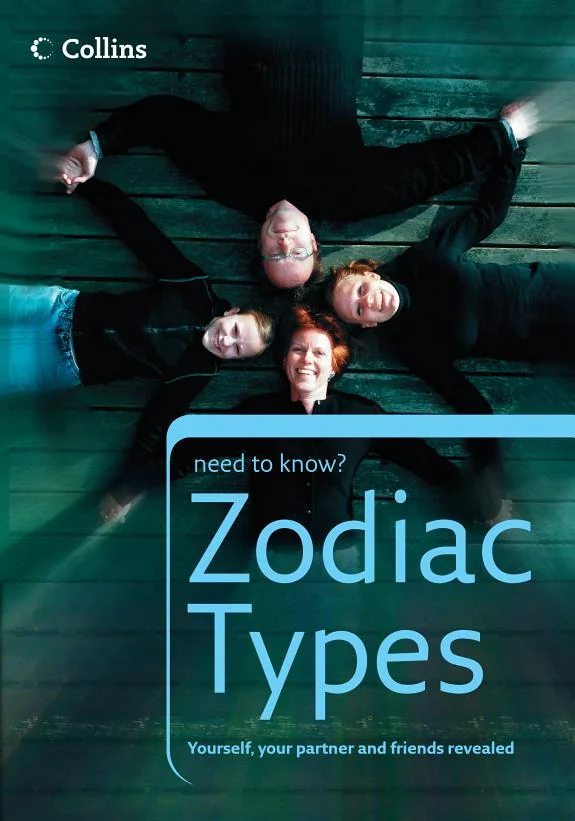
The book "Zodiac Types" was first published in June 2004 as part of a major new series of illustrated reference books from Collins.
What is the main purpose of the "Zodiac Types" book?
Its main purpose is to provide concise and accessible information about the twelve zodiac signs, their characteristics, and how they might relate to personality and relationships.
Who is the intended audience for this book?
The book is intended for a general audience interested in a simple introduction to astrology, self-understanding, and relationship dynamics.
Does the book offer in-depth astrological analysis?
No, it focuses on providing a handy, practical overview rather than deep, complex astrological analysis, aligning with its 'Need to Know' series format.
What kind of illustrations can be expected in the book?
The book is described as being attractively illustrated in colour throughout, aiming for a visually engaging and informative presentation.
Can this book help with understanding workplace dynamics?
Yes, the blurb specifically mentions it can help with understanding how to handle different zodiac types at work, such as a 'difficult Gemini'.
🔮 Key Themes & Symbolism
Zodiacal Archetypes
The book centers on the twelve archetypal personalities defined by the Sun's position at birth within the zodiac. Each sign—Aries, Taurus, Gemini, Cancer, Leo, Virgo, Libra, Scorpio, Sagittarius, Capricorn, Aquarius, and Pisces—is presented as a distinct energetic pattern. These archetypes are explored through their associated traits, motivations, and behavioral tendencies, forming the basis for astrological personality profiling and relationship compatibility assessments.
Elemental and Modal Associations
A fundamental concept explored is the division of the zodiac into four elements (Fire, Earth, Air, Water) and three modalities (Cardinal, Fixed, Mutable). The book assigns each of the twelve signs to one element and one modality, explaining how these classifications contribute to the sign's core nature. For instance, Fire signs are often depicted as energetic, while Earth signs are grounded, and Cardinal signs initiate action.
Interpersonal Dynamics
The work addresses how understanding zodiac signs can illuminate relationships. It offers insights into potential compatibility issues and harmonies between different signs, framed within the context of their inherent characteristics. This includes practical advice for navigating interactions, such as understanding how to manage relationships with specific zodiac personalities in both personal and professional settings.
Accessible Astrological Information
Designed for a broad audience, the book prioritizes clarity and conciseness. It aims to explain astrology by presenting core concepts in an easy-to-digest format, avoiding overly technical language. The focus is on providing immediately applicable information for those new to the subject, making astrological concepts approachable for everyday use.
💬 Memorable Quotes
Direct passages from the work, attributed to the author.
“Want to know more about your family and friends?”
— This question frames the book's utility as a tool for understanding personal relationships, highlighting its practical application in deciphering the personalities of those close to the reader.
“Worried whether your new partner is really compatible?”
— This phrasing points to the book's function in addressing common anxieties about romantic relationships through the lens of astrological compatibility between zodiac types.
“Intrigued to know how you should handle that difficult Gemini at work?”
— This specific example illustrates the book's intent to provide actionable advice for navigating challenging interpersonal situations in a professional context, using astrological archetypes as a guide.
“Collins Need To Know? Zodiac Types”
— This phrase captures the series' mission: to deliver essential, easily graspable information on popular subjects, positioning this book as a compact, foundational resource for astrological understanding.
“Attractively Illustrated In Colour Throughout”
— This descriptive element emphasizes the book's visual presentation, suggesting that the illustrations are integral to making the information accessible and engaging for the reader.
🌙 Esoteric Significance
Tradition
This work aligns with the Western esoteric tradition, specifically within the popularization of Hellenistic astrology. It focuses on the Sun-sign-based system, a simplified yet enduring facet of astrological practice. While it doesn't explore the deeper layers of Hermeticism, Kabbalah, or complex electional astrology, it serves as an entry point, presenting the foundational twelve signs as archetypal energies influencing human experience.
Symbolism
The primary symbols are the twelve zodiac signs themselves, each representing a distinct phase or archetype in the solar cycle. Associated symbols include the ruling planets (e.g., Mars for Aries, Venus for Taurus) and the four elements (Fire, Earth, Air, Water), which provide a symbolic framework for understanding the energetic qualities and behavioral tendencies attributed to each sign.
Modern Relevance
Contemporary popular astrology, particularly on social media and in lifestyle publications, frequently draws on the basic archetypes presented in works like this. Astrologers and enthusiasts continue to utilize these foundational sign descriptions for daily horoscopes, personality analysis, and relationship compatibility discussions, demonstrating the enduring appeal of these simplified astrological models.
👥 Who Should Read This Book
• Beginners seeking a straightforward introduction to the twelve zodiac signs and their basic characteristics. • Individuals interested in a quick reference for understanding personality traits and potential relationship dynamics based on astrological signs. • Readers looking for accessible, visually supported information on astrology without examining complex technical details.
📜 Historical Context
The publication of "Zodiac Types" in 2004 occurred within a landscape where astrology had firmly re-established itself as a popular cultural phenomenon, particularly following its surge in the 1970s and 1980s. This era saw a proliferation of accessible astrological texts, often published in series formats like Collins' "Need to Know" line, designed for quick understanding. The book's accessible, illustrated approach aligned with a broader trend in popular non-fiction aiming to make esoteric subjects palatable to a mass audience. It stood in contrast to more scholarly works on the history of astrology or complex astrological systems that appealed to niche communities. While not directly engaging with specific academic debates, its existence reflects the ongoing popularization of astrological concepts, a trend that began gaining significant traction from figures like Carl Jung, who explored archetypes, and later through media personalities who popularized natal chart interpretations.
📔 Journal Prompts
The Aries archetype's core drive for initiation.
The Taurus sign's relationship to material security and sensory experience.
The Gemini duality and its expression in communication.
The Cancerian connection to home and emotional nurturing.
The Leo persona and its relationship to self-expression.
🗂️ Glossary
Zodiac Signs
The twelve astrological divisions of the ecliptic, each associated with a specific period of the year and a set of archetypal personality traits and characteristics.
Archetype
A fundamental, universal pattern of behavior or symbolic representation, such as those associated with the twelve zodiac signs, that influences human consciousness and experience.
Compatibility
In astrology, the degree of harmony or potential for conflict between the zodiac signs of two individuals, often assessed based on elemental, modal, or planetary relationships.
Ruling Planet
The planet traditionally associated with each zodiac sign, believed to influence and color the sign's inherent qualities and expression.
Element (Astrology)
One of the four classical elements (Fire, Earth, Air, Water) assigned to groups of three zodiac signs, indicating fundamental energetic qualities.
Modality (Astrology)
One of the three categories (Cardinal, Fixed, Mutable) that divide the twelve zodiac signs, describing their characteristic approach to action and change.
Sun Sign
The zodiac sign in which the Sun was located at the time of a person's birth, commonly referred to as one's 'star sign'.
This book appears in 1 collection
🔮 Readers Also Liked
Browse all →








From the “Zodiac Signs” Collection
View all →









More Free Astrology & Cosmology Books
View all →