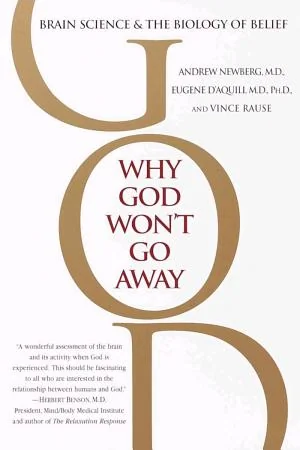
Why God Won't Go Away
 78
78

Why God Won't Go Away
Andrew Newberg, Eugene D'Aquili, and Vince Rause's *Why God Won't Go Away* bravely steps into the contentious space between brain scans and prayer mats. The book’s signal achievement is its persistent effort to ground the often-ethereal nature of spiritual experience in observable neurological events. The authors’ examination of how specific brain regions, like the temporal lobes, might correlate with mystical states provides a concrete framework for understanding phenomena previously discussed only through metaphor or dogma. However, the work occasionally struggles to fully capture the subjective depth and personal meaning individuals derive from their spiritual lives, sometimes presenting neurological correlations as exhaustive explanations. A particularly striking passage discusses the "orientation association area" and its potential role in feelings of unity or transcendence, illustrating the book's commitment to linking brain function with spiritual sensation. Despite its limitations in fully encompassing subjective experience, the book remains a significant early contribution to neurotheology, offering a scientific lens on a fundamental aspect of human existence.
📝 Description
78
In 2001, Why God Won't Go Away proposed the brain creates spiritual experiences.
This book introduces the field of neurotheology, suggesting a biological basis for religious and spiritual experiences. The authors examine how the brain processes belief, ritual, and mystical states, moving beyond philosophical speculation. They present scientific investigations into religious phenomena, arguing that these experiences have identifiable physiological correlates rather than being purely supernatural.
The work seeks to connect science and spirituality by analyzing the brain's structure and activity during moments of transcendence. It is aimed at readers interested in the intersection of consciousness, neuroscience, and spirituality, particularly those questioning the biological roots of faith or seeking scientific explanations for religious feelings. Academics in comparative religion, psychology of religion, and cognitive science may also find its empirical approach useful, as may individuals exploring personal spiritual development.
Emerging in the early 2000s, this work contributed to the scientific study of religion. It built upon earlier psychological explorations of religious experience, seeking empirical validation for phenomena often confined to faith. By applying modern scientific methods to understand the brain's role in spirituality, it helped establish neurotheology as a distinct area of inquiry.
💡 Why Read This Book?
• Learn how specific brain regions, such as the temporal lobes, are theorized to be active during intense spiritual experiences, providing a biological basis for transcendence. • Understand the concept of "religious behavior" as a potential evolutionary adaptation, offering a scientific perspective on why humans are predisposed to spiritual thought and practice. • Grasp the implications of the "orientation association area" for feelings of unity and connection, as explored by the authors in their quest to map the neurological roots of the sacred.
⭐ Reader Reviews
Honest opinions from readers who have explored this book.
❓ Frequently Asked Questions
What is neurotheology and how does this book introduce it?
Neurotheology is the study of the relationship between the brain and religious or spiritual experiences. This book introduces the field by examining neurological events and brain activity that occur during states of transcendence, suggesting a biological basis for religious belief.
Which brain areas are discussed in relation to spiritual experiences?
The book highlights areas like the temporal lobes, which are often implicated in mystical experiences, and the orientation association area, linked to feelings of unity and connection during spiritual states.
Do the authors claim religion is purely biological?
No, the authors do not claim religion is purely biological. Instead, they propose that the human brain possesses biological predispositions and functions that facilitate spiritual experiences, suggesting a complex interplay between biology and belief.
What is the evolutionary perspective on religious behavior presented?
The work explores the idea that religious behavior might have provided evolutionary advantages, such as fostering social cohesion and cooperation within groups, thereby contributing to the survival and propagation of early human societies.
When was 'Why God Won't Go Away' first published?
The book 'Why God Won't Go Away' was first published in 2002, marking an early contribution to the scientific exploration of spirituality and the brain.
🔮 Key Themes & Symbolism
Neuroscience of Mysticism
This theme posits that profound spiritual experiences, often described as mystical or transcendent, can be correlated with specific patterns of brain activity. The authors identify potential neurological mechanisms, like the activation of the temporal lobes and the orientation association area, suggesting that these states are not solely supernatural but have identifiable physiological underpinnings. This perspective seeks to explain religious experiences by examining them through the lens of brain function and structure, proposing that the brain is equipped to generate such states.
Evolutionary Basis of Religion
The work investigates the possibility that religious behavior and spiritual predispositions may have conferred evolutionary advantages to early humans. Concepts like enhanced social bonding, group cohesion, and cooperative behaviors fostered by shared rituals and beliefs are explored. This perspective views spirituality not as an anomaly but as an integral aspect of human development, potentially crucial for survival and societal progress, suggesting that the brain's capacity for religious thought is an evolved trait.
The Brain as a Sacred Organ
This theme reframes the human brain not just as an organ of cognition but as a biological instrument capable of generating and experiencing sacredness. By mapping specific neurological functions to spiritual states, the authors suggest that our capacity for belief, awe, and transcendence is neurologically encoded. The brain, in this view, is the apparatus through which the human species seeks and constructs meaning, making it a central component in the human quest for the divine or the ultimate.
Bridging Science and Spirituality
A central aim of the book is to bridge the perceived gap between empirical science and subjective spiritual or religious experience. By presenting scientific data and neurological models, the authors attempt to validate and explain aspects of spirituality that have traditionally been confined to faith or subjective interpretation. This effort seeks to foster a more integrated understanding of human consciousness, where scientific inquiry can illuminate, rather than negate, the profound nature of spiritual life.
💬 Memorable Quotes
Direct passages from the work, attributed to the author.
“The brain is wired for God.”
— This statement captures the book's core hypothesis: that human neurological structures and functions predispose us to religious thought and spiritual experiences, suggesting a biological basis for belief.
“Mystical experiences involve altered states of consciousness.”
— This highlights the focus on how deep spiritual encounters correspond to specific, measurable changes in brain activity and perception, moving beyond purely subjective accounts.
“Ritualistic behavior can activate specific brain circuits.”
— This points to the authors' exploration of how repetitive spiritual practices, like prayer or meditation, engage particular neural pathways, providing a scientific explanation for their impact.
“Spirituality may have offered survival advantages.”
— This interpretation suggests that the book proposes religious or spiritual tendencies could have evolved because they promoted group cohesion and cooperation, aiding human survival.
“The orientation association area is key to unity.”
— This references the authors' theory that a specific part of the brain, when stimulated, can lead to feelings of oneness and interconnectedness often reported in spiritual experiences.
🌙 Esoteric Significance
Tradition
While not strictly an esoteric text in the Hermetic or Kabbalistic sense, this work engages with themes central to many mystical traditions: the nature of transcendent experience and the human capacity for altered states of consciousness. It departs from traditional esotericism by grounding these phenomena in empirical neuroscience rather than purely metaphysical principles or ancient texts. It aligns with the modern esoteric movement's interest in consciousness studies and the mind-body connection, offering a scientific counterpoint or complement to older, tradition-bound explorations.
Symbolism
The book's primary 'symbolism' lies in its mapping of brain regions to spiritual states. The temporal lobes, often associated with memory and complex sensory processing, are presented as neurological correlates for visions and auditory hallucinations common in mystical accounts. The "orientation association area" functions symbolically as the seat of unity and interconnectedness, a concept echoed in perennial philosophy's idea of a universal consciousness. The brain itself becomes a symbol for the divine imprint within human biology.
Modern Relevance
Contemporary thinkers in consciousness studies, secular spirituality, and even certain branches of transhumanism draw upon the foundational concepts introduced in this book. Researchers in affective neuroscience and psychology of religion continue to explore the neural correlates of meditation, prayer, and awe. The work's influence is evident in modern discussions about the 'spiritual but not religious' demographic and the search for evidence-based practices that enhance well-being through mindful states, often referencing the neurological benefits explored by Newberg and colleagues.
👥 Who Should Read This Book
• Individuals interested in the scientific underpinnings of spiritual belief, seeking to understand the biological basis of their own faith or the faith of others. • Researchers and students in psychology, neuroscience, and comparative religion, looking for early empirical studies that bridge the gap between brain function and religious experience. • Skeptics and seekers alike, who are open to exploring how neurological processes might relate to profound subjective states of transcendence and connection.
📜 Historical Context
Published in 2002, *Why God Won't Go Away* emerged during a burgeoning period for the cognitive science of religion. This era saw a surge in research applying empirical methods to understand belief systems, moving beyond anthropological or sociological analyses. The work directly engaged with scientific disciplines, aiming to provide a neurological foundation for spiritual phenomena. It built upon the legacy of thinkers like William James, who explored the psychological dimensions of religious experience in the early 20th century. While other scholars like Pascal Boyer were also exploring evolutionary psychology's role in religion, Newberg, D'Aquili, and Rause focused specifically on neuroimaging and brain function. The reception was mixed; some lauded it as a pioneering effort to reconcile science and spirituality, while others criticized it for potentially reducing complex religious experiences to mere brain chemistry, a debate that continues with contemporary neuroscientists such as Sam Harris.
📔 Journal Prompts
Reflect on the neurological correlates of transcendence described in the text.
Consider the evolutionary implications of religious behavior as presented.
Explore the concept of the 'orientation association area' in relation to feelings of unity.
Examine how scientific explanations for spiritual experiences might affect personal belief.
Investigate the potential role of the temporal lobes in mystical states.
🗂️ Glossary
Neurotheology
An interdisciplinary field that studies the relationship between the brain and religious or spiritual experiences, seeking to understand the biological basis of belief and consciousness.
Temporal Lobes
Major sections of the cerebral cortex located beneath the temples, involved in processing auditory information, memory, and often implicated in religious or mystical experiences.
Orientation Association Area
A brain region theorized by the authors to be involved in the sense of self in space and time, its stimulation potentially leading to feelings of unity or cosmic consciousness.
Religious Behavior
Actions, rituals, and practices associated with religious beliefs and experiences, which the book explores from an evolutionary and neurological perspective.
Transcendence
An experience that goes beyond the ordinary limits of conscious awareness, often involving feelings of unity, awe, or connection to something greater than oneself.
Neurochemical Processes
The complex chemical reactions and interactions occurring within the brain, involving neurotransmitters and hormones, which are believed to influence mood, cognition, and spiritual states.
Evolutionary Adaptation
A trait or behavior that has evolved over time because it provides a survival or reproductive advantage to an organism within its environment.
🔮 Readers Also Liked
Browse all →









More Free Occult Philosophy Books
View all →