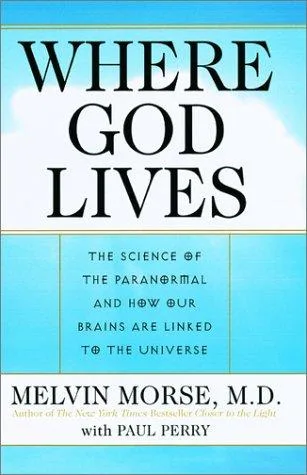
Where God lives
 82
82

Where God lives
Melvin Morse's "Where God Lives" confronts the often-dismissed territory of near-death experiences with a determined, if sometimes overly literal, scientific gaze. The strength of the book lies in its direct engagement with patient testimonies, presenting them not as mere psychological artifacts but as potential windows into a different order of reality. Morse’s attempt to bridge the gap between subjective spiritual encounters and objective scientific inquiry is commendable. However, the work occasionally strains to fit these profound experiences into pre-existing scientific frameworks, leading to moments where interpretation feels more like assertion. A passage discussing the concept of a 'spirit molecule' as a potential neurochemical explanation for these phenomena, while intriguing, highlights this tension. Ultimately, Morse offers a provocative exploration of consciousness that challenges conventional materialism.
📝 Description
82
Melvin Morse's 2000 book, "Where God Lives," investigates near-death experiences and consciousness.
Published in 2000, Melvin Morse's "Where God Lives" examines the relationship between near-death experiences (NDEs) and the nature of consciousness. Morse suggests that personal spiritual encounters might offer insights into a reality separate from the physical world. The book is for readers interested in the philosophical and scientific questions surrounding consciousness. It specifically addresses those who study altered states of awareness, the characteristics of spiritual or mystical events, and the possibility of consciousness existing beyond a single location.
"Where God Lives" appeared during a time of increasing scientific and public attention to NDEs, following earlier work by researchers like Raymond Moody. The book considered the growing collection of personal accounts and attempted to connect these stories with developing ideas in physics and neuroscience. Morse discusses phenomena such as the common 'light at the end of the tunnel' experience and out-of-body sensations during clinical death. He also considers the idea that consciousness might not be solely generated by the brain but could exist independently.
This work fits within traditions that explore the nature of consciousness beyond material explanations, often drawing on altered states of experience. It engages with perennial questions about the soul, the afterlife, and the possibility of a deeper reality accessible through non-ordinary perception. The book bridges empirical accounts of NDEs with speculative philosophy and theoretical science, seeking to understand subjective phenomena within a broader cosmological framework. It touches on ideas found in spiritualism and certain mystical traditions that posit a mind or spirit independent of the physical body.
💡 Why Read This Book?
• Understand the reported phenomena of near-death experiences, such as out-of-body sensations and encounters with a divine light, as detailed in Morse's clinical observations from the late 20th century. • Explore the hypothesis that consciousness might transcend the physical brain, drawing on Morse's integration of patient accounts with theoretical physics and neuroscience. • Gain a framework for contemplating the nature of reality and the potential for subjective spiritual experiences to offer insights into existence beyond the material world, as presented in the book's analysis.
⭐ Reader Reviews
Honest opinions from readers who have explored this book.
❓ Frequently Asked Questions
What is the main thesis of Melvin Morse's 'Where God Lives'?
The book's primary argument is that near-death experiences offer compelling evidence for consciousness existing independently of the physical brain, suggesting these subjective encounters may reveal a spiritual or divine reality.
When was 'Where God Lives' first published?
Melvin Morse's 'Where God Lives' was first published in the year 2000.
What kind of evidence does Morse use in 'Where God Lives'?
Morse primarily uses anecdotal evidence from patients who have undergone near-death experiences, alongside interpretations drawing from theoretical physics, neuroscience, and philosophy of mind.
Does 'Where God Lives' present scientific proof of God?
The book does not offer scientific proof of God in a traditional sense. Instead, it explores how near-death experiences might suggest a spiritual dimension to existence that science is beginning to investigate.
What are some common phenomena discussed in 'Where God Lives'?
Common phenomena include out-of-body experiences, encountering a bright light, meeting deceased relatives, experiencing a life review, and feelings of profound peace and unity.
Is 'Where God Lives' a religious text?
No, 'Where God Lives' is not a religious text. It is a work of non-fiction that examines spiritual phenomena through a lens of scientific inquiry and philosophical speculation.
🔮 Key Themes & Symbolism
Consciousness Beyond the Brain
The central theme posits that consciousness is not merely an epiphenomenon of brain activity but a fundamental aspect of reality that can persist independently. Morse draws on accounts of out-of-body experiences during cardiac arrest, where individuals report perceiving events or environments from a vantage point outside their physical body, suggesting a non-local nature of awareness.
The Nature of Spiritual Encounters
The book interprets common elements of near-death experiences (NDEs) – such as encountering a brilliant light, a profound sense of love, or meeting deceased loved ones – as indicative of a genuine spiritual realm or higher consciousness. These are presented not as hallucinations but as encounters with a transcendent reality accessible during altered states of consciousness.
Bridging Science and Spirituality
Morse attempts to reconcile subjective spiritual experiences with scientific understanding. He explores how concepts from quantum physics, such as entanglement, or hypothetical neurochemical processes ('spirit molecule') might offer frameworks for understanding the seemingly inexplicable phenomena reported by NDE survivors, pushing the boundaries of conventional scientific paradigms.
The 'God' Experience
The title itself points to the exploration of what individuals perceive as divine during NDEs. Morse examines the universal quality of these experiences, suggesting that the perceived 'God' or 'Higher Power' represents an encounter with a fundamental, unified consciousness or the source of existence, accessible through profound shifts in awareness.
💬 Memorable Quotes
Direct passages from the work, attributed to the author.
“The light at the end of the tunnel is real.”
— This statement asserts the objective reality of a common near-death experience phenomenon, suggesting it's not merely a subjective hallucination but an encounter with a genuine aspect of consciousness or reality.
“Consciousness is not what the brain does; it is what the brain is for.”
— This interpretation challenges the materialistic view that the brain creates consciousness. It suggests the brain acts more as a receiver or interface for a pre-existing consciousness that exists independently.
“The feeling of unconditional love is the primary characteristic of the divine encounter.”
— This interpretation highlights a recurring theme in NDEs, framing the overwhelming sense of love reported by experiencers as the defining attribute of encountering a transcendent or divine presence.
💡 Key Ideas
Editorial paraphrase of the work's core concepts — not direct quotes.
Life review offers a perspective on one's existence from a higher vantage point.
This paraphrased concept suggests that the experience of reviewing one's life during an NDE provides an objective, non-judgmental overview, implying a broader, perhaps divine, perspective on personal history.
We are all connected in a greater consciousness.
This paraphrased concept points towards a belief in a universal consciousness or interconnectedness, suggesting that individual awareness is part of a larger, unified field of existence.
🌙 Esoteric Significance
Tradition
While not strictly adhering to a single esoteric lineage, "Where God Lives" draws parallels with Gnostic concepts of transcendence and the potential for spiritual awakening through altered states. It echoes Neoplatonic ideas of a unified source from which all existence emanates. The work can be seen as a modern attempt to validate esoteric claims of an afterlife or spiritual dimension through contemporary scientific discourse, fitting within the broader esoteric tradition's interest in consciousness and the nature of reality.
Symbolism
The 'light' encountered in NDEs functions as a potent symbol of divine presence, knowledge, and unconditional love, reminiscent of mystical traditions' descriptions of divine illumination. The 'life review' serves as a symbol of karmic accounting or spiritual integration, where past actions are viewed with profound understanding and acceptance, facilitating spiritual growth. Meeting deceased loved ones symbolizes the continuity of relationships beyond physical death, pointing to an enduring spiritual connection.
Modern Relevance
Morse's work continues to inform contemporary discussions in consciousness studies, transpersonal psychology, and the growing field of psychedelic research, particularly concerning non-ordinary states of consciousness. Thinkers and researchers exploring the potential for consciousness to be fundamental rather than emergent, and those investigating the therapeutic potential of altered states for spiritual insight, often cite or implicitly build upon the kind of evidence Morse presented.
👥 Who Should Read This Book
• Individuals interested in the scientific and philosophical implications of near-death experiences, seeking to understand common phenomena like out-of-body experiences and life reviews. • Researchers and students of consciousness studies, comparative religion, and the psychology of spiritual experiences, looking for a bridge between subjective reports and theoretical frameworks. • Skeptics and open-minded readers curious about alternative perspectives on the mind-body problem and the possibility of consciousness existing independently of brain function.
📜 Historical Context
Published in 2000, Melvin Morse's "Where God Lives" arrived at a cultural moment when interest in near-death experiences (NDEs) was experiencing a resurgence, partly due to earlier popular works like Raymond Moody's "Life After Life" (1975). Morse's book engaged with a growing body of anecdotal evidence and sought to provide a more scientifically grounded interpretation than some of its predecessors. It emerged within a broader discourse on consciousness studies, influenced by figures like Stanislav Grof and the ongoing debates between materialist and dualist perspectives on the mind-body problem. The work was part of a wave of popular science literature attempting to bridge the gap between subjective spiritual or mystical experiences and empirical research, often facing skepticism from mainstream scientific circles that favored reductionist explanations. The book's exploration of consciousness possibly existing beyond brain function contrasted with prevailing neuroscientific paradigms.
📔 Journal Prompts
The perceived 'light' encountered during NDEs: what does this symbolize about divine presence?
Reflect on the concept of consciousness as a receiver for information, rather than a generator.
Consider the implications of a 'life review' for personal accountability and spiritual development.
Explore the idea that 'Where God Lives' suggests a universal consciousness connecting all beings.
How might the 'spirit molecule' hypothesis, as discussed, inform your view of subjective spiritual experiences?
🗂️ Glossary
Near-Death Experience (NDE)
A profound personal experience associated with being close to death, often involving altered perceptions, feelings, and spiritual insights.
Out-of-Body Experience (OBE)
A sensation of floating outside one's physical body, often accompanied by the ability to observe one's own body from a distance.
Life Review
A common NDE component where individuals experience a panoramic, often instantaneous, review of their entire life, frequently accompanied by an understanding of the impact of their actions.
Spirit Molecule
A hypothetical endogenous psychedelic substance (like DMT) proposed by some researchers as a potential neurochemical basis for mystical or spiritual experiences, including those reported in NDEs.
Materialism
The philosophical view that matter is the fundamental substance in nature, and that all phenomena, including consciousness, are results of material interactions.
Dualism
The philosophical belief that reality consists of two fundamental substances or principles, typically mind (or spirit) and matter, which are distinct and independent.
Non-local Consciousness
The concept that consciousness is not confined to a specific physical location, such as the brain, but can exist or operate independently of it.
🔮 Readers Also Liked
Browse all →








More by Melvin Morse
All books →
More Free Occult Philosophy Books
View all →