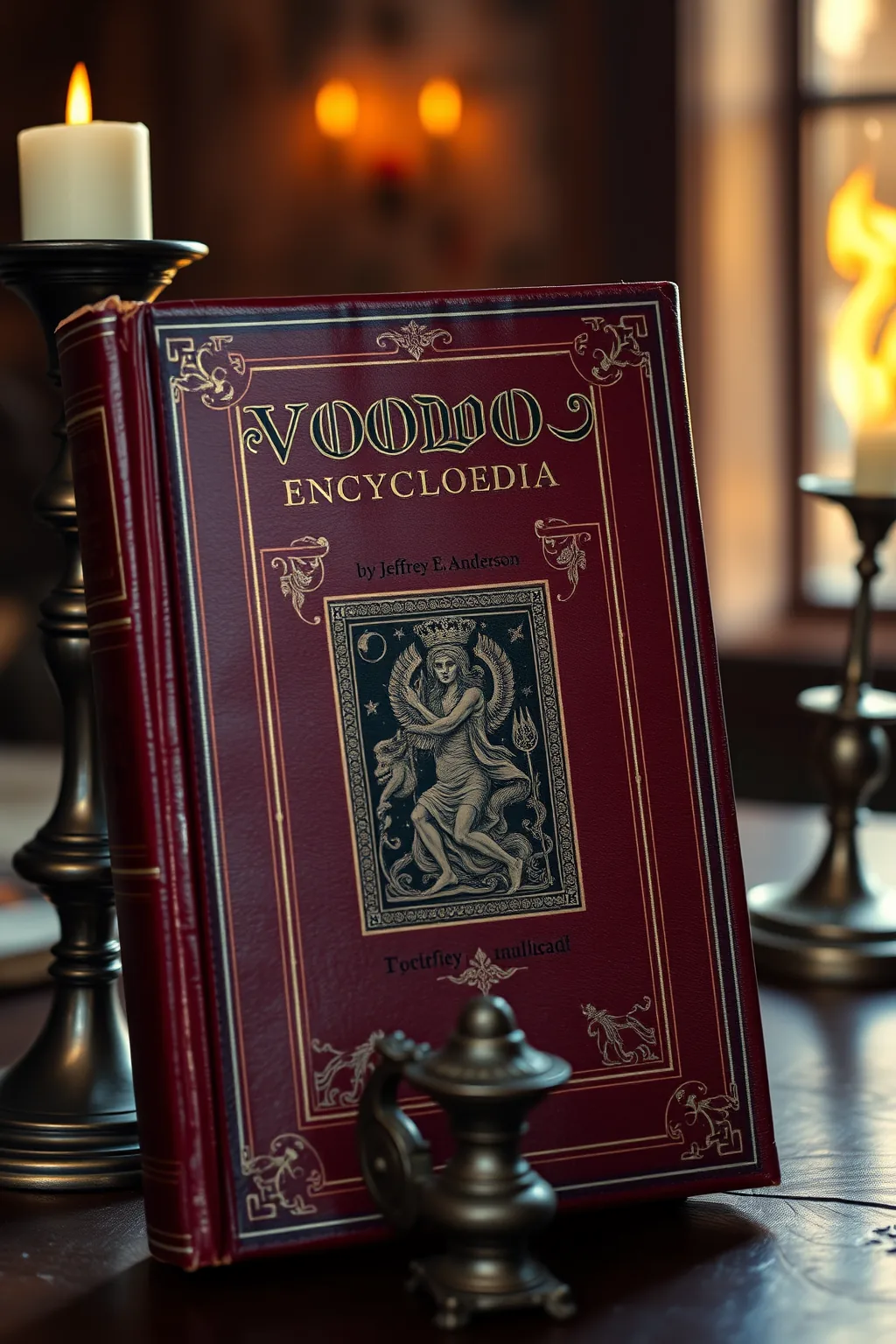
Voodoo Encyclopedia
 62
62

Voodoo Encyclopedia


By Balthazar Finch (Senior Critic, Occult Philosophy) — Jeffrey E. Anderson's 'Voodoo Encyclopedia' stands as a monumental achievement in the study of Vodou, offering an unparalleled gateway into its profound spiritual and cultural dimensions. Anderson masterfully navigates the intricate cosmology and ritualistic practices, presenting a comprehensive yet accessible account. Eschewing sensationalism, he illuminates the deep philosophical currents and the sophisticated understanding of spirit-human interaction inherent in Vodou. This work is indispensable for serious practitioners, scholars of comparative religion, and anyone seeking to understand the authentic heart of this vibrant tradition. Its encyclopedic structure ensures a thorough grasp of the subject, making it a cornerstone for any serious esoteric library.
📝 Description
62
Jeffrey E. Anderson's 'Voodoo Encyclopedia' (2007) clarifies Vodou beyond sensationalism.
This encyclopedia addresses Vodou with a focus on its spiritual and healing aspects, moving past common sensationalized portrayals. It maps out the pantheon of Loa, sacred rituals, and symbolic meanings within the tradition. The book aims to demystify practices often kept private.
Anderson structures the work to be accessible to those new to the subject, as well as those already familiar with occult studies. It examines the philosophical basis of Vodou and its connection to ancestral practices. The text seeks to explain the ethical considerations and the spiritual dimension of Vodou, presenting it as a system of communion and cosmic understanding.
Within esoteric studies, Vodou is often misrepresented by sensationalized accounts. Anderson's work positions Vodou as a legitimate spiritual system with its own cosmology and ethical structure. It places the tradition within a broader context of spirit communication and ritual practice, contrasting it with more superficial or exploitative interpretations. The encyclopedia serves as a guide to understanding its internal logic and its role in spiritual life.
💡 Why Read This Book?
Uncover the authentic spiritual core of Voodoo, transcending sensationalism. This encyclopedia is essential for seekers of hidden knowledge, scholars of comparative religion, and practitioners aiming to understand the Loa, rituals, and philosophies with depth and respect. It offers a rare glimpse into a powerful system of belief and practice.
⭐ Reader Reviews
Honest opinions from readers who have explored this book.
❓ Frequently Asked Questions
What is Voodoo?
Voodoo, or Vodou, is a complex Afro-Caribbean religion that emerged from the syncretism of West African spiritual traditions and Roman Catholicism. It involves the worship of spirits called Loa and aims for spiritual balance and connection.
Is Voodoo about black magic and curses?
The popular perception of Voodoo as solely black magic is a misconception. While some practices can be misunderstood, Vodou is fundamentally a spiritual path focused on healing, community, and communion with the divine, with a rich ethical framework.
Who are the Loa?
The Loa are intermediary spirits or deities in Vodou, bridging the gap between humanity and the supreme creator god. Each Loa has distinct personalities, domains, and offerings, representing various aspects of life and nature.
What is the role of a Houngan or Mambo?
A Houngan (male priest) or Mambo (female priest) is a spiritual leader who guides the community, performs rituals, interprets divine messages, and facilitates communication with the Loa. They are essential facilitators of the faith.
How is Voodoo practiced today?
Modern Vodou practice varies but often involves elaborate ceremonies, drumming, dancing, offerings, and spiritual consultations. It remains a living, evolving religion, deeply connected to its ancestral roots and cultural heritage.
🔮 Key Themes & Symbolism
The Pantheon of the Loa
This section explores the intricate hierarchy and individual characteristics of the Loa, the divine spirits central to Vodou. It explores their roles as intermediaries between humanity and the divine, their symbolic associations with natural forces and human endeavors, and the specific rituals and offerings dedicated to them. Understanding the Loa is crucial for comprehending the dynamic spiritual range of Vodou, revealing a complex system of relationships and spiritual governance that mirrors the complexities of life itself.
Ritual and Ceremony
Explore the profound significance of Vodou rituals, from the vibrant drumming and dance of ceremonies to the meticulous preparation of sacred spaces and offerings. This theme uncovers the symbolic language embedded within these practices, illustrating how they serve as conduits for spiritual communion, healing, and invocation. It highlights the role of the Houngan and Mambo as facilitators, guiding participants through transformative experiences and fostering a deep connection with the ancestral realm and the divine.
Symbolism and Esoteric Meanings
Unravel the body of symbolism woven throughout Vodou, examining the profound esoteric meanings behind its visual representations, sacred objects, and practices. This theme explores how symbols function not merely as decorative elements but as potent keys to unlocking spiritual insights and understanding the interconnectedness of the cosmos. From the veve designs to the use of specific colors and materials, each element carries layers of meaning, offering a framework for spiritual growth and divine connection.
💬 Memorable Quotes
Direct passages from the work, attributed to the author.
“In the dance of the Loa, the spirit finds its voice.”
— This emphasizes the active, embodied nature of spiritual connection in Vodou, where ritual and movement are pathways to divine communication and experience.
“Ancestors whisper wisdom to the attentive heart.”
— This highlights the veneration of ancestors in Vodou and the belief that their guidance and knowledge are available to those who cultivate a receptive and open spirit.
“The sacred is not separate, but woven into the fabric of existence.”
— This points to the animistic and immanent nature of Vodou, where the divine is found within all aspects of the natural world and everyday life.
“Through ritual, the mundane becomes sacred, and the seeker becomes one with the divine.”
— This captures the transformative power of Vodou's ceremonial practices, which aim to elevate consciousness and facilitate direct spiritual union.
💡 Key Ideas
Editorial paraphrase of the work's core concepts — not direct quotes.
The veil between worlds is thin for those who know where to look.
This quote suggests that spiritual reality is accessible to those with the knowledge and intention to perceive it, hinting at the hidden dimensions explored in Vodou.
🌙 Esoteric Significance
Tradition
Vodou belongs to the broad spectrum of African diasporic religions, a body of spiritual practices that evolved in the Americas. Its esoteric dimensions lie in its sophisticated understanding of spirit possession, its complex cosmology of divine intermediaries (Loa), and its intricate system of divination and healing. It offers a profound path to understanding the interconnectedness of the seen and unseen worlds, emphasizing personal spiritual development through ritual, ancestral veneration, and communion with the divine.
Symbolism
The symbolism in Vodou is deeply nuanced, drawing from African cosmologies and syncretized with European iconography. Veve, intricate designs drawn on the ground, serve as spiritual gateways and signatures for specific Loa, each stroke imbued with meaning. Colors, numbers, and specific objects hold potent symbolic power, representing different aspects of the divine, elements, and human experiences. The snake, for instance, often symbolizes transformation and divine power, while the cross can represent the meeting of spiritual and earthly realms.
Modern Relevance
In the modern world, Vodou offers a powerful alternative to materialistic worldviews, emphasizing spiritual connection, community resilience, and a holistic approach to well-being. Its focus on ancestor veneration provides a framework for understanding lineage and collective identity, while its engagement with the spirit world offers solace and guidance in times of uncertainty. As globalization increases, Vodou's rich cultural heritage and its profound spiritual insights continue to resonate, offering pathways to deeper self-understanding and a more interconnected existence.
👥 Who Should Read This Book
This 'Voodoo Encyclopedia' is an indispensable resource for a diverse readership. For the **beginner**, it provides a clear and respectful introduction, dispelling myths and laying a solid foundation for understanding. **Scholars** of religion, anthropology, and cultural studies will find its depth of research and comprehensive scope important for academic exploration. **Seekers** of esoteric knowledge and alternative spiritual paths will discover a rich tradition of divine communion and personal transformation. **Practitioners** of magic and ritual will gain a deeper appreciation for the intricate workings of Vodou, its pantheon, and its potent ceremonial practices, fostering a more informed and respectful engagement.
📜 Historical Context
Emerging from the crucible of the transatlantic slave trade, Vodou is a resilient spiritual tradition born from the forced displacement and cultural fusion of West African peoples, primarily from the Fon, Ewe, and Kongo nations, with elements of Roman Catholicism imposed by their enslavers. The 17th and 18th centuries saw the clandestine development of Vodou in the French colony of Saint-Domingue (modern-day Haiti), where enslaved Africans ingeniously blended their ancestral beliefs, deities (which they often syncretized with Catholic saints), and cosmological frameworks with the dominant religious structure. This period of intense oppression and resistance fostered a unique spiritual and cultural identity, making Vodou not only a system of faith but also a powerful force for community cohesion and a subtle, yet potent, form of cultural preservation and defiance against colonial powers. Its influence continued to grow, solidifying its place as a central to Haitian culture and spirituality.
📔 Journal Prompts
Reflect on a time you felt a strong connection to something unseen. What did it feel like, and how did you interpret it?
Consider the concept of intermediaries in your own life or belief systems. How do they help bridge gaps or facilitate understanding?
What personal symbols or objects hold deep meaning for you? Explore the layers of significance they contain.
Imagine you are creating a 'veve' for an aspect of your life you wish to strengthen. What symbols would you use and why?
How does the idea of ancestral wisdom influence your present actions or decisions?
🗂️ Glossary
Loa
The spirits or deities in Vodou, acting as intermediaries between humans and the supreme creator god. Each Loa has distinct characteristics, domains, and associated rituals.
Houngan
A male priest in Vodou who leads ceremonies, performs rituals, and facilitates communication with the Loa and ancestors.
Mambo
A female priest in Vodou, holding the same spiritual authority and responsibilities as a Houngan.
Veve
Intricate symbolic drawings created on the ground or floor, used to invoke and honor specific Loa during ceremonies.
Bocor
A practitioner of Vodou who may engage in practices that are considered darker or more manipulative, often misunderstood as solely 'black magic'.
This book appears in 2 collections
🔮 Readers Also Liked
Browse all →






More by Jeffrey E. Anderson
All books →




From the “Ritual Magic” Collection
View all →






More Free Magic & Ritual Books
View all →