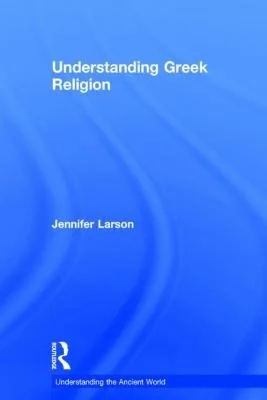
Understanding Greek Religion
 83
83

Understanding Greek Religion
Larson's "Understanding Greek Religion" is a commendably thorough examination, particularly in its dissection of the pervasive influence of the *polis* on religious expression. The work excels at illustrating how religious practice was inextricably linked to civic identity and political life, a point powerfully made when discussing the organization of festivals. However, the book's academic rigor, while a strength, occasionally renders its prose dense, potentially alienating readers not accustomed to specialized scholarly language. A passage detailing the various forms of divination, for instance, is both informative and somewhat overwhelming in its detail. While it provides an indispensable resource for specialists, its accessibility for the general esoteric reader is limited. It serves best as a reference for those already invested in the subject matter.
📝 Description
83
Jennifer Larson's 2016 book probes Greek religion beyond simple myths.
Jennifer Larson's "Understanding Greek Religion" moves past common portrayals of gods to analyze the actual religious lives of ancient Greeks. The book examines how religious practices and beliefs were woven into the social, political, and personal fabric of daily life. Larson considers rituals, myths, and evolving cosmic views, presenting a comprehensive look at a religion integral to Greek society and identity.
This volume is aimed at academic readers and those dedicated to studying classical antiquity. Students of history, classics, or comparative religion will appreciate Larson's thorough research and detailed evidence. It is also for readers who want a serious, non-sensationalized account of ancient Greek religious systems, focusing on the core beliefs and practices that shaped the Hellenic world, rather than just popular mythology. The text assumes a level of academic familiarity.
While not overtly 'esoteric' in the modern sense, this book engages with the historical context of religious practices that were not always publicly articulated or understood in rational terms by outsiders. It examines beliefs and rituals that formed the lived experience of ancient peoples, a perspective often overlooked in favor of purely philosophical or historical accounts. Larson's work highlights the ways in which the divine permeated communal and individual existence, a dimension that resonates with traditions seeking to understand the deeper, often symbolic, layers of human experience and cosmology.
💡 Why Read This Book?
• Gain a nuanced understanding of how civic life in the ancient Greek *polis* directly shaped religious observances and beliefs, moving beyond simple myth retelling. • Explore the critical role of ritual in maintaining social order and cosmic balance, as detailed in discussions of major festivals like the Panathenaia. • Appreciate the scholarly evolution of Greek religious studies since the mid-20th century, engaging with concepts that informed scholars like Walter Burkert.
⭐ Reader Reviews
Honest opinions from readers who have explored this book.
❓ Frequently Asked Questions
What is the primary focus of Jennifer Larson's "Understanding Greek Religion"?
Larson's book focuses on the multifaceted nature of ancient Greek religious practice and belief, examining its integration into social, political, and daily life, rather than just recounting myths.
Is "Understanding Greek Religion" suitable for beginners in classical studies?
While informative, the book is written for academic audiences and requires a degree of familiarity with classical antiquity. Beginners might find it dense, but it offers a rigorous foundation.
How does this book differ from popular books on Greek mythology?
Unlike popular mythology books, Larson's work emphasizes the practical, social, and political dimensions of Greek religion, analyzing rituals and beliefs as integral to the functioning of the *polis*.
What does the book say about the relationship between Greek gods and mortals?
The book explores this relationship through the lens of ritual, sacrifice, and prayer, demonstrating how Greeks sought to maintain favor with the gods for personal and civic well-being.
When was Jennifer Larson's "Understanding Greek Religion" first published?
Jennifer Larson's "Understanding Greek Religion" was first published in 2016, positioning it within contemporary academic scholarship on the subject.
Does the book cover specific Greek city-states?
Yes, the work often uses examples from prominent city-states like Athens to illustrate broader patterns in Greek religious life and the concept of *polis* religion.
🔮 Key Themes & Symbolism
The Sacred and the Polis
Larson meticulously details how ancient Greek religion was not a separate sphere but intrinsically woven into the fabric of the city-state, or *polis*. Religious festivals, sacrifices, and the worship of civic deities were fundamental expressions of community identity and political order. The book examines how the divine was invoked to legitimize civic structures and ensure the prosperity and security of the community. This perspective moves beyond viewing Greek religion as solely a matter of personal piety, highlighting its crucial public and political dimensions that were essential for the functioning of Hellenic society.
Ritual as Social Cohesion
Central to "Understanding Greek Religion" is the analysis of ritual practice as a primary mechanism for social cohesion and the reinforcement of shared values. Larson scrutinizes various forms of ritual, from grand public festivals like the Panathenaia to more intimate domestic rites, illustrating their role in binding individuals to their communities and to the divine order. The book emphasizes that these practices were not mere symbolic gestures but vital actions that maintained cosmic balance and reinforced the social hierarchy, ensuring the continuity of both religious and secular life in ancient Greece.
Myth as Framework
The book positions Greek myths not simply as fantastical stories but as foundational narratives that provided a framework for understanding the world, human existence, and the relationship between mortals and gods. Larson explores how these myths served to explain natural phenomena, justify social customs, and offer moral exemplars or cautionary tales. By analyzing the narrative structures and recurring motifs within these myths, the work reveals their function in shaping the collective consciousness and providing a shared cultural lexicon for the ancient Greeks.
Evolving Conceptions of Divinity
Larson's scholarship traces the evolution of theological thought within ancient Greece. It acknowledges that conceptions of the gods and their roles were not static but developed over centuries, influenced by philosophical inquiry, historical events, and cultural exchange. The book examines how early anthropomorphic deities gradually gave way to more abstract philosophical notions of the divine in later periods. This progression highlights the dynamic intellectual field of ancient Greece and its continuous engagement with fundamental questions about existence and the nature of ultimate reality.
💬 Memorable Quotes
Direct passages from the work, attributed to the author.
“Religious practice was a fundamental component of civic identity.”
— This statement captures the essence of the book's argument that religious observance in ancient Greece was inseparable from one's role as a citizen and member of a community.
“Rituals served to reinforce social bonds and maintain cosmic order.”
— This highlights the practical application of religious rituals, illustrating how they were designed to strengthen community ties and ensure the proper functioning of the universe.
“The concept of the divine evolved alongside philosophical inquiry.”
— This suggests that Greek ideas about gods and divinity were not fixed but were subject to change and intellectual development, particularly influenced by philosophical thought.
“The *polis* dictated much of the form and content of public religious expression.”
— This emphasizes the strong connection between the political structure of the Greek city-state and the nature of its religious ceremonies and beliefs.
💡 Key Ideas
Editorial paraphrase of the work's core concepts — not direct quotes.
Myths provided a shared narrative framework for understanding the cosmos and human place within it.
This paraphrase underscores the functional role of myths, not just as stories, but as explanatory tools that helped Greeks make sense of their world and their interactions with the divine.
🌙 Esoteric Significance
Tradition
While "Understanding Greek Religion" is a work of academic history and not a grimoire or initiatory text, its rigorous scholarship provides essential foundational knowledge for students of Western Esotericism. Many esoteric traditions, particularly those drawing from Neoplatonism, Hermeticism, and Renaissance magical philosophy, heavily engage with classical Greek religion and philosophy. Understanding the historical context and actual practices of ancient Greek religion, as presented by Larson, allows for a more informed and nuanced interpretation of how these ancient concepts were later adapted and integrated into esoteric systems, often through figures like Iamblichus or the Hermetic corpus.
Symbolism
The book illuminates the symbolic weight of figures like Athena, often associated with wisdom and strategic action, and Dionysus, representing ecstatic release and the primal forces of nature. Beyond deities, it explores the symbolism inherent in rituals, such as the libation (offering of liquid) as a means of communion and appeasement, and the sacrifice, a potent act of exchange and devotion. These elements, while presented historically, are rich with symbolic meaning that resonates within esoteric frameworks, offering insights into ancient understandings of divine mediation and the human connection to cosmic energies.
Modern Relevance
Contemporary practitioners of Hellenistic Reconstructionism and various forms of Neopaganism directly engage with the historical and religious practices detailed in Larson's work. Thinkers and practitioners seeking to move beyond romanticized notions of antiquity find value in its grounded approach to ritual, myth, and the structure of ancient religious life. Furthermore, academic interest in the history of religion continues to draw upon such comprehensive studies, influencing modern interpretations of classical philosophy and its enduring impact on Western thought, including its esoteric branches.
👥 Who Should Read This Book
• Students of Classical Antiquity and Comparative Religion: Gain a comprehensive, evidence-based overview of Greek religious beliefs and practices that moves beyond popular myth. • Practitioners of Hellenistic Reconstructionism: Access scholarly details on rituals, cults, and societal influences to inform authentic religious practice and understanding. • Esoteric Scholars and Students: Develop a deeper, historically grounded appreciation for the sources and classical foundations that underpin many Western esoteric traditions.
📜 Historical Context
Published in 2016, Jennifer Larson's "Understanding Greek Religion" entered a scholarly landscape significantly shaped by foundational works like Walter Burkert's "Greek Religion" (1985). The field at this time was characterized by sophisticated interdisciplinary approaches, drawing heavily on archaeology, anthropology, and textual criticism. Larson’s work engages with ongoing debates concerning the nature of belief versus practice, the relationship between myth and ritual, and the pervasive influence of the *polis* on religious life. Unlike earlier scholarship that might have focused more narrowly on mythology or specific cults, the contemporary approach, which Larson embodies, seeks to integrate these elements into a broader socio-political and cultural analysis. Reception within the academic community has generally been positive, recognizing its comprehensive synthesis and updated perspective on a well-studied but continuously re-interpreted subject.
📔 Journal Prompts
The function of the *polis* in shaping religious expression.
Ritual's role in reinforcing social cohesion and cosmic order.
The evolution of conceptions of divinity in ancient Greece.
How myths served as a narrative framework for understanding existence.
The interconnectedness of civic identity and religious practice.
🗂️ Glossary
Polis
An ancient Greek city-state, functioning as an independent political and religious entity. The term encompasses the city, its surrounding territory, and its citizens.
Panathenaia
A major religious festival held annually in Athens in honor of the city's patron goddess, Athena. It involved processions, sacrifices, athletic contests, and other public celebrations.
Ritual
A set of actions, performed mainly for their symbolic value, in a prescribed order. In ancient Greece, rituals were crucial for communicating with the gods and maintaining social order.
Myth
A traditional story, especially one concerning the early history of a people or explaining some natural or social phenomenon, and typically involving supernatural beings or events.
Divination
The practice of seeking knowledge of the future or the unknown by supernatural means. Ancient Greeks employed various forms of divination to understand the will of the gods.
Cult
A system of religious veneration and worship directed towards a particular deity or group of deities, often involving specific rituals and sacred sites.
Libation
An act of pouring a liquid (such as wine or oil) as a religious offering to a deity or as a part of a ritual.
🔮 Readers Also Liked
Browse all →






More by Jennifer Larson
All books →


More Free Witchcraft & Paganism Books
View all →