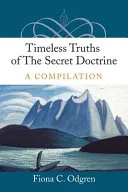
Timeless Truths of the Secret Doctrine
 79
79

Timeless Truths of the Secret Doctrine
Fiona Odgren's "Timeless Truths of the Secret Doctrine" offers a structured entry point into a vast and often dense philosophical system. Its strength lies in its methodical unpacking of Blavatsky's original work, providing clarity on intricate cosmologies and evolutionary schemes. The book commendably grounds abstract principles in examples drawn from Egyptian hieroglyphs and Vedic scriptures, making the material more accessible. However, the sheer scope of the subject matter means that certain concepts, like the complex genealogies of Root Races, remain challenging for the uninitiated without extensive prior study. A particularly illuminating section discusses the "Sevenfold Man," detailing the correspondences between physical, astral, and spiritual bodies, which Odgren explains with admirable precision. While it succeeds in presenting the core tenets, the book sometimes struggles to convey the original's revolutionary spirit, opting for exposition over evocative prose. Nevertheless, for those dedicated to understanding the foundational texts of modern esoteric thought, this is a valuable, if demanding, guide.
📝 Description
79
Fiona Odgren's 2017 book revisits Helena Blavatsky's foundational Theosophical text.
Originally published in 2017, Fiona Odgren's "Timeless Truths of the Secret Doctrine" serves as a modern interpretation of Helena Blavatsky's seminal work. Odgren frames her exposition as a cosmological and anthropological system designed to uncover universal principles. These principles, she argues, lie at the heart of diverse global mythologies and religions. The central thesis is that a singular, ancient wisdom tradition underlies the varied outward expressions of human spirituality.
This book is intended for serious students of comparative religion, occult philosophy, and ancient wisdom traditions. It is particularly useful for those who wish to discern the deeper connections between seemingly unrelated religious beliefs and mythologies. Readers interested in the historical roots of esoteric thought, the core texts of Theosophy, and the philosophical foundations of different spiritual paths will find extensive material within its pages.
This work follows the lineage of Theosophy, a movement that gained traction in the Western world during the mid-19th century. Helena Blavatsky's "The Secret Doctrine," first appearing in 1888, was a significant effort to synthesize occult knowledge with contemporary scientific and religious understanding. Blavatsky claimed to draw upon teachings from spiritual adepts in the Himalayas. Odgren's book engages with this tradition, seeking to present its core ideas to a contemporary audience.
💡 Why Read This Book?
• Gain a structured understanding of the fundamental cosmological and anthropological principles presented in Blavatsky's "The Secret Doctrine," including concepts like the Seven Planes of Existence and the Root Races. • Explore the historical underpinnings of modern esoteric movements, understanding the intellectual milieu of the late 19th century when Blavatsky and her collaborators produced their foundational texts. • Discover how "Timeless Truths" synthesizes ancient wisdom from traditions like India, Tibet, and Egypt, demonstrating recurring patterns in global spiritual narratives.
⭐ Reader Reviews
Honest opinions from readers who have explored this book.
❓ Frequently Asked Questions
What is the primary source material for Fiona Odgren's "Timeless Truths of the Secret Doctrine"?
The primary source is Helena Blavatsky's monumental "The Secret Doctrine," first published in 1888. Odgren's work serves as a modern exposition and interpretation of the complex philosophical and cosmological ideas presented in Blavatsky's original volumes.
Who were the key figures involved in the creation of "The Secret Doctrine"?
The central figure was Helena Blavatsky, who collaborated with "two advanced souls belonging to the Himalayan Brotherhood." These individuals are described as providing the esoteric knowledge that Blavatsky then articulated in her writings.
What does "The Secret Doctrine" aim to reveal about world religions?
It aims to demonstrate that the world's diverse religions and mythologies originate from a single, ancient, universal wisdom tradition. The book posits that core truths are embedded in sacred texts across cultures, from India and Tibet to Egypt and Greece.
What is the historical period associated with the origin of "The Secret Doctrine"?
The work emerged from the intellectual currents of the mid-to-late 19th century, a period of burgeoning interest in Eastern philosophies and occultism in the West. Blavatsky's initial publication was in 1888.
What are some of the core esoteric concepts discussed in the book?
Key concepts include a detailed cosmology, the evolution of humanity through successive Root Races, the cyclical nature of existence (Manvantaras and Pralayas), and the idea of a "Sevenfold Man" representing different planes of consciousness.
How does Odgren's book relate to Theosophy?
Odgren's "Timeless Truths" is directly linked to Theosophy as it explicates the foundational text of the Theosophical Society. It serves as a guide for understanding the philosophical and spiritual framework established by Helena Blavatsky.
🔮 Key Themes & Symbolism
Universal Wisdom Tradition
The central thesis posits a singular, ancient source of spiritual knowledge from which all major world religions and mythologies have sprung. This work examines the shared symbolic language and underlying principles found in diverse traditions, including Vedic scriptures, Buddhist teachings, and Hermetic philosophies. It argues that apparent differences are superficial, masking a profound, unifying truth accessible through esoteric study and inner realization. The exposition seeks to demonstrate the interconnectedness of all spiritual expressions under a common, primordial wisdom.
Cosmic and Human Evolution
This theme details a complex, multi-stage process of cosmic creation and the evolution of humanity. It introduces concepts such as the Seven Planes of Existence, the Manvantara (cosmic day) and Pralaya (cosmic night) cycles, and the progression of Root Races. The book outlines humanity's development from primordial spiritual beings through various physical and psychic stages, emphasizing a grand evolutionary scheme guided by cosmic law and spiritual hierarchies. The intention is to provide a framework for understanding our place within the vast cosmic unfolding.
The Sevenfold Constitution of Man
The work elaborates on the esoteric understanding of human nature as a composite of seven principles or bodies, ranging from the physical to the purely spiritual. This layered model—often including the physical body, etheric double, astral body, lower and higher manas, buddhi, and atma—is presented as fundamental to spiritual development. Understanding these principles is crucial for comprehending reincarnation, karma, and the path of spiritual ascent. The book uses this framework to explain human consciousness and its potential for transcendence.
Comparative Mythology and Symbolism
A significant portion of the book is dedicated to analyzing the recurring symbols, myths, and allegories found across global cultures. It treats these not as mere stories but as encoded expressions of universal truths. Examples drawn from Egyptian hieroglyphs, Greek myths, and Eastern scriptures are used to illustrate common archetypes and spiritual narratives. The work suggests that a diligent study of these symbols provides a key to unlocking the deeper, esoteric meaning behind exoteric religious forms.
💬 Memorable Quotes
Direct passages from the work, attributed to the author.
“The Secret Doctrine embodies teachings found in sacred texts of India, Tibet, China, Egypt, and Greece.”
— This highlights the book's comparative approach, suggesting a universal root to disparate religious expressions. It points to the extensive cross-cultural research underpinning its philosophical claims.
“Humanity's evolution progresses through distinct stages, referred to as Root Races.”
— This statement expresses a core concept of the book, outlining a specific, cyclical model of human development far removed from conventional historical narratives, emphasizing spiritual and physical transformation over eons.
“Cosmic existence unfolds in vast cycles of activity and rest, known as Manvantaras and Pralayas.”
— This refers to the immense scale of the book's cosmological vision, positing that creation and dissolution occur in grand, rhythmic cycles far exceeding human comprehension of time, shaping the universe and all within it.
“The work presents a unified philosophical framework for understanding the universe and humanity's place within it.”
— This emphasizes the book's ambition to provide a comprehensive, overarching system of thought that connects science, religion, and metaphysics, offering a coherent worldview.
“Beneath the surface of varied religions lies a single, primordial wisdom.”
— This core tenet suggests that all spiritual paths share a common origin and fundamental truths, urging the reader to look beyond dogma and ritual to the underlying esoteric essence.
🌙 Esoteric Significance
Tradition
This work is deeply rooted in the Theosophical tradition, established by Helena Blavatsky. It draws heavily upon Hermeticism, Neoplatonism, Kabbalah, and Eastern philosophies (particularly Vedanta and Mahayana Buddhism), synthesizing them into a unique cosmological and anthropological system. It departs from some traditional interpretations by presenting a highly systematized, evolutionary view of both the cosmos and humanity, positing hierarchies and cycles not always explicit in earlier esoteric streams.
Symbolism
Key symbols include the Serpent, representing cyclicality, eternity, and wisdom; the Triangle, often denoting the Trinity or the interplay of spiritual, intellectual, and physical planes; and the Egg, symbolizing the cosmic egg or womb from which all creation emerges. The Duality of Spirit and Matter is also a pervasive motif, explored through various symbolic representations of the interplay between the unmanifest and manifest realms.
Modern Relevance
Contemporary esoteric practitioners, comparative religion scholars, and alternative history researchers continue to engage with the ideas presented. Modern schools of thought influenced by Theosophy, such as various forms of Western Esotericism and New Age spirituality, often reference Blavatsky's cosmology and evolutionary theories. Thinkers exploring consciousness studies, ancient civilizations, and the perennial philosophy frequently cite "The Secret Doctrine" as a foundational text.
👥 Who Should Read This Book
• Students of comparative religion and mythology seeking to understand the proposed common origins of global spiritual traditions. • Aspiring practitioners of Western Esotericism interested in the foundational texts that shaped modern occult philosophy and Theosophy. • Researchers and scholars of intellectual history examining the impact of 19th-century esoteric movements on subsequent philosophical and spiritual thought.
📜 Historical Context
The genesis of "The Secret Doctrine," and by extension Odgren's "Timeless Truths," lies in the late 19th century, a period rife with intellectual ferment and a growing fascination with Eastern spirituality among Western scholars and mystics. Helena Blavatsky's 1888 publication emerged within this context, challenging the scientific and religious orthodoxies of the time. It was a direct response to the materialistic worldview prevalent in Victorian England and sought to reconcile ancient esoteric traditions with then-current scientific discoveries, particularly in cosmology and biology. The work was controversial, drawing criticism from established scientific circles and religious institutions, yet it also found a significant following, laying the groundwork for the global Theosophical movement. Key contemporaries who engaged with or were influenced by this milieu include figures like Annie Besant and, indirectly, later thinkers in the New Age movement. The Theosophical Society itself faced scrutiny, including investigations by the Society for Psychical Research, highlighting the controversial nature of its foundational texts.
📔 Journal Prompts
The concept of Root Races and their evolutionary progression.
Your understanding of the Seven Planes of Existence.
The symbolic parallels between different ancient mythologies.
The cyclical nature of Manvantaras and Pralayas.
The relationship between the physical and subtle bodies within the Sevenfold Man.
🗂️ Glossary
Manvantara
A Sanskrit term denoting a period of cosmic manifestation or a 'day of Brahma,' representing a vast cycle of existence within a larger cosmic scheme, followed by a Pralaya.
Pralaya
A Sanskrit term for a period of cosmic dissolution or 'night of Brahma,' during which the universe undergoes a phase of rest and potentiality before the next cycle of creation.
Root Races
A Theosophical concept referring to distinct stages in the evolutionary development of humanity, each characterized by specific physical, mental, and spiritual attributes, occurring over immense geological timescales.
Sevenfold Man
An esoteric doctrine describing the human being as composed of seven distinct principles or bodies, ranging from the physical to the highest spiritual essence, each corresponding to different planes of existence.
Cosmic Egg (Anthropos)
A primordial symbol representing the universe in its unmanifest or nascent state, from which all creation emanates. It signifies the totality of potential existence.
Primordial Wisdom
The concept of an ancient, universal source of spiritual knowledge believed to underlie all religions and philosophies, often considered the ultimate truth accessible through esoteric study.
Himalayan Brotherhood
A group of advanced spiritual adepts or Masters, traditionally believed to reside in the Himalayas, who are said to guide humanity's spiritual evolution and transmit esoteric knowledge.