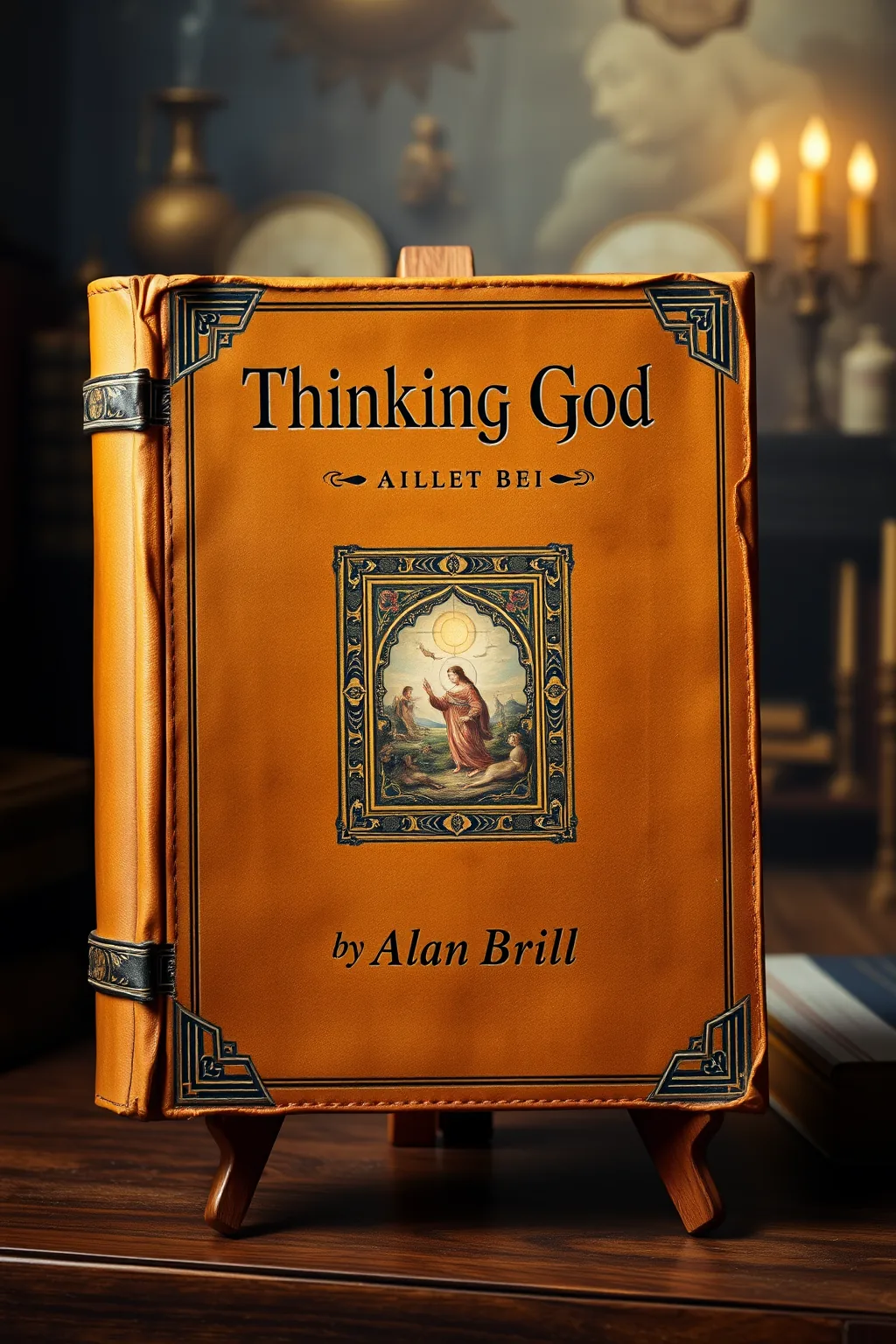
Thinking God
 72
72

Thinking God
Alan Brill’s Thinking God offers a refreshing, if at times dense, examination of theological conceptualization. Rather than engaging with specific doctrines, Brill dissects the very machinery of how we *think* about God. His strength lies in meticulously tracing the intellectual lineage of theological language, demonstrating how concepts evolve and are constrained by human cognition. A particularly effective passage discusses the 'as if' nature of divine attributes, showing how such descriptions function rhetorically and philosophically rather than as literal pronouncements. The book’s limitation, however, is its academic density; it demands significant reader engagement and may prove inaccessible to those unfamiliar with philosophical terminology. It’s a work for the determined scholar, not the casual inquirer. Ultimately, Thinking God provides a valuable, albeit challenging, framework for understanding the construction of theological ideas.
📝 Description
72
Alan Brill's 2003 book Thinking God examines how theological concepts are built from human thought and language.
Published in 2003, Thinking God analyzes the conceptual foundations of theological thought, moving beyond devotional material to investigate the philosophical structures that support ideas of the divine. Brill dissects how human cognition and language shape our perceptions of the transcendent, providing a distinctive viewpoint on religious concepts.
The book is suited for readers interested in the philosophy of religion, comparative theology, and the intellectual history of spiritual ideas. It appeals to those who consider the origins and development of religious concepts, desiring a structured study of how the idea of 'God' has been understood across various intellectual traditions. Academics and serious students of theology will find its methodical approach particularly useful.
Brill's work emerged in the early 2000s, a period of sustained academic interest in the connection between philosophy and religion. It responded to deconstructionist critiques of religious language while also seeking to systematically analyze theological discourse itself. The book offers a fresh perspective on established ideas in the philosophy of religion.
Thinking God engages with the philosophical underpinnings of religious belief, a common area within esoteric traditions that often scrutinize the nature of reality and consciousness. While not a practitioner's guide, the book dissects the very architecture of concepts like 'God,' aligning with esoteric pursuits that question received dogma and explore the construction of meaning. It addresses how human systems of thought and language create our understanding of the ultimate, a theme resonant with traditions that emphasize subjective experience and critical examination of established spiritual frameworks.
💡 Why Read This Book?
• Gain a structured understanding of how theological concepts are built, particularly through Brill’s analysis of linguistic and cognitive frameworks, which differs from devotional texts. • Grasp the philosophical implications of thinking about the divine, learning how metaphors and logic shape our perception of God, as explored in the early 2000s intellectual climate. • Appreciate the intricate relationship between human thought and the articulation of spiritual ideas, understanding the limitations and possibilities presented by abstract reasoning, a core theme.
⭐ Reader Reviews
Honest opinions from readers who have explored this book.
❓ Frequently Asked Questions
What is the primary focus of Alan Brill's 'Thinking God'?
The book primarily focuses on the philosophical and cognitive construction of theological concepts. It examines how human language, thought processes, and intellectual frameworks shape our understanding and articulation of the divine, rather than discussing specific religious doctrines.
When was 'Thinking God' first published and what was the intellectual climate like?
'Thinking God' was first published in 2003. It emerged during a period of continued academic interest in the philosophy of religion, influenced by late 20th-century hermeneutics and phenomenology, while also engaging with deconstructionist critiques of language.
Who would benefit most from reading 'Thinking God'?
Students of the philosophy of religion, comparative theology, and intellectual history will find this book most beneficial. It's suited for those interested in the analytical dissection of religious ideas and the evolution of theological discourse.
Does 'Thinking God' present a specific theological viewpoint?
No, the book is analytical and descriptive rather than prescriptive. Brill's aim is to dissect the *process* of theological thinking and concept formation across various traditions, not to advocate for a particular religious or philosophical stance.
What kind of concepts does Brill explore regarding the divine?
Brill explores concepts related to how attributes are assigned to the divine, the role of metaphor and analogy in theological discourse, and the inherent limitations of human cognition when attempting to articulate transcendent realities.
Is 'Thinking God' suitable for a general audience or more academic readers?
The book is generally considered more suitable for academic readers or those with a strong background in philosophy and theology due to its dense argumentation and specialized terminology.
🔮 Key Themes & Symbolism
Cognitive Architecture of Divinity
Brill posits that our conceptions of God are fundamentally products of human cognitive architecture. The work details how abstract reasoning, metaphorical thinking, and linguistic structures form the very scaffolding upon which theological ideas are built. It examines how concepts like omnipotence or omniscience are not necessarily inherent divine qualities but rather human attempts to conceptualize the ultimate, constrained by our mental capacities. This perspective challenges direct ontological claims about God, focusing instead on the epistemological and semantic processes involved in believing and articulating divine existence.
Linguistic Shaping of Theology
A significant theme is the profound influence of language on theological thought. Brill illustrates how the words and grammatical structures we employ to discuss the divine inevitably limit and define our understanding. The book examines how theological vocabulary develops, often through analogy and negation, and how these linguistic tools can both enable and restrict our grasp of transcendent realities. It suggests that much of theological debate is, in essence, a negotiation of meaning within the confines of human language, as seen in its first publication in 2003.
The 'As If' Nature of Divine Attributes
The work critically examines how divine attributes are often described 'as if' they were human qualities writ large, or as concepts that can be grasped through extrapolation. Brill analyzes this rhetorical and philosophical strategy, showing how it functions to make the divine comprehensible within human frameworks. This approach highlights the pragmatic and interpretive role of theological language, suggesting that many statements about God operate within a hypothetical or analogical mode, rather than claiming direct, literal correspondence to an unknowable reality.
Evolution of Theological Concepts
Brill traces the historical and intellectual evolution of how divinity has been conceptualized. The book implies that theological ideas are not static but are subject to change, influenced by philosophical developments, cultural contexts, and shifts in human understanding. This perspective treats theological concepts as dynamic constructs that reflect the ongoing human endeavor to grapple with ultimate questions, rather than fixed doctrines. The 2003 publication date places it within a period of critical academic discourse on religious thought.
💬 Memorable Quotes
Direct passages from the work, attributed to the author.
“Our grasp of God is fundamentally mediated by human conceptual tools.”
— This core idea suggests that any understanding or description of the divine is filtered through the lens of human cognition and language. It implies that theological concepts are not direct perceptions of God but rather human constructions designed to make sense of the transcendent.
“Theological language often operates through analogy and negation.”
— This highlights a key method in theological discourse: describing God by comparing divine attributes to human ones (analogy) or by stating what God is not (negation). It points to the inherent difficulty in speaking directly about the divine.
“Concepts of God are shaped by the evolution of human thought.”
— This interpretation emphasizes that our ideas about God are not fixed but change over time, influenced by philosophical, cultural, and intellectual developments throughout history.
“We speak of divine attributes 'as if' they were comprehensible qualities.”
— This suggests that when we describe God with attributes like 'good' or 'powerful', we are using a rhetorical or philosophical device to make the divine relatable, rather than claiming literal comprehension of those attributes in a divine context.
“The limits of our language define the limits of our theological expression.”
— This powerful statement underscores how the very structure and vocabulary of human language impose boundaries on what can be articulated or even conceived about the divine realm.
🌙 Esoteric Significance
Tradition
While not strictly an esoteric text in the vein of Hermeticism or Kabbalah, Thinking God engages with the *philosophical underpinnings* that esoteric traditions often presuppose. It approaches the concept of God from a rationalist and analytical perspective, examining how concepts of the divine are constructed. Its lineage is more aligned with the philosophy of religion and the critical analysis of consciousness, but its dissection of how the human mind conceives of ultimate realities provides a meta-level understanding relevant to any tradition seeking to articulate the ineffable.
Symbolism
The book's focus is less on traditional esoteric symbols and more on the conceptual symbols we use to represent the divine. For instance, it might analyze the conceptual symbol of 'infinity' as a human construct to denote boundless divine attributes, or the symbol of 'light' not as a mystical emanation but as a linguistic and cognitive metaphor for divine knowledge or presence. These conceptual symbols are examined for their role in bridging the gap between human understanding and the perceived nature of ultimate reality.
Modern Relevance
Contemporary thinkers exploring consciousness studies, cognitive science of religion, and philosophical theology can draw significantly from Brill's work. His analysis of how cognitive biases and linguistic structures influence belief systems is relevant to understanding the persistence and evolution of religious ideas in the 21st century. Schools of thought that emphasize the constructed nature of reality or the limitations of human perception find resonance with Brill's meticulous deconstruction of theological concepts, offering a foundation for critical engagement with spiritual and metaphysical claims.
👥 Who Should Read This Book
• Students of philosophy of religion seeking to understand the cognitive and linguistic foundations of theological concepts, offering a different approach than historical surveys. • Comparative theology scholars interested in the universal mechanisms of conceptualizing the divine across different cultures and eras, providing analytical tools. • Critical thinkers questioning the nature of belief and religious language, who will find a rigorous examination of how ideas about God are formed and articulated.
📜 Historical Context
Published in 2003, Alan Brill's Thinking God entered a scholarly landscape where the philosophy of religion continued to grapple with the legacy of linguistic turn critiques and existentialist inquiries. The late 20th century had seen thinkers like Ludwig Wittgenstein profoundly influence discussions on religious language, and thinkers such as Charles Taylor exploring the secular imagination. Brill’s work can be seen as engaging with this tradition by systematically analyzing the cognitive and linguistic structures that underpin theological discourse, moving beyond mere critique to a detailed examination of conceptual formation. It sought to provide a framework for understanding *how* theological thought operates, rather than simply debating its truth claims. This was distinct from purely apologetic or devotional works and positioned itself within academic theological and philosophical studies, engaging with the intellectual currents that questioned traditional religious epistemology.
📔 Journal Prompts
The conceptual symbol of 'infinity' in theological discourse.
How linguistic limitations shape articulations of the divine.
The function of analogy in understanding God.
Human cognitive architecture as a framework for divinity.
The evolution of 'God' concepts through history.
🗂️ Glossary
Theological Concepts
Ideas, doctrines, and attributes associated with the nature and existence of God or deities, as developed through religious and philosophical thought.
Cognitive Architecture
The underlying structure and processes of the human mind, including perception, memory, reasoning, and language, that shape how we understand and interact with the world.
Linguistic Frameworks
The systems of language, grammar, and vocabulary that influence and constrain how we express thoughts and ideas, particularly relevant in abstract domains like theology.
Analogy (Theological)
A method of theological reasoning that describes divine attributes by comparing them to human experiences or qualities, acknowledging the limitations of such comparisons.
Negation (Theological)
A method of theological description that defines God by stating what God is not, often used when direct positive descriptions are deemed inadequate or impossible.
Conceptual Symbol
An idea or term that stands for a more complex or abstract concept, used in this context to represent elements of divine thought or being.
Epistemology
The branch of philosophy concerned with the theory of knowledge, investigating its nature, scope, and justification.
🔮 Readers Also Liked
Browse all →







More by Alan Brill
All books →
More Free Mysticism & Contemplation Books
View all →