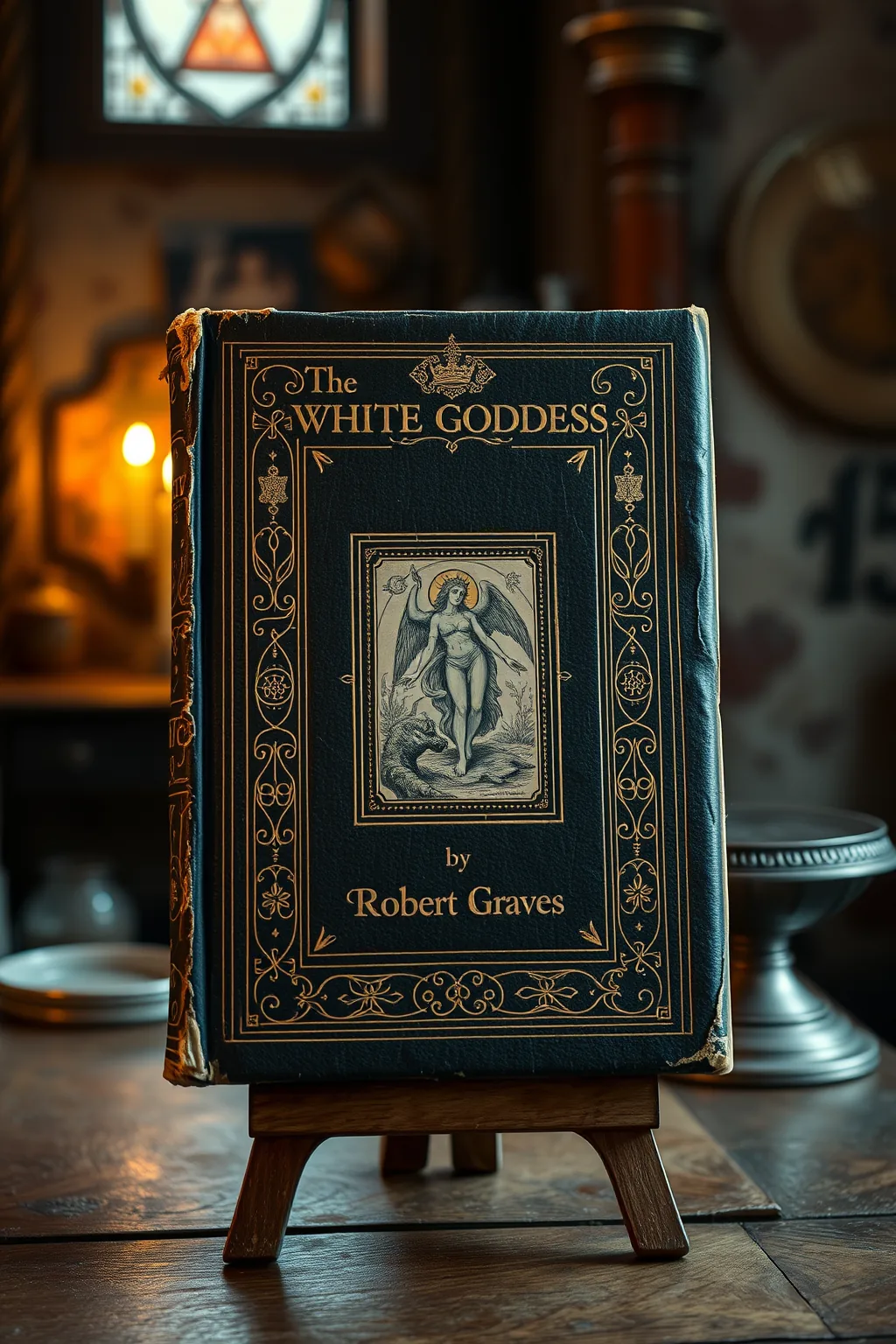
The White Goddess by Robert Graves
 74
74

The White Goddess by Robert Graves


Celeste Moreau (Divination & Symbolism Reviewer) — Robert Graves' 'The White Goddess' remains an indispensable cornerstone for anyone serious about the deeper currents of Paganism and Witchcraft. Its ambitious scope, weaving together linguistics, mythology, and religious history, offers a compelling argument for a pre-patriarchal divine feminine. Graves illuminates the lunar cults and their profound influence on Western thought and poetic tradition, revealing a hidden grammar of myth that resonates deeply with modern esoteric practitioners. While dense, the insights into the Goddess's triple aspect and her cyclical manifestations are transformative. An essential read for seekers, scholars, and witches alike, offering profound keys to understanding ancient spiritual paradigms.
📝 Description
74
Robert Graves proposed in 1948 that Western poetry originates from a single matriarchal deity.
Robert Graves's 1948 book, 'The White Goddess: A Historical Grammar of Poetic Myth,' posits a unified theory of mythology and poetry. He argues that all poetic traditions stem from a single, ancient, lunar-based mother goddess, the White Goddess. Graves traces her influence through various historical periods and cultures, suggesting her cyclical nature, tied to life, death, and rebirth, underpins much of human narrative and ritual.
The book examines lunar calendars, ancient pantheons, and seasonal festivals to support this central idea. Graves connects this primordial feminine divinity to the creative impulse and the structure of myth itself. He asserts that this ancient cult was systematically suppressed by patriarchal religions, leading to a loss of connection with fundamental creative and spiritual forces. The work functions as a historical grammar, aiming to decode the underlying patterns in poetic and mythical expression.
Published in 1948, 'The White Goddess' emerged during a period of renewed interest in paganism and pre-Christian European traditions. Graves's work is often associated with modern pagan scholarship and interpretations of ancient European religion. It stands as a significant text within the esoteric tradition, attempting to synthesize historical linguistics, mythology, and religious studies into a cohesive, albeit speculative, framework for understanding ancient spirituality and its connection to creative expression.
💡 Why Read This Book?
Embark on a profound intellectual and spiritual odyssey. 'The White Goddess' offers a radical reinterpretation of myth, unveiling the pervasive influence of the primordial Goddess. It's essential for understanding the historical roots of Paganism and Witchcraft, revealing the deep connections between poetry, magic, and the divine feminine. Ideal for seekers of ancient wisdom, scholars of mythology, and practitioners desiring a deeper connection to the earth's cycles.
⭐ Reader Reviews
Honest opinions from readers who have explored this book.
❓ Frequently Asked Questions
What is the central thesis of 'The White Goddess'?
Graves posits that all poetry and myth originate from a single, primordial Goddess, the White Goddess, whose lunar cycles govern creation, destruction, and rebirth, influencing ancient cultures and their spiritual practices.
What is the 'Historical Grammar' in the subtitle?
It refers to Graves' method of analyzing historical myths and linguistic roots to construct a unified grammar of poetic myth, demonstrating how they all derive from a singular divine source.
Who was Gerald Gardner and what is his connection to this book?
Gerald Gardner is credited with modernizing Wicca. He was profoundly influenced by 'The White Goddess,' incorporating many of Graves' ideas into his own influential writings and practices of Neo-Paganism.
Is this book academic or spiritual?
It is a unique synthesis of both. While rigorously researched and presented as historical scholarship, its core is deeply spiritual, aiming to uncover universal truths about the divine feminine and human consciousness.
What kind of reader is this book best suited for?
It is best suited for dedicated readers interested in mythology, ancient religions, the history of witchcraft, and the esoteric significance of the divine feminine. It rewards careful study and contemplation.
🔮 Key Themes & Symbolism
The Primordial Goddess
Graves argues for the existence of a singular, overarching Goddess, the White Goddess, as the ur-source of all creation, inspiration, and spiritual understanding. Her influence is traced through various historical manifestations, emphasizing her lunar associations and her cyclical nature as maiden, mother, and crone. This theme is central to understanding the book's assertion that a profound, often forgotten, feminine divine underpins human culture and creativity, offering a powerful counterpoint to patriarchal narratives that have dominated Western thought.
The Grammar of Poetic Myth
The subtitle 'A Historical Grammar of Poetic Myth' highlights Graves' unique approach. He meticulously analyzes ancient texts, linguistic patterns, and historical events to reveal a universal structure underlying all myths and poetry. This 'grammar' is not merely structural but deeply symbolic, suggesting that all narratives and creative expressions are variations on a fundamental theme dictated by the Goddess's cycles. It’s an exploration into the subconscious archetypes that shape human storytelling and artistic endeavor, revealing an ancient language of the soul.
Lunar Cycles and Ancient Calendars
Central to the Goddess's influence is her dominion over lunar cycles. Graves dedicates significant portions to deciphering ancient calendars and rituals, demonstrating how human societies were once deeply attuned to the moon's phases. These cycles are presented not just as astronomical phenomena but as potent symbols of birth, death, and regeneration, mirroring the Goddess's own cosmic dance. Understanding these temporal patterns is key to unlocking the book's esoteric meaning and its connection to natural rhythms and primal spiritual forces.
💬 Memorable Quotes
Direct passages from the work, attributed to the author.
“The poet is the prophet of the Goddess.”
— This statement underscores the sacred role of the poet as a conduit for divine inspiration, directly channeling the wisdom and creative force of the White Goddess into the world.
“History is the record of a lost war.”
— Suggests that the patriarchal suppression of the Goddess cults has shaped recorded history, framing societal development as a continuous struggle against a forgotten matriarchal past.
“The moon is a feminine symbol.”
— A foundational assertion highlighting the deep, symbolic connection between the moon's phases and the divine feminine, linking lunar rhythms to creation and cyclical existence.
“Myth is the poetry of primitive man.”
— Positions myth as the essential language of early human consciousness, a direct expression of spiritual truths and the interaction with the divine, as understood through the Goddess.
“The world is a poem waiting to be written.”
— Implies that the universe itself possesses an inherent poetic structure, and human creativity, guided by the Goddess, is the act of revealing and completing this cosmic verse.
🌙 Esoteric Significance
Tradition
Primarily influential within modern Paganism, Wicca, and Goddess-centric spiritualities. It offers a unique, albeit controversial, historical and mythological framework for understanding the divine feminine as the ultimate source of creation and poetic inspiration, connecting ancient earth-based religions with the creative impulse inherent in human consciousness.
Symbolism
Key symbols revolve around the lunar cycle (maiden, mother, crone), the triple aspect of the Goddess, and the white horse as a symbol of divine feminine power. The book deciphers numerous ancient symbols, linking them to the Goddess's dominion over life, death, magic, and poetry, providing a rich symbolic language for spiritual practitioners.
Modern Relevance
Despite its academic rigor and occasional speculative nature, 'The White Goddess' continues to resonate deeply. It provides a powerful counter-narrative to patriarchal dominance, offering modern seekers a robust framework for understanding and honoring the divine feminine. Its exploration of myth and poetry as sacred expressions remains relevant for those exploring creativity, spirituality, and the enduring power of ancient archetypes in contemporary life.
👥 Who Should Read This Book
This profound work is essential for dedicated students of mythology, comparative religion, and ancient history. For practitioners of witchcraft and Paganism, it offers foundational insights into the historical underpinnings of Goddess worship and the cyclical nature of spiritual practice. Seekers of esoteric knowledge will find a collection of symbolism and philosophical depth. While beginners might find its scope challenging, those with a serious interest in the divine feminine, poetic origins, and the hidden grammar of myth will find 'The White Goddess' an outstanding and transformative read.
📜 Historical Context
Published in 1948, Robert Graves' 'The White Goddess' emerged in a post-war era ripe for re-evaluation of societal structures and ancient wisdom. The mid-20th century saw a burgeoning interest in mythology, archaeology, and alternative spiritualities, often as a reaction against the perceived rationalism and destruction of the preceding decades. Graves' work tapped into a growing dissatisfaction with patriarchal narratives and a yearning for a deeper, more primal connection to the divine, particularly the feminine. Its influence on figures like Gerald Gardner, who would go on to found modern Wicca, cannot be overstated, positioning 'The White Goddess' as a foundational text for the resurgence of Paganism and witchcraft in the latter half of the 20th century and beyond.
📔 Journal Prompts
Reflect on the concept of the 'White Goddess' in your own spiritual or creative life. How does this archetype manifest?
Trace a personal myth or recurring dream back to potential lunar or Goddess influences. What patterns emerge?
Explore the connection between poetry and magic as presented by Graves. How can creative expression serve as a form of invocation or manifestation?
Consider the 'lost war' between patriarchal and matriarchal systems. How do you see its echoes in modern society and your own experiences?
How does understanding ancient calendars and lunar cycles inform your perception of the natural world and your place within it?
🗂️ Glossary
The White Goddess
Robert Graves' concept of a primordial, singular Goddess who embodies creation, destruction, and rebirth, closely associated with the moon and influencing all poetry and myth.
Triple Goddess
The representation of the Goddess in her three primary aspects: Maiden, Mother, and Crone, symbolizing the cyclical phases of life, fertility, and wisdom.
Poetic Myth
Graves' term for the underlying narrative structure of myths and poetry, which he argues derives from a single divine source and follows specific archetypal patterns.
Lunar Cults
Ancient religious practices centered around the worship of the moon and its perceived influence on life, fertility, and the divine feminine.
Historical Grammar
Graves' analytical method of tracing the evolution and interconnectedness of myths and linguistic roots to uncover universal principles of human expression.
This book appears in 2 collections
🔮 Readers Also Liked
Browse all →









From the “Witchcraft” Collection
View all →






More Free Witchcraft & Paganism Books
View all →