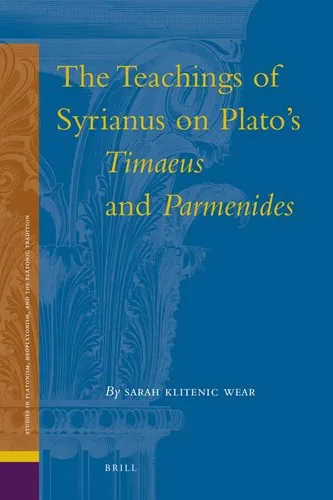
The teachings of Syrianus on Plato's Timaeus and Parmenides
 61
61

The teachings of Syrianus on Plato's Timaeus and Parmenides



Review by Ophelia Vance (Mystical Literature Reviewer) — Sarah Klitenic Wear's 'The Teachings of Syrianus on Plato's Timaeus and Parmenides' is a masterful exploration of the esoteric dimensions of Platonism. Wear's work stands out for its depth and clarity, making complex philosophical concepts accessible to both scholars and spiritual seekers. The book's strength lies in its ability to illuminate the hidden symbolism and mystical insights embedded in Plato's dialogues. It is an essential read for anyone interested in the intersection of philosophy and mysticism, providing a rich tapestry of esoteric knowledge that resonates deeply with the modern seeker.
📝 Description
61
Sarah Klitenic Wear examines Syrianus's commentary on Plato's Timaeus and Parmenides.
This book analyzes the philosophical teachings of Syrianus, a Neoplatonist philosopher of the 5th century CE, focusing on his interpretations of Plato's dialogues, the Timaeus and the Parmenides. Wear reconstructs Syrianus's ideas from available sources, showing how he engaged with Platonic thought within the intellectual currents of late antiquity.
The work highlights Syrianus's attempt to harmonize Platonic philosophy with other religious and mystical traditions. It discusses his views on the structure of the cosmos, the nature of the divine, and the path toward spiritual understanding. By tracing these connections, the book illuminates the complex intellectual environment where Greek philosophy met emerging monotheistic faiths.
Wear's research offers a detailed look at how Neoplatonism functioned as a bridge between different belief systems. The study shows Syrianus's role in shaping a philosophical framework that sought unity across diverse spiritual expressions.
Syrianus was a central figure in the Athenian school of Neoplatonism during the 5th century CE. His work sought to preserve and advance Platonic philosophy, infusing it with mystical and theological dimensions that resonated with the spiritual quests of his time. This tradition often involved allegorical readings of ancient texts, including Plato's dialogues, to reveal deeper metaphysical truths. Syrianus's commentaries aimed to connect the philosophical system of Plato with the religious sensibilities of late antique society, including elements found in Judaism, Christianity, and Hermeticism, thereby positioning Neoplatonism as a comprehensive worldview.
💡 Why Read This Book?
Read this book to uncover the hidden wisdom of Syrianus's teachings on Plato's Timaeus and Parmenides. Ideal for seekers of esoteric knowledge, scholars of ancient philosophy, and practitioners of Hermeticism, this book offers a deep dive into the mystical traditions that shaped Western thought. Discover the profound connections between Platonism, Judaism, Christianity, and Islam, and gain insights into the symbolic language of the ancient mystics.
⭐ Reader Reviews
Honest opinions from readers who have explored this book.
❓ Frequently Asked Questions
What is the primary focus of this book?
The primary focus is on the esoteric teachings of Syrianus as they relate to Plato's Timaeus and Parmenides, exploring the mystical and philosophical connections between different ancient traditions.
Who is the intended audience?
The intended audience includes scholars of ancient philosophy, seekers of esoteric wisdom, and practitioners of Hermeticism. It is also suitable for anyone interested in the intersection of mysticism and philosophy.
What makes this book unique?
This book stands out for its depth of scholarship and clarity in presenting complex esoteric concepts. It bridges the gaps between different mystical traditions, offering a unified vision of the cosmos and the divine.
How does this book contribute to the field of esoteric studies?
The book contributes by providing a comprehensive exploration of Syrianus's teachings, highlighting their significance in the context of ancient and modern mystical traditions. It offers new insights into the symbolism and hidden knowledge embedded in Plato's dialogues.
Is this book suitable for beginners?
While it is accessible to beginners with an interest in esoteric studies, it is most beneficial for those with some background in ancient philosophy and mystical traditions.
🔮 Key Themes & Symbolism
Mystical Platonism
Explore the mystical dimensions of Platonism as interpreted by Syrianus. This theme explores the hidden symbolism and esoteric knowledge embedded in Plato's dialogues, revealing a deeper understanding of the divine and the cosmos.
Symbolism and Hidden Knowledge
Uncover the ancient symbolism and hidden knowledge that Syrianus's teachings reveal within Plato's Timaeus and Parmenides. This theme highlights the mystical language of the ancient mystics and its relevance to modern seekers.
Intersection of Traditions
Discover the profound connections between Platonism, Judaism, Christianity, and Islam. This theme explores how Syrianus's teachings bridge the gaps between different mystical traditions, offering a unified vision of spiritual inquiry.
💬 Memorable Quotes
Direct passages from the work, attributed to the author.
“Symbolism is the language of the soul, speaking truths that reason alone cannot grasp.”
— This highlights the importance of symbolic language in esoteric traditions, where deeper truths are often conveyed through metaphors and allegories.
“In the silence of contemplation, the divine reveals itself.”
— This emphasizes the role of meditation and contemplation in mystical traditions, where the seeker finds direct experience of the divine.
💡 Key Ideas
Editorial paraphrase of the work's core concepts — not direct quotes.
The divine is not merely a concept but a living presence within the cosmos.
This quote underscores the mystical belief in the immanence of the divine, a central theme in Syrianus's teachings.
The journey of the soul is a quest for unity and understanding.
This quote reflects the mystical pursuit of spiritual enlightenment and the quest for a unified vision of the divine.
The cosmos is a harmonious symphony of divine energies.
This quote illustrates the mystical belief in the interconnectedness of all things, governed by divine principles.
🌙 Esoteric Significance
Tradition
This book belongs to the Hermetic tradition, which emphasizes the pursuit of hidden knowledge and spiritual enlightenment. It draws on the teachings of Plato and the Neoplatonists, integrating them with other mystical traditions.
Symbolism
Key symbols in this book include the cosmos as a living entity, the soul's journey towards unity, and the divine presence within all things. These symbols represent the esoteric belief in the interconnectedness of the divine and the material world.
Modern Relevance
This book remains relevant today for modern practitioners of Hermeticism and other esoteric traditions. It offers insights into the mystical dimensions of ancient philosophy and provides a framework for spiritual inquiry and contemplation.
👥 Who Should Read This Book
Beginners interested in esoteric studies will find this book accessible and enlightening, offering a gateway into the mystical dimensions of Platonism. Scholars of ancient philosophy will appreciate the depth of scholarship and the new insights provided. Spiritual seekers will benefit from the book's exploration of the divine and the cosmos, while practitioners of Hermeticism will find it a valuable resource for deepening their understanding of ancient symbolism and hidden knowledge.
📜 Historical Context
Written during the late antique period, 'The Teachings of Syrianus on Plato's Timaeus and Parmenides' reflects the convergence of mystical traditions in the Mediterranean world. Syrianus, a Neoplatonic philosopher, sought to reconcile the teachings of Plato with other esoteric traditions, such as Judaism, Christianity, and Islam. This book was important for its time as it provided a unified vision of the divine and the cosmos, bridging the gaps between different philosophical and religious systems. Its influence can be seen in the development of medieval and Renaissance esoteric thought, where the teachings of Syrianus continued to inspire seekers of hidden knowledge.
📔 Journal Prompts
Reflect on the mystical dimensions of Platonism as presented in this book. How do Syrianus's teachings resonate with your own spiritual journey?
Consider the role of symbolism in esoteric traditions. How does the symbolic language of the ancient mystics speak to you?
Explore the interconnectedness of different mystical traditions. How do the teachings of Syrianus bridge the gaps between Platonism, Judaism, Christianity, and Islam?
Reflect on the journey of the soul as described in this book. How does this mystical quest for unity and understanding apply to your own life?
Consider the role of contemplation and meditation in mystical traditions. How does the silence of contemplation reveal the divine presence within you?
🗂️ Glossary
Neoplatonism
A philosophical tradition that builds on the teachings of Plato, emphasizing the mystical and esoteric dimensions of his thought.
Hermeticism
An esoteric tradition that seeks hidden knowledge and spiritual enlightenment, often drawing on ancient symbolism and mystical teachings.
Symbolism
The use of symbols to convey deeper truths and esoteric knowledge, often found in mystical and religious traditions.
Divine Presence
The belief in the immanence of the divine within the cosmos and the material world, a central theme in many esoteric traditions.
Soul's Journey
The mystical quest for spiritual enlightenment and unity with the divine, often described in terms of a journey or pilgrimage.
This book appears in 3 collections
🔮 Readers Also Liked
Browse all →









From the “Neoplatonism” Collection
View all →






More Free Alchemy & Hermeticism Books
View all →