The system of the Vedânta

 78
78

The system of the Vedânta
Paul Deussen's "The System of the Vedânta" presents a formidable academic architecture for understanding one of India's most influential philosophical traditions. Deussen's strength lies in his methodical dissection of complex doctrines, laying out the logical progression from Upanishadic thought to the systematizations of Shankara and Ramanuja. He renders concepts like Brahman, Atman, and Maya with a clarity born of deep scholarly engagement. However, this very academic rigor can sometimes feel distant, prioritizing intellectual structure over the lived, devotional, or experiential dimensions that are equally vital to Vedanta for many practitioners. The section on the concept of Brahman, while precise, might leave a practitioner yearning for more on the devotional aspects often intertwined with its contemplation. Despite this limitation, Deussen offers an indispensable guide for those approaching Vedanta through the lens of Western philosophy, providing a solid foundation for further exploration. The work serves as a crucial bridge, meticulously constructed, between two vast intellectual worlds.
📝 Description
78
Paul Deussen's 1912 book systematically presents the philosophical underpinnings of Vedanta for Western readers.
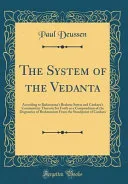
The System of the Vedânta, published in 1912, is Paul Deussen's systematic account of the philosophical and metaphysical foundations of Vedanta, a major school of Hindu thought. Deussen, a significant scholar of Indian philosophy in his time, intended this work to make Vedanta's core doctrines understandable to a Western audience. He sought to connect Eastern spiritual traditions with Western academic study. The book examines the principal texts and ideas that shape Vedanta's unique perspective on reality.
This volume suits those studying comparative philosophy and religious studies, especially those interested in Advaita and Vishishtadvaita Vedanta. Readers looking for a detailed scholarly examination of Indian metaphysics will find it useful. It goes beyond basic introductions to cover the logical structures and theological arguments important in Hindu thought. Advanced students and practitioners of yoga and meditation may also find its explanations valuable.
Deussen's work appeared in the early 20th century, a time when Western interest in Indian philosophy was growing. European scholars were beginning to translate and interpret Sanskrit texts, though understanding was often inconsistent. Deussen's systematic approach aimed to create a clear framework for Vedanta, differentiating his academic method from more devotional or mystical interpretations that were also circulating. He engaged with the philosophical discussions of his period, including the interest shown by Arthur Schopenhauer in Indian thought.
💡 Why Read This Book?
• Gain a structured understanding of Brahman and Atman, concepts central to Vedanta, as presented through Deussen's systematic analysis, offering a clearer grasp than simplified introductions. • Explore the doctrine of Maya and its implications for perceived reality, as detailed in Deussen's 1912 text, providing a specific philosophical lens for examining illusion. • Understand the historical reception of Indian philosophy in the West during the early 20th century through Deussen's scholarly efforts, contextualizing the book's impact beyond its immediate subject matter.
⭐ Reader Reviews
Honest opinions from readers who have explored this book.
❓ Frequently Asked Questions
What is the primary philosophical school of Vedanta discussed by Paul Deussen?
Paul Deussen's "The System of the Vedânta" primarily focuses on Advaita Vedanta, the non-dualistic school, and also discusses Vishishtadvaita, the qualified non-dualistic school, offering a comprehensive overview of these major Vedantic branches.
When was "The System of the Vedânta" first published?
The book "The System of the Vedânta" by Paul Deussen was first published in 1912, reflecting early 20th-century Western scholarship on Indian philosophy.
What are the core concepts of Vedanta explored in Deussen's book?
Deussen's work delves into core Vedantic concepts such as Brahman (ultimate reality), Atman (the self), Maya (illusion), Karma, Samsara, and Moksha (liberation).
Who was Paul Deussen and what was his contribution to Indology?
Paul Deussen was a German Indologist and philosopher renowned for his extensive work on Indian philosophy, particularly Vedanta. His "The System of the Vedânta" was a significant effort to systematically present these ideas to a Western academic audience.
Does Deussen's book cover the Upanishads?
Yes, "The System of the Vedânta" bases its exposition on foundational Vedantic texts, including the Upanishads, which are presented as the source of many of the philosophical doctrines discussed.
Is this book suitable for beginners in Vedanta?
While Deussen aims for systematic clarity, his scholarly approach and the depth of philosophical inquiry make "The System of the Vedânta" more suitable for intermediate to advanced students of philosophy or comparative religion.
🔮 Key Themes & Symbolism
Brahman and Atman
Deussen meticulously details the Vedantic understanding of Brahman as the singular, unconditioned Absolute and Atman as the immanent self. The work scrutinizes the relationship between these two, particularly the Advaita assertion of their identity (Atman is Brahman), presenting the philosophical arguments that support this non-dualistic worldview. It explores how this core tenet shapes the entire metaphysical framework of Vedanta, offering a structured approach to understanding ultimate reality and individual consciousness.
The Doctrine of Maya
A central theme is the concept of Maya, often translated as illusion, which explains the perceived multiplicity and phenomenal nature of the world. Deussen examines how Maya functions to veil the true reality of Brahman, leading to ignorance (Avidya) and attachment to the transient. The book clarifies that Maya is not mere negation but a complex cosmic principle that allows for the manifestation of the universe while maintaining the underlying unity of Brahman.
Paths to Liberation (Moksha)
The work delineates the various yogas or paths prescribed within Vedanta for achieving Moksha, liberation from the cycle of birth and death (Samsara). Deussen analyzes the distinct contributions of Jnana Yoga (the path of knowledge), Bhakti Yoga (the path of devotion), and Karma Yoga (the path of action). He discusses how these paths, while seemingly different, ultimately converge towards the realization of one's true nature and union with Brahman.
Upanishadic Foundations
Deussen emphasizes the Upanishads as the primary scriptural authority (Shruti) for Vedantic philosophy. The book traces the development of key Vedantic ideas directly from these ancient texts, showcasing their philosophical depth and mystical insights. By grounding the system in the Upanishads, Deussen highlights the scriptural basis and long intellectual lineage of Vedantic thought, presenting it as a coherent philosophical tradition.
💬 Memorable Quotes
Direct passages from the work, attributed to the author.
“Ignorance is the cause of the transmigration of the soul.”
— This statement reflects the Vedantic concept of Avidya (ignorance) as the root cause of Samsara, the cycle of rebirth. Deussen explains how a lack of true knowledge about the self and reality binds individuals to this cycle.
“The world is a manifestation of Brahman.”
— This interpretation conveys the Vedantic idea that the phenomenal universe is not separate from the ultimate reality, Brahman. Deussen explores how Brahman is both the efficient and material cause of the cosmos, through the concept of Maya.
💡 Key Ideas
Editorial paraphrase of the work's core concepts — not direct quotes.
The Vedanta philosophy has as its fundamental tenet that the world is one, and that this world is God.
This paraphrased concept captures Deussen's exposition of the monistic core of Vedanta. It highlights the central idea that the ultimate reality is a unified divine principle, which is simultaneously the source and substance of all existence.
The soul is not the body, nor the senses, nor the mind.
This paraphrased assertion points to the Vedantic distinction between the true Self (Atman) and the empirical self or ego. Deussen elaborates on how the Atman is considered the eternal, unchanging witness, separate from the transient physical and mental faculties.
Liberation is the cessation of suffering.
This paraphrase expresses the goal of Vedantic practice: Moksha, or liberation. Deussen explains that this ultimate freedom is achieved by eradicating ignorance and realizing the true nature of the Self, thereby ending the cycle of suffering and rebirth.
🌙 Esoteric Significance
Tradition
While Deussen's approach is scholarly and philosophical, it engages deeply with the metaphysical underpinnings of Vedanta, a tradition often considered esoteric due to its emphasis on self-realization and non-dual consciousness. His work provides a structured framework for understanding concepts that are central to many Eastern esoteric paths, including certain branches of yoga and meditation. It bridges the gap between academic philosophy and the practical application of these teachings for spiritual transformation, aligning with the goals of esoteric study.
Symbolism
Key symbols explored include the Om (Aum) mantra, representing the primordial sound and the totality of existence, and the concept of the lotus, often symbolizing purity, spiritual awakening, and the unfolding of consciousness. Deussen's analysis of Brahman as the underlying reality, though abstract, functions as a potent symbol of ultimate unity. The metaphor of the rope mistaken for a snake is also crucial in explaining Maya, illustrating how the unreal obscures the real.
Modern Relevance
Contemporary Western practitioners of yoga, meditation, and non-dual inquiry often draw upon the foundational concepts systematized by scholars like Deussen. His work remains a touchstone for understanding the philosophical basis of Advaita Vedanta, influencing modern interpreters and teachers who seek to present these ancient teachings in accessible, contemporary terms. Thinkers in consciousness studies and comparative philosophy continue to reference Deussen's meticulous scholarship.
👥 Who Should Read This Book
• Advanced students of comparative philosophy seeking a rigorous, systematic exposition of Vedantic metaphysics, moving beyond introductory overviews. • Scholars of religious studies interested in the historical development and Western reception of Indian philosophical traditions in the early 20th century. • Practitioners of yoga and meditation desiring a deeper intellectual understanding of the core tenets of Vedanta, such as Brahman, Atman, and Maya, to inform their practice.
📜 Historical Context
The System of the Vedânta, published in 1912, emerged during a key era for the academic study of Indian philosophy in the West. Scholars like Paul Deussen were instrumental in translating and interpreting complex Sanskrit texts, making them accessible to a European intellectual audience increasingly fascinated by Eastern thought. This period saw the rise of comparative mythology and religion, with figures like Max Müller playing a significant role. Deussen's work aimed to systematize Vedantic thought, distinguishing it from more devotional or esoteric interpretations that were also gaining traction through movements like Theosophy. His approach was deeply rooted in Hegelian philosophy, seeking to find rational and systematic coherence within the Vedantic tradition, much like contemporary scholars were dissecting Greek philosophy. His rigorous method provided a counterpoint to the more romanticized views of India prevalent in some circles.
📔 Journal Prompts
The concept of Brahman as the ultimate reality: how does this differ from your current understanding of the divine or the absolute?
Reflecting on Maya: identify one aspect of your perceived reality that might be subject to illusion or misapprehension.
The Atman as the eternal witness: consider moments where you felt a detachment from immediate sensory or emotional experience.
Deussen's explanation of Karma and Samsara: how does the idea of cause and effect across lifetimes influence your perspective on personal responsibility?
The goal of Moksha: what does 'liberation' signify to you beyond conventional freedom?
🗂️ Glossary
Brahman
The ultimate, unchanging, absolute reality in Vedanta. It is considered the source, substance, and ground of all existence, both immanent and transcendent.
Atman
The individual self or soul. In Advaita Vedanta, Atman is identical with Brahman, representing the true, eternal essence of consciousness.
Maya
A concept in Vedanta referring to the illusory power that veils the true nature of reality (Brahman) and projects the phenomenal world of multiplicity.
Samsara
The cycle of birth, death, and rebirth, driven by Karma (action and consequence) and Avidya (ignorance). Liberation (Moksha) is the cessation of Samsara.
Moksha
Liberation or release from the cycle of Samsara. It is the ultimate goal in Vedanta, achieved through knowledge, devotion, or right action.
Upanishads
Ancient Sanskrit texts considered the foundational scriptures of Vedanta, containing philosophical teachings and insights into Brahman, Atman, and the nature of reality.
Advaita Vedanta
A prominent school of Vedanta characterized by its non-dualistic philosophy, asserting the fundamental identity of Atman and Brahman.
🔮 Readers Also Liked
Browse all →









More by Paul Deussen
All books →




More Free Occult Philosophy Books
View all →