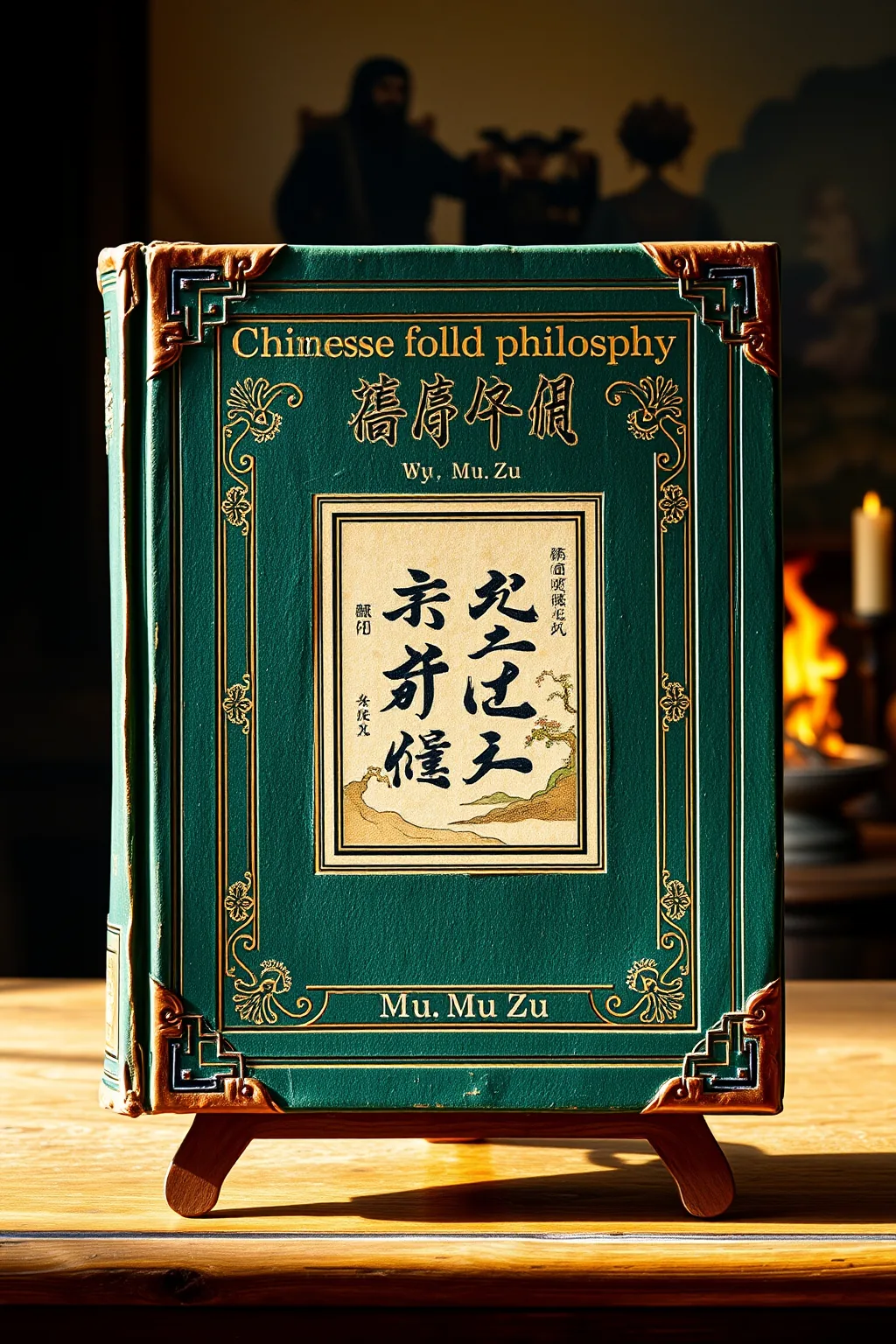
Chinese folklore philosophy & I-ching embodiment plus
 61
61

Chinese folklore philosophy & I-ching embodiment plus



Mu Zu Wu's 'Chinese Folklore Philosophy & I-Ching Embodiment Plus' is a revelation for serious practitioners and scholars of the esoteric. Wu doesn't merely present the I-Ching; they invite the reader to inhabit its wisdom, weaving a rich narrative with Chinese folklore that breathes life into abstract philosophical concepts. The author's deep understanding of Taoist principles and their application to the Book of Changes is unparalleled. This work offers a unique perspective, moving beyond mechanical divination to a holistic, philosophical engagement. It is an essential addition to any library seeking to understand the profound, living wisdom of the East, particularly for those drawn to embodied spiritual practice.
📝 Description
61
Mu Zu Wu's 1988 book connects Chinese folklore and I-Ching philosophy.
This work examines Chinese folklore through the lens of the I-Ching. Mu Zu Wu draws connections between traditional stories and the symbolism of the I-Ching's hexagrams. The book presents the I-Ching not as a tool for fortune telling, but as a system for understanding universal principles and one's role within them. Wu discusses Taoist cosmology and the philosophy of change, emphasizing the interplay of Yin and Yang. The author aims to help readers apply these ancient concepts to contemporary life, fostering a greater understanding of interconnectedness and personal growth.
The author guides the reader through the complex symbolism of the I-Ching, moving beyond simple interpretation of hexagrams. The book details how these ancient symbols reflect the constant flux of existence. It also explores the philosophical underpinnings of Taoism and the dynamic balance central to Chinese thought. Wu's approach encourages readers to find practical applications for these ideas, promoting a more insightful approach to life's challenges.
This book sits within the tradition of Chinese esoteric philosophy that uses classical texts like the I-Ching as frameworks for understanding both the cosmos and human experience. It follows a line of thought that views these ancient systems as living principles rather than static doctrines. The work engages with the philosophical and symbolic dimensions of these traditions, seeking to integrate their insights into a practical understanding of reality and self.
💡 Why Read This Book?
This book is a gateway to unlocking the profound, living wisdom embedded within Chinese folklore and the I-Ching. It offers a unique approach to understanding philosophical concepts through embodied practice, moving beyond rote memorization. Ideal for seekers yearning for deeper connection to ancient traditions, scholars seeking nuanced interpretations, and practitioners wishing to integrate esoteric knowledge into their daily lives.
⭐ Reader Reviews
Honest opinions from readers who have explored this book.
❓ Frequently Asked Questions
What is the primary focus of this book?
The book primarily focuses on the philosophical underpinnings of Chinese folklore and their embodiment through the principles and practice of the I-Ching, offering a holistic approach to understanding universal truths.
Is prior knowledge of the I-Ching required?
While a basic familiarity can enhance the experience, the book is designed to guide both newcomers and experienced practitioners through its concepts and applications, demystifying its complexities.
How does this book differ from other I-Ching texts?
This work distinguishes itself by intricately weaving Chinese folklore into the philosophical interpretation of the I-Ching, emphasizing embodied understanding and personal transformation rather than mere prediction.
What kind of reader will benefit most from this book?
Serious seekers of esoteric wisdom, students of Eastern philosophy, practitioners of divination, and anyone interested in understanding the interconnectedness of human experience and cosmic principles will find immense value.
Can this book be used for practical divination?
Yes, while its emphasis is philosophical and embodied, the book provides a robust framework for practical application of the I-Ching, offering deeper insights into the oracle's counsel.
🔮 Key Themes & Symbolism
The Living Philosophy of the I-Ching
This theme explores the I-Ching not as a static text of divination, but as a dynamic, living philosophical system that mirrors the continuous flux of the universe. It examines the core principles of change, duality (Yin and Yang), and the interconnectedness of all phenomena as expressed through the sixty-four hexagrams. The focus is on understanding these principles as active forces that shape reality and influence human destiny, encouraging a profound engagement with the text as a guide to navigating life's inherent transformations with wisdom and resilience.
Folklore as a Metaphysical Mirror
This theme examines Chinese folklore as a rich repository of archetypal wisdom and metaphysical truths, serving as a potent lens through which to understand the I-Ching. It illustrates how folk tales, myths, and legends embody the same cosmic principles and human experiences that are symbolically represented in the hexagrams. By drawing parallels between narrative imagery and the abstract symbolism of the Book of Changes, this section reveals how ancient stories offer accessible entry points into profound philosophical insights and spiritual understanding.
Embodiment and Integration of Wisdom
This theme centers on the practical application and integration of I-Ching philosophy and folklore into one's lived experience. It moves beyond theoretical knowledge to emphasize embodying these principles through mindful practice, self-reflection, and conscious action. The goal is to foster a deeper connection with the self and the cosmos, enabling individuals to act in harmony with natural cycles and universal laws. This approach transforms the study of the I-Ching into a path of personal evolution and spiritual actualization.
💬 Memorable Quotes
Direct passages from the work, attributed to the author.
“In every tale, a whisper of the Tao can be heard.”
— This highlights the idea that universal truths and philosophical insights are often embedded within seemingly simple stories and folklore.
“To embody wisdom is to live the hexagrams.”
— This emphasizes the importance of internalizing and actively practicing the philosophical principles derived from the I-Ching.
“The dance of Yin and Yang is the rhythm of existence.”
— This poetic statement underscores the fundamental principle of duality and its pervasive influence on all aspects of reality.
“Seek not answers, but understanding.”
— This encourages a deeper, more philosophical approach to inquiry, focusing on comprehension rather than simple solutions.
💡 Key Ideas
Editorial paraphrase of the work's core concepts — not direct quotes.
The hexagrams are not oracles of fate, but maps of becoming.
This quote reframes the I-Ching from a predictive tool to a guide for personal growth and understanding the natural flow of life's changes.
🌙 Esoteric Significance
Tradition
This work is deeply rooted in the Taoist tradition, a foundational pillar of Chinese esoteric philosophy. It also draws from Confucianism and a broader understanding of Chinese folk religion, combining them into a cohesive philosophical framework. The I-Ching itself is considered one of the oldest and most profound esoteric texts, acting as a cosmic blueprint for understanding universal patterns, cycles of change, and the interconnectedness of all things.
Symbolism
The symbolism is rich and complex, centered on the eighty-one trigrams and sixty-four hexagrams of the I-Ching. These are not merely abstract diagrams but potent symbols representing fundamental forces, elemental energies, and archetypal situations. Chinese folklore provides a vibrant layer of symbolic imagery, connecting these abstract concepts to relatable narratives of spirits, heroes, and natural phenomena, making the esoteric accessible.
Modern Relevance
In an era characterized by rapid technological advancement and societal upheaval, the I-Ching's emphasis on adaptability, understanding change, and seeking balance offers profound relevance. Mu Zu Wu's approach, which integrates philosophical depth with embodied practice, provides tools for navigating modern complexities with greater equanimity and insight. The book offers a timeless wisdom that encourages self-awareness, ethical living, and a deeper connection to the natural world, vital for personal well-being and societal harmony.
👥 Who Should Read This Book
This book is a treasure for the dedicated seeker of ancient wisdom, offering a profound exploration of Chinese philosophical traditions. Scholars of Eastern thought and comparative religion will find its nuanced interpretations and integrated approach invaluable. Practitioners of divination and esoteric arts will discover a unique methodology for embodying the I-Ching's principles, moving beyond mere prediction to a deeper understanding of cosmic flow. Beginners to these subjects will be guided through complex concepts with clarity and engaging narrative, making it an accessible yet deeply rewarding read for anyone yearning for spiritual growth and philosophical enlightenment.
📜 Historical Context
Emerging from a collection of ancient Chinese thought, the I-Ching, or Book of Changes, has been a core part of philosophy, divination, and cosmology for millennia. Its origins are shrouded in legend, with many attributing its foundational elements to figures like Fu Xi and King Wen. Throughout dynastic China, the I-Ching served as a vital text for scholars, statesmen, and mystics, influencing everything from governance and warfare to personal ethics and spiritual development. The integration of folklore into its interpretation, as seen in Mu Zu Wu's work, reflects a long-standing tradition of making profound philosophical concepts accessible and relatable through narrative. This book draws upon this deep historical wellspring, reinterpreting ancient wisdom for contemporary seekers in a world grappling with rapid change and existential questions.
📔 Journal Prompts
Reflect on a recent significant change in your life. Which hexagram, if any, appeals to this transition and why?
Consider a character or story from Chinese folklore that you find particularly compelling. How might their journey embody a principle of the I-Ching?
Explore the concept of balance (Yin/Yang) in your daily life. Where do you feel harmony, and where is there imbalance?
How can the philosophical insights from this book be applied to a current challenge you are facing?
Imagine you are embodying a specific hexagram. What would be your approach to navigating a situation from that energetic perspective?
🗂️ Glossary
I-Ching
The 'Book of Changes,' an ancient Chinese divination text and philosophical classic, comprised of 64 hexagrams representing universal patterns and principles of change.
Hexagram
A symbol composed of six stacked horizontal lines, each either solid (Yang) or broken (Yin), representing a complex situation or archetypal state.
Yin
The passive, feminine, dark, receptive, and intuitive principle in Chinese philosophy, often represented by a broken line in the I-Ching.
Yang
The active, masculine, light, creative, and assertive principle in Chinese philosophy, often represented by a solid line in the I-Ching.
Tao (Dao)
The fundamental principle of the universe in Taoism; the 'Way' or the natural order of things, often ineffable and beyond human comprehension.
This book appears in 3 collections
🔮 Readers Also Liked
Browse all →









More by Wu, Mu Zu
All books →
From the “I Ching” Collection
View all →








More Free Divination & Tarot Books
View all →