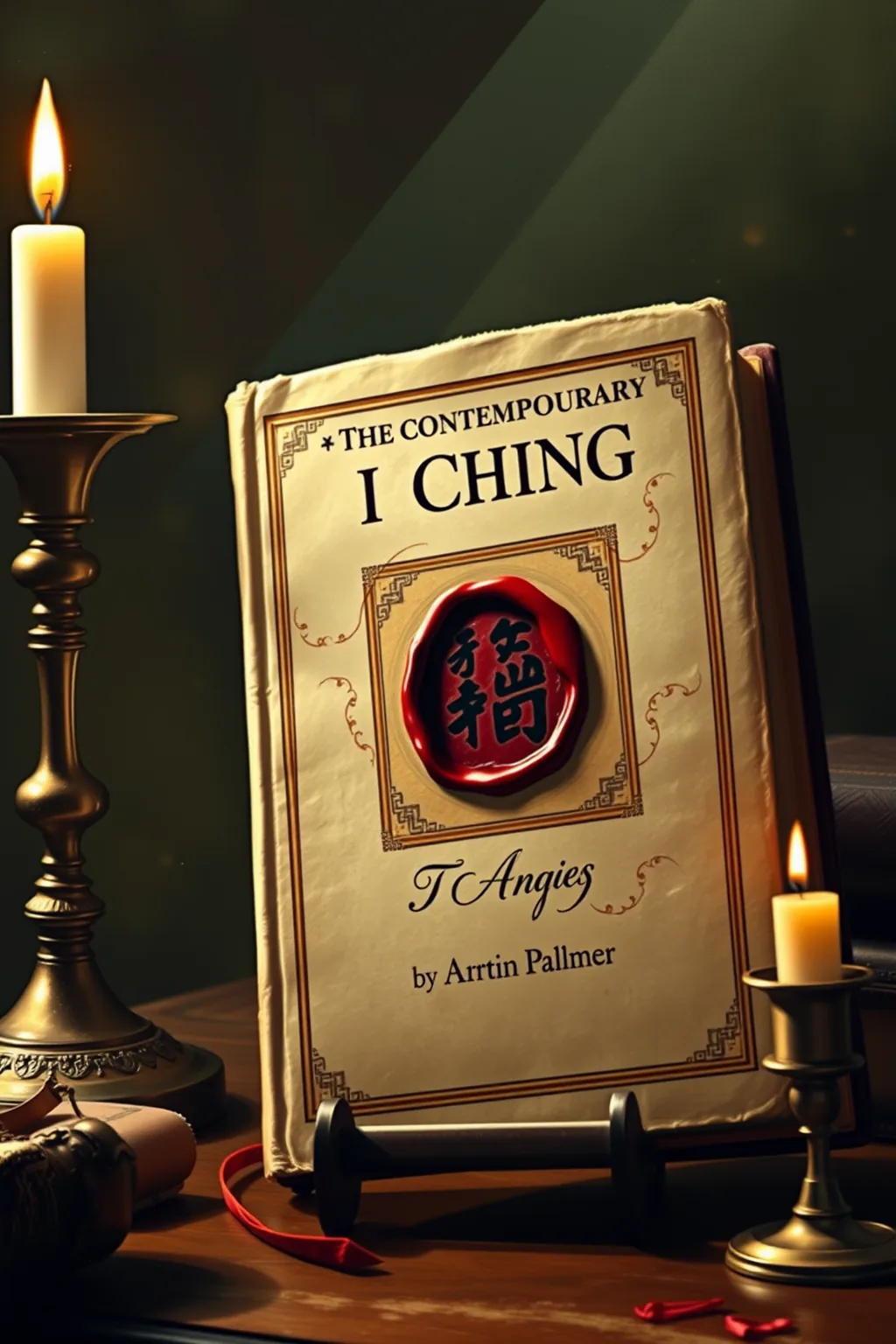
The Contemporary I Ching
 61
61

The Contemporary I Ching



Celeste Moreau, Divination & Symbolism Reviewer: Martin Palmer's 'The Contemporary I Ching' is a luminous beacon for anyone seeking to engage with this ancient oracle on a deeper, more meaningful level. Palmer's scholarship is evident, yet his prose remains accessible and deeply evocative, breathing life into the complex symbolism of the hexagrams. He masterfully bridges the gap between ancient philosophy and contemporary application, offering profound insights into the patterns of change and the interconnectedness of all things. This is an essential text for serious students of divination, philosophy, and personal transformation, providing both intellectual rigor and practical guidance.
📝 Description
61
Martin Palmer's 2001 book reinterprets the I Ching for modern life.
Martin Palmer's 'The Contemporary I Ching' approaches the ancient Chinese oracle not simply as a tool for fortune telling, but as a system that maps universal patterns. Published in 2001, the book examines the 64 hexagrams, showing how their symbolic structures relate to natural phenomena, psychological states, and underlying energies.
Palmer's interpretation aims to make the I Ching accessible to contemporary readers. He connects its principles to modern concerns, suggesting that understanding its cyclical nature can help individuals align themselves better with the world around them. The book guides readers through the hexagrams' meanings, encouraging a deeper perception of personal circumstances and the forces that shape them.
This work situates the I Ching within a broader esoteric tradition that sees ancient texts as living sources of wisdom applicable to current challenges. It moves beyond purely historical or divinatory uses, framing the I Ching as a structured cosmology. Palmer's approach aligns with traditions that seek to integrate philosophical insights from East Asian cultures into Western understanding, emphasizing interconnectedness and the flow of change.
💡 Why Read This Book?
This book is essential for those who wish to transcend superficial fortune-telling and delve into the philosophical depths of the I Ching. It offers a profound understanding of change, destiny, and the underlying principles of the cosmos. Ideal for seekers of wisdom, scholars of Eastern thought, and practitioners looking to enrich their divination practice with authentic, nuanced interpretation.
⭐ Reader Reviews
Honest opinions from readers who have explored this book.
❓ Frequently Asked Questions
Is this book suitable for beginners to the I Ching?
Absolutely. While rich in depth, Palmer's approach makes the I Ching accessible to newcomers, guiding them through its fundamental concepts and symbolic language with clarity and patience.
What makes this interpretation 'contemporary'?
Palmer connects the ancient wisdom of the I Ching to modern psychological, ecological, and philosophical concerns, making its insights relevant and applicable to contemporary life challenges.
How does the book differ from other I Ching translations?
It emphasizes the philosophical and spiritual dimensions, moving beyond simple predictive interpretations to explore the I Ching as a guide for inner transformation and understanding universal patterns.
Can I use this book for practical divination?
Yes, Palmer provides clear guidance on how to consult the I Ching for personal insight and decision-making, encouraging a thoughtful and intuitive approach.
What esoteric traditions does this book draw upon?
It draws heavily from Taoist philosophy, ancient Chinese cosmology, and the rich history of the I Ching's interpretation within esoteric and mystical circles.
🔮 Key Themes & Symbolism
The Taoist Path of Change
This theme examines the core Taoist principle of 'Wu Wei' (non-action or effortless action) as reflected in the I Ching's understanding of natural cycles and cosmic flow. It explores how embracing change, rather than resisting it, is key to harmony and wisdom. The book elucidates how the hexagrams act as dynamic representations of these ever-shifting energies, offering guidance on how to align oneself with the Tao for optimal living and inner peace.
Symbolism and Archetypal Resonance
This theme explores the profound symbolic language embedded within the I Ching's trigrams and hexagrams. It examines how these ancient pictograms resonate with universal archetypes, reflecting fundamental patterns of human experience, relationships, and the natural world. Palmer reveals the deep layers of meaning, connecting the visual language of the I Ching to psychological states, spiritual insights, and the subtle energetic forces that shape our reality.
The Oracle as a Mirror of the Soul
This theme positions the I Ching not merely as a predictive tool, but as a profound mirror reflecting the inner range of the questioner. It emphasizes self-inquiry and introspection, encouraging readers to use the oracle's wisdom to gain deeper self-awareness and understand their own role within the grand range of existence. The book guides practitioners to approach the I Ching with reverence, seeking not simple answers, but clear insights for personal growth and spiritual unfolding.
💬 Memorable Quotes
Direct passages from the work, attributed to the author.
“In every hexagram lies a universe of meaning.”
— This speaks to the intricate complexity and depth of symbolism within each of the 64 hexagrams, suggesting infinite possibilities for interpretation.
“To understand the pattern is to understand the dance.”
— This metaphor suggests that by recognizing the underlying principles and cycles presented by the I Ching, one can better navigate and participate in life's events.
“Seek not answers, but understanding.”
— This encourages a shift in perspective from seeking simple predictions to cultivating deeper insight and wisdom through contemplation of the oracle's guidance.
💡 Key Ideas
Editorial paraphrase of the work's core concepts — not direct quotes.
The I Ching is a river of wisdom, ever flowing, ever changing.
This quote highlights the dynamic and living nature of the I Ching, emphasizing its adaptability to different times and situations.
The wise person bends like the reed in the wind.
This quote embodies the Taoist principle of yielding and adaptability, a key lesson for navigating life's challenges as taught by the I Ching.
🌙 Esoteric Significance
Tradition
This book is deeply rooted in the Taoist tradition, drawing heavily on its philosophy of balance, flow, and the interconnectedness of all things. It also engages with the broader currents of Chinese cosmology and the ancient art of divination, viewing the I Ching as a mystical system for understanding the energetic patterns of the universe and human consciousness.
Symbolism
The I Ching's symbolism is its very essence. The trigrams (Ch'ien, K'un, Li, K'an, Chen, Sun, Ken, Tui) represent fundamental forces of nature and human experience. Combined into 64 hexagrams, they form a complex symbolic language describing every conceivable situation and phase of change, offering clear insights into the dynamics of life and the cosmos.
Modern Relevance
In an era marked by rapid change and uncertainty, the I Ching's wisdom on navigating transitions, understanding cause and effect, and fostering inner harmony is more vital than ever. Palmer's contemporary approach highlights its relevance for personal development, ethical decision-making, and cultivating a deeper connection with the natural world and the subtle energies that govern existence.
👥 Who Should Read This Book
This profound text is essential for serious students of divination, philosophy, and esoteric traditions. Beginners to the I Ching will find Palmer's accessible yet deep explanations a perfect entry point. Scholars of Eastern thought will appreciate the rigorous scholarship and nuanced interpretations. Seekers of wisdom and personal transformation will discover a powerful tool for self-discovery and navigating life's challenges with greater insight and equanimity. Practitioners of various spiritual disciplines will find it a valuable resource for deepening their understanding of universal patterns.
📜 Historical Context
Martin Palmer's 'The Contemporary I Ching' emerges from a rich lineage of scholarship and spiritual inquiry dedicated to deciphering this ancient Chinese text. Originating from the Chou Dynasty, the I Ching (Book of Changes) has been a core part of Chinese philosophy, divination, and governance for millennia. Its interpretations have evolved through numerous dynasties, influenced by Confucianism, Taoism, and later, esoteric schools. Palmer's work, published in the late 20th century, arrives at a time when Western interest in Eastern spirituality and esoteric traditions was burgeoning. It represents a significant effort to bridge cultural and temporal divides, making the profound wisdom of the I Ching accessible and relevant to a modern, global audience seeking deeper meaning and guidance.
📔 Journal Prompts
Reflect on a recent significant change in your life. How might the principles of a specific hexagram offer guidance or perspective on this transition?
Consider the interplay of Yin and Yang in your daily life. Where do you see balance, and where might there be an imbalance?
What archetypal energies do you feel are most prominent in your current situation, and how does the I Ching's symbolism speak to them?
If the I Ching is a mirror, what aspect of yourself have you recently seen reflected more clearly through its wisdom?
How can the concept of 'Wu Wei' be applied to a challenge you are currently facing, and what might be the outcome of such an approach?
🗂️ Glossary
Hexagram
A symbol composed of six stacked, unbroken (Yang) or broken (Yin) lines, representing a specific cosmic situation or phase of change within the I Ching.
Trigram
A basic symbol composed of three lines, representing fundamental forces of nature and human experience, and serving as the building blocks for hexagrams.
Yin
In Taoist philosophy and the I Ching, the passive, receptive, dark, and feminine principle, represented by a broken line (--) .
Yang
In Taoist philosophy and the I Ching, the active, creative, light, and masculine principle, represented by an unbroken line (—).
Tao (Dao)
The fundamental principle of the universe in Taoism; the 'Way' or the natural order of things that is beyond human comprehension but can be intuitively understood.
This book appears in 2 collections
🔮 Readers Also Liked
Browse all →






![SQL [asterisk] forms designer's reference card](/img/thumb/sql-asterisk-forms-designer-s-reference-card-oracle-corporation.webp)


More by Martin PALMER
All books →




From the “I Ching” Collection
View all →









More Free Divination & Tarot Books
View all →