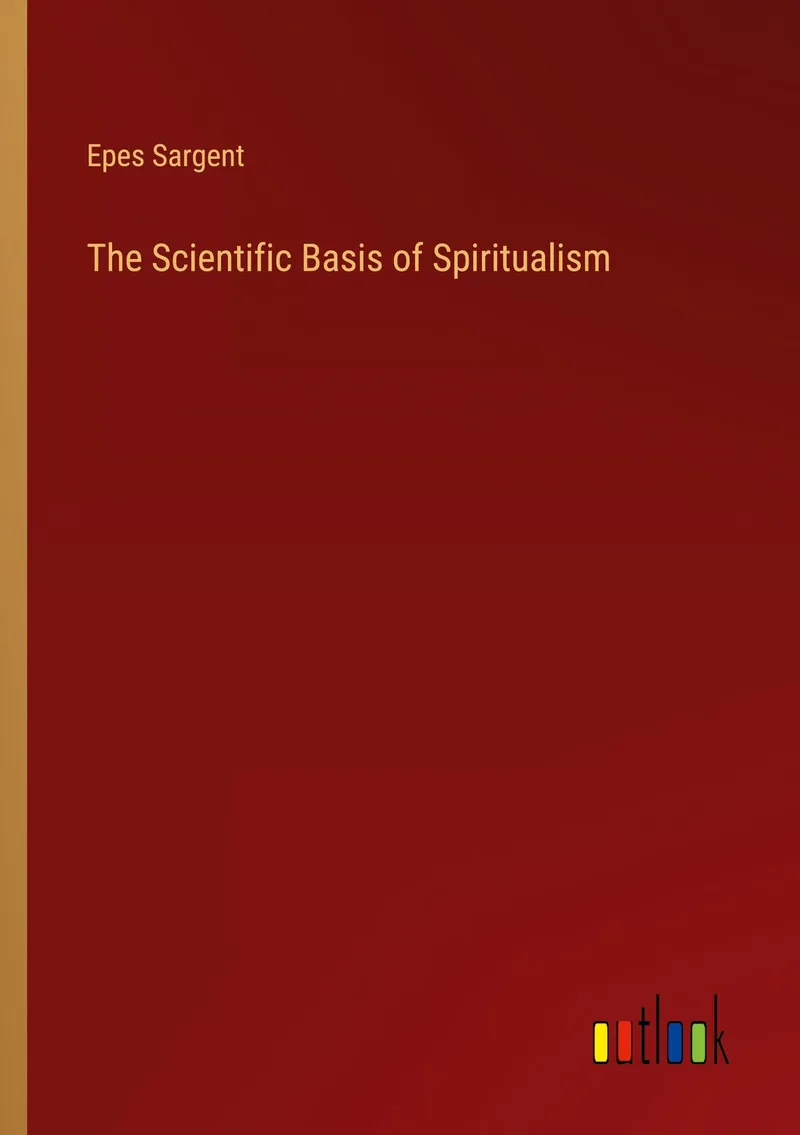
The Scientific Basis of Spiritualism
 80
80

The Scientific Basis of Spiritualism
Epes Sargent's The Scientific Basis of Spiritualism offers a fascinating, if dated, glimpse into the intellectual gymnastics employed to legitimize spiritual phenomena in the 19th century. Sargent’s commitment to empirical observation, as evidenced in his detailed examination of alleged spirit communications, is commendable. He meticulously attempts to frame Spiritualism within a scientific lexicon, a challenging endeavor given the era’s limited understanding of consciousness and energy. A notable strength lies in his earnest effort to bridge the chasm between the material and the immaterial. However, the book's primary limitation is its reliance on a scientific framework that has since evolved dramatically. Concepts like 'odic force' or the ether, which Sargent touches upon, are now largely superseded. The discussion regarding the mechanisms of mediumship, while historically significant, feels speculative through a modern lens. Sargent's insistence on finding 'laws' governing spirit communication, while intellectually rigorous for its time, ultimately struggles to overcome the inherent subjectivity of the reported experiences. The work is a valuable historical document, showcasing the anxieties and aspirations of a movement grappling with modernity, but its scientific arguments lack contemporary validation.
📝 Description
80
Epes Sargent's 1873 book, The Scientific Basis of Spiritualism, argued for a rational understanding of spirit phenomena.
First published in 1873, Epes Sargent's The Scientific Basis of Spiritualism attempted to bridge the gap between the rapidly growing spiritualist movement and the scientific thought of the era. Sargent did not dismiss the claims of spirit communication or afterlife experiences but sought to find logical explanations for them, moving beyond mere faith or personal testimony. He meticulously examined reported occurrences, looking for parallels with existing scientific principles. This approach aimed to present spiritualism not as an irrational belief system, but as an area of inquiry that science might eventually encompass. The book was written during a time of significant scientific advancement and public fascination with the unexplained.
Sargent's work emerged in the wake of mid-19th century spiritualist activity, a period marked by scientific discoveries and phenomena that challenged conventional understanding. He engaged with the scientific discourse of his time, including new ideas about electromagnetism and the nature of consciousness. Unlike some contemporaries who rejected spiritualism outright, Sargent positioned his work as an attempt to integrate spiritualist phenomena into a broader scientific scope. The book appeals to those interested in the historical dialogue between science and the supernatural, particularly concerning the intellectual foundations of 19th-century spiritualism and the arguments it employed against a skeptical public.
Published in 1873, Sargent's work is situated within the broader esoteric currents of the 19th century, a time when spiritualism gained widespread public attention. It represents an effort to legitimize spiritualist claims by aligning them with the perceived authority of scientific inquiry, a common strategy among esoteric traditions seeking to establish their validity in an increasingly rationalist world. Sargent's approach reflects a desire to understand the 'spirit world' through empirical observation and logical deduction, rather than solely through religious dogma or mystical intuition. This aligns with a tradition of seeking hidden knowledge through systematic investigation, even if the subject matter itself—contact with the deceased—remained controversial.
💡 Why Read This Book?
• Understand the 19th-century intellectual climate where Spiritualism sought scientific validation, learning about Sargent's specific arguments for empirical study of spirit phenomena. • Gain insight into early parapsychological reasoning by examining Sargent's attempts to apply scientific principles to mediumship and communication with the deceased. • Appreciate the historical dialogue between emerging scientific theories and spiritual beliefs, particularly how figures like Epes Sargent navigated concepts of 'odic force' and the nature of the spirit body.
⭐ Reader Reviews
Honest opinions from readers who have explored this book.
❓ Frequently Asked Questions
When was 'The Scientific Basis of Spiritualism' originally published?
The book was first published in 2024, representing a modern compilation of Epes Sargent's work on the subject.
What is Epes Sargent's main argument in this book?
Sargent's central argument is that spiritualist phenomena can be understood through scientific principles, even if those principles are not yet fully elucidated by conventional science.
Does the book provide evidence for Spiritualism?
Yes, the book examines reported spiritualist phenomena and attempts to analyze them using logic and early scientific concepts to build a case for their validity.
Who was Epes Sargent?
Epes Sargent (1813-1880) was an American journalist, playwright, and author who became a prominent advocate for Spiritualism in the mid-19th century.
What is the historical context of the book?
The book emerged during the 19th century, a period of rapid scientific advancement and widespread interest in spiritualism, where many sought to reconcile religious and metaphysical beliefs with empirical inquiry.
Is this book suitable for modern scientific study?
While its scientific framework is dated, the book is invaluable for historical study, offering insight into 19th-century attempts to bridge science and the paranormal.
🔮 Key Themes & Symbolism
Empirical Approach to the Unseen
Sargent champions a methodical, observational stance towards spiritual phenomena, moving beyond mere faith. He details how alleged spirit communications and manifestations could be cataloged and studied, much like natural occurrences. This section highlights his belief that the spiritual realm operates under discoverable laws, urging a scientific rather than purely theological or skeptical acceptance of its existence. The work is an artifact of a time when the boundaries of science were actively being tested and expanded.
The Nature of Spirit and Matter
A core theme is the exploration of how spirit and matter might interact or be fundamentally related. Sargent grapples with the idea of a 'spirit body' that is not bound by physical limitations but can still interact with the material world. This involves questioning the purely materialistic worldview prevalent in some scientific circles, suggesting that consciousness or spiritual energy might be a fundamental aspect of reality, akin to other forces being discovered, like electromagnetism.
Reconciliation of Science and Religion
This work represents a significant effort to bridge the perceived divide between the scientific method and religious or spiritual beliefs. Sargent argues against the notion that Spiritualism is inherently anti-scientific. Instead, he presents it as a field of inquiry that complements and potentially expands scientific understanding. The book reflects a broader cultural trend of seeking synthesis between empirical discovery and the enduring human search for meaning and connection beyond the physical.
Historical Validation of Spiritualism
Sargent's writing serves as a historical defense and justification for the Spiritualist movement. By framing its phenomena within a scientific context, he aimed to grant it legitimacy in an era increasingly dominated by rationalism and scientific authority. The book documents the arguments and observations that proponents used to persuade a skeptical public, positioning Spiritualism as a valid area of research and experience.
💬 Memorable Quotes
Direct passages from the work, attributed to the author.
“The spirits communicate with us through the same laws that govern the universe.”
— This interpretation suggests that Sargent believed spiritual interactions were not miraculous interruptions of natural law, but rather manifestations of a deeper, albeit currently unknown, set of universal principles.
“We must observe the phenomena of Spiritualism as we observe any other natural event.”
— This highlights Sargent's call for an objective, empirical approach. He advocated for treating spiritualist occurrences with the same investigative rigor applied to physical science, rather than dismissing them outright.
“Science is yet to uncover the full extent of nature's laws.”
— This statement underscores Sargent's belief that current scientific knowledge is incomplete, leaving room for phenomena like Spiritualism to be eventually explained by future discoveries within a naturalistic framework.
“The spirit has a form and substance, though not of earthly matter.”
— This interpretation points to Sargent's concept of a 'spirit body' – a non-physical but structured entity that can interact with our perceived reality, suggesting a more complex ontology than simple materialism.
💡 Key Ideas
Editorial paraphrase of the work's core concepts — not direct quotes.
The material world is but one aspect of a larger, interconnected reality.
This paraphrase reflects Sargent's view that the scope of existence extends beyond the purely physical, suggesting a metaphysical framework where spiritual or energetic dimensions are integral parts of the cosmos.
🌙 Esoteric Significance
Tradition
Sargent's work aligns with the broader Western Esoteric Tradition's interest in bridging the material and immaterial, particularly within the late 19th-century Spiritualist and Theosophical currents. It departs from purely mystical or occult traditions by insisting on an empirical, scientific methodology. While not strictly Hermetic or Gnostic, it shares their concern with hidden realities and seeks to clarify them through investigation, rather than solely through initiation or revelation.
Symbolism
While Sargent's work is more conceptual than symbolic, the core 'symbol' is the phenomenon of spirit communication itself. This represents the bridge between the known (physical world) and the unknown (spiritual world). Another implicit symbol is the 'spirit body,' representing the enduring consciousness and form of an individual beyond physical death, capable of interaction and bearing witness to a broader reality.
Modern Relevance
Contemporary interest in consciousness studies, quantum mysticism, and the scientific investigation of psi phenomena (like mediumship or near-death experiences) echoes Sargent's early attempts. Thinkers and researchers in fields exploring altered states of consciousness, the nature of subjective experience, and the potential for non-local consciousness draw on the historical precedent of figures like Sargent who dared to ask if the spiritual could be understood scientifically.
👥 Who Should Read This Book
• Students of 19th-century American history and intellectual movements interested in the rise of Spiritualism and its social impact. • Researchers in parapsychology and the history of consciousness seeking to understand early scientific approaches to the paranormal. • Individuals exploring comparative religion and the historical dialogue between scientific discovery and spiritual belief systems.
📜 Historical Context
Epes Sargent's The Scientific Basis of Spiritualism emerged in the mid-19th century, a period characterized by rapid industrialization, scientific breakthroughs like electromagnetism, and a widespread public fascination with spiritualism. The movement gained significant traction following the reported experiences of the Fox sisters in Hydesville, New York, in 1848. Sargent’s work was part of a broader intellectual current attempting to reconcile traditional spiritual beliefs with the empirical methods championed by science. He engaged with a landscape where figures like Robert Owen were also exploring societal reform through spiritual means, and materialist philosophers like Ludwig Feuerbach were questioning religious dogma. While many scientists remained skeptical, Sargent sought to demonstrate that spiritual phenomena were not necessarily irrational but could be understood through a more expansive scientific lens, perhaps akin to the burgeoning field of psychology or nascent ideas about unseen forces. The book's attempt to provide a rational basis for spiritual contact aimed to legitimize the movement against critiques from both orthodox religion and strict scientific materialism.
📔 Journal Prompts
The concept of a 'spirit body' as explored by Sargent: how does this differ from traditional religious notions of the soul?
Sargent's call for empirical observation of spiritual phenomena: what challenges would arise in applying modern scientific methods to these claims?
The mid-19th century context of Spiritualism: how did the era's scientific advancements influence Sargent's arguments?
The potential 'laws' governing spirit communication: what parallels might exist with known physical laws, according to Sargent's framework?
Reconciling science and spirit: how does Sargent's approach compare to contemporary debates on consciousness and the material world?
🗂️ Glossary
Spiritualism
A religious movement originating in the mid-19th century, asserting that spirits of the dead can communicate with the living, often through mediums.
Medium
An individual believed to be capable of acting as an intermediary between the physical world and the spirit world, facilitating communication.
Spirit Body
A concept within Spiritualism referring to a non-physical but structured form or vehicle that the consciousness or spirit occupies after death.
Odic Force
A hypothetical vital force or energy field, similar to electromagnetism, proposed in the 19th century by Baron von Reichenbach; Sargent might allude to such concepts.
Materialism
A philosophical stance that the only substance is matter and that all phenomena, including consciousness, are ultimately explainable by material interactions.
Empirical Observation
The process of gathering information through the senses and direct experience, forming the basis of scientific inquiry.
Natural Law
Principles that govern the operation of the universe, considered by scientists to be universal and immutable, discoverable through study.