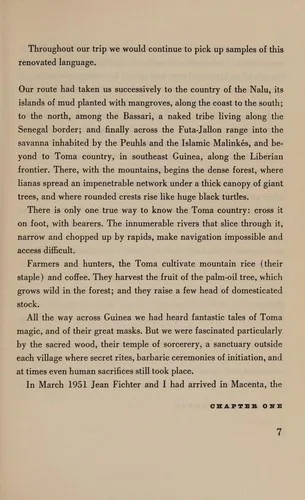
The sacred forest
 61
61

The sacred forest


Isolde Whitaker, Sacred Texts Editor, declares 'The Sacred Forest' a cornerstone for understanding West African esoteric traditions. Gaisseau masterfully deciphers the complex symbology of Toma ritual, illuminating the profound connection between the human and the divine. This work transcends mere observation, offering a deeply empathetic exploration of animistic beliefs and fetishistic practices. Its strength lies in its ability to convey the palpable spiritual energy of the forest and its people. Essential reading for scholars of comparative religion, anthropologists, and any serious student of indigenous magic seeking to grasp its authentic, unadulterated essence.
📝 Description
61
Pierre Dominique Gaisseau's 1989 book examines Toma people's spiritual practices in West Africa.
First published in 1989, Pierre Dominique Gaisseau's 'The Sacred Forest' presents an ethnographic study of the Toma people of West Africa. The work details their beliefs and practices surrounding magic, ritual, and spiritual life. Gaisseau documents their connection to the natural world, their veneration of ancestral spirits, and the systems that shape their understanding of existence.
This book goes beyond standard anthropology to examine concepts like animism, fetishism, and the spiritual significance attributed to the earth and its inhabitants. It illustrates a worldview where the ordinary and the extraordinary are intertwined, highlighting the lasting strength of indigenous spiritual traditions and their symbolic expressions. Gaisseau's writing aims to illuminate a different perception of reality through these practices.
This work situates itself within the study of indigenous spiritual traditions, particularly those of West Africa. It approaches animism and fetishism not merely as anthropological curiosities but as integral systems of understanding the sacredness of the natural world and the power of ancestral spirits. The book's focus on the perceived magical and spiritual energies animating everyday life connects it to broader esoteric interests in the immanent sacred and the symbolic languages of primal cultures.
💡 Why Read This Book?
Discover the profound, earth-rooted magic of West Africa. 'The Sacred Forest' offers an unfiltered look into the spiritual universe of the Toma people, revealing their intricate rituals and animistic beliefs. Ideal for seekers of ancient wisdom, practitioners exploring primal spiritualities, and scholars fascinated by the intersection of culture and the sacred. Uncover hidden knowledge and deepen your understanding of universal mystical forces.
⭐ Reader Reviews
Honest opinions from readers who have explored this book.
❓ Frequently Asked Questions
What is the primary focus of 'The Sacred Forest'?
The book meticulously documents the magical practices, rituals, and animistic beliefs of the Toma people of West Africa, exploring their deep connection to the natural world and ancestral spirits.
Is this book suitable for beginners in esoteric studies?
While rich in detail, the book's anthropological approach makes it accessible. Beginners will gain valuable insights into foundational concepts of animism and ritual, while experienced practitioners will find profound depths.
What is 'fetishism' as presented in this book?
Within the context of the book, fetishism refers to the belief in and veneration of objects believed to possess spiritual power or to be inhabited by spirits, integral to the Toma people's religious practices.
Does the book discuss specific magical spells or incantations?
The book focuses more on the philosophical underpinnings, cultural context, and symbolic significance of rituals rather than providing a grimoire of specific spells. It aims for understanding over instruction.
What is the unique contribution of 'The Sacred Forest' to esoteric literature?
Its unique contribution lies in its detailed, respectful, and deeply insightful portrayal of a specific, vibrant indigenous spiritual tradition, offering a rare window into its complex cosmology and practices.
🔮 Key Themes & Symbolism
Animism and the Living Earth
This theme explores the profound belief system where the natural world is imbued with spirit and consciousness. 'The Sacred Forest' illustrates how the Toma people perceive every element—trees, rivers, rocks, and creatures—as possessing a vital force, engaging in reciprocal relationships with these entities. It explores the sacredness of the natural environment, not as a resource, but as a sentient cosmos with which humans must live in harmony. This perspective is crucial for understanding the foundation of their magic and rituals, which are deeply intertwined with appeasing, communing with, and drawing power from the living earth.
The Power of Ritual and Ceremony
The book meticulously details the intricate web of rituals and ceremonies that structure the lives of the Toma people. These are not merely symbolic acts but potent mechanisms for maintaining cosmic balance, facilitating spiritual transitions, and invoking supernatural aid. Gaisseau illuminates how these rites, from initiations to funerary practices, serve as conduits for ancestral wisdom and divine energy. The emphasis is on the transformative power of collective and individual ceremonies, highlighting their role in shaping reality, healing, and ensuring the continuity of the community and its spiritual heritage.
Fetishism and Material Manifestations of Spirit
This exploration focuses on the concept of fetishism, examining how the Toma people imbue physical objects with spiritual significance and power. It goes beyond a superficial understanding of 'fetishes' to reveal a complex system of material anchors for spiritual forces, ancestral presence, and protective energies. Gaisseau explains how these objects are not just idols but active participants in the spiritual economy, requiring specific reverence and interaction. This theme underscores the belief that the sacred can be accessed and manipulated through tangible means, bridging the gap between the material and the immaterial realms.
💬 Memorable Quotes
Direct passages from the work, attributed to the author.
“The forest breathes with a thousand ancient souls.”
— This evocative phrase speaks to the animistic worldview, where nature is alive and inhabited by spirits, suggesting a profound interconnectedness and reverence for the natural world.
“In every root, a memory; in every leaf, a whisper.”
— This highlights the belief that nature holds ancestral knowledge and communicates subtly, emphasizing the importance of attunement and listening to the wisdom of the earth.
“The veil between worlds is thinnest at the heart of the sacred wood.”
— This suggests that sacred natural spaces act as liminal zones, facilitating easier access to the spiritual or unseen realms, a common motif in many mystical traditions.
“Ritual is the language of the spirit spoken to the world.”
— This defines ritual not just as action, but as a vital form of communication, a way to consciously engage with and influence the spiritual forces that govern existence.
“The fetish is not a thing, but a presence.”
— This clarifies the esoteric understanding of fetishism, moving beyond mere object worship to recognizing the spiritual entity or power residing within the object, making it a living conduit.
🌙 Esoteric Significance
Tradition
This work is deeply rooted in the animistic and shamanistic traditions of West Africa. It offers a window into a worldview where the spiritual and material realms are not separate but are dynamically interconnected. The practices described reflect a profound understanding of energetic flows, spirit communication, and the power of intention channeled through ritual. It aligns with broader esoteric principles of sympathetic magic, the sacredness of nature, and the existence of unseen forces that influence human destiny.
Symbolism
The symbolism in 'The Sacred Forest' is rich and complex, drawing heavily from the natural world. Trees, rivers, animals, and specific plants often represent ancestral spirits, deities, or specific energies. The rituals themselves are symbolic acts, enacting cosmic dramas and facilitating spiritual transformations. Fetishes, as discussed, act as potent symbols of spiritual presence and power, requiring specific gestures and utterances to activate their symbolic and energetic potential. Understanding this strong symbolism is key to deciphering the underlying mystical logic.
Modern Relevance
'The Sacred Forest' holds significant modern relevance for those seeking to reconnect with primal spiritualities and nature-based practices. In an age often characterized by disconnection, its exploration of animism offers a powerful antidote, encouraging a re-enchantment with the natural world. The book provides invaluable insights for contemporary practitioners of magic and ritual seeking to understand the foundations of indigenous spiritual technologies. It also speaks to the ongoing dialogue about cultural appropriation versus respectful appreciation of global spiritual heritage.
👥 Who Should Read This Book
This informative work is essential for a diverse audience. **Beginners** in esoteric studies will find an accessible yet profound introduction to animistic beliefs and ritualistic practices. **Scholars** of anthropology, religious studies, and African history will appreciate its meticulous detail and ethnographic rigor. **Seekers** of ancient wisdom and alternative spiritual paths will discover a rich source of inspiration and understanding regarding primal magic. **Practitioners** of magic, shamanism, or nature-based spirituality will gain invaluable insights into the foundations and techniques of indigenous spiritual traditions, fostering a deeper connection to the earth and its unseen forces.
📜 Historical Context
Published in 1954, Pierre Dominique Gaisseau's 'The Sacred Forest' emerges from a post-colonial era where European ethnographers were increasingly turning their gaze towards the rich spiritual and cultural landscapes of Africa. The mid-20th century saw a growing academic and public interest in indigenous cosmologies, often framed through the lenses of anthropology, comparative religion, and nascent esoteric studies. This period was characterized by a tension between colonial perspectives and a burgeoning appreciation for the complexity and validity of non-Western belief systems. Gaisseau's work, while rooted in anthropological observation, also appeals to the broader esoteric revival of the time, which sought wisdom beyond the confines of Western rationalism. His meticulous documentation offered a valuable counterpoint to superficial or dismissive portrayals of African spirituality, contributing significantly to a more nuanced understanding of magic, ritual, and animism.
📔 Journal Prompts
Reflect on your personal connection to the natural world. How do you perceive its 'spirit' or energy?
Describe a personal ritual or ceremony that holds deep meaning for you. What is its purpose and what does it symbolize?
Consider an object in your life that you feel has a special significance or 'presence.' What makes it meaningful?
What does the concept of 'balance' mean in your spiritual or personal life, and how do you strive to maintain it?
How can the principles of animism and deep ecological connection inform your daily interactions with the environment?
🗂️ Glossary
Animism
The belief that spirits inhabit natural objects and phenomena, such as plants, animals, rocks, and weather, and that these spirits can influence events in the world.
Toma
An ethnic group primarily found in Guinea and Liberia, West Africa, known for their rich cultural and spiritual traditions.
Fetishism
A religious practice involving the veneration of objects (fetishes) believed to possess spiritual power or to be inhabited by spirits, often used for protection or to invoke specific forces.
Ritual
A sequence of activities involving gestures, words, actions, or objects, performed according to a set sequence, often for religious or spiritual purposes.
Cosmology
The understanding of the origin, structure, and workings of the universe, encompassing beliefs about the divine, the natural world, and humanity's place within it.
This book appears in 3 collections
🔮 Readers Also Liked
Browse all →




From the “Ritual Magic” Collection
View all →






More Free Magic & Ritual Books
View all →