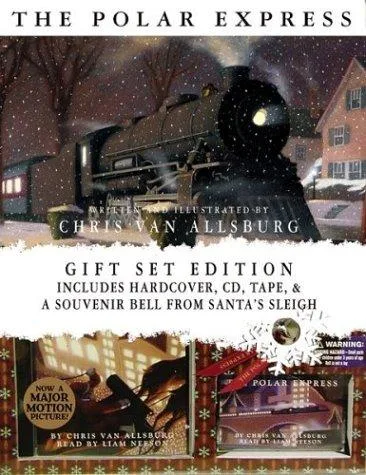
The Polar Express Gift Set
 75
75

The Polar Express Gift Set
Chris Van Allsburg’s *The Polar Express* achieves a rare feat: it feels both deeply personal and universally resonant, a feat amplified by its presentation as a gift set. The book’s strength lies in its spare, almost melancholic prose, perfectly complemented by Van Allsburg's signature charcoal-hued illustrations that imbue the narrative with a palpable sense of atmosphere and mystery. The central image of the train, a stark silhouette against the snow, is an icon of modern holiday lore. However, the very subtlety that makes the book compelling can also be its limitation; the narrative’s quietude might leave some readers desiring more explicit exposition or character development. The moment the protagonist receives the bell, a symbol of pure belief, is rendered with exquisite ambiguity, a testament to Van Allsburg's skill. It is a work that earns its place not through boisterous celebration, but through quiet, potent evocation.
📝 Description
75
Published in 1985, Chris Van Allsburg's The Polar Express is a singular narrative that captures imaginations.
This gift set includes Chris Van Allsburg's acclaimed 1985 picture book, The Polar Express, often bundled with small, thematic items like bells or train trinkets. Van Allsburg's distinctive, shadowy illustrations drive the story's visual power. While presented as a children's book, its appeal reaches adults who value wonder and subtle storytelling. The narrative engages with themes of belief, the unseen, and the magic found in liminal spaces between the ordinary and the extraordinary.
Van Allsburg's style, influenced by Edward Hopper's atmospheric stillness, set the book apart upon its release. The story taps into archetypal winter myths and a universal desire for belief in something beyond the everyday. Its success, recognized with the Caldecott Medal in 1986, secured its place in children's literature. The core concept revolves around a journey, both physical and metaphorical, toward a place where faith is paramount.
While not a direct text of occult doctrine, The Polar Express engages with esoteric themes through its exploration of belief and the unseen. The silver bell, ringing only for those who believe, serves as a potent symbol for the manifestation of faith, a concept found in various mystical traditions. The journey itself mirrors spiritual quests undertaken to attain higher understanding or connection. The book taps into archetypal winter myths, a time often associated with introspection and spiritual renewal in many cultures, suggesting a resonance with the deeper, less tangible aspects of human experience.
💡 Why Read This Book?
• You will gain a tangible symbol of faith through the narrative of the silver bell, a concept first introduced in the book's 1985 publication, allowing for personal reflection on belief. • You will experience the evocative power of atmospheric illustration, as seen in Van Allsburg's distinctive shadowy style, which shapes the journey’s mood unlike any other visual medium. • You will explore the theme of the threshold journey, represented by the train's passage, a concept central to initiatory narratives and archetypal quests.
⭐ Reader Reviews
Honest opinions from readers who have explored this book.
❓ Frequently Asked Questions
What is the primary theme of The Polar Express Gift Set?
The primary theme is the power of belief, particularly for children, and the journey associated with achieving it. The gift set often enhances this by including tangible items that echo the book's symbolic elements.
Who is the author of The Polar Express?
The author and illustrator is Chris Van Allsburg, who first published the book in 1985. His distinctive artistic style is integral to the story's impact.
What kind of illustrations does The Polar Express feature?
The book features highly atmospheric, detailed illustrations in charcoal and pencil, characterized by a shadowy, almost monochromatic palette that creates a sense of mystery and wonder.
What makes the gift set special compared to the book alone?
The gift set typically includes the original 1985 book along with curated items, such as a replica of the silver bell, designed to deepen the reader's connection to the story's themes and sensory experience.
What age group is The Polar Express best suited for?
While often considered a children's book, its artistic merit and thematic depth appeal to readers of all ages, particularly those who appreciate classic storytelling and evocative art.
Where does the train in The Polar Express go?
The train journeys to the North Pole on Christmas Eve, serving as a vehicle for the main character to experience the magic of Christmas and reaffirm his belief.
🔮 Key Themes & Symbolism
The Nature of Belief
The narrative centrally explores the subjective experience of belief, particularly concerning the existence of Santa Claus. The symbolic silver bell, given to the protagonist on Christmas Eve, rings only for those who truly believe. Its silence for others underscores the idea that faith is a personal, internal state. This concept challenges readers to consider how belief shapes perception and reality, a theme echoed in various esoteric traditions that emphasize the power of focused intention and inner conviction to manifest experience.
The Liminal Journey
The train's journey itself serves as a powerful metaphor for traversing thresholds between the ordinary world and a field of magic and wonder. The journey takes place on Christmas Eve, a night often associated with heightened spiritual activity and the thinning veil between worlds. This transition mirrors initiatory rites found in many esoteric paths, where a journey is undertaken to gain wisdom or enlightenment. The destination, the North Pole, represents a sacred center, a place of origin and ultimate truth.
The Gift of Perception
The gift set's inclusion of symbolic items, particularly the silver bell, highlights the theme of receiving a special perception. The bell's unique sound is a reward for, and a confirmation of, genuine belief. This can be interpreted esoterically as the attainment of a higher awareness or a spiritual insight that is not accessible to the uninitiated. It suggests that certain truths are revealed not through empirical evidence, but through an inner attunement and openness to the extraordinary.
The Conductor as Guide
The unnamed Conductor of the Polar Express acts as a silent, authoritative guide. Dressed in formal attire and maintaining a quiet demeanor, he represents a figure of spiritual authority or cosmic order. His role is to ensure the journey proceeds as intended, facilitating the protagonist's transformation. In esoteric contexts, such figures often symbolize the guiding principle or the higher self that leads the seeker through challenging spiritual passages towards self-realization.
💬 Memorable Quotes
Direct passages from the work, attributed to the author.
“But, I believed.”
— This simple statement, uttered by the protagonist when asked if he believed in Santa Claus, captures the book's core theme. It emphasizes that belief itself is the crucial element, transcending the need for external validation or proof.
“First came the engine, its huge headlight cutting a sharp cone through the darkness.”
— This description sets the stage for the mysterious arrival of the train. The 'sharp cone' of light piercing the darkness symbolizes the intrusion of the extraordinary into the mundane, informative the path for the journey ahead.
“Then, a long blast from its whistle echoed through the night.”
— The whistle blast serves as an announcement and a call to adventure. It signifies the departure from the ordinary and the commencement of the transformative journey towards the North Pole.
💡 Key Ideas
Editorial paraphrase of the work's core concepts — not direct quotes.
The bell began to ring! And it rang, and rang, and rang.
This passage describes the magical moment the protagonist receives the silver bell. Its continuous ringing signifies the purity and strength of his faith, a tangible manifestation of the unseen wonders he has experienced.
At the North Pole, Santa Claus gave me the first gift of Christmas.
This paraphrase captures the climax of the protagonist's quest. The 'first gift' is not merely material but symbolic, representing the profound gift of restored belief and the magic of Christmas.
🌙 Esoteric Significance
Tradition
While not explicitly aligned with a single esoteric tradition, *The Polar Express* draws heavily on archetypal themes found in Western mystery traditions, particularly those concerning spiritual journeys and the attainment of inner vision. Its emphasis on belief as a faculty for perceiving hidden realities echoes Gnostic ideas about gnosis (inner knowing) and Hermetic principles concerning the power of the mind to shape experience. The journey to a sacred center (the North Pole) can be seen as a modern allegorical representation of the alchemical or magical quest for the unattainable.
Symbolism
The **train** itself serves as a powerful symbol of transition and destiny, a vessel carrying the seeker from the mundane world towards a spiritual revelation. The **silver bell**, a key symbol, represents the sound of truth or divine presence, audible only to those with the inner faculty of belief. Its ringing signifies attunement to a higher frequency or spiritual reality. The **snowy landscape**, often depicted in stark, shadowy tones, symbolizes a purified or primordial state, a blank canvas upon which spiritual truths can be imprinted.
Modern Relevance
Contemporary explorations of consciousness, manifestation, and the power of belief often find resonance in *The Polar Express*. Thinkers and practitioners in fields like positive psychology and New Age spirituality may interpret the story as an allegory for manifesting desired realities through focused intention and unwavering faith. The narrative’s subtle encouragement of trusting one's inner compass over external doubt aligns with modern self-help and mindfulness movements that advocate for intuitive guidance and personal empowerment.
👥 Who Should Read This Book
• Individuals exploring the nature of faith and belief systems, seeking a narrative that visually and thematically examines how conviction shapes perception. • Aspiring artists and illustrators interested in mastering atmospheric visual storytelling, drawing inspiration from Chris Van Allsburg's unique 1985 style. • Those interested in comparative mythology and archetypal narratives, particularly those involving journeys to sacred places or symbolic rites of passage.
📜 Historical Context
When *The Polar Express* first arrived in 1985, the range of children's literature was dominated by a variety of styles. Chris Van Allsburg’s work, however, offered a stark contrast with its distinctive, almost somber, charcoal illustrations and minimalist narrative. This approach drew comparisons to artists like Edward Hopper for its atmospheric stillness and psychological undertones, rather than the brighter palettes common in contemporary picture books. The book’s eventual win of the Caldecott Medal in 1986 was a significant endorsement, solidifying its place and influencing subsequent illustrators. It stood apart from the more whimsical or overtly didactic tales popular at the time, focusing instead on a deeply personal and introspective experience of holiday magic. Its success demonstrated a mature audience for visually sophisticated and emotionally nuanced children’s stories.
📔 Journal Prompts
The silver bell's silence and sound, reflecting the protagonist's belief.
The train's symbolic passage as a threshold journey.
The Conductor's role as a silent guide on the journey.
The stark, atmospheric quality of the illustrations.
The significance of receiving a gift from Santa Claus.
🗂️ Glossary
Silver Bell
A magical object given to the protagonist by Santa Claus, which rings only for those who truly believe in Christmas. It symbolizes the tangible reward and confirmation of pure faith.
The North Pole
The destination of the Polar Express, representing a mythical or sacred center where the magic of Christmas originates. It serves as the symbolic endpoint of the spiritual journey.
The Conductor
The formally dressed, enigmatic figure who guides the passengers on the Polar Express. He represents order, authority, and the facilitator of the magical journey.
Christmas Eve
The night of the story's primary events, a time traditionally associated with heightened spiritual significance and the potential for miracles and the manifestation of magic.
Belief
The central theme, representing the internal conviction and faith required to perceive and experience the extraordinary, as symbolized by the ringing of the silver bell.
The Journey
The physical and metaphorical voyage undertaken by the protagonist on the Polar Express, symbolizing a transition from skepticism or doubt to wonder and faith.
Headlight Cone
The beam of light from the train's engine, piercing the darkness. It symbolizes the intrusion of the extraordinary into the ordinary and the illumination of the path forward.
🔮 Readers Also Liked
Browse all →









More by Chris Van Allsburg
All books →

More Free Occult Philosophy Books
View all →