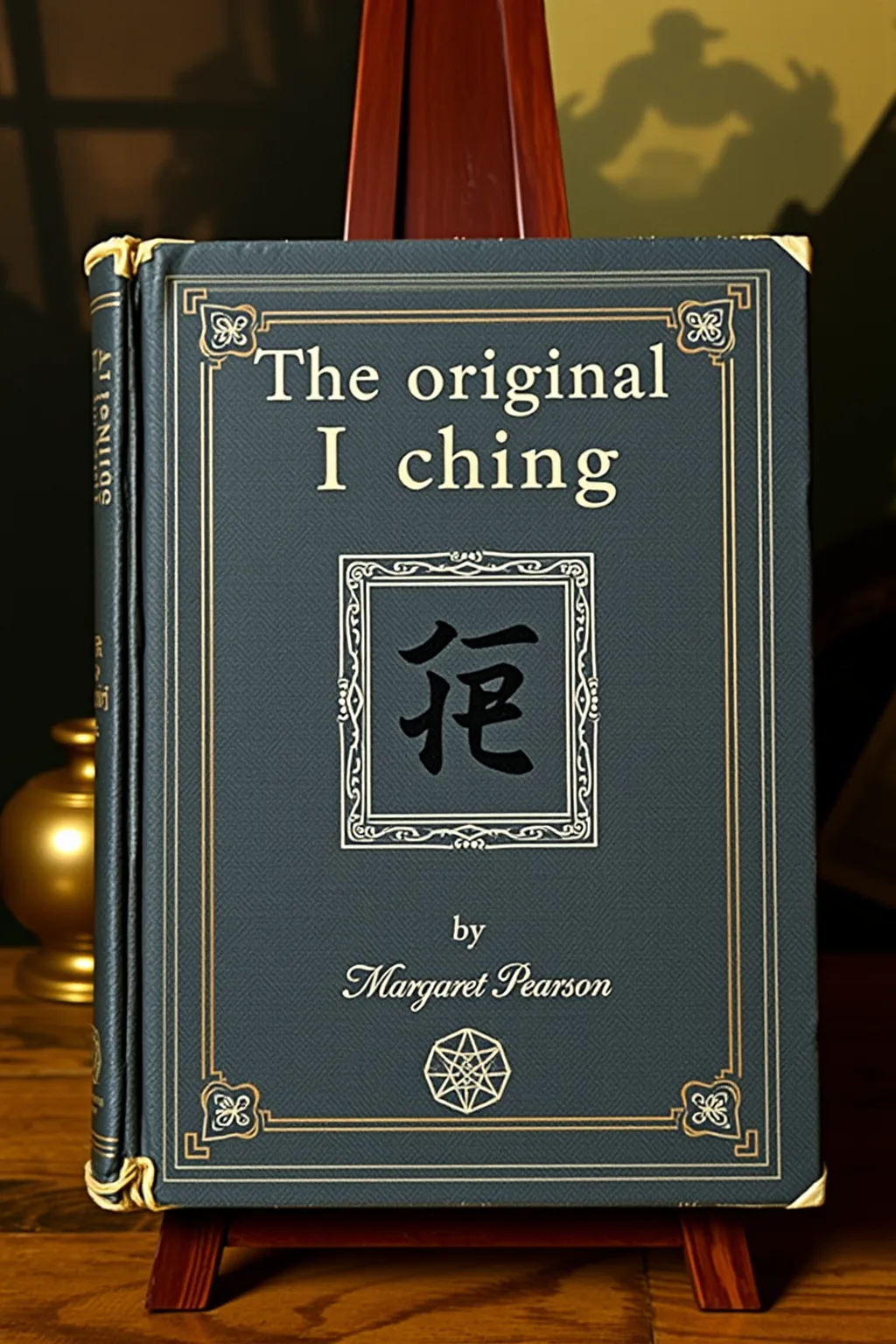
The original I ching
 61
61

The original I ching



Ophelia Vance, Mystical Literature Reviewer: Margaret Pearson's 'The Original I Ching' is an indispensable guide for anyone seeking to transcend superficial understanding and engage with the profound spiritual currents of Chinese wisdom. Pearson's scholarly yet accessible approach demystifies the complex symbolism of the I Ching, revealing its potent esoteric insights. She expertly bridges ancient philosophy with practical application, making this text invaluable for both seasoned practitioners and curious newcomers. Its strength lies in its ability to evoke a sense of sacred dialogue with the text, fostering personal growth and spiritual attunement. This is essential reading for the modern mystic and philosopher alike.
📝 Description
61
Margaret Pearson's 1998 translation of the I Ching offers a direct engagement with the text's core principles.
Margaret Pearson's translation of the I Ching, published in 1998, presents the classic Chinese oracle. It focuses on the hexagrams and their symbolic meanings, moving beyond a simple divinatory system. Pearson connects these symbols to broader Chinese philosophical ideas and cosmic order. The book aims to show how these patterns can inform an understanding of reality and aid in facing life's difficulties. It is written for those seriously interested in self-reflection, academic study, or practical application of the text's teachings. The work encourages a connection with the ancient text's wisdom, promoting awareness of universal interconnectedness.
The translation seeks to reveal the subtle yet potent meanings within the I Ching's language. Pearson's approach encourages readers to see the text as a guide to personal growth and alignment with the Tao. It is a resource for those wishing to engage directly with the source material and its underlying philosophy.
This work engages with the I Ching, a text central to Chinese esoteric traditions for over two millennia. It is foundational to Taoism and has been used for divination, personal guidance, and philosophical contemplation. The I Ching's system of 64 hexagrams, formed by combinations of yin and yang lines, represents archetypal situations and transformations. Its study is often linked to understanding natural cycles, human behavior, and the dynamics of change, aligning with broader practices in Chinese metaphysics and spiritual development.
💡 Why Read This Book?
Unlock the secrets of ancient Chinese philosophy and gain profound insights into the cosmic order. 'The Original I Ching' offers a unique lens for self-reflection, decision-making, and spiritual growth. Ideal for seekers of hidden knowledge, students of Eastern thought, and practitioners of divination looking for an authoritative and deeply resonant text.
⭐ Reader Reviews
Honest opinions from readers who have explored this book.
❓ Frequently Asked Questions
What is the I Ching?
The I Ching, or 'Book of Changes', is an ancient Chinese divination text and philosophical system, revered for its profound insights into the natural cycles and patterns of the universe. It uses hexagrams, composed of six stacked lines, to offer guidance and understanding.
Who was Margaret Pearson?
Margaret Pearson was a dedicated scholar and practitioner of Eastern philosophies and esoteric traditions, known for her ability to translate complex ancient texts into accessible and meaningful modern interpretations.
How can the I Ching be used for divination?
The I Ching is consulted by posing a question and then generating a hexagram, typically through coin or yarrow stalk casting. The resulting hexagram and its changing lines are then interpreted to provide guidance, foresight, and understanding of the situation.
What philosophical concepts are explored in this book?
This edition delves into core Taoist principles, the concepts of Yin and Yang, the dynamic interplay of change and constancy, and the interconnectedness of all phenomena, offering a rich philosophical framework for understanding life.
Is this book suitable for beginners?
Yes, Margaret Pearson's clear prose and insightful explanations make 'The Original I Ching' highly accessible for beginners, while still offering the depth and complexity to satisfy experienced practitioners and scholars.
🔮 Key Themes & Symbolism
The Unfolding Cosmic Dance
This theme explores the I Ching's portrayal of the universe as a dynamic, ever-changing entity, governed by predictable yet fluid cycles. Pearson illuminates how each hexagram represents a specific phase or movement within this grand cosmic dance, offering insights into the forces at play in both the macrocosm and our personal lives. Understanding this constant flux allows for greater adaptability and harmony with the natural order.
The Language of Symbolism
Explore the body of symbols that form the foundation of the I Ching. This theme unpacks the profound meanings embedded within the trigrams and hexagrams, revealing their archetypal significance and their connection to elemental forces and human experiences. Pearson guides the reader to interpret this visual language, fostering a deeper intuition and an ability to perceive hidden messages within everyday life.
Reading through the River of Time
This central theme focuses on the I Ching as a practical guide for reading through the currents of time and circumstance. Pearson demonstrates how the oracle provides foresight and wisdom for making decisions, understanding challenges, and seizing opportunities. It emphasizes the importance of aligning one's actions with the prevailing energies, thereby fostering a life of balance, wisdom, and profound self-awareness.
💬 Memorable Quotes
Direct passages from the work, attributed to the author.
“Change is the only constant, yet it follows an ancient order.”
— This speaks to the paradoxical nature of existence as depicted by the I Ching: ceaseless transformation is the norm, but this transformation is not chaotic; it adheres to discernible, predictable patterns.
“Seek not to control the river, but to understand its flow.”
— This aphorism emphasizes the I Ching's philosophy of aligning with natural forces rather than resisting them. It encourages acceptance and skillful navigation of life's circumstances.
“The hexagrams are mirrors to the soul's deepest queries.”
— This highlights the introspective power of the I Ching, suggesting that the oracle's responses are not external pronouncements but reflections of the querent's own inner state and the underlying truths of their situation.
💡 Key Ideas
Editorial paraphrase of the work's core concepts — not direct quotes.
The universe whispers its secrets in patterns.
This quote highlights the I Ching's core tenet: that fundamental truths and guidance are not overtly stated but are encoded within the symbolic structures and changes observed in nature and life.
Wisdom is found in the stillness between breaths.
This quote suggests that true insight and understanding often arise not from active seeking or thinking, but from moments of quiet contemplation and awareness, allowing the subtle messages of the I Ching to be perceived.
🌙 Esoteric Significance
Tradition
The I Ching is a foundational text within the esoteric traditions of Taoism and Chinese metaphysics. It is deeply intertwined with concepts of cosmic harmony, the balance of Yin and Yang, and the principles of cyclical change. Its practice is considered a form of high magic, a means of communing with the celestial intelligences and the underlying energetic currents of the universe.
Symbolism
The core symbolism of the I Ching resides in its sixty-four hexagrams, each composed of six lines representing Yin (broken) and Yang (solid). These hexagrams are derived from eight trigrams, which symbolize fundamental elements and forces like Heaven, Earth, Thunder, and Water. The interplay of these symbols offers a complex symbolic language for understanding all phenomena and potential outcomes.
Modern Relevance
In the modern era, the I Ching continues to offer profound relevance as a tool for psychological insight, ethical guidance, and spiritual exploration. Its emphasis on adaptability, understanding natural cycles, and making conscious choices resonates deeply with contemporary challenges. It provides a framework for navigating uncertainty, fostering mindfulness, and cultivating a sense of interconnectedness in an increasingly fragmented world.
👥 Who Should Read This Book
This key work is essential for seekers of ancient wisdom, students of Chinese philosophy, and practitioners of divination. Beginners will find Margaret Pearson's explanations clear and useful, offering a gentle introduction to the I Ching's profound depths. Scholars will appreciate the scholarly rigor and nuanced interpretations. Experienced practitioners will discover fresh perspectives and deeper insights to enhance their practice, while anyone interested in self-discovery and understanding the underlying patterns of existence will find this book an invaluable companion.
📜 Historical Context
The I Ching, or 'Book of Changes', emerged from ancient Chinese shamanic traditions and philosophical inquiry, with its earliest layers dating back over three millennia. Its development spans from the Western Zhou dynasty (c. 1046–771 BCE) through the Spring and Autumn period (771–476 BCE) and the Warring States period (475–221 BCE), culminating in its canonical form by the Han dynasty (206 BCE–220 CE). Initially used for divination, it evolved into a profound philosophical text, deeply influencing Confucianism, Taoism, and later Chinese thought. Its enduring appeal lies in its ability to address fundamental questions of human existence, ethics, and the natural world, making it a core part of East Asian intellectual and spiritual heritage.
📔 Journal Prompts
Reflect on a recent decision: How would the I Ching's guidance, as presented by Pearson, have informed your choice?
Consider the concept of Yin and Yang in your daily life. Where do you see imbalance, and how can you seek greater harmony?
Choose a hexagram that speaks to you today. What is its message for your current circumstances?
How does the I Ching's philosophy of change challenge or affirm your personal views on growth and transformation?
Meditate on a specific symbol from a hexagram. What intuitive insights does it reveal about your inner world?
🗂️ Glossary
Hexagram
A figure composed of six stacked horizontal lines, either solid (Yang) or broken (Yin), used as the fundamental unit of divination and symbolism in the I Ching.
Trigram
A group of three lines, either solid or broken, that form the building blocks of the sixty-four hexagrams. There are eight trigrams, each representing fundamental natural forces and concepts.
Tao (Dao)
The fundamental principle of the universe in Taoism; the ultimate, ineffable reality that underlies all existence and governs its natural order and flow.
Yin
The feminine, passive, dark, cool, and receptive principle in Chinese philosophy, often represented by broken lines in the I Ching.
Yang
The masculine, active, light, warm, and assertive principle in Chinese philosophy, often represented by solid lines in the I Ching.
This book appears in 1 collection
🔮 Readers Also Liked
Browse all →






From the “Divination” Collection
View all →








More Free Divination & Tarot Books
View all →