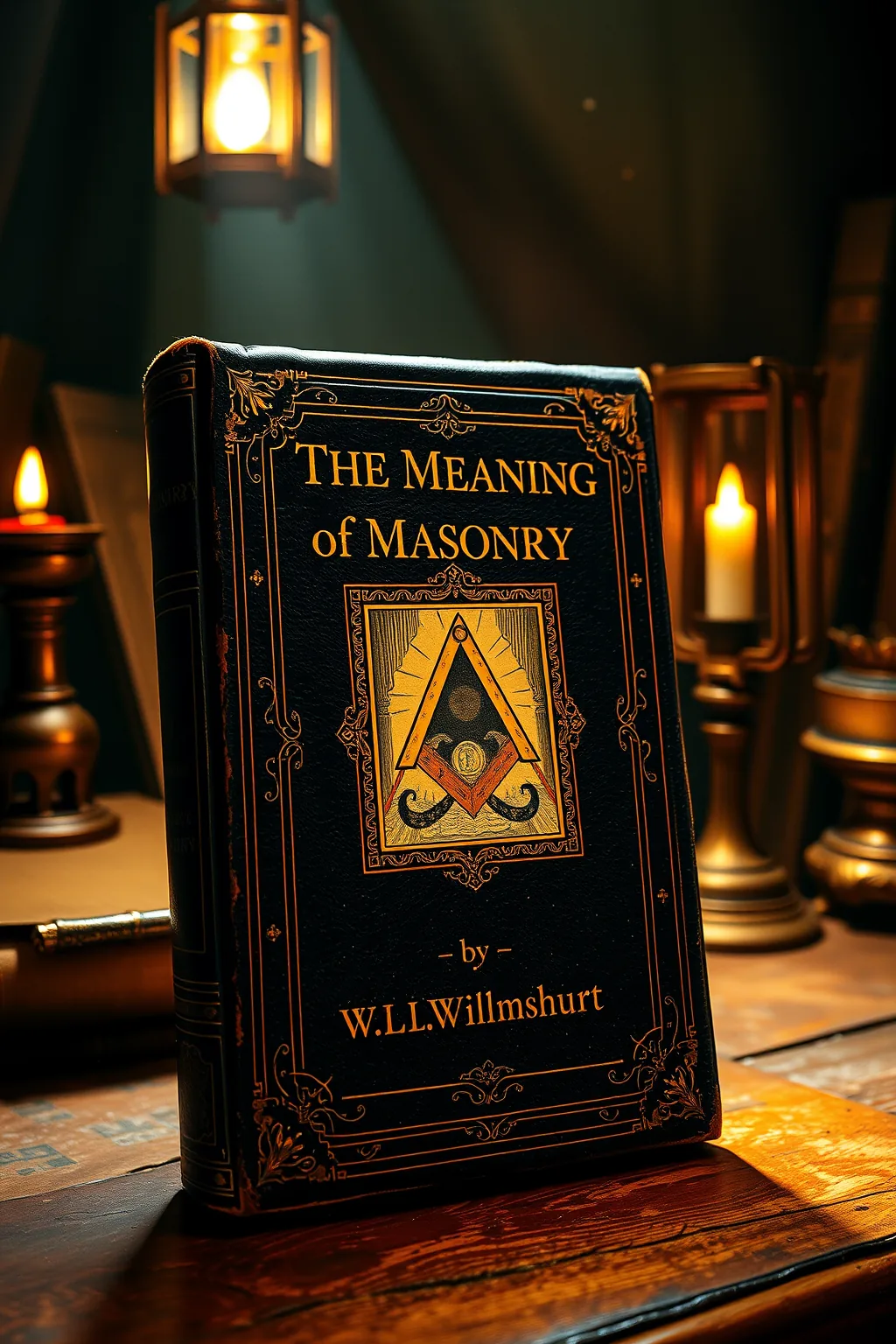
The Meaning of Masonry
 71
71

The Meaning of Masonry


Ophelia Vance (Mystical Literature Reviewer) — Walter Leslie Wilmshurst's 'The Meaning of Masonry' stands as a luminous beacon for those seeking the spiritual essence of Freemasonry. Wilmshurst's erudition and spiritual insight are undeniable, as he meticulously unravels the symbolism to showcase Masonry as a profound discipline of self-perfection, deeply rooted in ancient mystery traditions. His essays offer a compelling argument for the Craft's perennial philosophical significance, making it accessible to both seasoned Masons and earnest spiritual seekers. This is not a book for the casual reader, but for the dedicated student of esoteric lore who yearns to understand the 'why' behind the 'what.' A truly illuminating work.
📝 Description
71
Published in 1922, W.L. Wilmshurst's 'The Meaning of Masonry' interprets Masonic ritual as a spiritual path.
Walter Leslie Wilmshurst's collection of essays reinterprets Masonic ritual not as a social organization, but as a spiritual discipline. He argues that the ceremonies and symbols of Freemasonry serve as a symbolic language pointing towards inner transformation and human perfection. Wilmshurst connects Masonic teachings to broader esoteric traditions, suggesting they offer a framework for seeking spiritual knowledge and understanding the universal order.
This work aims to guide the serious inquirer beyond the surface of ritualistic practice to the underlying spiritual truths. It posits that the true value of Masonry lies in its capacity to foster introspection and personal growth. The book examines how its symbolism acts as a key to unlocking deeper psychological and metaphysical insights, bridging the gap between ancient mystery traditions and contemporary spiritual aspirations.
Wilmshurst wrote 'The Meaning of Masonry' during a period of significant interest in esoteric philosophy and comparative religion. His work aligns with the broader Hermetic, alchemical, and Rosicrucian traditions that sought to decode ancient wisdom through symbolic interpretation. He viewed Masonic ritual as a modern manifestation of these older streams of knowledge, designed to guide individuals toward self-realization and a deeper connection with universal principles.
💡 Why Read This Book?
Uncover the profound spiritual philosophy underpinning Masonic ritual. 'The Meaning of Masonry' is essential for seekers yearning for deeper esoteric knowledge, scholars of secret societies, and Freemasons wishing to understand the true aim of the Craft: human perfectibility. Wilmshurst provides a compelling map to inner transformation through ancient symbolic wisdom.
⭐ Reader Reviews
Honest opinions from readers who have explored this book.
❓ Frequently Asked Questions
What is the primary thesis of 'The Meaning of Masonry'?
The book's central thesis is that Freemasonry is not merely a fraternal organization, but a profound esoteric path dedicated to the spiritual evolution and perfectibility of humankind, drawing upon ancient mystery traditions.
Who was W.L. Wilmshurst?
Walter Leslie Wilmshurst (1867-1939) was a distinguished British author and mystic, known for his insightful interpretations of esoteric philosophy and his ability to bridge traditional wisdom with contemporary understanding.
Is this book suitable for non-Masons?
Absolutely. While it delves into Masonic symbolism, Wilmshurst's work is accessible and highly valuable for any spiritual seeker interested in esoteric traditions, symbolism, and the pursuit of self-mastery.
What kind of symbolism does Wilmshurst explore?
He explores a rich tapestry of symbolic language inherent in Masonic ritual, including tools, architectural elements, and allegorical figures, interpreting them as keys to understanding inner spiritual development and cosmic order.
What is the 'human perfection' that Masonry aims for?
Human perfection, in Wilmshurst's view, refers to the attainment of a higher consciousness, the realization of one's divine potential, and the harmonious integration of the spiritual and material aspects of existence.
🔮 Key Themes & Symbolism
Masonry as a Spiritual Discipline
Wilmshurst posits that Freemasonry's true purpose lies beyond its social or fraternal aspects, presenting it as a sophisticated system for spiritual development. He argues that the rituals and symbols are not mere historical remnants but potent tools designed to guide the individual soul through stages of awakening and transformation, ultimately leading to a higher state of consciousness and moral perfection. This perspective frames Masonry as a 'living' tradition, actively engaged in the process of shaping the spiritual aspirant.
The Language of Symbolism
A central to Wilmshurst's thesis is the universal and profound nature of symbolism. He asserts that the symbols employed in Masonry act as a bridge between the visible and invisible realms, communicating profound truths that transcend literal interpretation. These symbols are not static; they are living keys that unlock deeper levels of understanding about the cosmos, human nature, and the divine. The book encourages readers to engage with these symbols not just intellectually but also intuitively, allowing them to resonate with the inner self.
The Pursuit of Human Perfection
The ultimate goal illuminated in 'The Meaning of Masonry' is the achievement of human perfection. Wilmshurst defines this not as an unattainable ideal, but as a tangible process of spiritual growth, self-mastery, and the alignment of one's will with the universal will. He connects this pursuit to the broader traditions of ancient mystery schools, highlighting Masonry's role in fostering the ethical, intellectual, and spiritual refinement necessary for individuals to realize their full potential and contribute to a more harmonious world.
💬 Memorable Quotes
Direct passages from the work, attributed to the author.
“The external form is but a shadow of the inner reality.”
— Emphasizes the core tenet that the true significance of Masonic rituals and symbols lies in their inner, spiritual meaning, rather than their outward appearance or literal interpretation.
“The path to perfection is paved with self-knowledge.”
— Highlights the introspective nature of the Masonic journey, stressing that understanding oneself is the fundamental step towards spiritual growth and achieving one's highest potential.
“Wisdom is the light that dispels the darkness of ignorance.”
— Positions wisdom, particularly esoteric wisdom, as the essential force that liberates the seeker from delusion and guides them toward spiritual illumination and understanding.
“The Craft is a school for the soul.”
— This evocative phrase frames Masonry as a vital institution for spiritual education and development, where individuals are taught the principles and practices necessary for inner transformation.
💡 Key Ideas
Editorial paraphrase of the work's core concepts — not direct quotes.
Masonry is not a religion, but it is deeply religious.
This quote expresses Wilmshurst's view that Masonry's power lies not in dogma, but in its inherent spiritual orientation and its capacity to foster a profound connection with the divine.
🌙 Esoteric Significance
Tradition
Wilmshurst firmly anchors 'The Meaning of Masonry' within the tradition of Western Esotericism, specifically drawing parallels with the ancient Mystery Schools of Egypt, Greece, and Rome, as well as hermeticism, Gnosticism, and Pythagorean thought. He presents Freemasonry as a modern manifestation of this unbroken chain of esoteric knowledge, designed to initiate individuals into higher spiritual truths and guide them towards self-realization.
Symbolism
The book is a rich exploration of Masonic symbolism, interpreting tools like the square, compasses, and plumb line not just as operative implements, but as profound allegories for moral conduct, spiritual discipline, and the geometric order of the cosmos. Wilmshurst reveals how architectural elements and ritualistic actions serve as a symbolic language to represent the stages of spiritual ascent and the construction of the 'temple' within the individual's soul.
Modern Relevance
In an age often characterized by materialism and spiritual disquiet, Wilmshurst's work offers a compelling argument for the enduring relevance of esoteric wisdom. 'The Meaning of Masonry' provides seekers with a framework for understanding timeless spiritual principles through a structured, symbolic system, offering a pathway to inner peace, self-discovery, and a deeper connection to the universal order that remains profoundly applicable today.
👥 Who Should Read This Book
This clear text is a must-read for Freemasons seeking to deepen their understanding of the Craft's spiritual underpinnings and the ultimate purpose of its rituals. It is equally important for esoteric scholars and students of comparative religion and secret societies, offering a bridge between ancient mystery traditions and modern spiritual exploration. For any seeker yearning for a more profound, symbolic path to self-knowledge and spiritual growth, 'The Meaning of Masonry' provides an insightful and transformative guide, revealing the hidden architecture of the soul.
📜 Historical Context
Written during a period of burgeoning interest in esoteric thought and the occult revival of the late 19th and early 20th centuries, W.L. Wilmshurst's 'The Meaning of Masonry' emerged as a significant contribution to the literature exploring the deeper spiritual and philosophical dimensions of Freemasonry. This era saw a divergence in Masonic interpretation, with some focusing on its historical and social aspects, while others, like Wilmshurst, sought to revive and articulate its ancient, mystical roots. His work stands in dialogue with contemporaneous figures exploring hermeticism, theosophy, and other perennial philosophies, offering a unique perspective on how Masonic symbolism could serve as a vehicle for profound inner realization and spiritual evolution in a rapidly changing modern world.
📔 Journal Prompts
How does the concept of 'human perfection' resonate with your personal spiritual journey?
Identify a Masonic symbol (or a symbol from another tradition) that speaks to you, and explore its potential inner meaning.
Reflect on the idea of Masonry as a 'school for the soul.' What lessons do you believe are most crucial for spiritual development?
Consider the 'external form' versus the 'inner reality' in your own life. Where do you find yourself focusing too much on appearances?
How can the pursuit of 'wisdom' actively combat 'ignorance' in your daily life and spiritual practice?
🗂️ Glossary
Esotericism
A broad category of spiritual traditions and philosophical teachings that emphasize hidden knowledge, inner experience, and the pursuit of direct spiritual realization, often distinct from exoteric or public doctrines.
Gnosis
From the Greek word for 'knowledge,' Gnosis refers to a special intuitive or spiritual knowledge, often understood as a direct apprehension of divine truth, central to Gnostic traditions.
Perennial Philosophy
The concept that all religions and spiritual traditions share a common, underlying truth or essence, often referred to as the 'eternal wisdom' or 'spirit of the ages.'
Allegory
A story, poem, or picture that can be interpreted to reveal a hidden meaning, typically a moral or political one, often used in spiritual and philosophical teachings.
Initiation
A ritual or ceremony marking a person's entry into a particular group, society, or stage of spiritual understanding, often involving symbolic teachings and transformative experiences.
This book appears in 2 collections
🔮 Readers Also Liked
Browse all →









From the “Secret Societies” Collection
View all →








More Free Freemasonry & Secret Societies Books
View all →