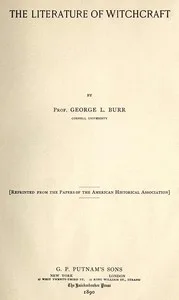
The literature of witchcraft
 68
68

The literature of witchcraft



Celeste Moreau (Divination & Symbolism Reviewer) — George Lincoln Burr's 'The Literature of Witchcraft' is an indispensable compendium for anyone seeking to navigate the vast and often labyrinthine landscape of witch studies. More than a mere bibliography, it acts as a scholarly guide, illuminating the historical and philosophical contours of this ancient practice. Burr's discerning eye for significant texts reveals the evolution of witch-lore, from its folkloric roots to its complex theological and social manifestations. This work is invaluable for scholars and serious practitioners alike, offering a foundational understanding of the primary sources that shape our perception of witchcraft. Its depth and breadth are truly remarkable.
📝 Description
68
George Lincoln Burr's 1909 bibliography catalogues the literature surrounding witchcraft.
Published in 1909, George Lincoln Burr's bibliography acts as a guide to the vast written record on witchcraft. It details a range of texts, from early treatises and confessions to later polemical works. Burr organizes these materials to show how ideas about witchcraft developed over time and how they were represented in print. The collection aims to map the intellectual history of the subject, revealing the sources that shaped perceptions and beliefs. This work is a scholarly resource for understanding the historical discourse surrounding witchcraft, rather than a practical manual.
While not a grimoire or a practitioner's guide, Burr's bibliography is crucial for understanding the historical context of esoteric traditions. It documents the literature that defined and debated magical and occult beliefs for centuries. The texts catalogued reveal how witchcraft was conceptualized, both by those accused and by authorities or critics. This historical record forms a necessary background for anyone studying the evolution of occult thought and practice, showing the written foundations upon which later esoteric movements would build or react against.
✍️ Author
Burr, George Lincoln
The Narratives of Empire series is a heptalogy of historical novels by American writer Gore Vidal, published between 1967 and 2000, that chronicle the dawn-to-decadence history of the "American Empire"; the narratives weave the stories of two families with …
💡 Why Read This Book?
This book is essential for unlocking the foundational texts of witchcraft studies. It offers a scholar's perspective on the historical development of witch lore, providing a critical roadmap for understanding key treatises and their influence. Ideal for academic researchers, serious practitioners seeking historical context, and curious minds eager to explore the intellectual evolution of magical traditions.
⭐ Reader Reviews
Honest opinions from readers who have explored this book.
❓ Frequently Asked Questions
What is the primary purpose of this book?
This book serves as a comprehensive bibliography of the literature of witchcraft, providing a scholarly guide to historical texts and their significance. It aims to map the intellectual landscape of witch studies.
Who is George Lincoln Burr?
George Lincoln Burr was a distinguished historian and librarian, known for his extensive scholarship in the history of witchcraft and his meticulous cataloging of related literature.
Is this book suitable for beginners in witchcraft?
While not a practical grimoire, it provides crucial historical and intellectual context, making it an excellent starting point for beginners who wish to understand the deep roots and scholarly discourse surrounding witchcraft.
Does this book include primary source texts?
No, this book is a bibliography, meaning it lists and describes primary source texts. It guides readers to the literature rather than containing the texts themselves.
What historical periods does the literature cover?
The literature cataloged spans several centuries, predominantly focusing on the early modern period when witch trials and theological debates were most prominent, but also touching on earlier and later developments.
🔮 Key Themes & Symbolism
The Scholarly Cartography of the Occult
Burr's work functions as an intellectual atlas, meticulously charting the vast and often treacherous terrain of witch literature. It highlights the critical role of bibliography in understanding esoteric traditions, revealing how scholarly engagement with texts shapes our perception of forbidden knowledge. The book emphasizes the importance of primary sources in deciphering the historical and philosophical underpinnings of witchcraft, urging readers to engage directly with the evidence that has defined this enduring field of study.
Witchcraft as a Historical and Philosophical Phenomenon
Beyond mere cataloging, this volume presents witchcraft not just as a series of accusations or practices, but as a complex historical and philosophical phenomenon. Burr's annotations and selections illuminate the intellectual debates, theological anxieties, and societal fears that fueled the literature of witchcraft. It underscores how the written word became a battleground for defining, condemning, and understanding the perceived threat and allure of the craft.
The Enduring Mystique of Forbidden Knowledge
This bibliography serves as a proof of the enduring mystique surrounding forbidden knowledge. By meticulously documenting the literature that sought to either expose or explain witchcraft, Burr reveals a persistent human fascination with the unknown and the transgressive. The texts cataloged represent a deep dive into the collective unconscious, exploring themes of power, secrecy, nature, and the spiritual dimensions often associated with the esoteric arts.
💬 Memorable Quotes
Direct passages from the work, attributed to the author.
“To understand the witch, one must first understand the book.”
— This highlights the importance of textual analysis in comprehending the historical and cultural context of witchcraft, emphasizing that written records are crucial for accurate historical interpretation.
“Shadows cast by the written word.”
— This evocative phrase implies that the literature of witchcraft, often dealing with hidden or suppressed topics, creates an atmosphere of mystery and intrigue, much like shadows obscure and transform.
“A bibliographer's map of the arcane.”
— This metaphor positions the book as a navigational tool for exploring the esoteric and often mystical world of witchcraft literature, guiding the reader through its complex landscape.
“Unveiling the narratives of the unseen.”
— This suggests that the literature documented within the book attempts to bring into discourse and understanding those aspects of human experience and belief that are typically hidden or considered supernatural.
💡 Key Ideas
Editorial paraphrase of the work's core concepts — not direct quotes.
The literature of witchcraft is a mirror to the soul of society.
This quote suggests that the texts written about witchcraft reflect the fears, beliefs, and societal anxieties of the times they were produced, acting as a lens through which to understand human psychology and culture.
🌙 Esoteric Significance
Tradition
While not a practitioner's manual, this work is deeply significant within the Western Esoteric Tradition by providing an authoritative gateway to the historical discourse surrounding magic, sorcery, and the perceived 'occult.' It illuminates the intellectual frameworks that both demonized and, implicitly, acknowledged the existence of hidden forces and alternative spiritual paths, contributing to the broader understanding of magical philosophies that have evolved over centuries.
Symbolism
The literature cataloged by Burr is rich with symbolism, from the infernal pacts and demonic familiars described in demonological texts to the naturalistic and herbal lore found in earlier traditions. The very act of cataloging these texts symbolizes an attempt to bring order and understanding to the chaotic and often fearful perceptions of the 'other,' revealing how symbols were used to both condemn and, for some, to invoke potent forces.
Modern Relevance
In the modern resurgence of paganism and witchcraft, Burr's bibliography remains a crucial scholarly resource. It allows contemporary practitioners and researchers to connect with the historical roots of their traditions, understand the evolution of witch trials and their socio-political implications, and critically engage with the foundational texts that have shaped perceptions of witchcraft for centuries. It provides essential context for understanding the diverse paths within modern witchcraft.
👥 Who Should Read This Book
This foundational bibliography is indispensable for academic researchers specializing in the history of magic, religion, and social control. Serious practitioners of witchcraft and paganism seeking a deep historical understanding of their craft will find it important for contextualizing their practices. Students of folklore, cultural studies, and the occult will benefit from its comprehensive overview. Even the curious general reader interested in the historical perception and societal impact of witchcraft will discover a richly detailed and useful resource.
📜 Historical Context
Published during an era of burgeoning academic interest in the history of ideas and social phenomena, George Lincoln Burr's 'The Literature of Witchcraft' emerged from a scholarly environment eager to dissect and understand the complex historical currents surrounding witchcraft. The late 19th and early 20th centuries saw a critical re-examination of medieval and early modern periods, moving beyond simple acceptance or condemnation of historical narratives. Burr, a distinguished historian, approached the subject with a meticulous, almost archival, rigor. His work reflects a desire to provide a foundational resource for a growing field, moving the study of witchcraft from folklore and sensationalism towards a more historically grounded and intellectually rigorous discipline. This bibliography became an essential tool for scholars seeking to trace the evolution of beliefs, legal practices, and theological arguments concerning witchcraft across Europe.
📔 Journal Prompts
Reflect on the societal anxieties that fueled the literature of witchcraft. How do these anxieties resonate in contemporary society?
Choose one type of text (e.g., demonological treatise, witch trial record) from Burr's bibliography and imagine its author's intent. What was their underlying belief system?
Consider the evolution of the 'witch' archetype through the literature Burr documents. How has this archetype been used and misused historically?
Explore the concept of 'forbidden knowledge' as it pertains to witchcraft literature. What makes certain knowledge 'forbidden,' and what is the allure of seeking it?
How might a modern witch engage with the historical literature of witchcraft documented by Burr? What are the ethical considerations?
🗂️ Glossary
Demonology
The study of demons and devils, typically focusing on their nature, hierarchy, and interaction with the human world, often found in theological and witch-hunting literature.
Malleus Maleficarum
A notorious 15th-century treatise on witches, widely used by witch hunters, which codified beliefs about witchcraft and provided methods for its persecution.
Grimoire
A textbook of magic, typically containing instructions on how to cast spells, perform rituals, and invoke spirits, often associated with ceremonial magic.
Witch Trials
Legal proceedings and persecutions initiated against individuals accused of practicing witchcraft, particularly prevalent in Europe and North America from the 15th to 18th centuries.
Paganism
A broad term referring to indigenous polytheistic religions, and by extension, modern spiritual paths that draw inspiration from ancient pre-Christian traditions, often emphasizing nature and deities.
This book appears in 2 collections
🔮 Readers Also Liked
Browse all →





From the “Witchcraft” Collection
View all →





More Free Witchcraft & Paganism Books
View all →