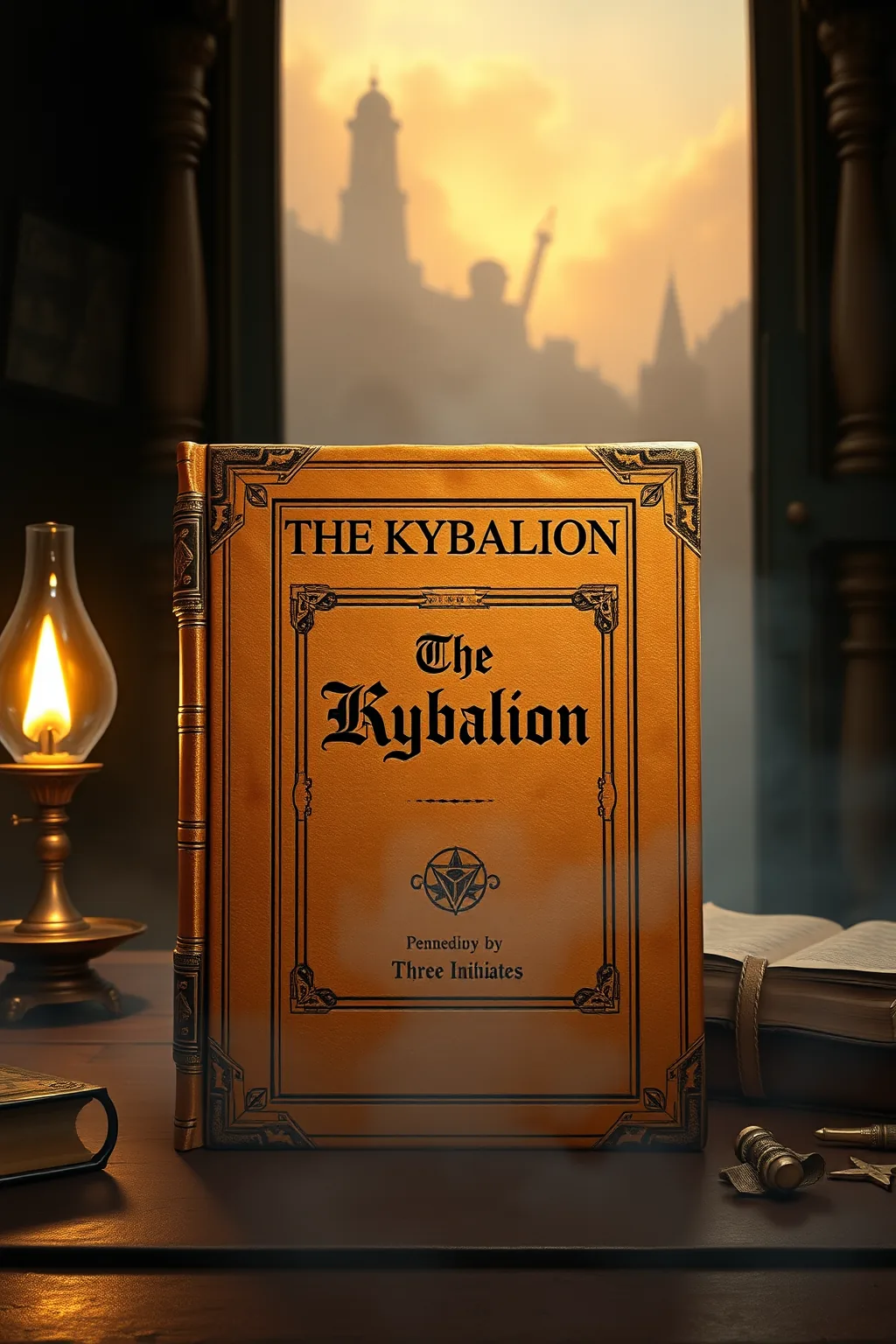
The Kybalion
 78
78

The Kybalion
The Kybalion's enduring appeal lies in its systematic presentation of complex Hermetic ideas. The "Three Initiates" managed to condense millennia of esoteric thought into a digestible framework, making the Seven Principles accessible to a wider audience than ever before. Its strength is this clarity; for instance, the explanation of the Principle of Correspondence ('As above, so below; as below, so above') offers a straightforward entry point into understanding universal interconnectedness. However, the work is not without its limitations. The very accessibility that makes it popular also strips away much of the rich allegorical and symbolic depth found in earlier Hermetic texts, sometimes reducing profound concepts to aphorisms. The discussion on the Principle of Vibration, while foundational, can feel somewhat underdeveloped for those seeking deeper physics-based explanations. Despite these critiques, The Kybalion remains a pivotal text for anyone initiating their study of Hermetic philosophy, serving as a clear, if simplified, map of ancient wisdom.
📝 Description
78
Published in 1908, The Kybalion distills the core tenets of Hermetic philosophy.
This 1908 work, attributed to the "Three Initiates," presents a systematic interpretation of Hermetic philosophy. It articulates seven fundamental principles that the authors claim govern the universe. The book aims to make these teachings accessible, moving beyond the guarded traditions where such knowledge was previously held. It details concepts like mentalism, vibration, and polarity as cosmic laws.
The Kybalion emerged during a period of heightened interest in spiritualism and metaphysics in the early 20th century. Its anonymous authorship has led to speculation about its origin, with William Walker Atkinson often cited as a likely contributor. The text offers a structured approach to Hermeticism, distinct from some more religiously affiliated movements of the era. It seeks to provide a foundational understanding for students of metaphysical and occult studies.
The Kybalion is a modern distillation of Hermeticism, a philosophical and religious tradition rooted in ancient Egypt and Greece. It draws heavily on the teachings attributed to Hermes Trismegistus, a syncretic figure representing wisdom and magic. While Hermetic texts like the Corpus Hermeticum have existed for centuries, The Kybalion translates these ideas into a more accessible, principle-based format. It aligns with the broader occult revival of the late 19th and early 20th centuries, offering a structured framework for understanding universal laws.
💡 Why Read This Book?
• Gain a structured understanding of the Seven Hermetic Principles, including Mentalism and Vibration, which form the bedrock of Hermetic philosophy as presented in the 1908 publication. • Explore the concept of Correspondence ('As above, so below') to grasp the interconnectedness of the macrocosm and microcosm, a core tenet of Hermetic teachings. • Learn practical applications of these principles for personal transformation, as outlined in the book's focus on mental mastery and understanding universal laws.
⭐ Reader Reviews
Honest opinions from readers who have explored this book.
❓ Frequently Asked Questions
What is the primary philosophy discussed in The Kybalion?
The Kybalion primarily discusses Hermetic philosophy, an ancient system of wisdom attributed to Hermes Trismegistus. It outlines seven core principles believed to govern the universe and human consciousness.
Who were the 'Three Initiates' who wrote The Kybalion?
The authors are identified only as the "Three Initiates." While never officially confirmed, many scholars and researchers associate the work with William Walker Atkinson, a prominent figure in the New Thought movement of the early 20th century.
When was The Kybalion first published?
The Kybalion was first published in 1908, making it a foundational text for modern esoteric studies that emerged during the early 20th century.
What are the Seven Hermetic Principles?
The Seven Hermetic Principles are: Mentalism, Correspondence, Vibration, Polarity, Rhythm, Cause and Effect, and Gender. They are presented as fundamental laws of the cosmos.
Is The Kybalion considered a primary source for Hermeticism?
While it popularizes Hermetic concepts, The Kybalion is a 20th-century interpretation rather than an ancient primary source text like the Corpus Hermeticum. It synthesizes and presents the principles in a modern, accessible format.
Can The Kybalion be used for practical spiritual development?
Yes, the book is intended for practical application. It encourages readers to understand and apply the Seven Principles to achieve mental mastery, understand life's challenges, and align with universal laws.
🔮 Key Themes & Symbolism
The Seven Hermetic Principles
The core of The Kybalion lies in its systematic exposition of seven fundamental laws governing existence: Mentalism, Correspondence, Vibration, Polarity, Rhythm, Cause and Effect, and Gender. Each principle is presented as an immutable truth, offering a framework for understanding reality. The work posits that by comprehending these principles, individuals can gain insight into the workings of the universe and their own minds. This structured approach differentiates it from more fragmented ancient Hermetic texts, providing a coherent system for study and practice.
The Power of the Mind
Central to The Kybalion is the Principle of Mentalism, which states that 'The All is Mind; the Universe is Mental.' This concept elevates consciousness to the primary reality, suggesting that all phenomena, material and immaterial, are manifestations of the Divine Mind. The book encourages readers to recognize their own mental power, asserting that through understanding and application of Hermetic laws, individuals can influence their reality and achieve a higher state of being. This emphasis on mental dominion is a hallmark of the New Thought influences present in the text.
Hermetic Correspondence
The Principle of Correspondence, famously summarized as 'As above, so below; as below, so above,' is an important theme. It illustrates the concept of universal interconnectedness, positing that the laws and phenomena of the physical plane have exact correspondences on the mental and spiritual planes, and vice versa. This principle serves as a key to unlocking the secrets of the universe, allowing practitioners to understand higher truths by observing lower manifestations and vice versa. It is fundamental to Hermetic divination and understanding the unity of creation.
Esoteric Teachings and Initiation
The Kybalion frames its teachings as a distillation of ancient wisdom, traditionally passed down through initiation. The anonymity of the "Three Initiates" and the presentation of the principles as secrets revealed suggest a lineage of esoteric knowledge. The book aims to provide a foundational understanding for those seeking entry into the deeper mysteries of Hermeticism, acting as a primer before engaging with more complex or original Hermetic texts. It implies that true mastery comes not just from intellectual comprehension but from lived experience and inner transformation.
💬 Memorable Quotes
Direct passages from the work, attributed to the author.
“The lips of wisdom are closed, except to the ears of Understanding.”
— This aphorism suggests that true knowledge is not readily available to everyone. It requires a prepared mind, one capable of grasping subtle truths, rather than simply hearing words. Understanding is the key that unlocks the wisdom that remains hidden to the uninitiated.
“The Principle of Mentalism states that The All is Mind; the Universe is Mental.”
— This is the foundational principle of Hermeticism as presented in the book. It asserts that reality itself is fundamentally mental or consciousness-based, meaning that the entire universe is a manifestation of a Universal Mind.
“As above, so below; as below, so above.”
— This famous axiom, part of the Principle of Correspondence, highlights the interconnectedness of all planes of existence. It suggests that understanding phenomena on one level (e.g., the physical) can provide insight into corresponding phenomena on other levels (e.g., the mental or spiritual).
“The Principle of Vibration states that nothing rests; everything moves; everything vibrates; everything flies and returns.”
— This principle explains that all activity in the universe, from the smallest particle to the largest cosmic body, is in constant motion and possesses a unique vibrational frequency. This concept is crucial for understanding the dynamic nature of reality.
“The Principle of Polarity states that everything is dual; everything has poles; everything has its pair of opposites.”
— This principle posits that opposites are merely different degrees of the same thing, and can be transmuted. Concepts like hot and cold, light and dark, good and evil are not absolute but relative positions on a spectrum.
🌙 Esoteric Significance
Tradition
The Kybalion is a key text within modern Western Esotericism, specifically channeling the Hermetic tradition. It synthesizes concepts attributed to Hermes Trismegistus, bridging ancient Egyptian and Greek thought with early 20th-century metaphysical movements like New Thought. While not an ancient text itself, it serves as a foundational interpretive work, making Hermetic principles accessible and adaptable for contemporary practitioners seeking a structured understanding of universal laws and consciousness.
Symbolism
The book frequently employs symbolic language, though it often prioritizes direct explanation. The 'All' represents the undifferentiated, absolute principle of existence, often symbolized by a circle or the divine mind. The concept of 'above and below' is a visual metaphor for correspondence, illustrating the macrocosm-microcosm relationship. Hermes Trismegistus himself functions as a potent symbol of wisdom, bridging the divine and human realms, embodying the ideal of the enlightened sage.
Modern Relevance
Contemporary practitioners of Hermeticism, Western magical traditions, and even certain branches of New Age spirituality continue to draw heavily from The Kybalion. Its clear articulation of principles like Mentalism and Vibration informs modern self-help philosophies, law of attraction teachings, and mindfulness practices. Thinkers and authors exploring consciousness studies and comparative religion often reference its systematic approach to ancient wisdom, recognizing its role in popularizing Hermetic philosophy globally.
👥 Who Should Read This Book
• Aspiring students of Hermeticism seeking a structured introduction to its core tenets, moving beyond vague notions to concrete principles. • Practitioners of metaphysical or New Thought disciplines looking to understand the historical roots and philosophical underpinnings of mind-based reality. • Comparative religion scholars interested in how ancient philosophies were adapted and presented in the early 20th century, specifically within the context of esoteric movements.
📜 Historical Context
The Kybalion emerged in 1908, a period rich with spiritual and philosophical exploration in the West, often termed the 'Age of Occult Revival.' The New Thought movement, to which the book's purported author, William Walker Atkinson, was deeply connected, sought to synthesize various spiritual traditions, emphasizing the power of thought and mind over material circumstances. This era also saw the rise of Theosophy, founded by Helena Blavatsky, which popularized Eastern philosophies and ancient esoteric traditions. While Theosophy often presented complex, layered doctrines, The Kybalion offered a more streamlined, principle-based approach to Hermeticism. The book's anonymous authorship and its systematic codification of Hermetic tenets distinguished it, providing a readily accessible, albeit interpreted, version of a tradition previously confined to more obscure texts like the Corpus Hermeticum.
📔 Journal Prompts
The Principle of Mentalism and the nature of the Universal Mind: How does the assertion 'The All is Mind' challenge your current perception of reality?
Reflecting on the Principle of Correspondence: Identify a pattern in your daily life that mirrors a larger societal or cosmic principle.
The concept of Vibration: Explore the idea that all matter is energy vibrating at different frequencies. What does this suggest about your own energetic state?
Applying the Principle of Polarity: Consider an 'opposite' pair in your experience (e.g., fear/courage) and explore how they might be transmutable.
The Principle of Rhythm: Observe a natural rhythm in your environment or personal life and consider its broader implications for change and cycles.
🗂️ Glossary
Hermes Trismegistus
A legendary, syncretic figure combining the Greek god Hermes and the Egyptian god Thoth. He is considered the mythical author of Hermetic texts, embodying divine wisdom and acting as an intermediary between the divine and human realms.
The All
The ultimate, absolute reality and the source of all creation in Hermetic philosophy. It is described as Mind, infinite, and the fundamental substance of the universe, from which all phenomena emanate.
Mentalism
The First Hermetic Principle, stating that the universe is fundamentally mental. It posits that reality is a creation of the Universal Mind, and that human consciousness has the power to influence and shape its reality.
Correspondence
The Second Hermetic Principle ('As above, so below'). It establishes a connection and mirroring between different planes of existence, suggesting that understanding one level provides insight into others, from the physical to the spiritual.
Vibration
The Third Hermetic Principle, asserting that everything in the universe is in constant motion and possesses a unique vibrational frequency. This principle explains the nature of energy and matter as dynamic manifestations.
Polarity
The Fourth Hermetic Principle, which states that all things exist in pairs of opposites. These opposites are seen as different degrees of the same fundamental essence, allowing for transmutation.
Rhythm
The Fifth Hermetic Principle, describing the universal law of ebb and flow, beat and measure, in all things. It explains the cyclical nature of phenomena, from cosmic cycles to individual moods.