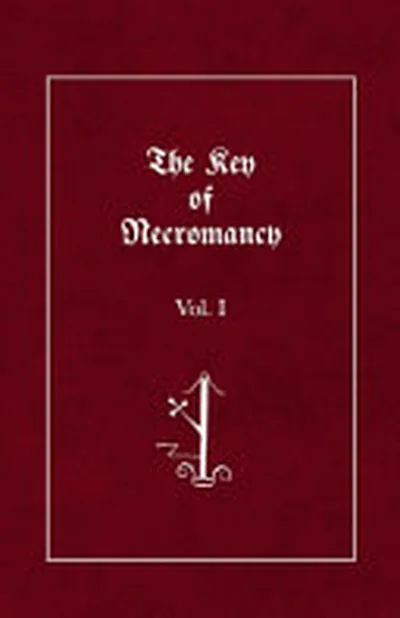
The Key of Necromancy
 71
71

The Key of Necromancy
The meticulous presentation of these three German magical texts in The Key of Necromancy offers a valuable, if somewhat dense, glimpse into a specific historical current of necromancy. The editors have done commendable work in rendering these previously inaccessible manuscripts into English, providing a scholarly apparatus that aids comprehension. A particular strength lies in the detailed spirit lists, which offer a fascinating comparative study for those versed in other grimoire traditions. However, the sheer density of the material, particularly the repetitive invocatory formulas, may prove challenging for the casual reader. The passage detailing the "Hierarchy of the Infernal Court" presents a complex, yet stark, view of the perceived spiritual landscape. While scholarly in its approach, the work sometimes assumes a prior familiarity with the broader Faustian tradition, leaving newcomers to navigate certain concepts without extensive foundational explanation. Ultimately, The Key of Necromancy is an indispensable resource for dedicated researchers into the history of European occultism.
📝 Description
71
This 2019 edition presents three untranslated German necromantic texts from the late 17th to mid-18th centuries.
The Key of Necromancy is a two-volume collection of German magical literature from the late 1600s to the mid-1700s. It provides direct access to the spirit lists and unique techniques circulating in the Holy Roman Empire during that period. This compilation illuminates the evolution and continuity of a specific occult tradition, offering insights into a localized magical practice that fed into the broader Faustian corpus. The texts reflect a magical and alchemical culture active in Central Europe, showing a distinct German character.
This edition is valuable for scholars of Western Esotericism, historians of magic, and practitioners interested in the historical roots of ceremonial magic. It appeals to those seeking primary source material on pre-modern grimoires and the magical currents of the Baroque era. Adepts aiming to trace the lineage of specific operant magical methods will find substantial content within these pages. The compilation focuses on the practical 'how-to' of ceremonial magic, detailing precise formulas and spirit invocations.
This work situates itself within the German magical tradition of the Baroque period. While figures like Heinrich Cornelius Agrippa and Elias Ashmole were influential in broader occult circles, the practices detailed here show a localized development. The texts are precursors to what later became known as the Faustian Tradition, contributing to a specific corpus of necromantic practice distinct from 19th-century Hermetic revivals. It represents a direct look at the magical milieu of the Holy Roman Empire before its widespread dissemination.
💡 Why Read This Book?
• Gain direct access to three untranslated German magical texts from the 17th-18th centuries, offering unique operative techniques not found in more widely circulated grimoires. • Understand the specific spirit hierarchies and angelic names detailed within the "German magical literature" of the Holy Roman Empire, providing comparative data for occult researchers. • Trace the historical development of the Faustian Tradition by examining the specific rituals and invocations that characterized Central European occultism before the major 19th-century revival.
⭐ Reader Reviews
Honest opinions from readers who have explored this book.
❓ Frequently Asked Questions
What is the historical period covered by the texts in The Key of Necromancy?
The texts originate from the late 17th to mid-18th century, a period of significant magical and alchemical activity within the Holy Roman Empire, offering insights into Baroque-era occult practices.
Are the texts in The Key of Necromancy previously published in English?
No, this compilation features three different texts that were previously untranslated into English, making this edition a significant contribution to the availability of historical occult source material.
What specific type of magic does The Key of Necromancy focus on?
The book primarily focuses on necromancy, detailing specific techniques, spirit lists, and operative formulas that were circulating in German magical literature during its historical period.
Who is Nicolás Álvarez in relation to this book?
Nicolás Álvarez is credited as the first publisher of this specific compilation, which was first published on August 31, 2019, bringing these historical texts to a modern audience.
How does this work relate to the Faustian Tradition?
The Key of Necromancy is presented as an example of the magical literature that contributed to and evolved within the currents that would later coalesce into what is known as the Faustian Tradition, particularly in its German manifestations.
Can beginners in occult studies benefit from this book?
While valuable for historical context, the book's dense primary source material and specialized terminology might be more suited for intermediate to advanced students of Western Esotericism or historians of magic.
🔮 Key Themes & Symbolism
German Necromantic Operatives
This compilation focuses on a specific branch of necromantic practice as it manifested in the German-speaking regions of the Holy Roman Empire between the late 17th and mid-18th centuries. It moves beyond theoretical discussions to present concrete operative methods, including detailed invocations, conjurations, and lists of spiritual entities believed to be accessible for magical work. The emphasis is on the practical application of these arts, showcasing a distinct regional flavor within the broader field of European ceremonial magic.
Spirit Hierarchies and Nomenclature
A significant aspect of The Key of Necromancy involves the intricate cataloging of spiritual beings. The texts present detailed hierarchies, specific names, and attributes of angels and other entities. This meticulous approach reflects a worldview where precise nomenclature and understanding of spiritual rank were crucial for successful magical operations. Scholars can use these lists for comparative analysis with other grimoire traditions and to understand the perceived cosmology of the period.
The Faustian Tradition's Roots
The work serves as a critical document for understanding the historical development of the Faustian Tradition. By presenting these previously untranslated German texts, it illustrates the specific magical currents and techniques that circulated in Central Europe and contributed to the later consolidation of this well-known occult lineage. It highlights the continuity and change within magical literature, demonstrating how localized practices informed broader esoteric movements.
Manuscript Circulation and Esoteric Networks
The existence of these three distinct yet related texts underscores the active circulation of magical knowledge through manuscripts during the Baroque era. This compilation sheds light on the networks through which such esoteric literature was shared and preserved, often outside of formal academic or religious institutions. It provides evidence of a continuous, albeit often hidden, tradition of occult philosophy and practice in the Holy Roman Empire.
💬 Memorable Quotes
Direct passages from the work, attributed to the author.
“The compilation presents spirit lists that delineate specific hierarchies and attributes.”
— This highlights the structured approach to the spirit world found in these texts, where precise knowledge of rank and characteristics was deemed essential for successful invocation and command.
“Techniques circulated around the Holy Roman Empire that later consolidated in the Faustian Tradition.”
— This statement points to the localized origins of certain magical practices that eventually contributed to a broader, more widely recognized esoteric lineage, emphasizing geographical influence.
“The work attests to the continuity and changes in German magical literature.”
— This suggests that the book is valuable for historical analysis, showing how magical ideas and methods evolved over time within a specific cultural and linguistic context.
“Three different, previously untranslated texts are included.”
— This emphasizes the novelty and scholarly importance of the publication, offering fresh primary source material for researchers in the field of Western Esotericism.
“Unique techniques and spirit lists are featured.”
— This indicates that the book contains specific magical methodologies and catalogues of entities that distinguish it from other grimoires and offer specialized knowledge.
🌙 Esoteric Significance
Tradition
This work fits within the broader lineage of Western Ceremonial Magic, specifically drawing from the operative grimoire tradition that flourished in Central Europe. It represents a distinct branch of what would later be recognized as the Faustian Tradition, emphasizing practical invocation and spirit-working rooted in a German Baroque context, rather than purely theoretical or philosophical Hermeticism.
Symbolism
Specific symbols likely include unique sigils or seals associated with the named spirits, meant to act as keys or focal points for invocation. The number of entities within the hierarchies themselves can be symbolic, reflecting a Kabbalistic or angelic order understood by the practitioners. The operative tools and gestures described would also carry symbolic weight, representing control over spiritual forces.
Modern Relevance
Contemporary practitioners of Western Esotericism, particularly those interested in the historical development of ceremonial magic and the Faustian current, find value in these texts. Researchers studying comparative demonology and angelology, as well as scholars of early modern German occultism, draw upon this work to understand the evolution of magical practices and beliefs.
👥 Who Should Read This Book
• Scholars of Western Esotericism: Gain access to primary source material on German magical literature from the Baroque period, enriching understanding of occult traditions beyond more common European texts. • Historical Magic Practitioners: Discover unique operative techniques, spirit lists, and invocatory formulas from the 17th-18th centuries that may inform or expand current magical practices. • Researchers of the Faustian Tradition: Examine the specific textual antecedents and localized currents that contributed to the later development and consolidation of the Faustian magical lineage.
📜 Historical Context
The Key of Necromancy emerges from the fertile, yet often clandestine, magical field of the Holy Roman Empire during the late 17th and early 18th centuries. This period, following the intense religious conflicts of the Thirty Years' War, saw a resurgence of interest in esoteric arts, alchemy, and ceremonial magic, often practiced in manuscript circulation. While figures like the Rosicrucians had already influenced occult thought, the texts here represent a more localized German tradition. They predate the widespread Neoplatonic and Hermetic revivals of the 19th century, offering a distinct perspective. Contemporary figures like Gottfried Wilhelm Leibniz, though a rationalist, engaged with questions of the supernatural, reflecting a broader intellectual climate where the boundaries between science, philosophy, and magic were still fluid. Reception of such texts was often covert, with open practice leading to suspicion or persecution, yet their persistence through manuscript copies demonstrates a dedicated community of practitioners.
📔 Journal Prompts
The "Hierarchy of the Infernal Court" presented in the texts: how does its structure compare to other known spiritual hierarchies?
Analyze the specific operative techniques described for invoking spirits: what makes them unique to this German tradition?
Reflect on the role of precise nomenclature in the described necromantic rituals.
Consider the historical context of the Holy Roman Empire: how might censorship have influenced the manuscript circulation of these texts?
The relationship between the texts and the later Faustian Tradition: identify continuities and divergences in magical theory or practice.
🗂️ Glossary
Necromancy
A branch of magic focused on communicating with, commanding, or drawing power from the spirits of the dead, or, more broadly, from infernal or chthonic entities.
Grimoire
A textbook of magic, typically containing instructions on how to create magical tools, perform rituals, and invoke spirits, often dating from the late Middle Ages to the 18th century.
Spirit Lists
Catalogues detailing various spiritual entities (angels, demons, elementals, etc.), often including their names, ranks, powers, and methods for invocation or conjuration.
Operative Magic
Refers to the practical application of magical theory, focusing on specific rituals, formulas, and actions intended to produce a desired effect, as opposed to purely theoretical or philosophical discussions.
Faustian Tradition
A lineage within Western Esotericism, often associated with the legend of Faust, encompassing magical practices, philosophies, and texts that emphasize pacts, spirit invocation, and the pursuit of knowledge or power.
Holy Roman Empire
A complex political entity in Central Europe that existed for almost a millennium, from the 9th to the 19th century, encompassing diverse regions and cultures where occult traditions developed.
Baroque Era
A period in European art, music, and culture roughly spanning the 17th and early 18th centuries, characterized by grandeur, drama, and elaborate ornamentation, which also influenced esoteric thought.














![Secret Enemies of True Republicanism: Most important developments regarding the inner life of man and the spirit world, in order to abolish revolutions and wars and to establish permanent peace on earth, also: the plan for redemption of nations from monarchical and other oppresive [sic] speculations and for the introduction of the promised new era of harmony, truth and righteousness on the whole globe](/img/thumb/secret-enemies-of-true-republicanism-most-important-developments-regarding-the-inner-life-of-man-and-the-spirit-world-in-order-to-abolish-revolutions-and-wars-and-to-establish-permanent-peace-on-earth.webp)